

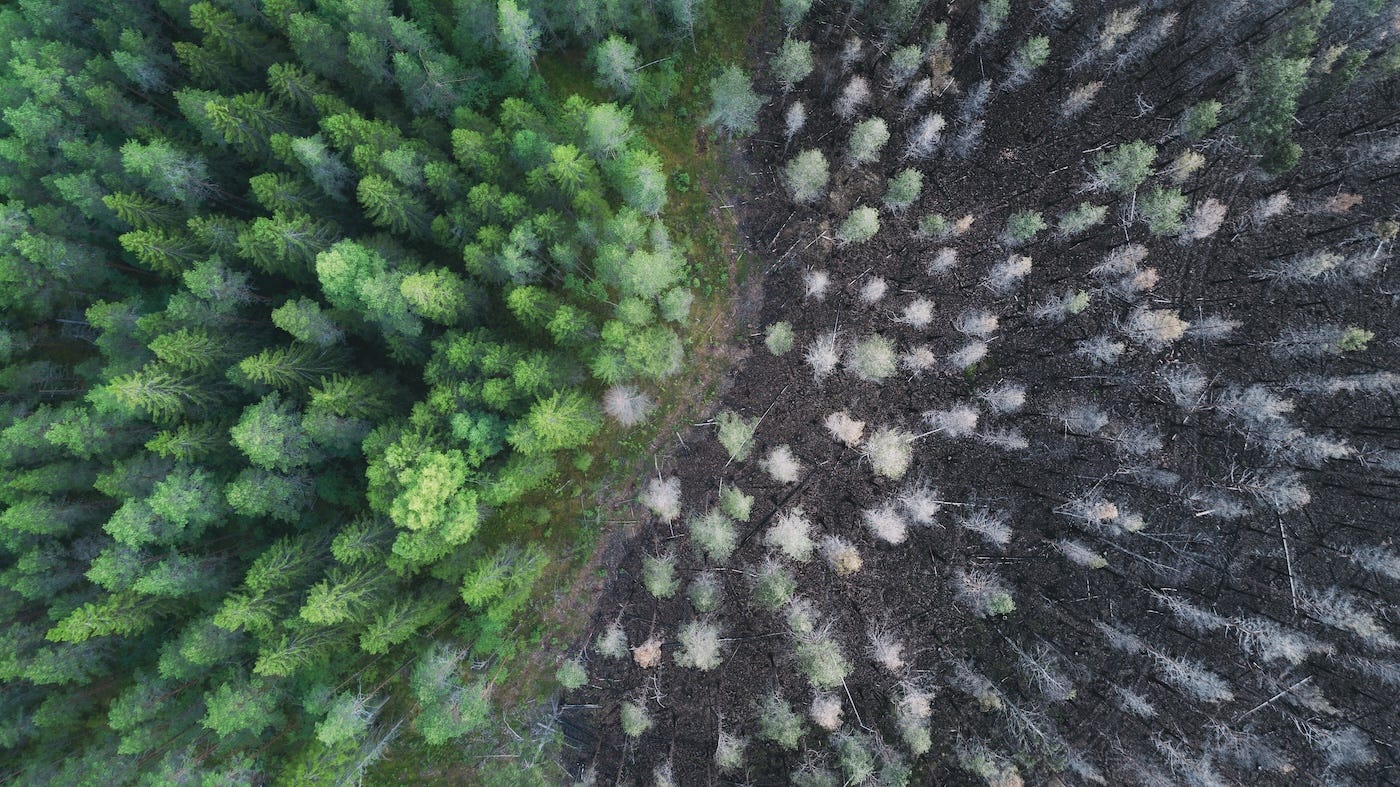
The Bipartisan American Affordability and Jobs Act (BAAJA) is poised to make major infrastructure projects easier to build and bring down costs for everyday Americans. But its impact goes beyond clean energy construction; BAAJA’s changes to environmental statutes will also make forest management easier. Even more promising, BAAJA comes on the heels of the bipartisan Fix Our Forests Act (FOFA), a recurring legislative proposal under consideration this Congress.
There is growing scientific consensus that removing flammable fuels from forests and grasslands with thinning and prescribed fire projects can bring down the severity of wildfires. But federal efforts have barely made a dent in the 117 million acres backlog of public land facing high or very high risk of wildfire.
One obstacle preventing wildfire mitigation is litigation brought under environmental statutes like the National Environmental Policy Act (NEPA). These lawsuits can delay projects for years, even when federal agencies ultimately prevail. Forest and land management projects account for the bulk of NEPA cases filed in U.S. District and Circuit Courts, even more than energy or infrastructure projects. BAAJA’s judicial review reforms will reduce litigation risk, giving more project certainty to fuels reduction and forest restoration efforts.
FOFA, however, provides necessary authorities tailored to forest management that BAAJA alone does not. FOFA is a permitting bill in its own right that provides regulatory streamlining for wildfire mitigation projects in high-risk firesheds and aims to reduce the project paralysis that comes with litigation. Its key provisions include repealing the Cottonwood decision; creating forest-specific permitting authorities through a fireshed framework and larger categorical exclusions; and increasing implementation capacity through agency strike teams, contracting reforms, and a proposed Wildfire Intelligence Center.
FOFA is further along in the normal legislative process than BAAJA. A version of FOFA passed the House last year. A bipartisan Senate version was negotiated and then passed out of committee this spring and now awaits a full Senate vote. While things could move quickly for BAAJA in the final weeks of the 119th Congress, FOFA remains essential as well. By passing both bills, Congress can remove barriers to wildfire mitigation at scale.
BAAJA Goes Further, Especially on NEPA Litigation
The reforms in BAAJA would make the path from federal approval to implementation of projects faster and more predictable. BAAJA seeks to streamline reviews under NEPA for many types of federal projects and shortens the deadline for legal challenges under the statute to 150 days. For forest management projects specifically, FOFA includes a similar provision, albeit with a slightly different trigger than BAAJA for when the 150-day clock starts. This deadline is consistent with when most NEPA suits are filed following completion of an environmental review.
BAAJA also goes further on standing than FOFA, requiring that plaintiffs bringing claims under NEPA must have submitted a substantive comment, if a comment opportunity existed. A similar provision was left out of the Senate version of FOFA.
Once a lawsuit is underway, BAAJA again goes further than FOFA on allowed remedies for environmental review claims. Under BAAJA, a court that finds an error in an agency’s NEPA review on a forest project would generally send the decision back for correction without canceling the project’s approval or pausing project work. This means project work will largely be able to continue while litigation plays out. FOFA takes a different approach, directing courts to give significant weight to considerations like wildfire risk, ecosystem health, and the consequences of inaction or delay, but preserves courts’ discretion to issue orders to delay or stop forest projects. While FOFA allows remand without vacatur and encourages courts to allow projects to continue unimpeded, it doesn’t require it.
Lastly, BAAJA would change where NEPA disputes are heard in the first place. Rather than beginning in federal district court and potentially proceeding through an appeal, these challenges would go directly to the appropriate federal court of appeals. This could shorten litigation timelines by eliminating the initial district court proceeding.
Beyond NEPA, BAAJA would also shorten litigation windows and reform judicial review under the National Historic Preservation Act and Clean Water Act, while establishing a 150-day window for challenges to Endangered Species Act biological opinions. Together, these reforms would substantially reduce the time that federally approved projects remain vulnerable to legal challenges. They would provide greater certainty about when legal disputes must be filed and how they will be resolved, and ultimately constrain the extent to which litigation can derail project implementation.
Stronger limits on project-stopping remedies matter for protecting wildlife, habitats, and landscapes. As an example, the Smokey Project was a roughly 7,000-acre fuels-reduction effort in California’s Mendocino National Forest that spent years tied up in litigation. Although a federal court allowed the project approval to remain in place while the Forest Service corrected deficiencies in its environmental review, it temporarily prohibited certain tree-removal activities. The Ninth Circuit ultimately upheld the agency’s review, but before the project could resume, the 2020 August Complex Fire burned across the entire project area before the planned treatments were fully implemented. This case illustrates the environmental risks of allowing litigation to delay time-sensitive forest projects.
Together, BAAJA’s changes to plaintiff standing, shortened legal challenge deadlines, and stricter limits on remedies will reduce both litigation risk overall and the risk of environmentally beneficial forest projects being delayed or halted while litigation plays out.
Considering Endangered Species
BAAJA proposes faster Endangered Species Act (ESA) reviews for projects including forest management. The Senate deal cuts the deadline for ESA consultations from 90 to 60 days. Working in tandem for forest management projects in particular, FOFA would establish interagency “strike teams” to speed these up, as well as other environmental reviews.
However, there is an outstanding legal hurdle specific to forests that isn’t addressed by BAAJA or by making ESA consultations on individual projects faster. FOFA would address the Ninth Circuit’s 2015 Cottonwood decision, which expanded the circumstances in which the Forest Service must reopen ESA consultation on existing forest management plans, including new critical habitat designations or new endangered species listings.
Since Cottonwood, the Forest Service has been forced to delay wildfire mitigation projects as forest management plans are reassessed time and time again. This has paradoxically increased delays to projects intended to protect habitats from severe wildfire. In response to assertions by many stakeholders that Cottonwood has not resulted in any direct conservation benefit for threatened and endangered species, FOFA would repeal Cottonwood and clarify that while individual projects will still be subject to ESA consultations, agencies do not need to reinitiate ESA consults on existing land-management plans over new endangered species considerations.
Additional Reasons for Congress to Pass FOFA
FOFA has other proposals, absent from BAAJA, that would further address procedural delays for forest management projects. FOFA would establish a Wildfire Intelligence Center and instate a “fireshed management” framework to enable agencies to identify priority regions where proactive thinning, prescribed burns, and restoration projects can help reduce wildfire risk.
Within those identified firesheds, FOFA would expand categorical exclusions under NEPA to encompass larger sized projects. That means agencies won’t need to prepare a project-specific environmental assessment or environmental impact statement, while projects remain subject to the other applicable environmental laws. FOFA expands certain existing categorical exclusion acreage limits, generally from 3,000 to 10,000 acres, which are specifically designed to speed up emergency fireshed management activities like hazardous-fuel management, fuel breaks, and vegetation management. BAAJA would complement these authorities by allowing agencies to combine different categorical exclusions for projects involving multiple qualifying activities.
While BAAJA would change how federal projects are reviewed and challenged in court, FOFA provides additional authorities and coordination tools tailored to wildfire mitigation and forest restoration. Congress should pass FOFA regardless of what happens with BAAJA. If both bills are passed this winter, even better. FOFA would in many ways layer on top of BAAJA to enable federal agencies to spur needed forest management on millions of acres nationwide.

Is there any research on how many fire projects are delayed by lawsuits versus those delayed by government inaction or developer delays? Without that, I'm not convinced that permitting reform is a solution to a real problem. Sounds like the argument against public participation made successfully in New York and other states to remove local control ("home rule") and ram environmentally destructive large-scale renewables down the throats of unwilling towns. However, I've represented municipalities and citizen groups for 20 years in these state permit proceedings (which preempt local permitting, which no longer happens in NY) and I can tell you it was always the developers who delayed things by submitting conceptual project plans that the state deemed inadequate, and then sitting on their rearends for months before preparing appropriate application supplements which were themselves inadequate, forcing the developer back to the drawing board once again. Nothing that intervenor parties did delayed these proceedings--nor could it have, because once an application is accepted as complete in NY, the state has only 12 months to finalize a permit. Failing to do so results in a draft permit, issued at the time of application completeness, being issued as final. This is "permitting reform" in NY.