

Earlier this year, I argued that reforming Clean Water Act Section 401 was a reasonable trade for transmission reforms. That argument was incomplete. Section 401 reform is necessary to make transmission reform work. An unreformed Section 401 would leave a backdoor veto in place for hostile state governments to kill major transmission lines.
The Bipartisan American Affordability and Jobs Act (BAAJA) creates a clear and credible path to building the infrastructure we need to decarbonize our electricity sector and stabilize prices. A crucial piece of the bill’s design is that it also sharply constrains Section 401 as a tool for obstructing projects.
Section 401 lets states grant, condition, or deny water-quality certification for projects requiring a federal approval that “may result in a discharge” into waters of the United States within state borders. States can also waive certification. If a state denies certification, the federal government can’t issue its approval. Despite a statutory one-year deadline, loopholes and disputes can stretch the process across years without resolution.
BAAJA would narrow state Section 401 certification to specified, longstanding water-quality requirements. It introduces a higher bar for states to justify denials and conditions. BAAJA also gives covered transmission and gas pipelines a separate rule focused on direct point-source discharges, eliminating a state’s ability to use Section 401 to regulate the entire project. BAAJA makes state denials and conditions harder to defend, but leaves a path for litigation to challenge certification decisions. The courthouse is strictly closed if a state waives certification.
Opponents of BAAJA’s Section 401 reforms will cite two primary objections. First, they’ll say Section 401 reform will let more polluting projects get built. Second, they’ll argue BAAJA’s reforms deny states the ability to police impacts on their waters. The first argument ignores the projects we need, and the second is legally and practically inaccurate. Both are totally insufficient to justify the status quo.
Despite some environmental groups’ resistance, BAAJA’s Section 401 reforms will ensure better environmental and climate outcomes. Section 401 reform is a necessary adjunct of transmission backstop siting authority. Reform will end the nightmarish and expensive permitting cycles afflicting hydropower dams. And it will introduce more certainty to permitting processes that chill pro-climate project construction.
Grid decarbonization is vulnerable to an unreformed Section 401
Famously, New York state used Section 401 to veto the construction of pipelines that would have expanded gas supply to downstate New York and to pipeline systems serving New England. The choice to stop the gas pipelines is among the reasons New York and New England remain dependent on dirtier, more greenhouse gas-intensive, and more expensive oil for heat and electricity.
And though both Democratic- and Republican-led states have fought transmission lines, red states have led the charge against them. Arkansas used its state laws to object to the Clean Line project that would’ve brought wind power from Oklahoma across Arkansas and into TVA’s system near Memphis, Tennessee.
That was more than ten years ago. Fast forward to today, and Elon Musk’s Memphis data center is getting power from disembodied airplane engines that belch greenhouse gases and noxious fumes into surrounding neighborhoods. The Clean Line cancellation may not have directly caused Musk to rely on dirty energy. But more local grid capacity might have limited the need for dirtier stopgap measures.
Rightly or wrongly, red states perceive these lines as costly and without adequate in-state benefits. Perhaps worse, transmission is now coded as a Democratic camel’s nose to distributed renewable energy.
Until BAAJA, the federal government’s tools couldn’t overcome state siting barriers. With BAAJA, these big lines are much more likely to get built.
To understand the stakes, it’s important to remember how broad Section 401 is. A state obtains jurisdiction to veto an entire project if it entails a federally permitted activity that “may result in a discharge” into “waters of the United States” within state boundaries. Even a small qualifying discharge could be all the jurisdictional hook a state needs to veto an entire multi-state power line. And because Section 401’s one-year time limit doesn’t prevent certifications from stretching across years, projects are vulnerable to late-stage denial.
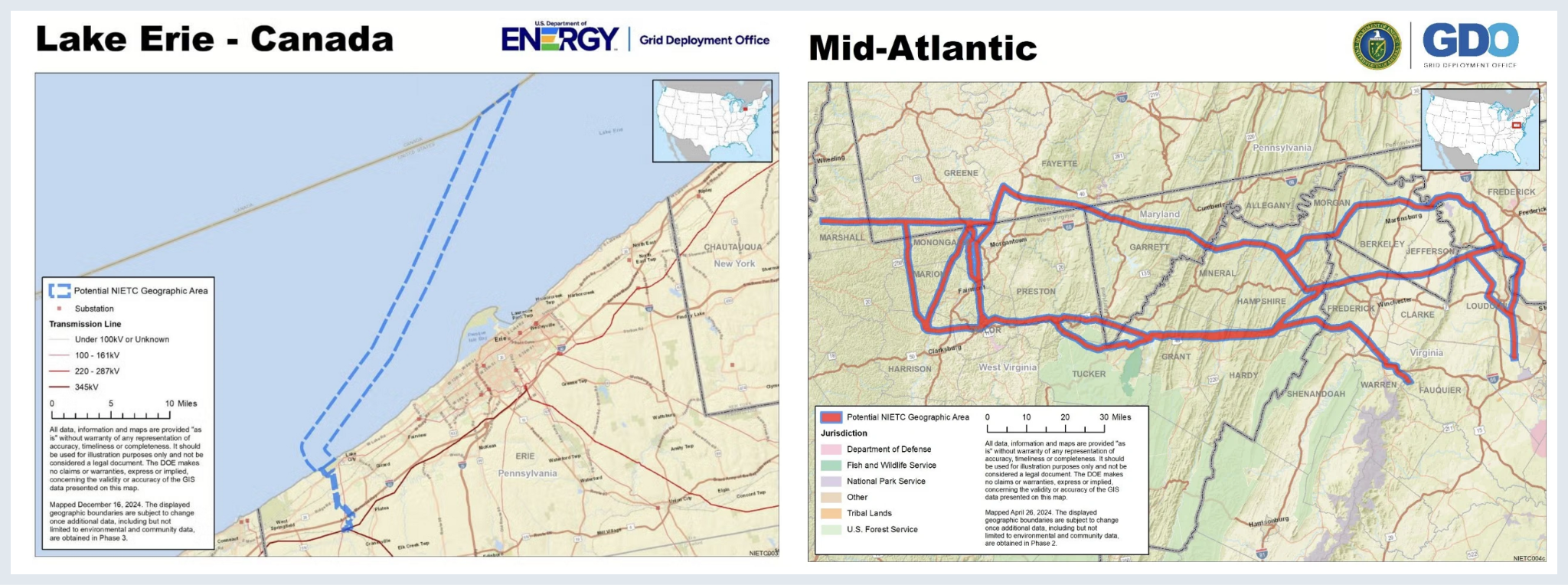
Power lines regularly impact water bodies. Some lines have major underwater components, like the CHPE line carrying hydropower from Quebec to New York. Others, like the Grain Belt Express, entail substantial wetland conversion. One of DOE’s proposed National Interest Electric Transmission Corridors went straight through Lake Erie. Transmission construction also often entails temporary water body disturbances, e.g., from access roads. All such water impacts could confer a veto on a hostile state government.
To date, states have had a variety of tools to stop lines they don’t like. To address these, BAAJA’s transmission provisions significantly limit state governments’ ability to oppose transmission projects. But that only highlights why Section 401 reform must happen alongside BAAJA’s transmission reforms. Otherwise, we’ll overcome state siting barriers only to leave states a backdoor veto under the Clean Water Act. This is a palpable danger to the bill’s clean energy ambitions.
BAAJA confers special Section 401 relief on transmission lines for a reason. The bill will not solve all future conflicts over transmission planning and cost allocation. But it consolidates those conflicts in a more singular decision-making process, rather than leaving them vulnerable to water quality certification abuse.
Reform Section 401 to unshackle hydropower dams
Section 401 also impacts America’s oldest source of reliable clean energy: hydropower. Many of America’s hydropower dams require periodic FERC relicensing, with terms ranging from 30 to 50 years. These processes are broken, in large part because of Section 401.
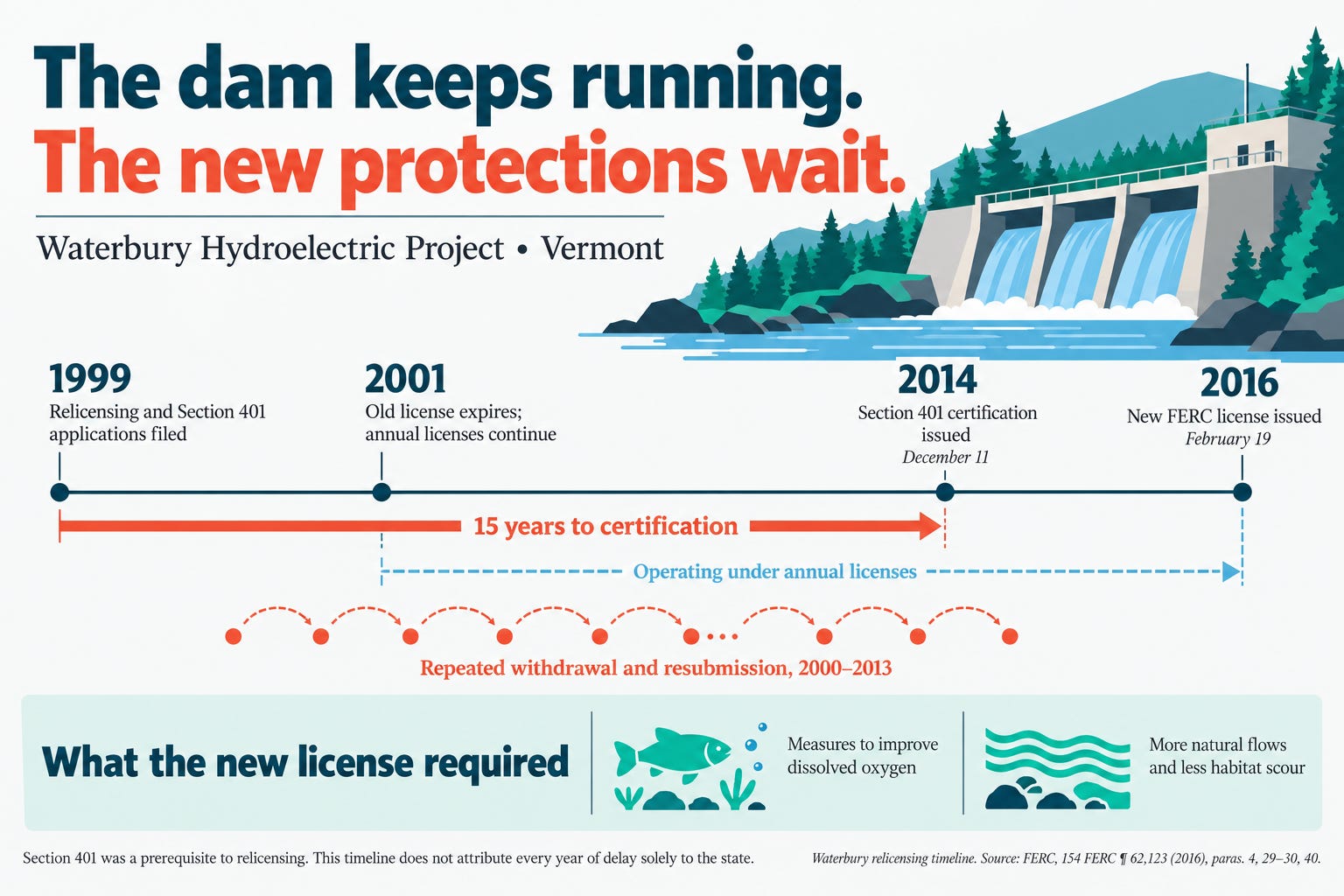
Licenses regularly take many years and can stretch into decades. Section 401 delays can leave dams operating under old licenses, postponing the environmental protections that relicensing is supposed to deliver. Huge relicensing expenses are passed on to ratepayers. And as dams age, we place at risk one of the grid’s most important bulwarks of reliability, especially important for helping restart after blackouts.
One of the reasons these problems persist is that Section 401 confers leverage on states to impose expensive and onerous conditions on dam developers that are tenuously related to water quality. The statutory one-year deadline has not served as an effective time limit, so the disputes drag on and on. Some dam developers, faced with extreme state-imposed Section 401 conditions, can be pushed to abandon generation.
The National Hydropower Association reports that certification conditions have included support for a feral pig task force, funding for fish in unrelated water bodies, the construction of hiking trails and parking, and so on. These conditions creep into Section 401 certifications because of over-broad statutory text and a capacious reading at the Supreme Court, which together opened the door to states to assess the ‘activity as a whole’ in its certification decisions.
Some groups are worried BAAJA’s reforms would undercut states’ leverage to shape projects. BAAJA indeed reduces that leverage, including by imposing stricter limits on the conditions states can impose. And under BAAJA, those conditions must be tied to water quality.
But BAAJA very clearly preserves states’ ability to impose conditions based on specific, longstanding water quality provisions in the Clean Water Act. It’s just that Section 401 will no longer function as an all-purpose veto and leverage point for whatever states can extract from dam managers, all while delaying improved dam function and ecological outcomes.
For many states, water quality issues are concrete and severe. State leverage over dam licensing has been essential to Maryland’s ability to protect the Susquehanna River, the Chesapeake Bay, and the people and industries that depend on them. BAAJA’s reforms would preserve Maryland’s capacity to impose reasonable water-quality-related conditions on the Conowingo Dam. Maryland could still regulate recreational uses of the water, sediment, temperature, water flow, and potential harms to aquatic life. But states would need to justify those conditions under BAAJA’s tighter evidentiary and substantive standards.
Cooperative federalism can’t mean endless veto points
The Clean Water Act gives states a major cooperative role in protecting the environment within their borders. Because of the new constraints in the bill, state attorneys general and some environmental advocacy groups are likely to oppose BAAJA’s Section 401 reform. Advocates’ primary reason to leave Section 401 unreformed is to ensure states and plaintiffs can aggressively shape or even kill projects they don’t like.
One problem with this approach is there’s no way to know before the laws are written which specific projects are objectionable. Meanwhile, Section 401 embeds the ability to veto projects that climate advocates would often deem valuable and good, e.g., powerlines and dam upgrades. Under some circumstances, even pipelines can facilitate greenhouse gas emissions reductions, as is the case with the NESE pipeline in New York.
Also, Section 401 places the judgment as to what constitutes a “bad” project in the hands of state elected figures and third-party plaintiff organizations with idiosyncratic political incentives.
The macro problem with bad-projects discourse is that it’s ruinous for predictable infrastructure planning and investment. Among other disasters, our war of energy project attrition has crippled the wind industry, and prolonged the use of dirty, expensive heat and electricity for vulnerable people in New York and New England.
Section 401 has been a weapon of choice in this democratically corrosive exchange of fire. Let’s pass BAAJA and its Section 401 reforms, and put this cycle behind us.
