

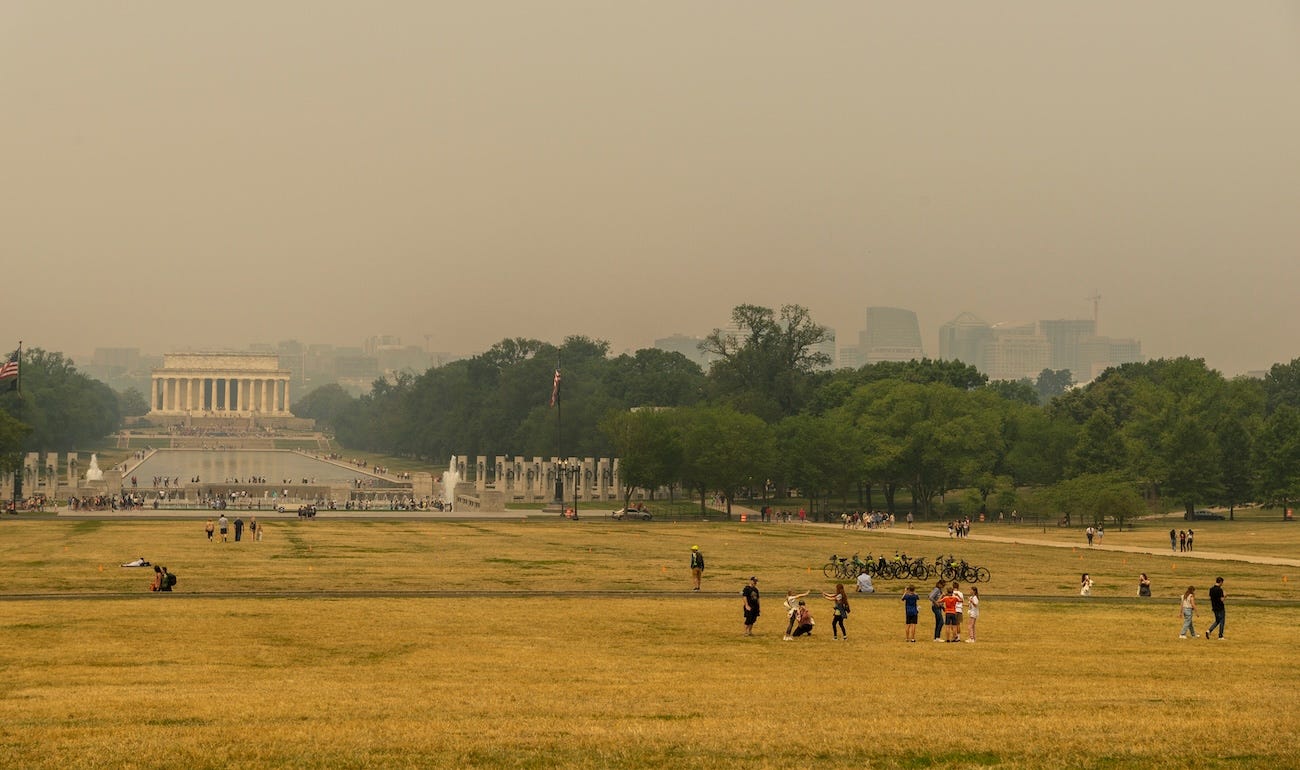
Smoke from wildfires in Canada and Minnesota left much of the east coast under hazy skies this past weekend—an increasingly familiar summer occurrence. In some parts of the D.C. metro area, air quality reached a hazardous 373 AQI. No U.S. forest policy could have prevented smoke from Canadian wildfires from reaching D.C. But the episode is a reminder of the broader wildfire crisis and of the need to ensure federal investments in reducing wildfire risk are actually yielding results here at home.
Climate conditions, decades of fire suppression, and a century of fuel accumulation leave us increasingly vulnerable to catastrophic wildfire. A perfect storm of political reorganization, staffing attrition, and regulatory gridlock is actively making it even harder for government agencies to respond. Without addressing these challenges, federal funding for wildfire mitigation will be slow to stop our forests from burning as often and as severely.
Congress is days away from breaking for August recess and faces a dwindling number of weeks for legislative activity before the end of the year. This past weekend’s conditions and the worsening wildfire season underway across the western United States serve as reminders that Congress cannot afford to delay action on legislation aimed at reducing wildfire risk.
Wildfire mitigation under Trump 2.0
Historically, greater federal investment in hazardous fuel reduction (HFR) has translated into more acres treated. As Congress increased funding for mechanical thinning, prescribed fire, and other fuel reduction activities, treatment output rose accordingly.
The Infrastructure Investment and Jobs Act (IIJA) followed by the Inflation Reduction Act (IRA), provided a multiyear infusion of funding for hazardous fuel reduction beginning in FY2022. According to the last decade of HFR data for the Forest Service, both funding and reported treatment acres peaked in fiscal year 2023.
When President Trump returned to office, his administration inherited those investments and the opportunity to translate them into substantially higher risk mitigation outcomes. Yet, reported treatment has since moved in the opposite direction. IIJA funding is set to expire this year. After $514 million in HFR spending over its five year period, there has been little acceleration in treatment rates. The US Forest Service (USFS) treated 3.3 million acres in 2025, below 2024 levels and short of its own 3.6 million acre target.
Even prior to Trump 2.0, the current pace of treatment was vastly outmatched by the crisis. In recent years, USFS and DOI have averaged treatment of 5-7 million acres per year nationwide. For comparison, California alone requires treatment on roughly 3.9M acres per year to meaningfully reduce wildfire risk. In 2022, the Biden administration published a wildfire strategy with the goal of carrying out fuel treatments on an additional 50 million acres nationwide over a decade. USFS and DOI have identified a backlog of 117 million acres with high or very high wildfire risk potential.
Why hasn’t more funding produced more treatment
Since the influx of unprecedented wildfire mitigation funding from the IIJA and IRA, treatment rates have not accelerated proportionally and measurable reductions in wildfire risk remain elusive. There are several reasons the recent funding surge has not yet translated into record treatment output.
First, as IRA and IIJA supplemental funding kicked in for HFR, Congress pulled back on the “regular” annual base appropriations for the same activities. Regular appropriations for these activities are primarily included in the annual funding bill for Interior, Environment, and Related Agencies. This apparent supplanting is, in part, due to a shift of some funding to a new budget line item consolidating salaries and expenses across all Forest Service programs starting in FY2021. The budgeting change makes year-to-year comparisons of HFR funding difficult, but two things are clear: the IRA and IIJA funding is less of a windfall because it offsets some of the drop in regular appropriations, and federal funding for HFR has, nevertheless, reached record highs.
Second, more treatment requires more planning. Large landscape treatments require years of planning before implementation, so some lag is expected. Workforce losses have affected USFS’ ability to maintain the current pace of HFR treatments, much less execute even more. Data from late last year showed HFR work by USFS was down 38% in 2025. If USFS is suffering a similar slow down in planned acres—which stakeholders and Members of Congress are concerned is the case—USFS will struggle to sustain higher treatment levels in future years.
There will undoubtedly be calls for more mitigation funding this year as IIJA funding expires and the next round of annual spending bills are negotiated. Adding to the looming funding cliff, the Wildfire Suppression Operations Reserve Fund is scheduled to expire after FY2027 unless Congress extends it, raising the risk that suppression costs will once again crowd out funding for HFR efforts.
Funding remains necessary but just throwing more money at the problem isn’t enough. Congress must also address slow multi-year NEPA reviews, resolve litigation induced delays, and ensure agencies prioritize wildfire mitigation among other agency priorities like wildfire suppression or timber production.
What Fix Our Forests can and can’t fix
Congress should dedicate sustained funding for HFR, but also focus on removing barriers to implementation. The Fix Our Forests Act (FOFA), which passed the House and advanced out of Committee in the Senate last year, takes aim at regulatory streamlining and reducing litigation risks. Forest management projects, which include HFR efforts, attract more litigation than any other federal projects. The bipartisan bill expands several authorities intended to accelerate hazardous fuel treatments on more acres, including expanded categorical exclusions under NEPA to encompass larger sized projects, shorter timelines for legal challenges, and improved interagency coordination mechanisms.
Trump 2.0 has made it clear that their deregulatory agenda goes hand in hand with historic federal workforce reductions. This is important because while streamlining environmental reviews or improving interagency coordination might result in some improved efficiencies, regulatory reform doesn’t automatically put chainsaws in the woods. USDA’s sweeping reorganization and mounting workforce reductions threaten to further exacerbate preexisting staff capacity constraints at USFS.
When asked in congressional hearings why treatment targets had fallen despite available funding, Forest Service Chief Tom Schultz did not provide a clear explanation for the decline beyond citing vague “operational challenges.” Meanwhile, Interior Secretary Doug Burgum and other agency officials have emphasized full suppression. It would be a mistake to return the failed policies of the last century that prioritized full suppression at the expense of proactive fuel management.
Some environmental organizations and sympathetic lawmakers have cited the lack of direct funding in FOFA and a general distrust of the current administration’s land management priorities and implementation abilities as reasons to withhold their support from the legislation.
Congress’ next move
Despite warranted skepticism, Congress should pass FOFA this year. Giving diminished, understaffed regional offices the statutory tools to cut through red tape is the best opportunity they have to maximize remaining resources, and lay the groundwork for future administrations to make better use of appropriated mitigation funding.
Congress has already demonstrated that it is willing to invest billions in reducing wildfire risk. The next question is whether federal agencies can convert those dollars into completed fuel treatments on the ground. Until Congress pairs sustained funding with regulatory reform, implementation capacity, and accountability for acres treated, appropriations alone will continue to produce disappointing results.

A very perceptive article. Congress has appropriated funds for fuels management many times in the past, but acres treated remains insufficient every year. The problem is who does the work. Fire staffs have a wolf by the ears playing wildfire whack a mole, which leaves very little time to properly plan, prepare, and execute prescribed fires, for example, at a scale sufficient to make a difference in wildfire behavior and effects. What is needed is not just funding, but a staff dedicated to fuels management, independent of the fire suppression organization, which can do the work across the country and around the year when conditions permit. I expect the unification of the fire staffs of four DOI bureaus into the new US Wildland Fire Service is a step in the wrong direction.