

It’s easy to forget today, as more and more people have come to take the idea of solar geoengineering seriously, that the idea first really broke through into elite public consciousness as something of a troll. The notion had been discussed in a few arcane corners of the academy over previous decades. My uncle, William Nordhaus, even briefly mentioned it in his seminal 1975 paper on climate change. But the 2009 publication of SuperFreakonomics, by Steven Levitt and Steven Dubner, was the first time that discussion of the topic, to my knowledge, broke through to the mainstream. Levitt and Dubner argued that it would be far cheaper to simply hack the atmosphere with sulfur particles than to reorganize the global economy around non-fossil technology.
The book provoked a furious reaction, almost entirely to the single chapter devoted to the topic. All of the now familiar objections were present. Geoengineering created moral hazard and might become a gigantic perverse incentive for the world to continue to burn fossil fuels. It could create new armed and perhaps even nuclear conflicts, as the resulting changes in weather patterns might shift rainfall or ocean currents in ways that advantaged some nations and disadvantaged others. Geoengineering might solve one aspect of the problem, a warming atmosphere, but wouldn’t do anything about another, ocean acidification. The untimely cessation of geoengineering, before atmospheric concentrations of CO2 had been significantly reduced, would result in termination shock, causing temperatures to rise rapidly and catastrophically.
The troll ended up playing a central role in both turning geoengineering into the climate culture war object that it is today and galvanizing efforts to transform it from a thought experiment to a real technology. Within a few years, multiple international frameworks for governing geoengineering had been proposed. Research funding began to flow into the sector. Today, multiple startups around the world purport to be developing the technology. Several new NGOs have launched to advocate for geoengineering research. The billionaire tech class has taken notice, which has led, predictably, to some quarters of the environmental movement taking notice. The Environmental Defense Fund has launched a deep pocketed research program. Even NRDC says it supports geoengineering research.
Over the years, I too have been supportive of geoengineering research. Back in 2018, I argued in Foreign Affairs that the two degree delusion created its own sort of moral hazard, lending credence to the idea that adaptation to higher temperatures and geoengineering research were not necessary. In my 2021 review of Elizabeth Kolbert’s Under a White Sky, I suggested that future human societies might engineer the climate not to save our own skins but to preserve biodiversity. And in 2024, I somewhat cheekily proposed that we use a somewhat less controversial form of geoengineering, marine cloud brightening, not to mitigate climate change but to moderate natural climate variability driven by the ENSO cycle.
Geoengineering was interesting to me discursively because it usefully separated concern about the consequences of climate change from all of the priors that had been mapped onto the issue from its emergence as a public concern in the late 80s and early 90s. The notion of modifying the atmosphere intentionally seemingly had the potential to disrupt the polarized battle lines that had hardened around the climate issue, making it less of a proxy for the environmental movement’s long-standing regulatory and soft energy obsessions.
But as discussions about geoengineering have moved from the fanciful to the practical, I have increasingly come to see it not as the antidote to climate catastrophism and green millenarianism in the public discourse but rather as the most likely, and perhaps only, plausible pathway to actual catastrophic climate change. My evolution on this question has less to do with the technology itself—the risk of termination shock has always been part of the conversation. Rather, it is my evolving view on climate risk and the continuing disconnect between the actual consequences of climate change on human societies, which have thus far been marginal, and the climate discourse, which insists that the consequences have already arrived and are already catastrophic, that has led me to reconsider the wisdom of even geoengineering research.
Geoengineering has been promoted as a “break in case of emergency” technology in the event that climate change gets really bad. But this framing of geoengineering presumes that there is a clear and observable threshold of badness where it is clear that emergency action is required. It should already be obvious that no such threshold exists.
Much of the climate movement insists that the emergency has already arrived, reliably conflating natural climate variability with climate change, which in turn is blamed for climate related disasters that are predominantly driven by maladaptation, poverty, and failing institutions, not anthropogenically intensified climate hazards. Many geoengineering advocates, meanwhile, have themselves become increasingly catastrophic about climate change, at least in part to justify use of the technology.
As a result, the troll has ended up reifying the catastrophism it was intended to combat. In a “post-truth” world in which states of emergency are easily manufactured, geoengineering strikes me as far more likely to be deployed in response to a fake emergency than a real one.
The Fake Emergency
Despite a degree and a half of warming over the last two centuries, human populations have done nothing over that period other than become more resilient to climatic extremes. Climate related mortality has fallen dramatically. Economic costs have fallen as a share of GDP and remain flat as a share of wealth exposed to extreme climate phenomena. Emissions continue to rise, and with that atmospheric concentrations of CO2 and global temperature. But emission growth is slowing globally and falling in many regions of the world.
Things could, of course, get worse in the future. But all of the key drivers of future emissions are moving in the right direction. Global fertility rates have fallen precipitously and population growth is likely to come to a halt in the coming decades. Economic growth is slowing in most industrialized and industrializing economies. The global energy system is slowly decarbonizing. Moreover, the primary factors that will determine how the climate affects human societies going forward are the same things that have so dramatically increased our resilience to climate extremes over the last century. Societal wealth, and the improved technology and infrastructure that come with that, mediate our relationship with climate hazards and moderate their impact on us.
For both ideological and strategic reasons, the environmental movement has long misunderstood and overlooked these factors. Environmental determinism has led the environmental and climate movements to fetishize environmental change and downplay our species remarkable adaptive capacities. A belief that catastrophic framings of climate risk would result in strong public demand for climate action has further led the climate movement and its many allies in the media, academia, and government to exaggerate the present day impacts of climate change.
The latter effort has abjectly failed. The issue has no greater support or salience today than it did forty years ago, when pollsters first started asking the public about it. People support climate action as long as it doesn’t inconvenience them or cost them money. When it does, public opinion swiftly turns negative.
Levitt and Dubner’s key innovation was the idea that you could solve the problem, or at least hold it at bay, without resorting to costly policies that the public was unlikely to support. The environmental movement predictably objected to this idea. What, after all, is the point of a climate crisis if you don’t get to slay the fossil fuel industry and construct a solar energy utopia?
That basic reaction to the technology has continued to obtain. The environmental community, mostly, continues to insist that climate change is an existential crisis but not so existential that it might justify geoengineering. The loudest climate advocates are overwhelmingly also loud opponents of geoengineering, insisting that it is a false solution and that the crisis can be averted through a mass mobilization of the global economy to rapidly transition to renewable energy.
But objections of the climate movement notwithstanding, geoengineering strikes me as exactly the sort of solution that political leaders, in the face of a climate emergency (real, imagined, or manufactured) and a public allergic to constraining its own consumption or paying for costly solutions, would turn to. As Nils Gilman observed in his 2020 Breakthrough Journal essay, The Coming Avocado Politics, there is really no reason to expect that the reaction to a major climate panic would be an embrace of eat your spinach environmentalism or a green new deal. Gilman focused on the possibility that catastrophism would stoke xenophobia and support for deportations and enforcement of energy poverty upon poor countries. But geoengineering seems like the sort of response that would fit comfortably as well.
This is the problem with the “break in case of emergency” framing that has attended the geoengineering discourse over the last decade. It assumes that the public discussion about the impacts of climate change reasonably approximates the actual impacts of climate change and that, hence, the technology will remain behind glass until it is truly needed. Nothing that has transpired in the climate discourse over the last fifteen plus years, since SuperFreakonomics brought the idea of geoengineering to public attention, should inspire any confidence that this is so.
A Man-Made Climate Crisis
The problem with geoengineering is not simply that it is unnecessary given human adaptive capacities. Rather, it is that the technology is far more likely to cause a climate catastrophe than avert one. The reason for this is that termination shock turns climate change from a slow moving phenomena into a fast moving one.
Anthropogenic warming driven by the combustion of fossil fuels has warmed the planet very rapidly on geological timescales but quite slowly on human timescales. We experience far greater temperature variance in most regions of the world from winter to summer, or when we travel from Honolulu to Anchorage, than we have or will experience from climate change. We are resilient to temperature variance and extremes because human populations and societies have had centuries and millennia to adapt to those climates.
This has become something of a talking point for the climate movement in recent years, which claims that our present infrastructure is no longer fit for purpose in our superheated climate. But the actual data suggests otherwise. As wealth, technology, knowledge, communication, and migration have accelerated, our adaptive capacities have accelerated as well—much faster thus far than warming is amplifying climate impacts.
Could a social or economic collapse of some sort, driven primarily by factors other than climate change, dramatically undermine those capacities? It surely could. But the climate consequences of such a collapse would almost certainly pale in comparison to the direct consequences. The only plausible path to catastrophic climate impacts, in other words, entails more proximate problems whose consequences would be far greater than catastrophic climate change.
There is one major exception to this in my view though. Geoengineering. As opposed to the multi-decadal, century, and millennial times scales over which climate change is changing the climate, a termination shock due to the untimely cessation of geoengineering would significantly alter the climate at local and regional levels over decadal, or even annual, timescales. The temperature spike would occur predominantly over the course of one to five years. Most other climate impacts would unfold over similar timescales. Termination shock might disrupt the Asian and African monsoons and accelerate melting of the Greenland and West Antarctic ice sheets. Agricultural yields could see dramatic declines virtually overnight.
Geoengineering notwithstanding, all of these risks will be familiar concerns to anyone who has followed the climate discourse for very long. But geoengineering makes it possible for these changes to occur over the course of just a few years, not decades or centuries, stressing the ability of human societies to adapt because the rate of change matters as much as the magnitude. Such rapid climate change would occur far faster than anything produced by even the worst case emissions driven warming scenarios produced by climate modelers. It is, rather, almost singularly associated with geoengineering termination shock.
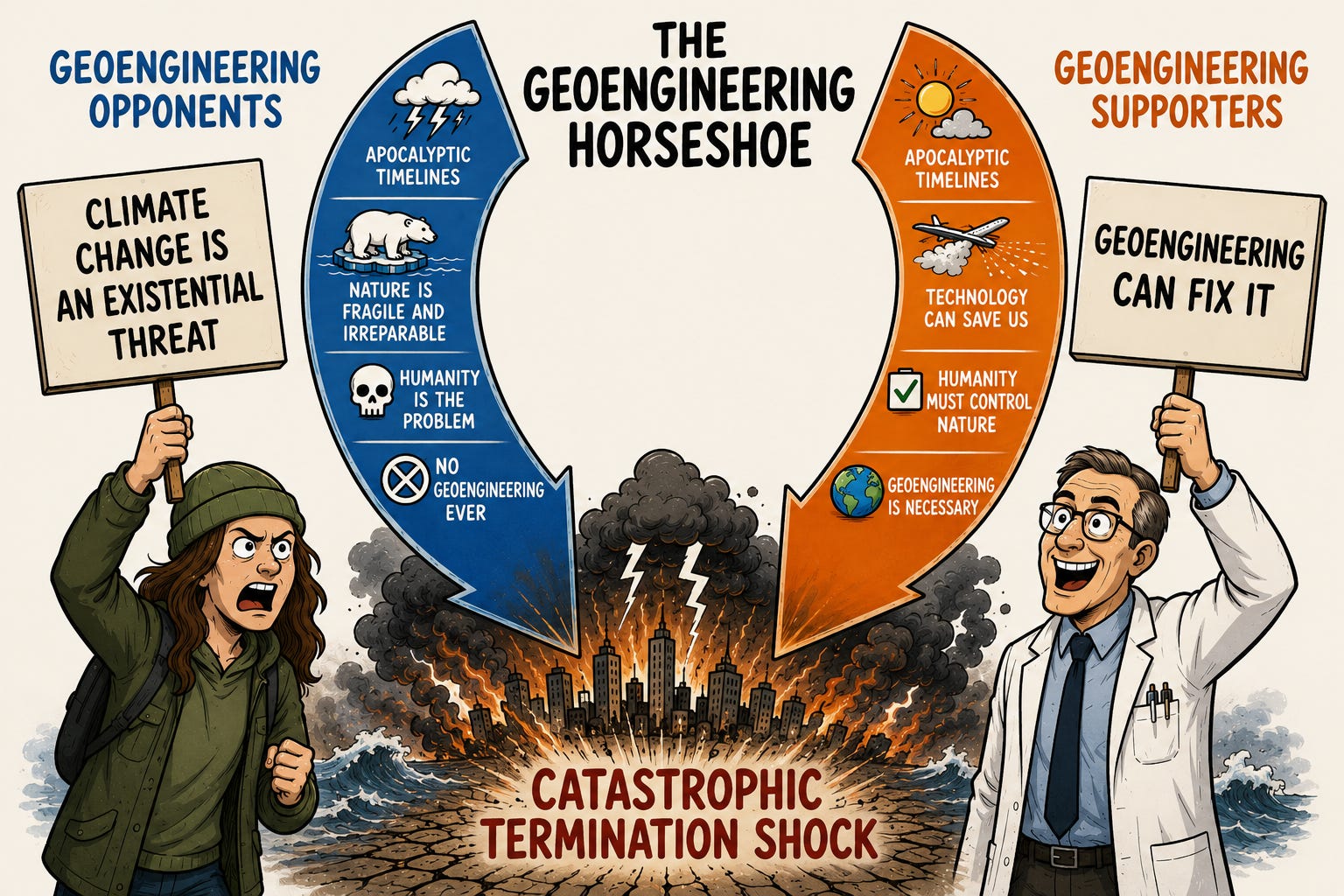
The Climate Catastrophe Horseshoe
The climate discourse is a funny beast. A lot of people gravitated toward geoengineering for the same reason that Dubner and Levitt did, because it offered an alternative to the climate emergency. But once they became committed to the geoengineering solution, the solution started to reshape how they thought about the problem.
This is one of the underappreciated features of a wicked problem. It’s not just complicated. In a pluralistic society, and in the face of irresolvable scientific, economic, and technological uncertainties, a multiplicity of meanings are easily projected onto the issue. The nature of the problem and its solution are contested from all sides and the common intuition that solutions are proposed in response to how one understands a problem gets inverted. Problems are increasingly defined in ways that justify the solutions that various factions, constituencies, and interests are already invested in.
The original troll positioned geoengineering as an antidote to catastrophic framings of the climate issue—a kind of get out of jail free card for climate angst. If things really did get as bad as environmentalists said they would, we could always just geoengineer our way out of the problem. But as many geoengineering supporters came to embrace the idea, the reasoning subtly shifted. Increasingly, geoengineering is advocated not as a kind of insurance in case things get really bad but because they are already really bad.
Once you decide that human control of the climate is desirable, not a sin against nature, the desire to geoengineer becomes hard to resist. Wicked logic then almost inevitably drives you toward catastrophism to justify its use. As a result, geoengineering advocates and opponents now hold nearly identical views about climate risk, despite holding diametrically opposite views on geoengineering as a solution.
There is hubris on both sides of that divide. The climate movement remains far too confident that catastrophic framings of the issue will not only result in climate action but the sort of climate action that the movement has in mind. Geoengineering advocacy, meanwhile, simply assumes a level of technocratic competence that is nowhere to be found: that we will be capable of understanding the consequences of geoengineering in advance of undertaking it, that we actually have the technological capability to deliver sulfur particles reliably and with precision to the upper atmosphere, that wise global governance might assure that we will only use the technology in the face of dire necessity and in a manner that is democratically accountable, and that once we start, there will be some plausible mechanism to assure that we don’t stop prematurely.
Put the yin and yang of geoengineering advocacy and opposition together and what you get is an emergent, rather than intentional, path to geoengineering: the development of a technology with assurances that it would only be used under the most dire of circumstances, a global climate movement determined to characterize all negative climate related impacts upon society as proof of just such a dire predicament, strong political incentives for policy-makers to address climate change in ways that don’t cost very much, and the lack of any global institution with the legitimacy to decide when to start or how to stop.
Such an emergent path may even serve the interests of partisans on both sides of the issue. Advocates are effectively getting the world a little bit geoengineering pregnant through research and development, aided and abetted by the catastrophic claims of a climate movement that ostensibly opposes the technology. The climate movement gets a true looming apocalypse to motivate its decarbonization agenda, because without deep decarbonization, catastrophic climate change really does beckon in the event that the world fails to sustain geoengineering.
Such an outcome might serve both the climate movement’s social engineers and the geoengineering community’s aspiring climate engineers. But I fear that it is unlikely to serve the public’s interest. Geoengineering, instead, risks turning the climate movement’s catastrophism into a self-fulfilling prophecy.
A nice article about how keeping climate as a crisis serves the interests of both wings of the climate-industrial complex. This, despite the demise of RCP8.5 & SSP7.0 scenarios that were used for the past 15 yrs to try to dupe the world into attempting a social & environmental utopia.
The current models are not fit for purpose in that they cannot do regional forecasts, they can't accurately predict the hurricane season or monsoons a year ahead of time, nor do they have any accuracy in predicting 2 years ahead of time ENSO (el Niño / la Niña). It is hubris to think that they could even consider geoengineering.
And you are spot on to emphasize "Who is going to make the decision?" We know there will be winners and losers, just like any time the climate changes.
There is no climate crisis. There is a climate change policy crisis because we are allowing millions of poor people to die yearly because of a lack of energy due to those policies. Example: 2-3 million per yr die of indoor air pollution from lack of propane or electricity. It is immoral!