

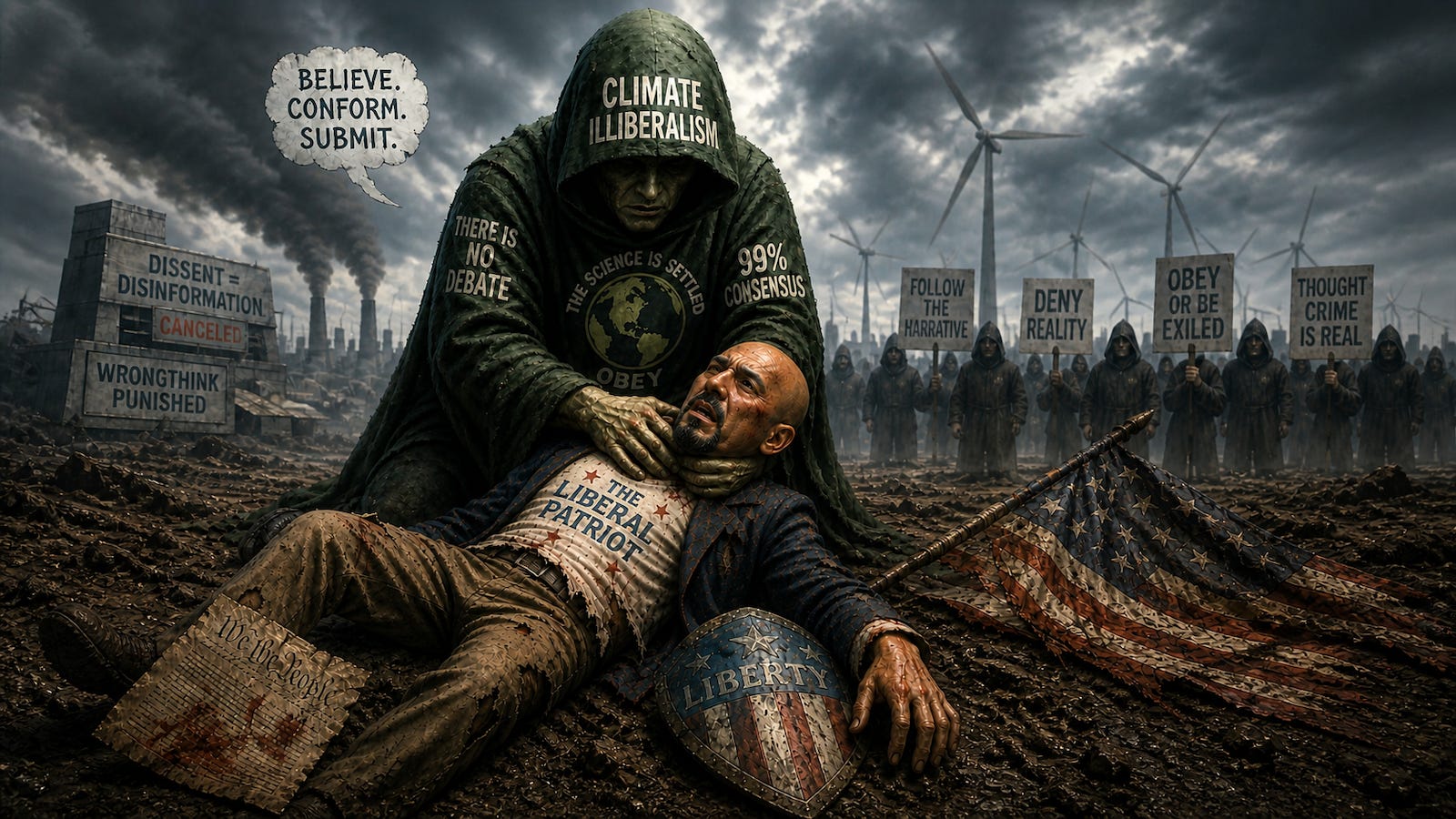
In the fall of 2023, John Halpin, a founder and the executive editor of The Liberal Patriot (TLP), got a heads up that one of his funders was unhappy with an essay they had published about climate change. “I was given an ultimatum by a donor not to write about climate policy and politics anymore, and not to publish anyone else on the subject as well, b/c they didn’t like our criticisms of Democratic orthodoxy and strategic failures on the issue.”
TLP’s writing on climate change was far from the most contentious issue about which the website challenged Democratic orthodoxy. Over nearly six years TLP published multiple columns per week arguing, for instance, that Democrats needed to embrace much stricter enforcement of the US border and deportation of immigrants living illegally in the United States; impose limits on medical interventions for trans-identified youth and prevent natal males from competing in girls’ and women’s organized sports; and push back on activist rhetoric describing Israel as an “apartheid state” committing “genocide” in Gaza.
Each of these issues is controversial within the Democratic Party and its political coalition. That was explicitly the point of TLP, to challenge the whole suite of progressive Democratic orthodoxies that have, in TLP’s telling, hobbled the ability of the party to reliably win electoral majorities and build a durable governing coalition. One need not endorse every position the authors at TLP took to understand that their project was a fundamentally tent-enlarging one, meant to expand the boundaries of politically and culturally permissible rhetoric and views within the party and across the center-left more broadly. No donor to TLP could conceivably have failed to understand the nature of the project.
But that dissent, in the eyes of at least some of TLPs funders, needed to end at the climate’s edge. Ruy Teixeira, Halpin’s cofounder and TLP’s most prolific and influential author, told us that across 6 years, 1500 posts, and a range of controversial subjects, TLP’s funding and editorial independence had been threatened exactly four times. Every one of those instances was in response to an article about climate change.
Teixeira and Halpin, to their credit, stood their ground. But it cost TLP and the effort to revitalize the Democratic Party. “I refused the ultimatum,” Halpin wrote. As a result, “we lost future funding and subsequently had to stop the growth of the organization.” TLP is no more because Teixeira and Halpin refused to bend the knee to Democratic climate catastrophism.
Scientism, Not Wokeness
We, unfortunately, bear some responsibility for TLPs demise. Teixeira had published fairly regularly on the foibles of Democratic climate and clean energy politics and occasionally on the shaky underpinnings of a lot of what Democrats often said about the climate problem. And TLP published a policy memo we wrote in 2023 on energy politics in an age of war and inflation. But the proximate reason for the ultimatum from TLPs largest funder at the time was an essay by our then-colleague Patrick Brown about the arbitrary nature of the 1.5 Celsius atmospheric temperature target.
Kyle Saunders, in his post about what happened, notes that the objection was not that Patrick’s essay was factually wrong. The objection, rather, was that the analysis “may be technically correct, but it’s harmful.” Saunders uses this as a launch point for a broader exposition about the epistemic problems that have resulted over the last 50 years as various academic post-modernisms have leaked into the broader discourse and politics of the Left.
And this is surely true. But that also can’t really explain why the climate issue, uniquely, has become such a third rail for so many liberal reformers. Teixeira and colleagues could go after many other progressive and Democratic sacred cows with little consequence. Climate change was different.
Why? Because the climate enterprise on the Left is not so much about, as Saunders would have it, the transformation of once “reasonable intellectual cautions (be careful about objectivity, power shapes knowledge, perspectives matter) into philosophical dogma (objectivity is a myth, all knowledge is social construction).” Rather, the central claims of the climate movement (as opposed to climate science) are produced in the opposite fashion, by transforming dogma (nature bats last, the earth has exceeded its carrying capacity, harmonizing human societies with nature is necessary to assure human survival) into capital-S scientific truths (natural disasters are caused by global warming, the 1.5 degree target is a biophysical threshold, harmonizing the global energy system with natural energy flows is both feasible and imminent).
What distinguishes climate politics on the Left from most of the other issues that TLP took on, in other words, is not so much its post-modernism as its scientism. The immigration and trans debates are rife with conflicting scientific and empirical claims and counterclaims about the impact of immigration on wages or the causes and resolutions of gender dysphoria, for instance. But there is no analogue for the totalizing claims to scientific consensus and authority made by the climate movement.
Modern environmentalism has always been different from other issue-based movements in this way. While other advocates claimed to speak for given constituencies—workers, women, illegal immigrants, etc—environmentalists claim to, as the Lorax put it, speak for the trees. The conceit of the movement, from its origins in the scientists’ movement of the 1960s and Rachel Carson’s Silent Spring, was that it spoke for the interests of the Earth as revealed by science.
Sometimes that science has been clear. The overuse of DDT harmed wild bird and insect populations. Combustion of fossil fuels is warming the planet. But more often, it is not. In fact more often, the scientific claims made by the environmental and climate movements are not well supported at all. The evidence that glyphosate causes cancer or gas stoves are responsible for an epidemic of childhood asthma or neonicotinoids are causing bee populations to collapse is, at best, dubious. Claims of planetary boundaries and planetary overshoot are little more than numerated ecotheological claims, not established biophysical thresholds. What holds these various claims together is not a consistent body of evidence, it is what the late Steve Rayner called a “myth of nature.” Nature is fragile, ergo, “a wide range of environmental threats—though apparently unrelated—are understood as manifestations of the same underlying vulnerability. The myth of nature thus provides a unifying rationale that renders diverse risks coherent and compelling.”
Saunders isn’t wrong about the post-modernism. It’s there too. The contemporary climate movement constantly toggles between the two, wrapping itself in the mantle of science in one moment, a priori rejecting all evidence that might challenge its claims as “climate denial” or “fossil fuel talking points” in the next. When environmental leaders and donors say that a particular set of facts is unhelpful—say that the 1.5 degree threshold is arbitrary or that humans are safer than they have ever been from the climate—what they mean is not just that it is unhelpful to their advocacy objectives but also that it is immaterial to their broader truth. Everybody knows that we are screwed absent sweeping changes, even if the particular scientific claims made by the movement are not accurate.
Climatism’s March Through the Institutions and the Democratic Party
Beyond its deep scientism, the other thing that distinguishes the environmental community from other issue based constituencies on the Left is that it is far wealthier. The institutional environmental movement is a multi-billion dollar enterprise, perhaps the wealthiest social movement in the history of humankind. And the same people who write six and seven figure checks to name-brand environmental groups also frequently write similar checks to Democratic super PACs. They account for an outsized share of Democratic Party fundraising.
They also underwrite much of the scientific research that produces so much of the catastrophic science that supports the movement. Billions of philanthropic dollars have flowed into academic institutions to produce this knowledge. You will be hard pressed to find an elite university that doesn’t feature a well financed program, often created explicitly to produce catastrophic warming and impact studies and pollyanna estimates of a costless energy transition.
As Jessica Weinkle has documented for years, there is an internecine web of conflicted interests among climate philanthropies and NGOs, university departments, financial regulators, law firms, and even the National Academies of Science and other public science institutions. Environmental philanthropy has successfully captured much of the relevant infrastructure of scientific discovery and communication, in the belief that doing so would lead to public demand for climate action.
For these reasons, the climate issue is epistemically broken in a somewhat different way than what Saunders describes elsewhere on the Left. Environmentalism never explicitly challenges the notion that there is fixed knowledge that can be empirically established in the way that various other political post-modernisms do. It is up to something different. When TLP published work that was critical of claims that looming climate catastrophe required a swift transition to renewable energy technologies, it ran headlong into this self-reinforcing web of interests and institutions.
Educated Class Warfare
TLP launched in 2020, at the height of the Great Awokening. Halpin and Teixeira were early to the effort to combat the illiberal overreach being advanced by the new heralds of progressive politics,from anti-colonialism to gender self-identification to corporate DEI to the slavish beatification of Greta Thunberg.
In the years since, many of the worst excesses of the Great Awokening have receded. We don’t hear much these days about white fragility or Ibram Kendi. Major exposes, such as Ryan Grim’s piece on the paralysing impact that these ideas had upon the ACLU and the Sierra Club (among others), demonstrated how destructive anti-racism had been within center-left institutions.
This liberal backlash extended, to varying degrees, to other classically woke concerns. The idea that, maybe, defunding the police was both bad politics and bad policy; that some safeguards needed to be placed on pharmaceutical gender affirmation for children; that unionizing workforces in nonprofit media and advocacy shouldn’t override the mission or issue focus of their organizations; and that multiple perspectives could obtain as to whether or not Israel’s actions after October 7 should be characterized as a “genocide,” became acceptable, if not fashionable.
The backlash to the climate catastrophism of that era, by contrast, has been far more muted. Liberal and progressive elites were far more insulated from post-pandemic inflation and energy and fuel price spikes that Biden era climate and energy spending seemingly corresponded with. Instead, the gentrified soul of the Democratic Party mostly experienced benefits, not discomfort and inconvenience, from climate policy—a cool, nicely subsidized electric vehicle, a home powered by solar panels and cooled with a heat pump, and delicious farm-to-table cuisine. For the Democratic Party’s educated and affluent base, the party’s climate agenda and priorities have been, at worst, benign and frequently exalting.
Teixeira, most especially, wrote volumes about why Democrats’ preoccupation with concerns of the educated classes had alienated working class and non-college educated voters and inveighed against the idea that Democrats could overcome cultural differences with those voters by focusing exclusively on economic populism. The economic issues, he argued, were easily washed away from one election cycle to the next by short term macroeconomic shifts. The cultural issues, by contrast, were evergreen and everpresent.
Climate change is, of course, the archetypal concern of the educated class, operating across both key political frequencies and, uniquely, alienating non-college educated and working class voters culturally and economically. So with the benefit of hindsight, it was in equal parts ironic and entirely predictable that liberal climate catastrophism would kill the Liberal Patriot. The Democratic Party is broken precisely because its educated base and powerful donor class have demanded that it move the climate issue to the center of its core political value proposition whether or not the average voter much cares about the problem.
This is why we have long argued that environmentalism is antithetical to both the Abundance movement and any left-of-center politics that aspires to inspire the loyalty of working class voters. As long as the environmental and climate movements hold outsized power and influence within those coalitions, neither movement is likely to realize its promise. The death of the Liberal Patriot is just the latest confirmation of that.
I am a member of the Colorado Nuclear Alliance. We advocate for nuclear power as firm, reliable clean energy. Currently, the policy of the State is to close all of our coal and natural gas generators and use 100% "renewable" energy (i.e. wind, solar, and batteries) to achieve our clean energy goals. We constantly run into opposition from the Sierra Club when we testify before the legislature advocating bills to include nuclear energy as a clean energy resource for the State. The Sierra Club has also captured the Public Utilities Commission to the extent that our three PUC Commissioners, who are appointed by our Democratic governor, are all anti-nuclear, "renewable" energy advocates. We have to work with Republican legislators to advance any legislation, although we have succeeded in changing the minds of enough Democratic legislators to get a pro-nuclear bill passed and signed by the governor in the 2025 legislative session. The anti-nuclear and anti-fossil fuel stance of Front Range Democrats has alienated mostly rural "energy communities" who will be negatively impacted economically by the closure of fossil fuel plants and oil and gas exploration and production in the State. I'm a Democrat, but I'm also a geologist who worked in the oil and gas business for decades. I am very disappointed with the stance of many of my fellow Democrats on energy and climate issues. I understand that CO2 emissions since the dawn of the Industrial Age have caused the planet to warm, but the warming that we are experiencing is not an apocalypse. Combating it will require a rational, science-based transition to clean energy that will take decades to accomplish.
Yes, well described. I've been a liberal, I most often use the term center left, and for 20 years have watched the liberal media and my fellow liberals confuse global warming with climate crisis. Much worse, they have elevated it to a required orthodoxy and tried to demonize and shame anyone not on board. The orthodoxy and its elites, in addition to promoting catastrophism that has little scientific support, has antagonized not just the poor and middle class, as you describe, but also hundreds of thousands who are science literate and do not take kindly to being demonized and called science deniers. I watched Trump get elected in 2016 and 2024, partly because "my" misguided liberals have ignored so many "working class" issues and insulted so many who are well informed about climate science and realistic energy policy. Sad. Far more than sad, because Trump is so corrosive to our constitution, traditions, and experiment in democracy.