

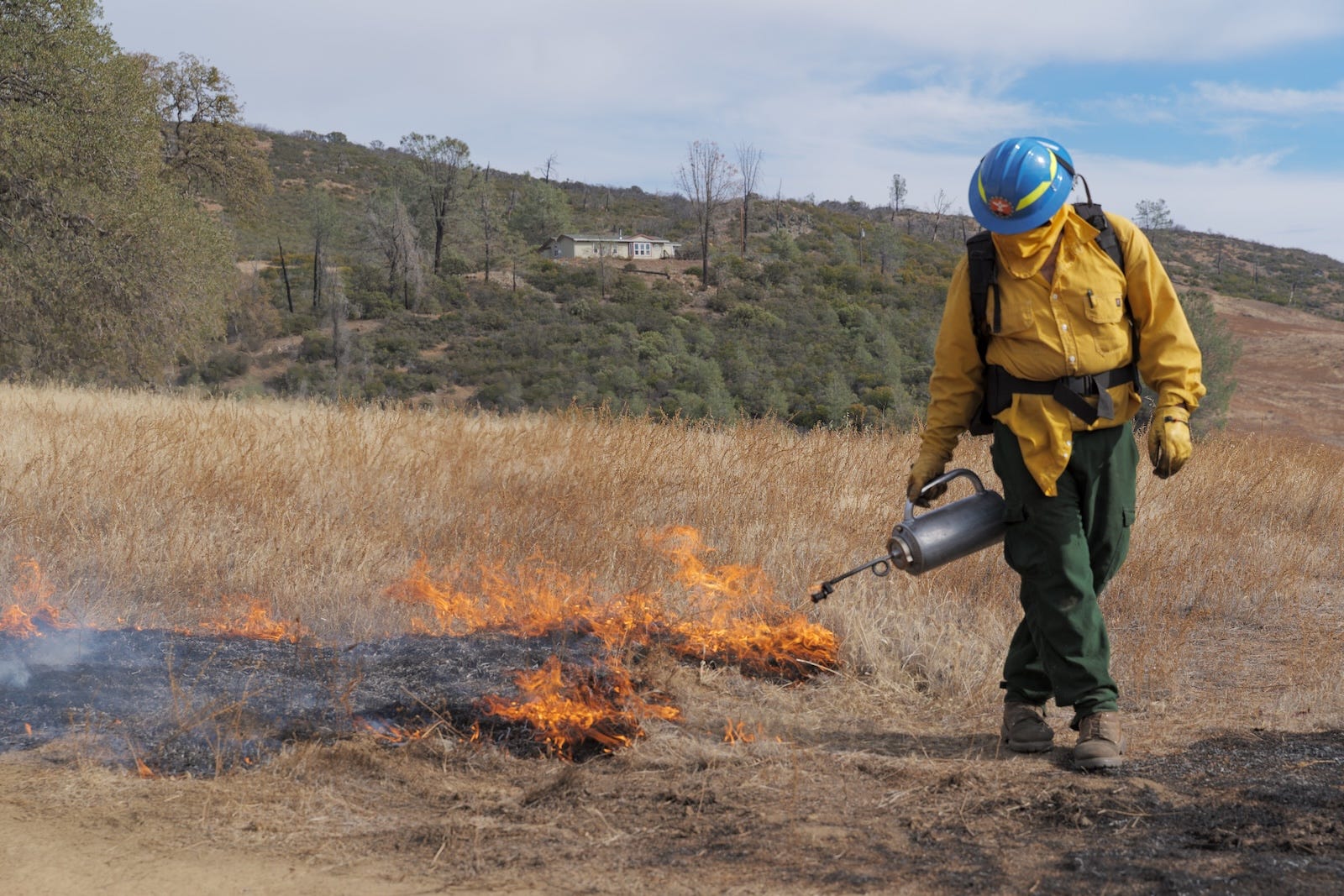
The Western United States is facing another severe fire season. More than 12 million acres have burned so far in 2026, already surpassing the total cumulative area burnt by wildfires in all of 2024. According to the National Interagency Fire Center’s incident reports, the number of acres burned is up 231% compared to the previous 10-year average for the first three months of the year, with activity largely concentrated in the Southeast and Great Plains. In addition to area burned, the number of distinct wildfires is also above average, indicating increased ignition frequency.
Climatic conditions and a build up of hazardous fuels—combustible vegetation such as dry grass, dense brush, and fallen branches—are primary drivers of this year’s worrying start. But, Trump may be fanning the flames. The administration’s sweeping reorganization of U.S. land management agencies is making it harder to proactively prevent wildfires and jeopardizing better forest policy currently before Congress, together worsening future fire seasons.
Warmer winter temperatures and low snowpack across many Western basins are expected to intensify fire behavior later this spring and summer. This will exacerbate the consequences of decades of overly aggressive fire suppression that has contributed to fuel accumulation across U.S. forests, increasing the likelihood of severe fires under enabling weather conditions.
A growing body of evidence shows that proactive hazardous fuel reduction—including practices like mechanical thinning and prescribed fire (i.e. controlled burns)—can meaningfully reduce fire intensity, restore ecosystem resilience, and generate large net economic benefits. A 2024 meta-analysis of Western U.S. forests found that fuel treatment reduces wildfire severity by roughly 62–72% compared to untreated areas, with mechanical thinning combined with prescribed fire as the most effective strategy for preventing wildfires that destroy the majority of overstory trees. A 2025 study found that prescribed fire reduced the burn severity of wildfires by an average of 16% and lowered net smoke emissions by 14% during California’s 2020 fire season.
As the case for scaling fuel treatment becomes increasingly well established, the policy landscape is shifting. The Fix Our Forests Act (FOFA) is a sweeping legislative response to the nation’s escalating wildfire crisis. The bill aims to expedite active forest management by streamlining environmental review, limiting litigation delays, and accelerating hazardous fuel treatments on federal lands. FOFA passed the House with bipartisan support and advanced through the Senate Agriculture Committee in 2025. Trump’s reshuffling of the US Forest Service (USFS) and Department of Interior (DOI) threatens the passage of FOFA and would make implementation significantly harder.
A Diminished and Declining Workforce
The USFS manages 193 million acres of national forests and grasslands. DOI manages wildfire response and fuel treatments across more than 500 million acres of public and tribal lands. In the first year of Trump’s second term, the USFS lost almost 6,000 employees through deferred resignations, early retirements, and buyouts amounting to a 16% reduction.
These workforce losses are already affecting the agencies’ ability to plan, permit, and execute fuel treatments at scale. In 2025, USFS saw a 38% reduction in wildfire risk reduction, including hazardous fuel treatments, compared to the four previous year average.
Even before the staffing changes in 2025, federal agencies have struggled to scale fuel treatments. In recent years, total treatment has averaged 5-7 million acres per year, far short of the 117 million acres identified as having high or very high wildfire risk potential. A 2024 Breakthrough Institute analysis found that California alone may require 3.9 million acres of treatment per year to most effectively reduce risk.
Additional workforce reductions are expected in 2026 that could further constrain capacity. Despite echoing some of the key goals articulated in FOFA around scaling up risk reduction, the White House’s recent budget proposal for FY2027 emphasizes organizational restructuring over permitting reform or workforce expansion. The central proposal is the transfer of fire-related employees from USFS to a new U.S. Wildland Fire Service within DOI. This is the biggest structural change proposed in the budget that could impact fuels management work on National Forest System lands.
Trump’s executive order on wildfire prevention and response in 2025 directed the consolidation of wildland fire programs across USDA and DOI. While the USFS move to DOI has not yet been initiated, DOI established a new U.S. Wildland Fire Service (USWFS) in January 2026. The new entity consolidates fire management operations of six preexisting DOI agencies including the National Park Service, Bureau of Indian Affairs, and the Bureau of Land Management. But it is unclear how the USWFS will balance suppression with mitigation work. The newly appointed Director of the U.S. Wildland Fire Service, Brian Fennessy emphasized that fire suppression is the service’s “primary mission,” igniting concerns that fuel reduction will not receive sufficient attention.
Critically, the administration has not spelled out how consolidating the nation’s wildfire efforts under one agency will increase the scale and pace of fuel treatments nationwide. The FY2027 USWFS budget proposes an increase in funding and staffing levels over FY2026 levels to support conducting fuels management activities but estimates the funding would support fuels management on 4.7 million acres. This is far less than the combined 6.6 million acres treated by USFS and DOI in FY2024, the most recent year for which complete data is available.
Reorganization Risks Compounding Capacity Loss
Alongside internal changes at DOI, USDA initiated a sweeping reorganization of its own earlier this year. In March, the Forest Service announced it would be relocating its headquarters to Salt Lake City, Utah, closing regional offices, and restructuring to a state based leadership model. These changes risk further exacerbating operational challenges that Trump’s Forest Chief Tom Schultz himself said impacted the agency’s ability to meet annual goals for prescribed fire.
It’s too soon to know how relocation assignments for Forest Service employees will impact overall staffing levels. But, historical precedent suggests such relocations can significantly reduce staffing capacity. The Bureau of Land Management’s 2019 move to Colorado led to substantial attrition and was reversed in 2021. Similarly, relocation of USDA research agencies to Kansas City resulted in approximately 75% staff attrition and a sharp decline in productivity.
These risks extend beyond operations to politics. After passing with bipartisan votes in the House and moving out of committee in the Senate in 2025, FOFA now awaits a Senate vote before going to the President’s desk. FOFA’s bipartisan coalition may weaken as concerns grow—particularly among Senate Democrats—about staffing shortages and inadequate transparency surrounding the DOI reorganization.
FOFA Implementation Challenges Loom
If Congress does manage to pass FOFA this year, a diminishing federal workforce also jeopardizes its implementation.
Expanding hazardous fuel treatments requires more than regulatory reform. Skilled staff are needed to execute environmental reviews, manage contractor relationships, conduct environmental consultations, and oversee treatment projects. The reorganizations at USDA and DOI will reshape implementation capacity precisely when states facing a severe wildfire season need it most.
FOFA could accelerate project approvals through a range of proposals, including expanded categorical exclusions and limits on injunctions. A Breakthrough Institute analysis found that litigation delays can add over two years to project timelines, and that forest management projects face more litigation than other federal project types.
Relief is needed on this front, but litigation is only one component of delay. By some estimates, NEPA compliance accounts for roughly one-fifth of the time required to implement forest management projects, with the remaining delays arising from contracting, funding, and project execution constraints.
Agency capacity remains crucial for meeting the Forest Service’s current regional targets, much less treatment levels supporters hope FOFA will usher in and, eventually, the goals set by the Forest Service’s 10-year Wildfire Crisis Strategy to treat an additional 50 million acres. These goals will be increasingly difficult to achieve with workforce and budget constraints.
A Perfect Storm
A convergence of political and institutional challenges now threatens to limit our ability to mitigate the scale, intensity, and economic burden of future wildfires.
The sweeping reorganizations at USFS and DOI threaten to further diminish forest management capacity, complicate Democratic support for FOFA in the Senate, and jeopardize FOFA’s successful implementation if passed.
At the same time, other budget pressures are looming. Forest restoration and fire mitigation funding from the Infrastructure Investment and Jobs Act (also known as the Bipartisan Infrastructure Law) is appropriated only through 2026. Further, the Wildfire Suppression Operations Reserve Fund, which has served as a backstop since 2020 ensuring surging emergency fire suppression costs don’t crowd out mitigation spending, is set to expire in 2027.
Carryover balances and IRA funding available through 2031 will moderate near-term impact but, absent new appropriations, federal wildfire mitigation funding could face a meaningful decline later this decade. These dynamics create a perfect storm where rising wildfire risk coincides with declining institutional capacity and uncertain policy support.
Lawmakers should not allow these converging risks to delay action. Passing FOFA remains an important step toward scaling proactive forest management. Congress must ensure FOFA is duly followed by sustained investments in workforce capacity, contracting systems, and project delivery infrastructure. Without these commensurate investments, FOFA’s expanded authorities will be underutilized, leaving communities, ecosystems, and public budgets increasingly exposed to catastrophic wildfire.
