

This is the second part of a two-part essay. Part I argued that public power transmission can only earn public trust if it’s anchored to public resources with tangible public benefit: clean, firm power. It found a model in the Pacific Intertie, the 1960s federal project that linked Northwest hydropower to California energy demand by anchoring transmission to a public resource, segmenting ownership among utilities, and disciplining the arrangement with a public-benefit yardstick. Part II applies that template to the transmission problems of today.
Today’s calls for a federally-supported transmission buildout largely aim to tap into hypothetical private wind and solar resources across the nation. Those resources come with a lobby—Big Tech and other corporate consumers, as well as renewables investors themselves—that’s looking to socialize their costs and optimize their portfolios even, or especially, if that means restructuring markets. Powering the Pacific Intertie, on the other hand, were specific hydropower resources in the public domain, free of a private beneficiary. Those resources met direct needs by distant customers in the form of firm power; no volatile, open market for balancing purposes required.
Today’s progressive demands should similarly anchor new interregional transmission to new generation resources for clear public benefit. Now what’s needed is a resource that’s not limited to the last drops of untapped hydropower; one that offers direct benefit to receiving utilities and to the public, as clean, firm power; one that locals love and that can be deployed as an anchor in public power systems across the nation.
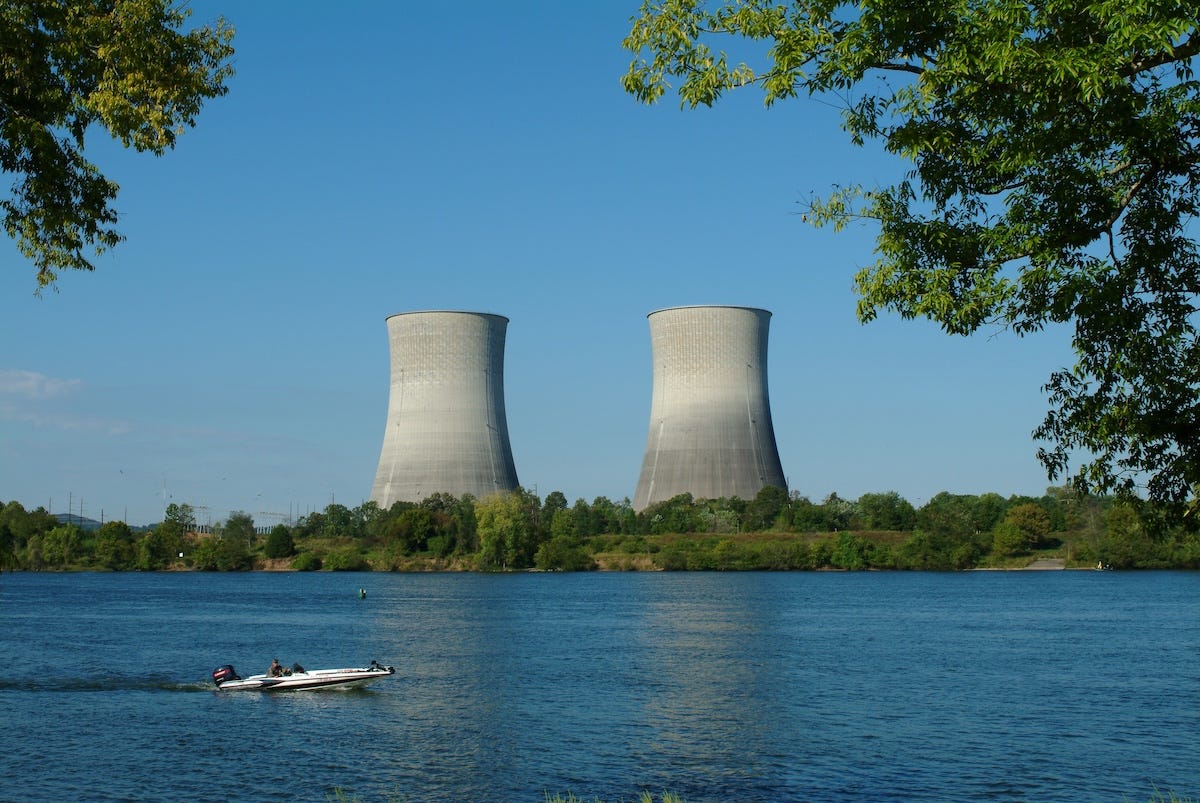
America has one resource that fits the bill: nuclear power. And the federal government already has a public power utility with the institutional capacity to build and operate it as an anchor for new interties into other territories: the Tennessee Valley Authority.
In the past I’ve argued in these pages and elsewhere that TVA was the right utility to lead a nuclear revival in America, if only Congress would unlock its financial constraints. The case then was about reindustrialization and decarbonization.
Now the need is slightly different. Hyperscalers are driving up demand forecasts across the country and are willing to pay a premium. What’s really needed by utilities to serve them and to meet resource adequacy requirements is clean, firm power—not anywhere, but everywhere. That’s not just about advancing the development of artificial intelligence. Since everyone is tied into the same grid, it’s also about harnessing that load growth to put downward pressure on prices. Expediting nuclear development has its benefits, too, of course.
A National Anchor Power Program would cut through the thicket that constricts both interregional transmission and nuclear power. Federally supported nuclear power, built, hosted, and run by a public power utility, with a share of the output delivered outward over new interregional HVDC transmission lines into neighboring utility territory. Public power expanded beyond public power’s current borders.
Making the program work without stealth deregulation, without being guided by any private industry’s particular interests, and with buy-in from the public, utilities, states, and the hyperscalers footing the bill is the challenge. The history of the Pacific Intertie provides some lessons to solving it.
Casting the anchor lines
Presented with the anchor program idea, the likely question at the top of one’s mind is who pays for the interregional lines? Following the model of the Pacific Intertie, it’s whoever owns each segment.
TVA owns the segment in its territory—the HVDC line up to its border and the source converter station. It finances the segment through its own bonds, and it recovers the costs not from Valley ratepayers but through the wholesale export on the line. The receiving utility owns the AC delivery infrastructure on its side—the substations, the reinforcements, the last miles to its data centers—in its ordinary state-regulated rate base, earning its ordinary return. And the long middle of the HVDC line—the stretch that runs beyond TVA’s borders and across whatever states lie between—is owned by a federal anchor authority. As for who pays for the anchor line, its costs are recovered not from either utility’s ratepayers but from the hyperscaler customers who contracted for the anchor power.
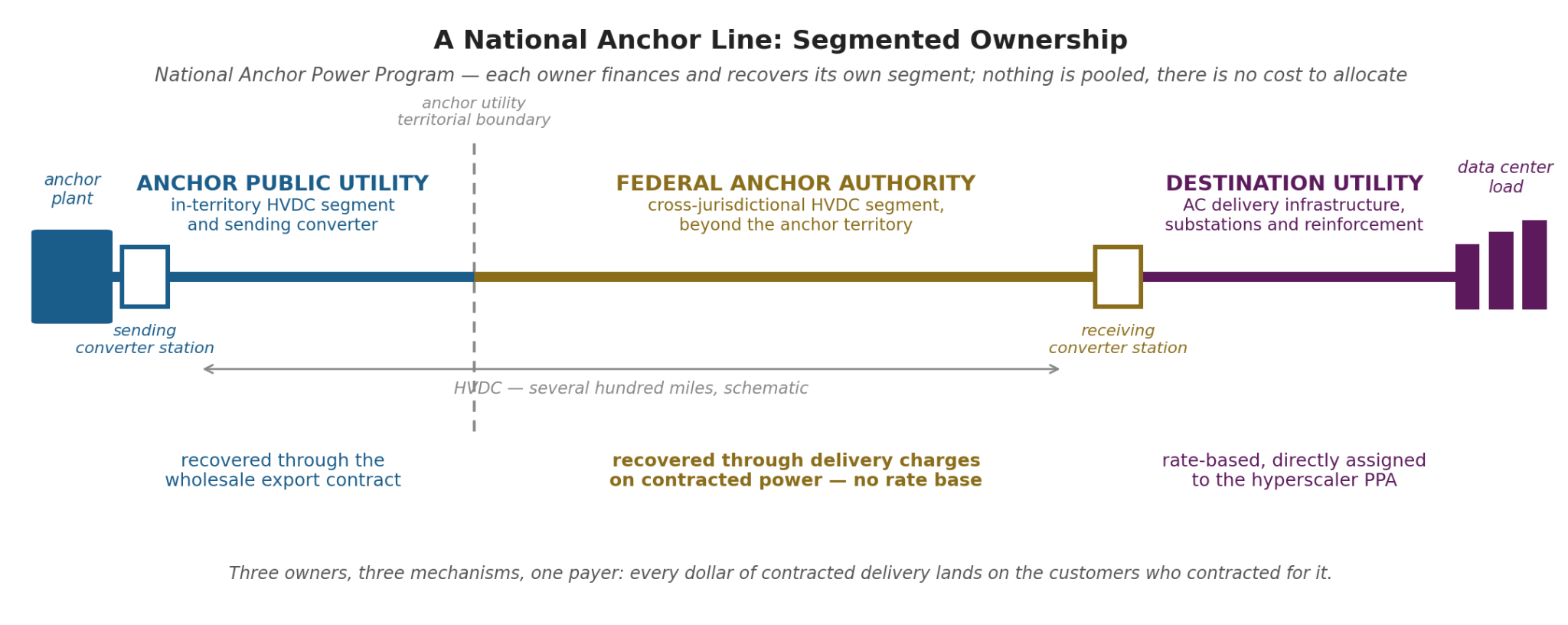
Segmentation means no drawn-out fight at FERC over the allocation of costs and benefits, and no stealth deregulation. Rather than statutorily expanding the anchor utility’s borders—sure to be a heavyweight political fight—the middle segment is owned federally, and not by any new public utility, simply a federal holding entity. That setup retains the anchor utility’s control of dispatch along the line; more on that later.
Given their history with interregional transmission, why would investor-owned utilities cooperate with the program? Because the anchor program aligns with their commercial interest, instead of breaking it apart. A participating utility retains its retail relationships with hyperscaler customers, and it expands its rate base and therefore its profits with its share of the line. The utility’s local generation isn’t stranded since the anchor power is additive to meet growing demand, a precondition for the line’s proposal. And because the power is firm, exactly what the hyperscaler customers need, there’s no operational burden of flexible balancing placed on the utility, as would have been placed on TVA with the failed Clean Line dispatching intermittent wind power into its territory.
With these federally directed transmission lines, why should the public trust they aren’t being fleeced in order to benefit a particular private lobby? Primarily because the lines tap into a public generation resource—detailed in the next section—rather than speculative private ones whose investors would love to socialize costs. On the other end, the hyperscalers benefit from the clean, firm power delivery, to be sure, but all the ratepayers in the same territory benefit from that power too. They get the retail price depression of utility load growth and the capacity value of firm power, but without their utility adding the massive costs of a nuclear plant onto the books and into their rates.
There’s another key lesson from the Pacific Intertie in establishing public trust: yardstick pricing. To initiate an anchor line the program office would identify a potential hyperscaler load center, do the tricky siting work to plot a pathway to it, and estimate the costs. That results in a yardstick delivery price for hyperscalers to pay. The receiving utility would need to propose a viable AC segment in its territory whose cost can match that price. If the utility isn’t playing ball, the program office can threaten to develop a different anchor line, to a different utility, instead. The program office initiates projects and wields the yardstick to discipline costs, in contrast to today’s status quo of years-long competitive processes to solicit proposals from merchant developers.
Where the program differs most from the Pacific Intertie, however, is the anchor itself.
Nuclear-powered anchors
With the experience of Vogtle still fresh, concerned onlookers are likely to worry that new nuclear plants mean ballooning cost overruns that enrich shareholders by soaking ratepayers. How does the anchor program dispel that concern?
For one, there’s no shareholders in the plant who profit from the investment itself; there is only the anchor public power utility to own the plant, TVA. But that doesn’t mean cost overruns aren’t still possible, of course, so TVA ratepayers need protection.
Again taking the yardstick as inspiration, the anchor utility works with the federal anchor office—as well as any experts outside the government—to develop a cost estimate for the plant. By standardizing the project for multiple anchors, that engineering and administrative work pays off over time. The result is a yardstick acquisition price for the plant that the anchor utility, TVA, pays upon completion. There’s a guaranteed limit to what its ratepayers cover.
Who absorbs the cost overrun risk, then? The federal government finances the construction on its own balance sheet and then sells the plant at the acquisition price. Overruns don’t merely fall on federal shoulders, though. The first slice of it is covered by the anchor utility, to keep its construction disciplined. The bulk of the overrun after that falls on an anchor reserve fund that’s seeded by the anchor program’s hyperscaler customers. The federal government handles tail risk overrun after that.
The hyperscaler customers fill up the reserve fund before the anchor plant ever turns on to deliver them power, much like utility “construction works in progress” financing charges average-joe customers in advance. The Searchlight Institute and Groundwork Collaborative both envision hyperscaler-funded grid upgrades; the former with a carrot and the latter a stick. Here’s how the anchor program applies the “hyperscalers pay” principle to the generation resource.
One might wonder whether this insurance isn’t just another subsidy for nuclear developers. The reason is that the whole program is only available to publicly-owned anchor utilities. That’s a modern take on the New Deal preference for public entities like municipalities and electric coops: instead of power from public resources offered more cheaply to public consumers, it’s cost overrun protection for public builders only.
In contrast, recently reintroduced bipartisan legislation, the Accelerating Reliable Capacity Act, would offer federal backing for a portion of overruns even when the builder profits from the plant. Applicants propose a cost and the government says yay or nay to limited overrun insurance—unlike the anchor program’s government-authored yardstick price. Nuclear proponents have good reason to support the ARC Act. Utility executives and even some utility regulators have explicitly conditioned new nuclear projects on the passage of such a policy. But the Vogtle experience of Georgia Power shareholders profiting from cost overruns—more capital expense means more returns—makes a blanket federal insurance program a difficult pill to swallow for many.
Imagine now a potential pilot project for the anchor program: twin AP1000 reactors built at TVA’s dormant Bellefonte site in northern Alabama, sending clean, firm power over a line stretching 250 miles into metro Atlanta to serve Georgia Power’s booming data center corridor. At Vogtle, Georgia households provided the financing with construction-works-in-progress charges for over a decade before the plant ever generated a single watt, while Georgia Power profited all along. Under the anchor program, those households get the load growth of the data centers and the capacity value of the firm power without the gamble of a construction megaproject in their rate base. Serving them public nuclear power would be fitting recompense.
The anchor program largely inherits from the Pacific Intertie its approach to cost allocation and recovery. But there are still questions confronting the 2026 program that weren’t relevant to the setup in 1964, back before RTOs and NEPA.
New challenges on the wire
Columbia River hydropower is seasonal—more flow after winter snow melts, less flow in dry seasons—and Northwest demand peaks in winter while Southwest demand peaks in summer. The seasonal bidirectional exchange of power was therefore essential to the design of the Pacific Intertie. Bonneville didn’t just export hydropower; it imported surplus fossil-fueled power from utilities.
A nuclear-powered anchor line would engage in no such exchange. The contracted flow is constant: clean, firm power at all hours, in all seasons, committed to hyperscalers.
One of the whole justifications of interregional transmission expansion, however, is reliability during grid stress events. During exactly such an event, Winter Storm Elliott in 2022, TVA had to issue the first rolling blackouts in its history. A new DOE National Transmission Needs Study demonstrates that “the majority of transmission congestion costs are concentrated in only 5% of the hours,” such as in winter storms. “While interregional transmission can enable the exchange of lower-cost electricity throughout the year,” the study puts it, “it can provide even greater value during those peak periods, which are the hours driving resource adequacy needs.”
How to incentivize the reliability benefit of that sort of interregional transmission has remained a puzzle for decades. The status quo rests on merchant developers recovering costs from energy revenues—the failed Clean Line project into TVA for example, or the Champlain Hudson Power Express line from Quebec to New York City. If a line is to offer emergency exchange during grid stress, however, it can’t also be filled up with regular energy sales as those examples. Advocates like Grid Strategies warn that interregional lines must instead recover costs via cost-of-service regulation, which invites all the FERC cost allocation battles between utilities that Order 1920 tries to mitigate, or via some other means.
The anchor program can solve the puzzle—a public means to recover costs for interregional transmission capacity reserved for emergencies. If an anchor corridor delivering clean, firm power from TVA to PJM reserved some capacity for reliability, perhaps on a parallel line that makes use of the same siting process, then that could be called upon for emergency exchange, in either direction, during the next Elliott. And the hyperscalers, as major causers of grid contention today, fund the bulk of the extra capacity; the federal government and the two connected utilities split the rest as mutually beneficial cost of service.
An anchor line crossing into an RTO territory like PJM raises new questions though. Consider another nuclear project at TVA’s dormant Yellow Creek site and an anchor line connecting it to Dominion’s territory in North Virginia—the world’s largest market for data centers, and part of PJM. The natural pressure on such a transmission project would be to integrate TVA into PJM, giving the latter dispatch control over a public power resource in the former.
To keep existing market structures isolated, particularly on the public power side, the anchor program relies on HVDC technology. There’s precedent here, too: Texas’s ERCOT has long retained its unique market structure, which is distinct from that of the Texas utility territories outside it, because it crosses seams not with AC but with controllable HVDC lines. It’s a core part of the solution to stealth deregulation, but it raises operational questions too.
An HVDC anchor line includes a converter station that injects power into the receiving utility’s local AC network. Ordinarily it’s the utility’s control over that station that confers dispatch authority to the RTO. In the anchor program, though, the anchor utility retains control over that remote station. To supersede the RTO’s authority, the program requires federal ownership of the middle segment of each anchor line—from the anchor territory to the receiving territory, including the converter station. Dispatch is delegated to the anchor utility, giving TVA control over power injected into PJM.
The anchor line is segmented into three owners for cost recovery, each recovering its own segment through its own mechanism: TVA through its wholesale export contract, the receiving utility through its ordinary regulated rates with the costs assigned to the hyperscaler, and the federal middle through delivery charges. There are three owners and three regulators but one payer: every dollar of the firm power delivery lands on the hyperscalers who contracted for it. In operations, though, the segmentation vanishes. TVA dispatches the link end to end, converter to converter, as a single public power machine.
With costs and operations sorted, one more terrain of political struggle against the anchor program remains: the land.
Public power on the ground
We’ve assumed for the anchor program so far that steel can be put in the ground if the money and control problems are solved. Conflicts over land use, however, pose yet another political challenge, one that a progressive appeal to public ownership doesn’t resolve either.
Just a few months ago, TVA withdrew plans for a transmission line across Tennessee after a local farmer, John Gregory, organized in opposition. In addition to selling livestock, Gregory and his wife run a “farm school” on the property that the 100-foot clearance for the line would have plowed right through. A TVA surveyor dismissed the concern entirely, he told AgWeb. As recourse Gregory exercised political voice not through the kind of procedure targeted by abundance but through old-fashioned politicking, with a social-media megaphone to political leaders.
The crucial step for Gregory was recruiting MAGA country star John Rich to the cause. Rich’s organizing and outreach last year forced TVA to abandon a gas-and-batteries plant elsewhere in the outskirts of Nashville, a project that required not just new transmission lines but new pipelines. Eventually TVA decided to just sell the property. As part of his protest, Rich wrote and released a new song on YouTube, “The Devil and The TVA”:
You think you own something
But you don’t own nothing
When the government man comes around
Puts his dirty old boots on your ground
If the Pacific Intertie met local landowner opposition, it doesn’t seem to have registered in contemporaneous political debate. There was no procedural route like NEPA to formalize it, nor YouTube to popularize it.
One way to mitigate the land use opposition is to shrink the battlefield. That means our federal transmission expansion can’t be organized solely around the far more land-intensive resources of wind and solar power. That’s a hard lesson for, say, the leftwing Climate and Community Institute, whose ambitions on public power development consistently and narrowly aim only for renewables deployment.
The anchor program, on the other hand, would be kicked off with existing TVA-owned land for the plants and a few hundred miles for each anchor line. Tighter land use is still open to conflict; even these lines will need to cross many people’s property.
If the “government man” wants to put his “dirty old boots on your ground,” we can at least ensure that there’s a specific public purpose. The skeptic might nonetheless see Amazon as the cause and the beneficiary of the intrusion. In recent months Georgia locals have been arguing a transmission line exists solely for the data centers, for example.
Compared to progressive proposals for transmission powered by prospective wind and solar farms, the anchor program poses a clearer, if crude, case that it’s keeping everyone’s lights on: the nuclear plant anchoring the line. The nuclear construction project that’s “built for the people of the United States” and that employs thousands during construction—and several hundred for generations to come—will be a clear reminder of public benefit. It’s not for nothing that nuclear, according to the latest Gallup polls, is the energy source with the most bipartisan approval.
* * *
The anchor program threads the needle to give federal development of transmission the buy-in it needs from utilities, states, the public, and the hyperscalers whose demand launches the country into a new economic conundrum. As with New Deal public power, the point is to deliver the benefits of public resources as cheaply as possible. The segmented architecture, inspired by the Pacific Intertie, resolves the cost allocation and recovery battles that have sunk so many proposals. Hyperscalers foot most of the bill.
Though it’s been sketched here as a program for TVA, it could just as easily apply to the New York Power Authority, which is currently developing its own nuclear projects, or the Nebraska Public Power District, which sees nuclear as not just critical for its operations but essential for surpassing local political hostility to renewables. As the program grows, more hyperscalers pay into the reserve fund; more ratepayers gain capacity value to support load growth without emissions; the federal office improves its siting, planning, and pricing; and the construction risk of the AP1000s decreases. But it needn’t be confined to AP1000s; in later years smaller public power utilities could host an SMR like the BWRX-300 that’s under development at TVA, or even microreactors. Nuclear power isn’t a hard requirement either. In the West, the standardized clean, firm resource built and delivered via the anchor program—and worthy of cost overrun insurance for public builders—could be enhanced geothermal instead.
Following the example of the Pacific Intertie, the anchor program presents a template to build new interregional transmission without imposing stealth deregulation and with a political coalition on its side. That revolves around building clean, firm resources needed nationwide as public anchors, pooling risk from hyperscalers into cost overrun insurance for public builders only. And it expands public power’s capacities without chartering new public utility systems or acquiring private ones like in Roosevelt’s time. We don’t need to go full New Deal to once again wield public power for electricity abundance.
