

Across the political spectrum, one hears that America needs more transmission lines to decarbonize its grid, to lower costs, to increase renewable energy deployment, to interconnect large data center loads, to ward off blackouts, and so on. Different political factions see very different roles for the federal government to play in that development, from permitter to market maker to planner to builder.
There’s one point that unifies the factions, however: that those dastardly electric utilities stand in the way. From the libertarians at R Street, to the center right at Niskanen Center, to the progressive left at Roosevelt Institute, to the ecosocialist left at Climate and Community Institute, advocates of major transmission expansion identify the utilities—with their old-fashioned public service regulation, monopoly territories, and vertical integration—as a major obstacle to overcome.
For the Abundance camp, though, the slow expansion of transmission stems less from utility opposition than from federal permitting processes that are held up, too easily, by myriad private stakeholder groups. Permitting, thanks to its widespread recognition as a central factor in the transmission problem, is the angle of attack taken up by most legislative efforts to aid transmission expansion in recent years.
But these efforts come equipped with what the Breakthrough Institute’s Ted Nordhaus, Ryan Alimento, and Seaver Wang recently identified as stealth deregulation. To take their most high-profile example, the Energy Permitting Reform Act of 2024 was in part “an attempt to use transmission reform as a trojan horse to force states where utilities continue to be traditionally structured and regulated to allow competition from merchant power generators.”
Stealth deregulation of electricity markets in traditionally-served territories is the natural result of seeing utilities as the inherent problem and market competition as the inherent solution. As Nordhaus et al. point out, however, there are major benefits to the cost-of-service regulation and vertical integration of utilities that are swept away by this view. My collaborator Matt Huber and I have argued for “the utility of utilities” as well, emphasizing, for example, the benefits of this market structure for massive clean energy projects like offshore wind and nuclear power.
Preserving existing market structures isn’t a prescription for transmission expansion either. Any kind of market-neutral authority to site transmission lines between territories will immediately run into the battleground of allocating and recovering costs between them. For many liberals and progressives, this problem comes with a clear solution: put the federal government in charge. The recent Gridlocked report from Groundwork argues this most directly by proposing a new National Power Authority that can build transmission and generation alike, nationwide. There is, after all, a rich American history of federal public power systems like the Tennessee Valley Authority and the Bonneville Power Administration.
But let’s say we wave the magic wand of abundance and create a federal entity with decision-making authority on siting and even building major transmission lines, a true progressive victory. Before any steel goes into the ground, before it can “just build transmission,” this public authority must act as an umpire. Which resources deserve investment, what the benefits are, and how the costs should be allocated—adjudicating these questions is one of the major challenges lying underneath “permitting reform.”
The progressive umpire problem
A magically conjured progressive authority for transmission expansion needs to be able to call balls and strikes, but advocates don’t appear to be playing the part.
First, consider the benefits of new transmission. Chief among them, according to some of the loudest voices for a stronger federal role, is increasing renewable energy generation. New transmission lines sited for prospective generation resources and paid for across a broad customer base unlocks renewables investment, like the CREZ example in Texas. With continent-spanning transmission lines, the argument goes, we can drive up the deployment of wind and solar generation and drive down the emissions rate.
Our federal umpire can’t take the benefits at face value, though. Deciding to socialize the network buildout that enables wider renewables integration comes with clear financial interests whispering in the federal government’s proverbial ear. That includes investors in renewables themselves, of course, but more importantly the many large corporate consumers hungry for renewable energy to substantiate their climate accounting goals. Last year hyperscalers Amazon, Google, Meta, and Microsoft signed 80% of all corporate renewables contracts, for example.
Former FERC Chair Mark Christie has written extensively on how this corporate interest behind public transmission investment warps the adjudication of cost-benefit tradeoffs. Yet transmission proponents largely paint a picture in which the only corporate interests lobbying to steer such decisions are the utilities. Meanwhile the Corporate Energy Buyers Association and other such trade groups consolidate the political interests of major energy consumers in much the same way their forebears lobbied for deregulation in decades past.
Now consider the costs of new transmission. That utilities often oppose transmission lines for undercutting their own local generation is not merely about their shareholders’ profits—private interest over public. The so-called stranded cost problem is a real one for the socialized assets of the rate base, the assets the utility invested in as part of performing their public service. But also, depending on the contracts around the power sales over the line, the existence of new transmission might impose a new operational burden on the utility, and therefore new costs.
Consider the example of the Plains and Eastern Clean Line project in the 2010s, a failed attempt by private developers to sell wind power from Oklahoma into Arkansas and the Tennessee Valley Authority via a large HVDC transmission line. TVA ultimately neglected to sign a long-term power-purchase agreement with the project, destroying its viability. Abundist author Marc J. Dunkelman explains these events in Why Nothing Works as TVA protecting its fossil-fueled power from competition with carbon-friendlier wind. (TVA’s massive nuclear fleet, and the debt it incurred to build it, goes unmentioned.) But that’s a bad call from the umpire.
From TVA’s perspective, the contract just didn’t make sense for ratepayers. “We’re looking at a power demand in the future that is flat, or declining slightly,” TVA’s then-CEO told reporters in 2017, “so we don’t anticipate needing major additions to power generation for a decade or more.”
Rejecting the contract for the Clean Line’s wind power meant TVA’s revenues went to public assets and public workers instead of private assets and their investors outside the Valley. That dynamic is not about utility profit; TVA doesn’t have any shareholders to enrich. It’s possible the imported wind power would’ve been so cheap that the avoided costs would make up for the lost revenues. But as wind power dispatched and delivered intermittently, Clean Line also would have imposed additional costs on TVA: the operational need to flexibly balance all that power. Utilities in RTO regions can rely on purchasing energy on demand from a private fleet of gas-powered generators competing to make a buck—exactly what enabled CREZ to tap into renewables potential in Texas—but not TVA.
The magic wand of abundance conjures an exciting progressive vision of public authority, in this case, to expand our transmission system. But without accurately recognizing cost-benefit tradeoffs—without paying attention to which interests are in the umpire’s ear and why—that public authority can’t be trusted to call balls and strikes fairly.
What public power was for
When Franklin D. Roosevelt campaigned for Governor of New York in 1928, he characterized proposals for private hydroelectric development of the St. Lawrence River as “attempted robbery.” A few years later, as Governor, he established the New York Power Authority. Later, as President, he spearheaded yet more public power developments. “These great Government power projects,” Roosevelt stated at the Boulder (Hoover) Dam dedication in 1935, “will affect not only the development of agriculture and industry and mining in the sections that they serve, but they will also prove useful yardsticks to measure the cost of power throughout the United States.” The whole point of the Bonneville Power Administration, for example, was to deploy a transmission network that could deliver low-cost federal hydropower to the masses.
Today, however, we auction off public waters and public lands for private interests to develop into renewable power projects on a regular basis. It’s not robbery if you invite them to do it.
Federal transmission is pitched as a backstop to build the network that will deliver energy from such private, for-profit renewables projects. These generators aren’t public infrastructure projects that bear commemorative plaques or employ generations of workers, the kind that earns buy-in from locals. Instead, they’re hypothetical agglomerations of faceless, peopleless wind and solar farms that myriad competing private developers created. Local buy-in concentrates in the lucky landowners who will collect annual lease payments and creates bitterness in all their neighbors who lose out.
The power produced by these projects, that the federally-supported transmission would carry to distant loads, is intermittent and therefore less directly useful to a receiving utility than the firm, dispatchable hydroelectric power of old. That’s where stealth deregulation comes in, to fertilize the soil with new market structures that prioritize the offering and buying of such power. Meanwhile, utility bill increases in territories like PJM stem largely from capacity prices, and these non-firm resources offer less accredited capacity value than firm ones.
For a federal authority to be trusted with any of this, our vision of public power transmission expansion must be anchored instead to public resources with tangible public benefit—clean, firm power owned and operated at cost that puts people to work. It’ll have to play ball with utilities, too.
A different public power template
What might such a program look like? Rather than dreaming of a public power system rivaling the New Deal in its ambition, we can find inspiration instead in the postwar federal transmission project known as the Pacific Intertie.
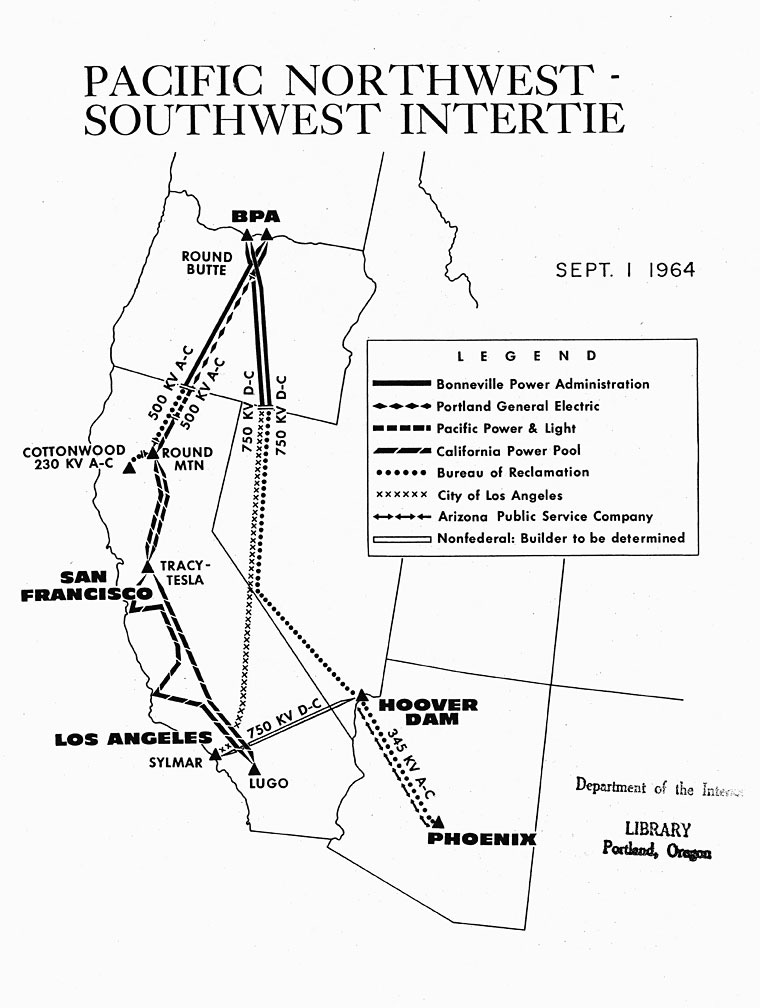
Under the Kennedy Administration in 1961, a federal task force initiated the planning of the Pacific Intertie, a collection of interregional transmission lines connecting federal hydropower in the Pacific Northwest, managed by the Bonneville Power Administration (BPA), down to load in California, reaching all the way to the municipal utility for Los Angeles. In its original form finished in 1970, the project consisted of two parts: dual AC transmission lines carrying roughly 2,500 MW across 940 miles and an HVDC line carrying 1,440 MW across 846 miles—the first HVDC transmission line in the United States and still the longest. Since then it’s been widened and expanded, to transfer even more power between the regions.
California utilities like Pacific Gas & Electric, then the country’s largest utility, needed more power to serve the state’s growing load, and Northwest hydropower looked like a good solution. By 1958 PG&E was in talks with BPA and an Oregon utility to build a far smaller line that would enable them to purchase federal hydropower. The public power ideologues of the Northwest threw their copious cold water onto that proposal: not only did the law require preference for public customers on sales of federal hydropower—unlike a behemoth like PG&E—they worried their regional power would be sucked dry by California. A Congressional resolution passed the next year ordered a halt to “all negotiations for any interconnection or sale of surplus power” until Congress could further study the issue. A firmer political coalition was needed.
In 1961 the Interior Secretary set up a federal task force led by BPA’s administrator to find a solution. Though great pains were taken to play ball with the utilities, the task force was driven by a public power ethos. The clearest path forward was, to them, for the federal government to build its own transmission lines from the Columbia River in Oregon down to Southern California. They drafted plans for various such pathways as bargaining chips against the utilities.
To beef up their opposition to Bonneville intrusion into their state, the California private utilities formed the California Power Pool, a seed that eventually blossomed into today’s CAISO. According to the newly formed power pool, there was “no need whatever for the Federal Government to spend vast sums of taxpayers’ money to build the transmission system the task force proposes.”
Over the next three years the political questions around ownership, preference, and regional allocation of the Intertie bounced around the task force, Congress, and Western governors. Democrats urged federal solutions and public preference, while Republicans in Congress, mostly aligned with the utilities against this scourge of socialism, tried to restrict BPA and encourage private enterprise. Though HVDC offered technical benefits for the lengthy project, it was really competition with the Soviet Union, who’d recently deployed the first HVDC line in the world, that drove the inclusion of this technology in the resulting project.
Even Canada became part of the political balancing act. To ensure regional power needs would continue to take priority, only surplus power could be sold to the new customers. BPA, however, didn’t quite have enough of that to go around. Meanwhile British Columbia was developing its own new hydroelectric projects and needed a market for their power. As BPA’s administrator explained years later, it was critical to Los Angeles that they receive firm power in any such transmission project, not just variable surplus, and it was exactly this firm demand from a growing customer base that sealed the deal for Canada.
Ultimately the task force reached a compromise with the utilities on a new, less government-controlled idea for the Intertie. Rather than a single federal authority building, owning, and recovering costs for the lines, they would be segmented by utility territories; those responsibilities would fall, separately, to each segment’s owner. The federal government would build and finance the segments that fell within its Oregon territory, while each other utility, public and private alike, would similarly build and finance their own. Not only would private utilities like Portland General Electric and the members of the California Power Pool plan and build their own segments of the lines, they’d collect their return on equity too. Markets would be preserved.
Though some in the West decried the proposal as a giveaway to private utilities, the task force set out clear ground rules, at the behest of Congressional Democrats, for those utilities’ participation. The chief requirement was that the public benefit should be equal to or greater than the hypothetical, all-federal designs for the Intertie that had served as the task force’s bargaining chip—a direct, postwar application of Roosevelt’s “yardstick” principle for public power during the New Deal. After months of study, the task force had priced out the costs involved in their alternative designs, and any proposals from utilities had to beat them. Two such segment proposals were denied on this basis.
Rather than acting merely as toll collectors, each utility in the Intertie needed to purchase some of the hydropower itself as well as offer up its own fossil-fueled power for purchase by BPA during the dry seasons. The utilities also absorbed, via their ratepayers, their shares of the overall project risk, in case it fell apart or the California demand never materialized.
At the terminus in California, the Los Angeles Department of Water and Power, a public utility, received about 700 MW over the innovative HVDC line. From the Oregon-Nevada border all the way down to Los Angeles, the equipment for the line was built and operated by LADWP but with ownership split between them, the private utility Southern California Edison, and a few smaller municipalities, all of whom helped to finance its construction.
After the 1970 dedication in Los Angeles, a Times editorial declared that it “may not look as romantic as the pyramids in the desert near Cairo, but it’s a lot more practical, and the towers and lines … are as awe inspiring as anything man has ever created.”
The Pacific Intertie’s task force fought for three years over ownership, preference, and regional allocation. What it never had to fight over was whose resource deserved a federal line, because the resource already belonged to the public. It never had to model speculative benefits, because Los Angeles was asking for firm power by the megawatt. It never had to allocate costs among rivals, because each participant financed its segment and recovered it through its own rates. And it never had to judge whether private participation served the public, because it wielded yardstick pricing. The private utilities kept their segments, their returns on equity, and their market structures—precisely the interests whose competing claims would be litigated before any federal authority today. Still the Pacific Intertie played the builder and not the umpire.
Part II of this essay argues that this combination serves as a template for solving the transmission problems of our own generation.
Fred Stafford is a STEM professional and independent researcher on the power system, decarbonization, and public power. His newsletter can be found at PublicPowerReview.org. “Fred Stafford” is a pen name.

Spending hundreds of billions of dollars to promote the build-out of intermittent, unreliable wind and solar would be a gigantic waste of resources. Instead, we should focus on replacing polluting thermal resources (i.e. coal and natural gas) with firm, high capacity factor, long-lived nuclear power plants, many of which could be built on existing power plant sites and would use existing transmission infrastructure.