

“Kamala definitely needs to start getting involved.”
That’s what climate activist RL Miller told E&E News in August 2024, when congressional Democrats and Republicans were negotiating over major federal permitting reform legislation. “What Democrats should do is refuse to take [the permitting bill] up,” said Miller, “and wait until January to start passing more serious clean energy-only bills.”
Kamala, of course, never did get involved.
A year later, Bill McKibben made a similar argument about permitting reform on Jerusalem Demsas’s podcast. “I just don’t see that there’s a negotiation to be had now,” he told Demsas. “I think we should try to make it happen, but not with these guys.”
My concern, as 2026 began, was that this line of thinking—that permitting should be pursued, but only on a partisan basis—would prevail in the latest round of congressional permitting negotiations.
Late last year, after the House passed the SPEED Act, all eyes turned to the Senate for the Upper House’s companion legislation. Then, the Trump administration paused federal leases on five wind farms off the Eastern Seaboard. Key Senate Democrats announced they would, in turn, pause negotiations on permitting reform legislation. “The illegal attacks on fully permitted renewable energy projects must be reversed if there is to be any chance that permitting talks resume,” said Democratic Senators Martin Heinrich and Sheldon Whitehouse in a joint statement.
As I argued recently with my colleagues Marc Levitt and Elizabeth McCarthy, this was a substantive and strategic overreaction. One need not defend any portion of the Trump administration’s energy agenda to observe that walking out on permitting negotiations does as much or more damage to Democrats’ energy and climate priorities as it does to the administration’s agenda.
The Trump administration, though, has been far from a good-faith counterpart in the negotiations. While the Interior Department advanced its scorched-earth campaign against renewable energy projects, the White House has pursued a NEPA reform agenda predicated entirely on executive action. Not unlike their Democratic adversaries in Congress, the Trump administration has at times not seemed to care very much about permitting reform legislation.
Since December, courts have reversed the administration’s stop-work orders for all five of the affected wind farms, and the Trump Administration more recently quietly rebooted federal approval of solar projects on public lands. And, as of yesterday, Senators Whitehouse and Heinrich have announced their intentions to resume permitting negotiations.
This is encouraging. But we’re not out of the woods yet. Both political and policy disputes stand between resumed talks and final legislation. And those of us who have been pushing permitting reform for years remember well that partisanship has repeatedly stymied permitting legislation, from the handshake deal after the passage of the Inflation Reduction Act in 2022 to the Energy Permitting Reform Act (EPRA) in 2024.
It’s vitally important that Congress follows through this time. Abundance, artificial intelligence, stewardship of public lands, and other key national priorities are being held back by laws Congress passed half a century ago and that Congress now needs to fix. And the Trump administration’s lackluster attitude on the legislative front only goes to show what happens when one party gains the consolidated political control that Democrats like Miller and McKibben are clamoring for: temporary executive actions that worsen energy policy polarization.
Permitting reform should be one of the only remaining policy issues for which bipartisanship can prevail. If our legislature can’t do this, what can it do?
The Permitting Proceduralist Arms Race
Meaningful permitting reform legislation has become a significant priority among certain congressional Democrats and Republicans in recent years. There are multiple bills in both houses of Congress, including major reforms to NEPA that passed the House on a bipartisan basis last fall, as well as several bills that advance the “permitting certainty” Democrats have prioritized. And the Trump administration’s anti-renewables agenda, if anything, strengthens the case for reforming NEPA and other laws that enable weaponized regulatory obstructionism, and strengthens the case for durable, bipartisan congressional action.
Democrats’ reticence on this issue is frustrating because, in one sense, they’re the party that started it. By canceling the Keystone XL pipeline permit, and attempting to cancel approved oil and gas drilling leases, the Biden White House opened the Pandora’s Box of weaponized permitting procedure. The Biden administration was also infamously meek in its support of permitting legislation.
Democrats’ general frustrations with the current administration are understandable. President Trump kicked his second term off with DOGE, and continued to pursue legally dubious RIFs, reversals, repeals, cancelations, and firings. The Departments of Energy and Interior have gone scorched-earth on many of Democrats’ signature climate and energy achievements, including specific renewable projects, but also clean energy innovation hubs and scientific funding. It has not always been immediately obvious that President Trump would sign permitting legislation that Democrats would support, nor that his agencies would implement any new laws in the ways Democrats would prefer.
But while President Trump may exert uniquely forceful executive preferences, it is not unusual for a minority party to be confounded by the executive’s agenda. And while Trump won’t be president in a few years time, the nation’s infrastructure woes will endure. Waiting for the perfect opportunity of consolidated political power would be worse than chasing a phantasm; it’s the very impulse that created the permitting proceduralism arms race in the first place.
From Energy Policy Acts to Energy Policy Polarization
Energy politics and policy have polarized substantially over the last couple decades. The parties today not only diverge on the types of policies they favor—with Republicans generally preferring regulatory relief, and Democrats preferring new spending programs—but, more and more, on the types of technologies they’re willing to support.
Though the clean-versus-fossil dispute has long divided the parties, there was traditionally a middle ground. Republicans controlled both Houses when Congress passed, and George W. Bush signed the 30% investment tax credit for solar panels into law in 2005. Democrats voted across the aisle to end America’s oil exports embargo in 2015. The two parties regularly came together to write omnibus energy policy bills in 1975, 1978, 1992, 2005, 2007, and even in 2020, in the last piece of legislation signed during President Trump’s first term.
Then things changed in 2022, when a narrow Democratic majority took much of the policy errata established under these prior Acts and jammed reforms through the budget reconciliation process, to the tune of hundreds of billions in new federal outlays. In passing the Inflation Reduction Act, Democrats took bipartisan national energy policy and turned it into hyperpartisan climate policy. And of course the law was merely the signature piece of the Biden administration’s “whole of government” climate agenda which included a regulatory crackdown on fossil fuel production. Almost regardless of what the IRA would go on to accomplish, the Biden years represented an unequivocal escalation in the energy tribalism wars.
Republicans, at the first chance they got, responded in kind. In Our Big Beautiful Bill, Republicans went after the IRA, gutting incentives for solar, wind, and electric vehicles. And, like clockwork, Democrats have already drafted legislation to revive the IRA.
This is no way to manage national energy policy.
Beyond Secret Congress
Again, it wasn’t always like this. Energy regulations and technology subsidies were historically passed via so-called “secret Congress” and more staid bipartisan negotiations. These vectors for legislative deliberation are still available, but the opportunities to utilize them for meaningful purposes are waning.
Consider the ADVANCE Act that passed in President Biden’s last year in office. ADVANCE was a package of nuclear regulatory reforms designed to streamline the commercialization and deployment of advanced reactor technologies in the United States. Though the legislation was introduced well into the era of energy policy hyperpartisanship, it secured overwhelming bipartisan support in both Houses. There was no great public fanfare or controversy, either from the public or from civil society. It was in this sense a classic success story for Secret Congress.
Even right now, Secret Congress is hard at work on quiet, abundance-oriented legislation. As of this writing, the Senate is considering the 21st Century ROAD to Housing Act, a bill that would streamline regulations on housing development, open up new financing for affordable housing projects, and even make narrow reforms to NEPA.
Not all bipartisanship can be accomplished in secret, though. And that brings us back to permitting reform.
Major, cross-sectoral reforms to NEPA and transmission planning are neither the kind of policies that generate tons of front-page headlines, nor the type of under-the-radar progress that can be expeditiously achieved by Secret Congress. Laws like NEPA benefit from large and well-funded special interest issue advocates on all sides, and the reforms themselves are often quite meaningful to businesses and the public alike. Reconciliation is not an option, as much as both parties have tried to shoehorn statutory reforms through budgetary gimmicks. And while US infrastructure policy may not be as politically perilous as immigration or welfare reform, it has become swept up in a variety of culture wars, making ambitious bipartisan legislation a difficult proposition.
But that’s the job.
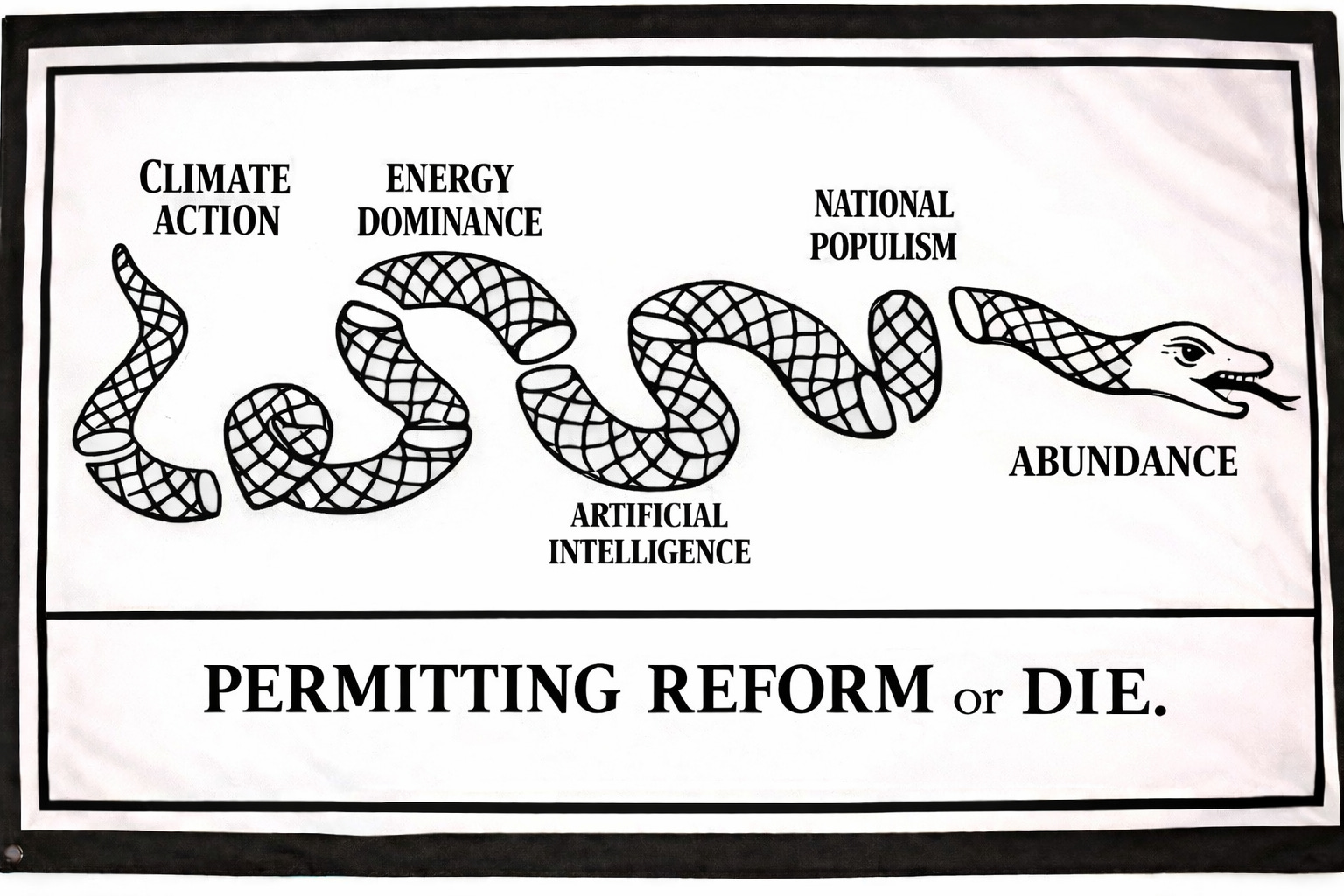
Permitting Reform or Die
The good news is that the coalitional dynamics behind environmental regulatory reform really have shifted in recent years. Streamlining NEPA and other environmental statutes makes sense whether one’s frame of reference is abundance, energy dominance, conservative populism, climate pragmatism, or national security.
The bad news is that permitting reform keeps falling short anyway. As much as members of both parties are working across the aisle to craft intelligent and practicable reform proposals, the parties at large still don’t feel the overwhelming imperative to get bipartisan legislation across the finish line. Public choice theory explains much of what’s going on here. The public doesn’t connect transmission cost allocation policy and NEPA to anything that readily improves their lives, and no President has utilized the bully pulpit to convincingly connect the dots for them. Permitting reform faces opposition from the large and well-endowed environmental movement, as well as a vocal cohort of ideologically anti-renewables influencers. The divergent electric power transmission planning priorities of liberalized versus vertically integrated utilities also complicates the negotiations. Optimizing for all operant stakeholder priorities is genuinely difficult.
But I’d argue it’s political culture, more than lobbying and logrolling, that most explains Congress’s failure to pass meaningful reform legislation. America’s two main political parties face vanishingly few incentives to legislate, or to work with each other. Raising money, advancing to higher office, and attracting media attention can all be accomplished by doing precisely the opposite—by cultivating an aura of fierce partisanship. The stubborn permitting reform deadlock may simply be the depressing inevitability that occurs when the unstoppable force of Energy Dominance meets the immovable object of the Climate Emergency.
Indeed, my lingering fear amid the pause in negotiations has not been so much that Democrats struck out a poorly considered negotiating position, but rather that they will stand their ground on a thoroughly considered political gamble. The midterms are mere months away, and the generic ballot shows Democrats as the favorites. Most analysts expect Democrats to regain a majority in the House, and taking back control of the Senate is a plausible, though unlikely, prospect as well. Democrats may yet take the advice offered by Miller, McKibben, and other progressives: to kick the can down the road until they’ve once again consolidated political power.
This would be a grave substantive and tactical error if the goal is a pragmatic, durable energy policy. Democrats who fail to work across the aisle on meaningful permitting legislation in the 119th Congress are unlikely to find willing Republican counterparts for a new round of negotiations in the 120th. The irony that the legislative obstruction on display here perfectly mirrors the delayed investment in American energy infrastructure would be bemusing if it were not legitimately tragic.
And the tragedy only deepens if Democrats are banking on total control of the federal government in 2029. Waiting until your preferred party has a political trifecta to advance energy policy reforms not only risks worsening the decay of American infrastructure, it threatens the further disintegration of America’s political and civic institutions. Congress has proven itself fully incapable of even broaching bipartisan talks on issues like immigration, education, and abortion. Until fairly recently, energy policy was a bright exception to the structural and strategic party polarization that has come to define American politics.
Our legislators need to take that seriously. To do so would compel Democrats and Republicans not only to work together to reform environmental review and judicial oversight of NEPA this year, but to work continuously, session after session, on meaningful reforms to the nation’s gauntlet of regulatory barriers to technology and infrastructure investment. The Trump administration is showing us what it feels like for one party to go it alone on permitting policy. Does this feel sustainable to anyone?
As I wrote in my most recent Dispatch column, “The fate of permitting legislation is a test, both of the “all-of-the-above” energy abundance agenda and of a civil, bipartisan politics that has come under threat in recent decades.” Failing to pass meaningful permitting reform this year would signal a harrowing rubicon in our political culture, beyond which it will become unclear whether our federal legislative branch serves much productive purpose at all.
The sensible NEPA litigation and judicial review reforms currently under consideration under the SPEED Act and related reform proposals are truly benign insofar as ALL of our energy and infrastructure projects must be engineered, constructed, and operated in compliance with all of the hundreds of environmental, health, safety and natural resource management laws passed over the last 50 years at the federal, state, local and tribal levels. And unlike NEPA, these laws and regulations impose stringent provisions for ongoing monitoring, auditing, reporting, and self-reporting of noncompliance, government inspection and enforcement, citizen suit and whistleblower authority, essentially strict liability for any noncompliance, and severe civil and criminal penalties and administrative injunction authority, liability for personal injury and natural resource damages, the full weight of administrative and judicial review, and essentially unlimited and readily available public and community access to the all of the information underlying this system. On top of this is a sea change in corporate management practices; executive accountability; engineering, procurement, process and auditing controls; insurance requirements; stewardship ethics; sustainability objectives and even gigaton scale commitments to voluntary and often profitable abatement of greenhouse gases. No wonder that proven noncompliance with such legal protections is now an extreme aberration across the US.
In the light of these well accepted and well practiced substantive, procedural, and judicial safeguards, two simple reforms would deliver the energy and infrastructure we need up the three times faster at one third the cost. First, the actual text of the NEPA statute only requires review and assessment of “presently unquantified” environmental attributes of major federal actions. So why don’t we eliminate needless duplication of effort and focus NEPA reviews on environmental matters that are not otherwise regulated or managed by another (or the same) agency under another statute. See: https://www.wsj.com/opinion/a-simple-way-to-cut-nepas-red-tape-environmental-laws-supreme-court-38e7f6fd?st=LoHZG3&reflink=article_copyURL_share. The Business Roundtable recently endorsed this approach as their number one permitting priority. https://cdn.builder.io/o/assets%2F679146658e6d45af922aa9d9409fb683%2F70a78bc4b4d147749a1e7674cfa8a166?alt=media&token=9944f841-71f1-45e9-accb-1f5db11571c2&apiKey=679146658e6d45af922aa9d9409fb683
Second, prolonged permitting is not required in the context assuring compliance with health and safety requirements. Project developers and operators are free to design, construct, and operate facilities under a strict system of monitoring, reporting, inspection, enforcement, injunction, and penalties. Our health and safety laws do not impose needless procedural delay on project development and completion. So why don’t we adopt the same approach to environmental compliance assurance and provide legislative pre-clearance at least for critical infrastructure in locations that have received federal siting (e.g. transmission, pipelines, LNG terminals) or local zoning approvals for such activities. As noted, all projects must comply with all laws. And under such an approach both project sponsors and governmental officials retain strong incentives to cooperatively consult with each other and even, in the exceptional instance, secure a permit to the extent application of a regulatory standard is unclear. There is substantial precedent for such a policy, most recently implemented through statutory waiver of advance permitting and judicial review led by President Biden for border wall construction, by Senator Schumer for chip manufacturing facilities, by Senator Manchin for pipeline construction, and by Governor Newsome for housing. A bipartisan group of former federal, state and local regulators has recommended this approach in the context of accelerated action on infrastructure addressing climate change. https://columbiaenergyexchange.libsyn.com/energy-permitting-needs-reform. That imperative is greatly amplified by the strongly bipartisan priorities of affordability, national security, energy dominance, security, and resilience, and restoration of our civilian and defense industrial base. What are we waiting for?