

Shortly before the winter holidays, the House of Representatives passed the SPEED Act, arguably the most ambitious federal permitting reform legislation to pass either house of Congress in recent years. The bill passed on a bipartisan vote, although narrowly, with 11 Democrats voting aye and 195 voting nay. (210 Republicans voted for the bill with only one Republican opposed.) As of SPEED’s passage, advocates of federal permitting reform—including those of us at the Breakthrough Institute—were anticipating companion legislation from the Senate.
Then the Trump Administration announced stop-work orders for five permitted offshore wind projects off the coast of New England, citing authority based on national security concerns, and key Democratic Senate permitting reform negotiators immediately went on strike. “The illegal attacks on fully permitted renewable energy projects must be reversed if there is to be any chance that permitting talks resume,” Senators Sheldon Whitehouse and Martin Heinrich wrote in a joint statement. “There is no path to permitting reform if this administration refuses to follow the law.”
In the short time since, the courts have reversed the stop-work orders for all five affected wind farms. But the damage was done, and Democrats have not (yet) resumed permitting negotiations.
They should.
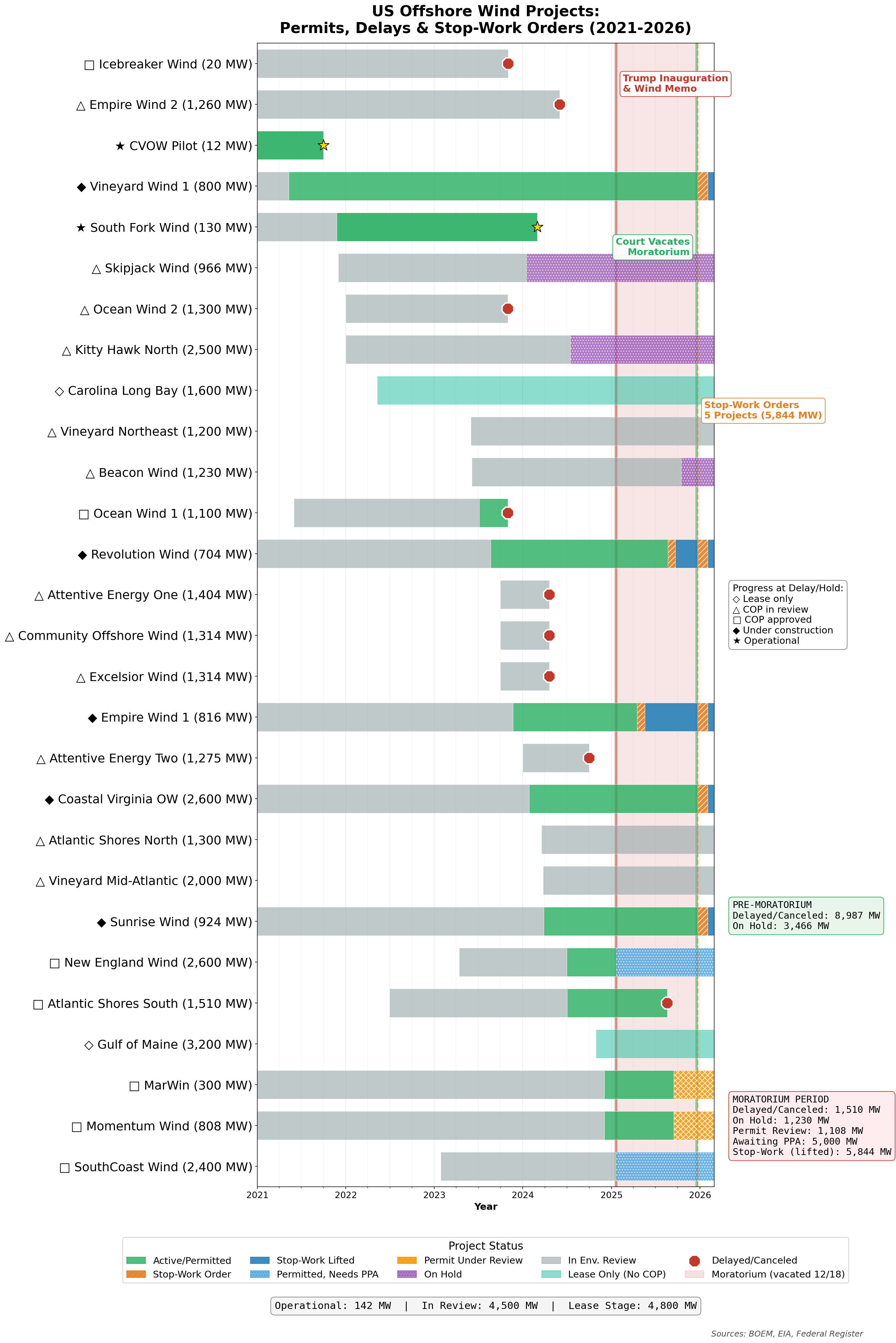
The Trump Administration’s orders were indeed troubling, as these wind projects had already been permitted and begun construction. But as brazen as Democrats may have reasonably found the Administration’s actions here, the projects are simply not worth shutting down critical national energy policy negotiations over. As the figure below illustrates, the offshore wind capacity paused by the Trump Administration is less than the capacity that was canceled or delayed for economic reasons during the Biden Administration. It has long been widely understood that NEPA meaningfully contributes to this delay, even as many Democrats defend the law’s status quo.
Of course six gigawatts of offshore wind capacity is hardly the full context here. The Departments of Energy and Interior have pursued an all-out assault on renewable energy since President Trump’s inauguration last year. In an appendix to this post, we provide a non-exhaustive account of this assault, which provides perfectly good justification for Democrat’s frustrations.
Still, it’s important to note that, despite this assault, wind and solar deployment continued during the first year of President Trump’s second term, and are expected to do so in the future:
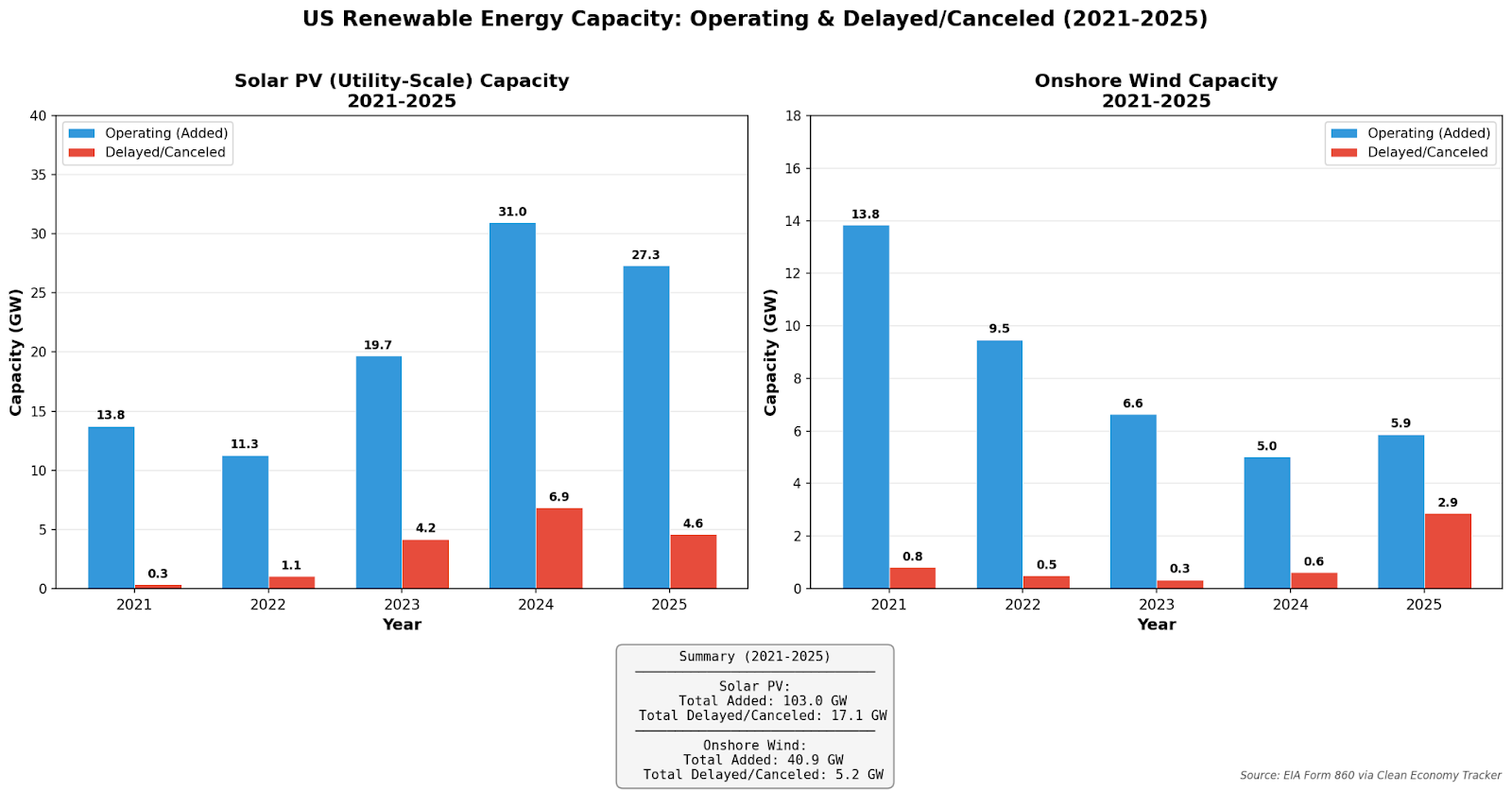
This doesn’t excuse the Interior Department’s order, but it does put them in context. The onshore wind industry added much less capacity in 2025 than in 2021, reflecting a yearslong trend of declining additions. But it’s still adding more capacity than is being cancelled. America’s solar industry, meanwhile, continues to grow healthily, with utility-scale installations reaching near-record deployment in 2025. Over the next few years deployment of solar and onshore wind are expected to decline, though not crater, as their federal tax credits expired at the end of last year. But as we wrote in our proposal to eliminate those credits, these industries are “mature, cost-competitive technologies that don’t need further subsidization.” Their continued growth, despite expiring tax credits and tribalist permitting proceduralism from the Trump Administration, is testament to that.
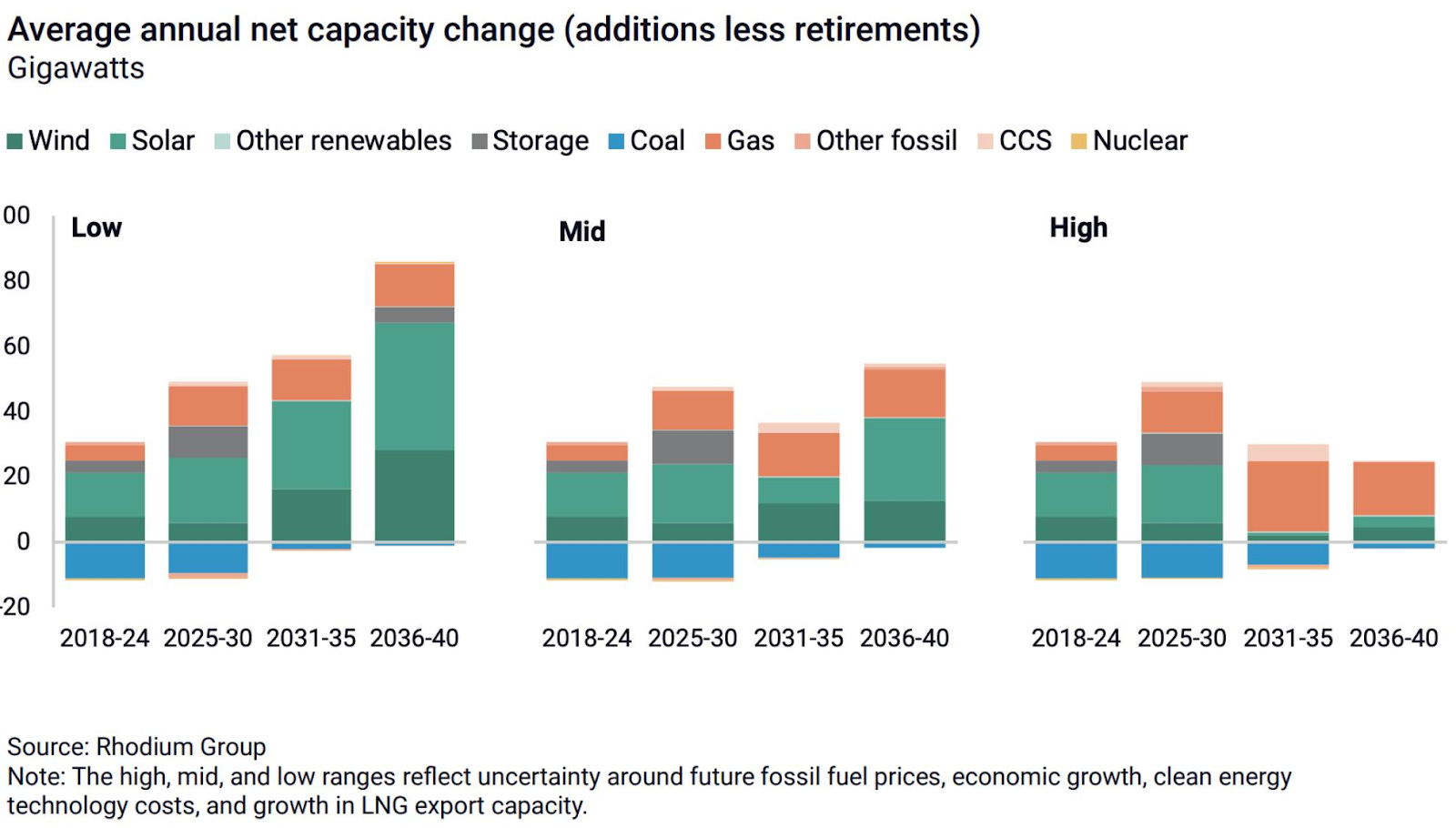
Of course, as the New York Times reported this month, even cheap solar panels and wind turbines are difficult to install in the face of the permitting “blockade” imposed by the Trump Administration. How this blockade will impact total onshore renewables deployment over the long term is hard to anticipate. There are signs the Administration is quietly walking back its procedural restrictions on new renewable energy projects. The solar and wind trade associations forecast stable growth through the end of the decade. And the independent analysts at Rhodium anticipate steadily growing deployment for the next 15 years:
Still, the prospects for these two commercially mature American industries remain murkier than in recent years given the state of federal permitting procedure today. Anecdotally, developers are reluctant to advertise cancellations or openly challenge the Administration’s permitting hurdles, casting a cloud over publicly available analyses of the market.
Offshore wind is in a different category altogether, and frankly merits less defiance from congressional Democrats. Offshore wind faced major headwinds before President Trump took office, and the five projects affected by Interior’s stop-work order were unlikely to improve the industry’s standing even if/when they’re completed.
The projects may not even be moving forward at all without renewable portfolio standards in Massachusetts, New York, Rhode Island, Connecticut, and Virginia. These subsidy programs make offshore wind more economic, but they also raise costs for ratepayers, albeit slightly, as our colleague Lauren Teixeira covered last year. Ratepayers may have been willing to bear those costs in a pre-covid, pre-inflation economic environment before load growth was driving up electricity costs around the country. But in a new era of energy affordability anxiety, it’s unlikely that new or expanded renewable portfolio standards will come to the offshore wind industry’s rescue.
What could come to the rescue is permitting reform. Modernizing the National Environmental Policy Act (NEPA) and other environmental regulatory statutes could help unlock significant investment in new electricity generation, transmission, and storage, while lowering costs by reducing the administrative and litigation burdens. Indeed, NEPA has acted as a critical obstacle to offshore wind development specifically. Especially with the “permitting certainty” provisions in proposals like ours, the CERTAIN Act, and in the newly introduced FREEDOM Act, energy and infrastructure projects that have been duly permitted would earn new protections from executive interference like that imposed by the Trump Administration, while pending projects would benefit from requirements that permits are processed in an expeditious manner.
To be clear, that interference is significant, as we detail in our appendix. But passing durable, bipartisan permitting reform is a response to the Administration’s energy policies, not a surrender to them. Democrats would be cutting off their nose to spite their face by balking at this opportunity.