

A few years ago, I wrote about a particular class of clean energy advocates who I described as “not anti-nuclear but.” The true face of the anti-nuclear movement, I argued, is not “hair-shirt wearing opponents of progress” but rather “a highly credentialed progressive policy wonk, a lawyer, or, academic, or journalist, who often claims not to be opposed to nuclear energy at all.”
Five years later, that cohort of barely disguised opponents has largely been defeated. Even NRDC now supports reopening shuttered nuclear reactors.
Instead, the biggest challenge the nuclear sector faces today, in my view, comes from within. The “pro-nuclear but” camp is genuinely pro-nuclear but typically argues for policy and technology that represent little change from the status quo that has been responsible for a generation of decline and stagnation—reactors that no one has been willing to build and regulations that have stifled innovation.
In the sections that follow, I run through five common “pro-nuclear but” claims: that advanced reactors are too exotic and unproven; that economies of scale mean that small modular reactors will never be cheaper than large reactors; that serious regulatory reform isn’t important and undermines safety and public confidence; that enriched fuels significantly increase proliferation risk; and, that doubling down on public engagement proceduralism is the key to assuring social license to build new reactors.
I’ve written about some of these claims in the past. They often overlap and there is a grain of truth in each of them. But each claim in one way or another mistakes highly contingent technological, economic, and political developments from the last century as intrinsic to nuclear energy and its future. Taken together, they reflect not a hard headed pragmatism about the technology but a self-fulfilling prophecy, one that risks dooming the sector to stagnation and obsolescence at a moment of unprecedented opportunity.
Myth #1: The Paper Reactor Problem
If you’ve followed nuclear energy over the last 15 years or so, you have almost certainly come across Admiral Rickover’s famous observation about paper reactors:
An academic reactor or reactor plant almost always has the following basic characteristics:1) It is simple. 2) It is small. 3) It is cheap. 4) It is light. 5) It can be built very quickly. 6) It is very flexible in purpose (“omnibus reactor”) 7) Very little development is required. 8) It will use mostly “off-the-shelf” components. 9) The reactor is in the study phase. It is not being built now.
On the other hand, a practical reactor plant can be distinguished by the following characteristics: 1) It is being built now. 2) It is behind schedule. 3) It is requiring an immense amount of development on apparently trivial items. 4) Corrosion, in particular, is a problem. 5) It is very expensive. 6) It takes a long time to build because of the engineering development problems. 7) It is large. 8) It is heavy. 9) It is complicated.
These days, the quotation is almost always used to raise skepticism about small, advanced reactors in contrast to proven technology, namely large light water reactors. But the characteristics that Rickover described don’t cleave nearly as neatly as people who invoke the quote imagine. The only reactors currently being built now in the United States are, in fact, small advanced reactors, two Kairos Hermes reactors in Tennessee and the TerraPower Natrium reactor in Wyoming, along with a half dozen or so demonstration reactors as part of the Department of Energy’s Reactor Pilot Program at Idaho National Laboratory. Several are behind schedule. All, as first-of-a-kind reactors, will be expensive.
First-of-a-kind small advanced reactors will surely face many of the problems that Rickover described above. Non-light water reactors had exactly these sorts of issues in the 60’s and 70’s when they were demonstrated by government laboratories and very occasionally commercialized. Sodium coolants leaked and caught fire. Steel alloys and other materials became embrittled by high neutron flux fast reactors. Corrosion, in particular, was a problem. First-of-a-kind commercial reactors were expensive to build and operate and were frequently down for repairs and maintenance. This history has been the foundation for much contemporary skepticism toward advanced reactors.
But these problems are, ironically, the characteristics in Rickover’s telling of practical reactors, not academic reactors. Back in the 60s and 70s, the US was building lots of conventional nuclear plants at competitive cost that featured proven technology and well developed supply chains, so there was little reason to push through the first of kind and supply chain challenges necessary to get non-light water reactors to market. But that is not the case today. A range of institutional and economic changes have made it far more difficult to build large light-water reactors at competitive costs in advanced developed economies. And there is ample reason to believe that fifty years of progress in materials science, computation, and design will help advanced reactor developers solve many of the problems that plagued early advanced reactor designs in the post-war era.
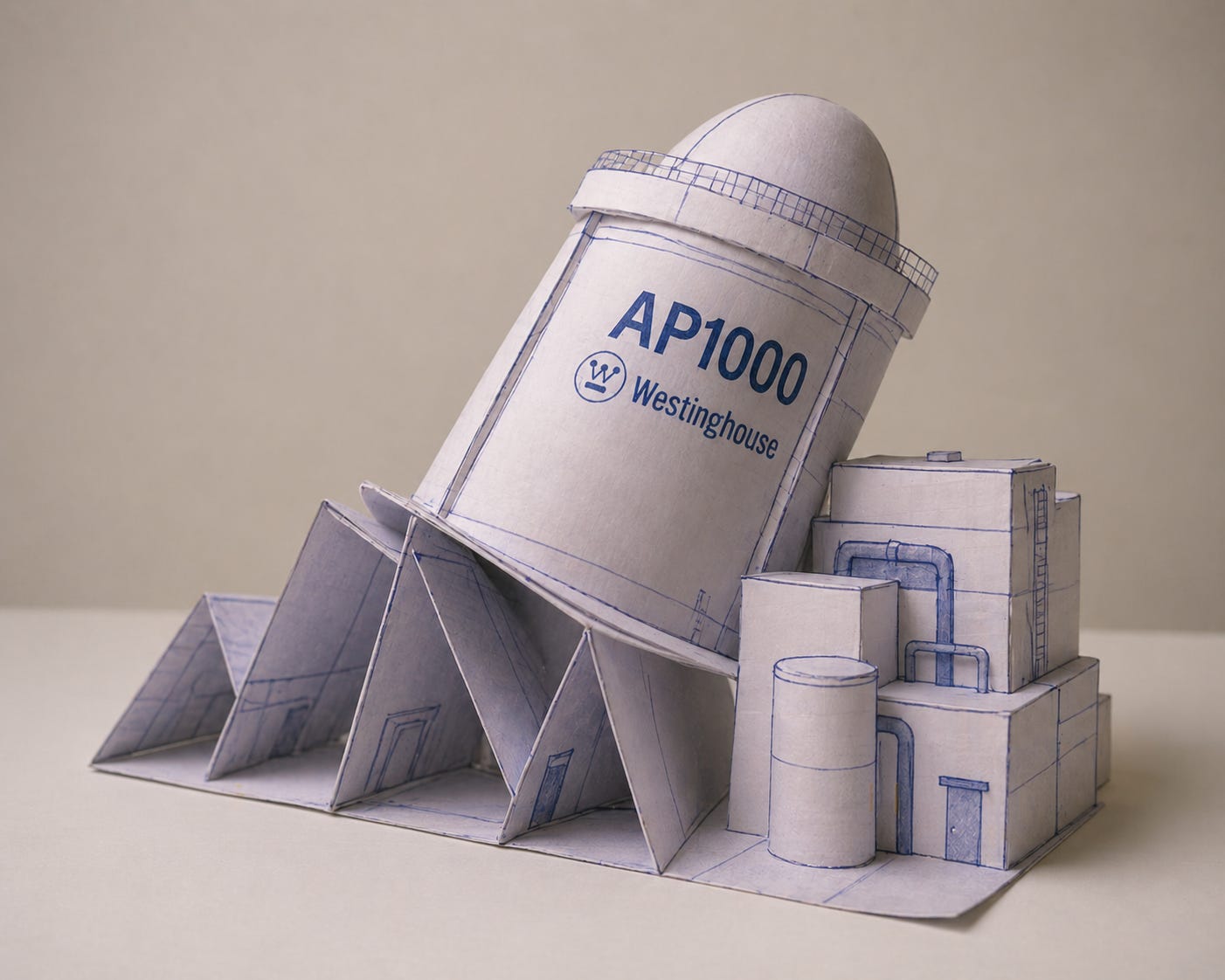
For at least the last five years, meanwhile, breathless reports that the next AP1000 build was imminent have come to naught, despite a Trump executive order calling for 10 new reactors under construction by 2030. Unable to convince domestic parties to take on the risk, the administration appears to be considering switching horses, dropping the AP1000 and acquiescing to using Korean or Japanese technologies and firms to get large reactor projects underway in the US.
So while it is true that the AP1000, thanks to the completion of two reactors in Georgia in 2024, are proven technology, there is very little reason to think, despite many proponents’ claims, that the next one will be built quickly or cheaply. Rather, it appears unlikely that any site, other than the unfinished AP1000 build that was abandoned in South Carolina in 2017, will begin construction before 2030.
Many boosters have also claimed that the next build might be as much as 30% cheaper than the Georgia plants. But recent estimates by both Duke Energy and TVA project that the next AP1000 build will cost more than the first two plants in Georgia. TVA projects that an AP1000 will cost the same as the first of four planned GE BWRX300 units, with subsequent builds seeing substantial further cost declines. Cheapest of all, in TVA’s analysis, is the Terrapower Natrium reactor which it projects will cost about two-thirds as much as an AP1000.
Besides the two plants at Vogtle, the only AP1000s ever completed are in China, which did so at costs that the West is unlikely to replicate and has since significantly changed the design for future builds. The much hyped Fermi project, which planned to build four AP1000s to power its President Donald J. Trump Advanced Energy and Intelligence Campus, is, as Robert Bryce wrote last week, imploding. With every day that passes since the completion of the Vogtle reactors in 2024, the AP1000 looks more like a paper reactor and less like a practical one.
Myth #2: Economies of Scale Are the Coin of the Nuclear Realm
Back in the 60s and 70s, the size of light-water reactors increased from demonstration reactors that clocked in around 600MW, to 800MW commercial reactors, and then upwards of 1GW. Size, it turned out, really mattered for light-water reactors. As reactors got larger, the cost per MW to build and operate them declined, at least until the mid-70s, when rising commodity and labor costs, high interest rates, and overregulation saw nuclear costs escalate significantly. That’s because a 600MW reactor requires much the same infrastructure, security, and operating staff as a 1200MW reactor.
This basic dynamic should mostly apply to small light-water designs as well. For somewhat different reasons, both NuScale’s VOYGR reactor and GE’s BWRX300 reactor require substantially more concrete and steel per MW of capacity than an AP1000. Small light-water reactors also still require a significant exclusion zone, a well-staffed control room, and much the same infrastructure as a large light-water reactor.
But that assumption does not necessarily apply to many other reactor types. Given the larger safety margins and lower likelihood and consequences of worst case accidents, many small advanced designs can be much more lightly staffed or remotely operated. The exclusion zone is often the plant wall or the fence line. Security needs are less extensive and fewer moving parts and redundant safety systems mean much reduced maintenance, infrastructure, and staffing.
We won’t really know what these reactors will cost until some of these first-of-a-kind non-light water reactors are built. In contrast to light water reactor costs, which have a well established cost structure and significant data to base estimates of future costs upon, non-light water reactor costs, in both structure and particulars, are far less certain. A comprehensive literature review and engineering analysis led by Idaho National Laboratory concluded recently that while cost estimates for non-light water reactors were highly uncertain, the best estimates provide little basis for the claim that non-light water SMRs will cost more than conventional large light-water reactors.
And while it is true that all else equal, a larger reactor will generally cost less per MW to build and operate than a small reactor, all else is almost never equal. Whether light water or something else, large reactors have proven virtually impossible to build in liberalized electricity markets, which dominate in the US and most other developed economies. As Adam Stein and I noted in the fall of 2024, site availability, in the short and medium term, significantly limits opportunities to build large reactors in large enough numbers that we might get good at doing it again. Meanwhile, smaller reactors, simpler builds, and much reduced unit costs mean that economies of multiples, process innovation, manufacturing, and simplified supply chains have much greater potential to drive costs down for small, non-light water technologies.
I don’t write any of this to suggest that we should give up on the AP1000 or that economies of scale never matter. The AP1000 is a wondrous technology. It would be great if we could figure out how to get some more of them built in the US. But the logic of the small, advanced reactor appears, at the moment at least, to be winning the day in the real world. Billions of dollars in private investment have flowed into dozens of next generation startups, orders from hyperscalers, big tech, and industrial users are growing, and real “practical” reactors are actually under construction, suggesting that legacy light-water technology and large reactors may not, in fact, turn out to be the future of nuclear.
Myth #3: Far Reaching Regulatory Reform Is Unnecessary, Compromises Safety, and Risks Public Confidence in Nuclear Energy.
If you’d been a fly on the wall as Congress was debating passage of the ADVANCE Act back in 2024, you would have heard a lot of erstwhile nuclear advocates insisting that a key provision directing the NRC to modernize its mission statement to account for the benefits of nuclear energy was at best a distraction and at worst would compromise nuclear safety.
Some said it publicly. Others privately. Yet, today, you will be hard pressed to find any nuclear advocate still skeptical of that change. Some have publicly reversed course. Others simply took credit for it after the fact.
That’s because barely a year after the NRC revised its mission statement, the impact of the reset is already clear. Congressionally mandated action to modernize NRC licensing for a new generation of reactors had dragged along without resolution for over five years prior to the agency’s mission statement revision. In the year since, the NRC has both finalized the Part 53 licensing framework mandated by Congress in 2019 and revised its entire regulatory code pursuant to Executive Order 14300. The NRC approved TerraPower’s construction permit, NuScale’s uprated license amendment, and Kairos Hermes 2 license ahead of schedule.
The new mission statement, alone, can’t take credit for this. President Trump replaced and then removed the former chair of the commission, issued Executive Order 14300, and used DOGE and other sources of executive power to force the NRC to move much faster on reform. The mission statement was part of a much broader culture shift that has ramified throughout the agency and far beyond.
But the dramatic change in the pace of rulemaking and license approvals is good evidence of just how conservative, arbitrary, and lacking in urgency much of the agency’s regulatory practices actually were. The memory-holing of all the arguments made against the mission statement requirements in the ADVANCE Act prior to its passage, meanwhile, suggest that there was never much basis to them in the first place.
And yet, many of the same parties are now making almost exactly the same arguments in opposition to current proposals to eliminate ALARA, abolish or significantly limit the use and misuse of LNT, raise maximum public radiation dose limits, and license demonstration reactors through DOE. As with mission modernization, these “pro-nuclear but” advocates claim that they are unnecessary because both conventional and advanced reactors are already able to meet the old standards. They say that raising regulatory thresholds increases the risk of accidents and that even if new rules and standards don’t materially increase public health risk, they will undermine public confidence in nuclear regulation.
I have written recently about these claims and won’t go into too much detail here. Suffice to say that as with the claims that were made about mission modernization, there is little by way of an actual mechanism that critics will stipulate for how these changes would lead to negative consequences. Raising the public radiological dose limit, for instance, from 100 millirem to 500 millirem, might seem to portend significant public health consequences until you realize that both doses are well over an order of magnitude below exposures at which an increase in cancer incidence could conceivably be observed.
The argument that changing these standards won’t matter because current and proposed reactors already meet more stringent standards, meanwhile, asserts, with little basis, that design decisions that have been informed by the current standards and regulatory norms would be the same under a different regulatory regime. As with claims about the technical issues and economics of scale that challenge small, advanced reactors, this argument is strongly anchored in the current regulatory and technological status quo, which tells us nothing about what future developers might do under different policies.
Finally, the chestnut that these changes risk undermining public confidence both misunderstands the nature of public opinion and is fundamentally incompatible with any sort of risk informed regulation. If public fear of radiation exposure is both highly irrational and irrationally high, after all, then all risk informing of regulation definitionally undermines public confidence. To the contrary, what has become clear over the last year, as regulatory reform has shifted from talking point to reality, is that it is possible to license and regulate nuclear energy far more flexibly and expeditiously without compromising safety or provoking a public outcry.
Myth #4: Advanced Reactors and Enriched Fuels Increase Proliferation Risk
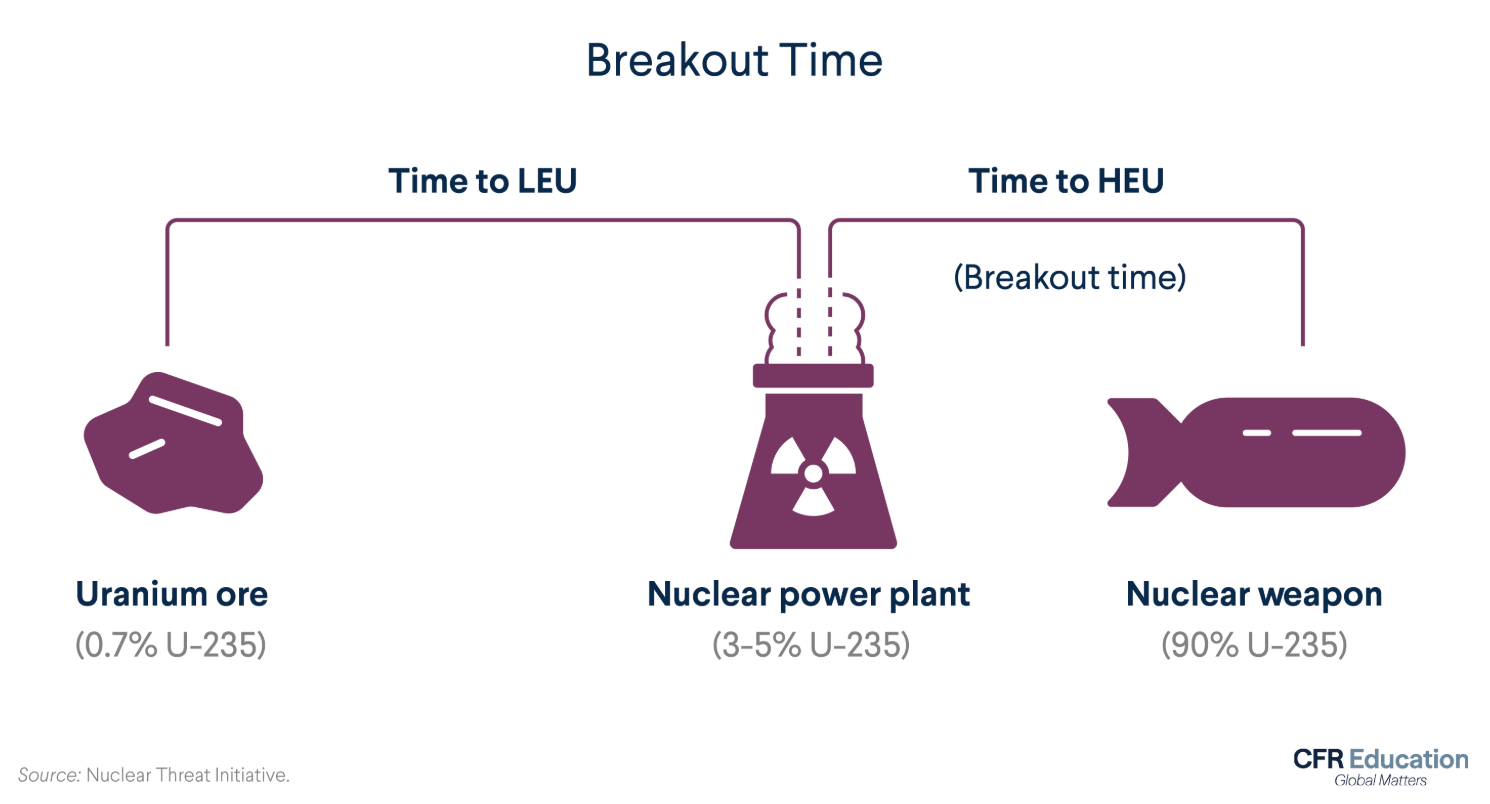
If you are not deeply enmeshed in nuclear policy and technology, you might think that the distinction between low enriched uranium (LEU) and high assay low enriched uranium (HALEU) is arcane. With regard to the importance of these different fuel types to different sorts of reactors, the distinction is anything but. Most advanced reactor technologies require the latter, which is typically enriched to just below 20% U235 content, versus LEU which is typically enriched to 4-6% and is sufficient to power conventional reactors.
But when it comes to proliferation risk, the distinction is indeed arcane and largely irrelevant. Neither 4% enriched uranium nor 20% enriched uranium is remotely sufficient to make a fissionable weapon. The case against HALEU is that it takes a lot less additional enrichment to turn 20% enriched uranium into weapons grade uranium with over 90% U235 content than it does to turn LEU into weapons grade material. But the key thing that determines whether you can make weapons grade material is not whether you start with LEU or HALEU but whether you have the enrichment capacity to make LEU in the first place. The process and technology for enriching a decent grade of uranium ore from 0.6% U235 to 4 or 6% is exactly the same as what is required to enrich LEU from 6% to 18 or 20% which is the same that is necessary to enrich HALEU from 20% to weapons grade at 90%. It’s just centrifuges, lots of them, spinning up the U235 concentration in the fuel.
Once you have sufficient enrichment capacity to increase the concentration of U235 from .06% in uranium ore to 6% in LEU, you already have all the enrichment capacity and technical capability you need to make weapons grade fuel. HALEU is just a step along that path, and not a particularly significant one. Time to breakout is somewhat shorter if you start with HALEU rather than LEU. But any actor that has stockpiled significant LEU has ample enrichment capacity to get from there to weapons grade material in short order.
What makes producing weapons grade uranium difficult is not procuring uranium ore or centrifuges but hiding the effort from prying international eyes. Sanctions, technology restrictions, and other disincentives to weapons proliferation make nuclear weapons development an unattractive enterprise for all but the most determined state actors. States that are determined to do so will generally, sooner or later, succeed. But the existence of civilian nuclear energy and enrichment capabilities is not correlated significantly with weapons development.
Nonetheless, it has been an article of faith within the non-proliferation community for decades that HALEU production ought to be discouraged, a posture that continues to this day. And while few proliferation experts today outright oppose HALEU reactors and fuel, the basic heuristic is that more enrichment capacity and more enriched fuels are bad even though, in many contexts, lower enriched fuels and technology can be faster and easier pathways to weapons grade material. LEU used in light water reactors, for instance, produces spent fuel with higher plutonium levels than HALEU in most advanced reactors. A CANDU reactor produces similar levels of plutonium from natural uranium with no enrichment at all.
Nonetheless, general preference within the non-proliferation community has been for large light-water reactors using LEU with a once-through fuel cycle that forgoes reprocessing. Once all the caveats and safeguards for HALEU fuel production and reactors that many non-proliferation experts insist upon are accounted for, there is little likelihood that HALEU-based technologies will prove scalable.
Myth #5: Consent-Based Siting Holds the Key to Community Acceptance of Nuclear Facilities
For much of the last generation, the shadow of the failed Yucca Mountain nuclear waste repository has loomed over nuclear politics and policy. Nevada Senator Harry Reid’s long tenure as leader of Senate Democrats resulted in the issue dominating Democratic policy priorities at both the NRC and DOE. Opposition to Yucca, along with sustained fights to prevent the completion of the Shoreham plants in New York and Seabrook in New Hampshire, were taken as evidence that local NIMBY resistance was at the core of failed efforts to site and build nuclear facilities around the country.
In response to this diagnosis, the notion of consent-based siting has gained support among many nuclear advocates. If the problem is that nuclear plants and waste facilities are being forced upon communities that don’t want them, then the answer is to find communities that want them. Better yet, do even more community and public engagement before choosing sites, and offer lots of special, legally binding, community benefits, so more communities will want those facilities.
But while there is nothing wrong with consent based siting in theory, most proposed nuclear facilities actually have significant community consent. As Breakthrough’s Adam Stein recently wrote, in the case of proposed waste facilities, the communities where they have been proposed have strongly supported these facilities. Even Yucca Mountain had significant local support.
The opposition to these facilities, rather, typically comes from further afield. State officials, the city of Las Vegas (150 miles away), and national environmental groups were the main opponents of Yucca Mountain. Opposition to temporary waste storage facilities in Texas and New Mexico has been similarly composed.
The problem has not been local NIMBYs who don’t want these facilities in their communities but state officials whose incentives are more often to pander to larger constituencies in population centers that see no direct benefit from these facilities finding common cause with ideological opponents who often have little connection to the communities in question whatsoever. Recent proposals in this vein, such as the proposed Office of Public Engagement at the NRC, would almost assuredly make the situation worse, basically paying environmental justice and similar activist groups with little actual presence in local communities to show up and obstruct nuclear projects and demand community benefits that no one locally is asking for.
In reality, many communities are competing for new nuclear facilities. Four towns in Wyoming all campaigned to be the site of the first TerraPower reactor. As Stein notes, the Department of Energy’s proposed Innovation Hub approach, which packages long-term waste storage with reprocessing, advanced reactor demonstration, and other opportunities that position these hubs as centers for innovation around cutting edge energy technologies has potentially flipped the script. Twenty-eight states have indicated interest in hosting hubs. Combining local and state incentives, and supporting local communities that want them, has far greater potential to build broad stakeholder support for nuclear facilities than pouring more public engagement resources into communities that have not been the source of resistance to those facilities and typically have wanted them.
Nuclear for the 21st Century
As I noted at the beginning of this post, none of these claims are necessarily wrong. It is possible that non-light water reactor technology will prove as difficult to tame as it was fifty years ago. If that proves to be the case, large reactors may well continue to be the nuclear technology of choice, regulatory reform to allow for different technological pathways and innovation will be less essential, there will be little need for HALEU fuels, and the number and diversity of siting contexts and use cases for new nuclear infrastructure will be greatly simplified. But the applicability of each of these erstwhile conditions and constraints to the future of nuclear energy is every bit as contingent as the histories from which they are drawn.
And while I don’t doubt the sincerity of many who make these claims, there are other reasons why so much of the nuclear advocacy community continues to fight the last century’s wars. For a lot of nuclear insiders, the nuclear they know is the basis of their expertise and status within the community. For many generalists without deep knowledge of either the technology or its history, the “pro-nuclear but” posture is a way to signal that they are serious people, not wild-eyed “nuclear bros”. And for a lot of left-of-center nuclear advocates, “pro-nuclear but” helps resolve the cognitive dissonance between their (not unreasonable) conviction that “the Orange Man is bad” and the reality that the Trump administration has proven far more effective at accelerating nuclear innovation, regulatory reform, and commercialization than Biden-era Democrats.
At a moment when power demand, AI economics, global energy supply shocks, climate concerns, and a huge shift in public opinion about nuclear have created possibilities for the technology that have not existed since the dawn of the nuclear era, the effort to downselect nuclear’s future to a post-industrial simulacrum of its 20th century past has real policy consequences.
In order to convince utilities and state regulators to sign up for new large reactors, for instance, legislation is now proposed to establish federal cost-overrun insurance, which seems as likely to incentivize cost overruns as spark a renaissance in large light water reactors. The NRC’s regulatory reform efforts, to take another example, have stopped short of establishing a clear and consistent numerical standard for reactor safety in the face of criticism from various “pro-nuclear but” quarters.
Much of the nuclear advocacy community, meanwhile, has failed to substantively engage the NRC as it has embarked upon a soup to nuts revision of its entire regulatory code. Licensing barriers and ambivalence at the Department of Energy has delayed congressionally mandated establishment of a HALEU fuel bank. And while climate and clean tech philanthropy has underwritten much of the academic discussion around consent-based siting, there has been little support for state based nuclear advocates, the kind of people who might actually show up at a local meeting to support a proposed nuclear project.
To be clear, there is much to be said for leaning into strategies that have worked in the past. But that heuristic doesn’t offer much guidance for nuclear energy. The assumptions, norms, institutions, practices, and technologies that characterized the sector over the last fifty years bear significant responsibility for its decline. That’s why the civil society pro-nuclear movement that has so transformed the political and policy landscape around nuclear energy over the last fifteen years had to be launched by outsiders who were willing to question those assumptions and norms. As that effort gained momentum, it was too often captured by the old nuclear priesthood and its many conventional wisdoms. A better future for nuclear energy will almost certainly require something different.
Excellent explanation! What a tangled forest the path to develop technology is through the ideas, paradigms, impressions, geopoliticals, politicos and bureaus. No affordable at the scale needed reactor exists, vessel size, coolant type or fuel cycle, which means technology development is mandatory for all variants. Deployment of any variant without significant technical, construction, logistic, deregulation and integration development will guarantee repeated failure and prohibitive cost.
Great post. This nuclear renaissance is likely to deliver solutions that are not yet evident, and will suprise to the upside. Energy demand has tightened focus and unleashed innovation. There is no way humanity in general, or venture capitalists specifically are going to leave the density of uranium, thorium and their manufactured cousins (plutonium and U-233) on the shelf.