

Despite the apparent decline in interest in climate change over the past few years, many advocates still think the public and elites will be shocked back into a state of eco-alarm by some portentous disaster. As Jadzia Tedeschi put it for the Climate Majority Project recently, “We’ve only just crossed the tipping point. What comes next will be of a different order.”
What Jason Mark’s new book presupposes is: what if it isn’t?
In The Earth Said Remember Me, Mark, a longtime environmental journalist, considers the subject of “shifting baseline syndrome.” The term was coined by a scientist in the 1990s who described how multi-generational declines in fishing stocks could be missed by official counts that only included evidence from the most recent catches.
As Mark generalizes the concept:
Each of us have our baseline expectations—usually forged in youth—for how the world is supposed to work, how it’s supposed to look. Then the world morphs and the baseline shifts. But either we forget how the world originally appeared, or else a new generation comes along and establishes a whole new baseline based on the conditions of its youth.
Mark’s interests have always resided mostly outside the global tipping points, emissions policy, and climate marches that saturate environmental writing these days. As much as he’s reported on these subjects, I’ve most often encountered his dispatches as a more classical nature writer. The author of 2015’s excellent Satellites in the High Country and meditative essays on humanity’s relationship with animal life and the experience of working on landscapes altered by global warming, he has long excelled at a more outdoorsy, tactile, gardener’s practice of environmental journalism.
The Earth Said Remember Me is in keeping with this practice, a field guide to ecosystem degradation and humanity’s alienation from our neighbors on Planet Earth. And as I read the book, I thought that his subject was not so much shifting baseline syndrome as what we ecomodernists might call “decoupling syndrome.”
As modern humans have destroyed, detached, and otherwise decoupled from dependence and impact on the natural world, we have become structurally better off as a species while less connected to most other species. Post-industrial environmental philosophy, from Thoreau to Muir to Carson to McKibben, is largely a reaction to this alienation, to what humanity loses even as we reduce our ecological footprint.
Restoring what’s lost, Mark’s reporting suggests, is not a task for after the apocalypse, but the constant, chronic responsibility of humanity.
Decoupling from Nature
Shifting baseline syndrome, though, is real, and is one reason that I have come to doubt that any kind of “climate wake-up call” will mobilize the mass public to demand sweeping climate action.
It’s true and tragic, for instance, that wildfire smoke has become viscerally worse in the last decade, not just where I live on the foothills of overgrown temperate forests of the American West, but also in the Midwest and Eastern Seaboard far downwind from relatively pristine Canadian boreal forests. But for better or worse, the smoke becomes an expected, if still infrequent and unpredictable, nuisance in the fabric of public life. There are no climate lockdowns analogous to the covid pandemic, not least because even a comprehensive authoritarian ban on fossil fuel consumption would have little noticeable effect on wildfires, or other extreme weather for that matter.
And that’s the main reason I don’t think the climate wake-up call will ever arrive. Conspicuous events like this summer’s wildfires and heatwaves notwithstanding, the general trend in extreme weather and natural disasters is one of stability. The frequency and intensity of hurricanes, tornadoes, flooding, and drought have not increased for decades, as Roger Pielke, Jr. illustrates in a new dashboard synthesizing official data for all kinds of natural disasters in the United States. And the human cost of these disasters is, if anything, declining, as wealthier populations become more resilient to the Earth’s climate over time. Our climate baseline just isn’t shifting that rapidly.
What is shifting is the rest of nature.
As Linus Blomqvist put it in Breakthrough’s seminal conservation report Nature Unbound, “Human success has come at the expense of non-human life.” Both by warming the biosphere and encroaching on forests, deserts, grasslands, and marine ecosystems, humans have decimated wildlife populations in the Industrial Era. The World Wildlife Fund estimates an average 73% decline between 1970 and 2020 in its Living Planet Index, which tracks roughly 35,000 vertebrate populations across nearly 5,500 species of fish, mammals, birds, amphibians, and reptiles. About half of the world’s coral reefs have disappeared since 1950. Humans now use about half the ice-free land on Earth, having transformed many ecologies, mainly with cropland and grazing lands, and fragmented many more.
But for the same reason that human societies have become less vulnerable to climate impacts, we are arguably less vulnerable to these ecological losses than we once were.
For one thing, a decreasing quotient of us actually lives near anything like the natural world. As of last decade, over half of the world’s population lives in cities, a figure that is expected to approach 80% by the end of the century. As one of these billions of urban dwellers, I get my fair share of exposure to nature, in my excursions in the Bay Area’s periurban trails and my ventures to California’s more remote mountains, deserts, and grasslands—but only because I want to. These experiences with wild(ish) nature are recreational, not regular; experiential, not vocational.
So while our ancestors may have relied on nearby rivers for freshwater, wild game for protein, and natural pollinators for agriculture, humans today increasingly use extensive hydrological engineering and treatment for urban water supplies, “factory farms” of domesticated livestock for protein, and commercially managed honey bees for industrial-scale crop pollination. Modern societies are simply less dependent on ecosystem services, renewable flows of energy and nutrients, and even just the basic existence of other species for our material well-being.
Go Outside
It’s on these systems—the shifting and morphing webs of Earth’s plant and animal life—that Mark focuses in his book. And that’s why, sad and contemplative as the experience of reading it was, I came away from it inspired, not demoralized.
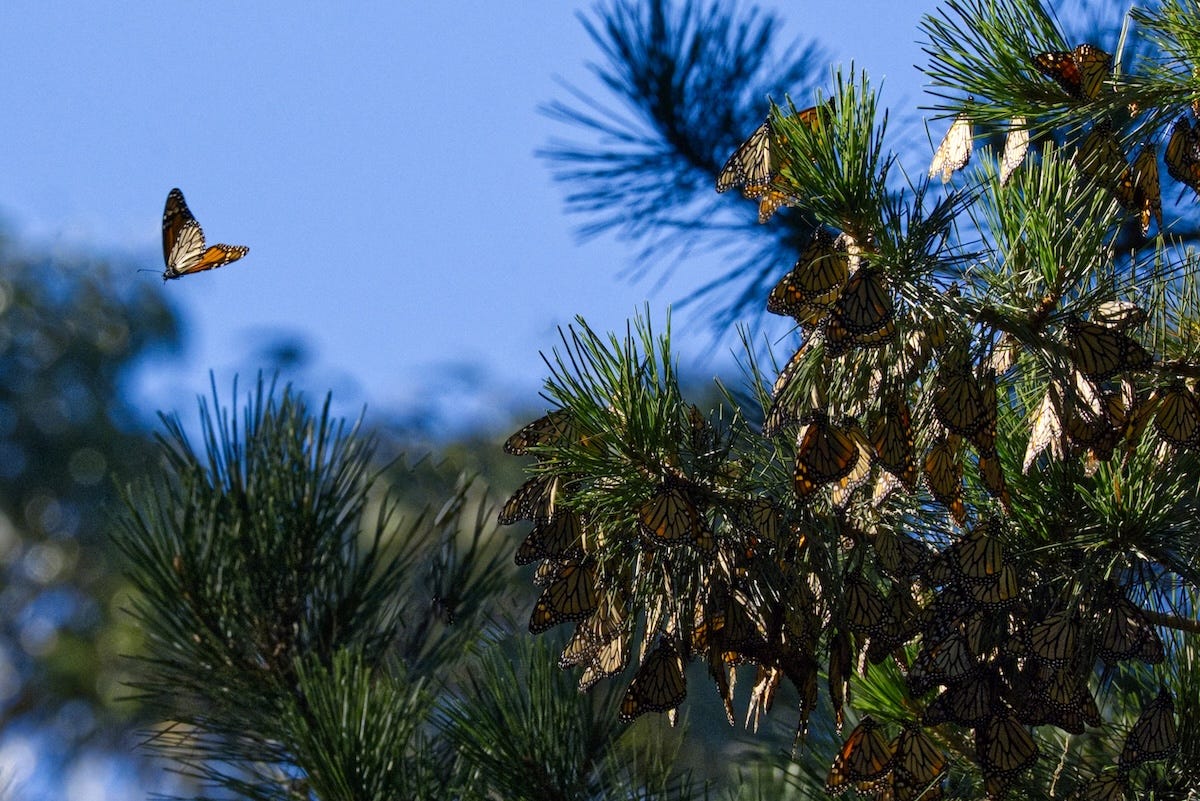
In a genre beset with abstractions about tipping points and hypothetical disasters that will magically fix our environmental politics, Mark offers a more prosaic, journalistic account of global ecological change, and how to confront it. In his reporting on attempts to resuscitate monarch butterfly populations in Northern California, or the Lummi Nation’s efforts to restore wild salmon abundance in Cascadia, Mark observes how humans today actually interact with and work to shape their local wildlife—whether for its existence value as with the monarchs, or its sustenance value in the case of the salmon, or, most often, a mix of both.
And while Mark uses these case studies to depict shifting baseline syndrome—the extent to which today’s wildlife enthusiasts can’t even know what they’re missing—the deeper undercurrent of his book, I would argue, is ecological decoupling.
We most often use the concept of decoupling to capture the growing gap between empirical measures of human well-being and environmental impact. GDP is increasing while carbon emissions decline: classic decoupling.
But decoupling also describes the process by which modern human societies rely less on ecological sources of wealth and well-being, and more on engineered or synthetic resources. We don’t need firewood to heat our homes if we have electric heating. We don’t need to deplete wild fish stocks if we have aquaculture. We don’t need to harvest fats and oils from whales if we have petroleum-based alternatives.
And it’s this form of decoupling, the long modern arc from rural subsistence to high-tech urbanity, that overwhelmingly accounts for the alienation from the natural world that Mark laments. Most Americans, and increasingly most humans, simply don’t need, for their immediate health and well-being, to be aware of local wildlife counts, or wild fish harvests. To the extent these empirics show up meaningfully in the typical person’s live experiences, it’s through many layers of social and technological mediation.
Mark offers a framework for bridging these layers, and for overcoming shifting baseline syndrome:
Go outside.
Bear witness.
Make a record.
Pass it on.
This is also a recipe, I think, for resisting the alienation caused by our decoupling from nature. In fact I’d go so far as to argue that exploring and experiencing nature directly are the very best ideas in environmentalism, a philosophy that erred in connecting our tactile and complex ecophilia to a more global, flattening policy agenda demarcated by global average surface temperature and parts per million. The supposition of modern environmental risk, after all, is that violating global biophysical boundaries will cause global ecological systems to collapse. This abstract scientism contrasts sharply with the corporeal, meliorist ecological activism on display in Mark’s reportage.
“In my life I’ve watched the gray whale return and the peregrine falcon and the otter,” Mark quotes one Mia Monroe, co-founder of the Western Monarch Count. “I don’t know what’s ahead for monarchs. But I do know that when people realized there was a problem, and we did something different, then nature responded.”
Mark includes dozens of such sentiments throughout the book, not to warn of impending and irreversible collapse, but to implore his readers to choose to care about nature, and to tend to it. As Emma Marris wrote in her own meditation on decoupling, “If we use up nature, we will be miserable. If we wall ourselves off from nature, we will be miserable. The path to joy is to allow nonhuman nature to thrive by reducing our demands upon it, while loving ourselves enough to allow ourselves to remain within it.”
Remembering and Restoring
“What if that Pearl Harbor moment never comes to pass?” writes Mark. “What if the alarm bells announcing the asteroid keep blaring until they fade into white noise?”
This simple provocation (mixed metaphors and all) goes somewhere that many environmental writers aren’t willing to venture. Having mused on the white noise of the climate apocalypse myself, I’m drawn to Mark’s diagnosis of a chronic condition most often misunderstood as terminal. In describing even devastating ecological loss, Mark portrays a natural world in constant change, rather than a step-wise shift from the pristine to the apocalyptic. Our task is not to stop the baseline from shifting, he suggests, but to remember the Earth that existed before our time, to save and restore what we can, and to shape the Earth our children will enjoy.
Great perspective! That said, I want to encourage you to not repeat the WWF's Living Planet Index claims of 70+% loss of wildlife. They use an unusual averaging technique that heavily biases the measure. Small pockets of catastrophic losses disproportionately affect the metric, completely overwhelming the large majority of stable populations. It's used within biodiversity like RCP8.5 in the climate change world.
Nice article. Just one thought to lob into the conversation: baseline shifting also works in both directions. Since the environmental movement began, many (most?) metrics of environmental health have moved toward improvement. Air pollution, water pollution, acid rain, chemical exposure, etc. have all amerliorated, at least on a global basis. How bad it was (the old baseline) has been forgotten. For me it is a point of optimism that while human presence has had massive impacts on nature, it has also been able to make changes and incorporate solutions that mitigate or even reverse problems.