

Catastrophic flooding after the collapse of a Himalayan glacier kills thousands. Record heat across western Europe results in excess mortality in the tens of thousands. Raging wildfires in France and Spain spark large scale evacuations. Wildfires in Canada’s boreal forests spread smoke and particulate air pollution across the eastern seaboard.
The common thread across these disparate geographies and events this summer is that all of them plausibly implicate climate change. Hotter and longer heat waves are arguably the most predictable and detectable consequences of a warming climate and western Europe has experienced more warming than any other heavily populated region of the world. Glacial collapse is a feature of a warming climate. Hotter and drier weather, all else equal, really does increase the likelihood of larger and more intense wildfires.
Between the apocalyptic claims of the climate movement and the “nothing to see here” insouciance of climate skeptics is the reality that climate change is happening, it is having real impacts on human societies, and those impacts, in particular places, are having real human and economic costs. Climate change is almost certainly not the greatest threat that human societies or the global economy face. It will not bring human extinction or societal collapse. But it will have real costs in real places and there is good reason to enact policies to reduce those costs, both by reducing greenhouse gas emissions over the coming decades and, most especially, improving societal resilience to climatic extremes, whether they are being intensified by anthropogenic warming or not.
At the same time, the continuing effort by the climate movement to center the issue in the western imagination, to integrate it into a left-wing unicause inclusive of everything from Palestine to degrowth and anti-capitalism to resistance to artificial intelligence, and to tar anyone who demurs about any of it as an industry shill and science denier has been politically disastrous and has deeply compromised efforts to accelerate global decarbonization and adaptation.
At a moment when the liberal international order is under siege, climate catastrophism and the green transition have been broadly rejected by western publics, and the limits of both the green political coalition and its technological and policy agenda have been exposed, a reset of the climate issue is long overdue.
Beating the Heat
The proclivity to reduce complex social and environmental phenomena to a simple story about climate change has served the discursive purposes of the climate movement but has broadly misrepresented the nature of most climate related impacts and the solutions to them. Consider this summer’s heatwaves and resulting mortality across western Europe. Record heat across the continent resulted in excess mortality somewhere north of 30,000 people. That number will probably be revised upwards as more data comes in. But it is well below the 70,000 or more excess deaths that resulted from the 2003 heat wave, which did not last as long, featured much cooler nighttime lows (which drive heat mortality), and impacted a nominally younger population.
Heat waves across western Europe have gotten worse over the last several decades due to climate change. There were no comparable excess mortality events due to heat waves before the turn of this century. But Europe is already adapting, hence mortality associated with increasingly intense summer heat waves has been flat, and is probably falling since the turn of the century.
That is without the continent getting serious about air conditioning, which it could easily afford.
Consider that over the last twenty years, as heat waves have intensified, the EU has spent somewhere in the neighborhood of €2 trillion on climate and decarbonization policies. Over that period, those policies have perhaps avoided one-hundredth of a degree Celsius of warming.
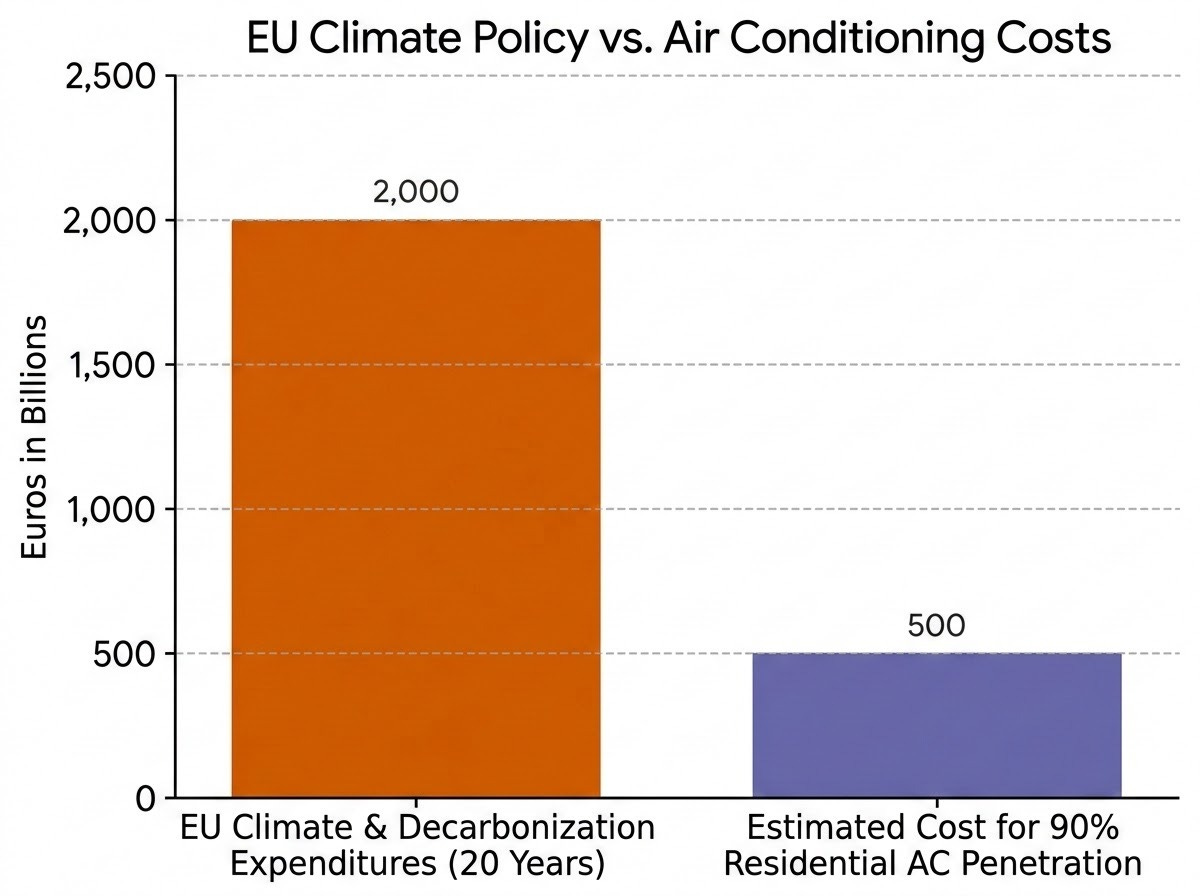
By contrast, using ChatGPT, I calculate the cost of achieving US levels of air conditioning across the entire EU, meaning 90% residential penetration. Even accounting for higher costs due to the prevalence of older housing stock with a much higher share of small, multi-unit, apartments, the cost would run to somewhere around €500 billion, around one quarter of the EU’s climate and clean energy expenditures. At lower levels of penetration, targeting vulnerable populations and deprioritizing parts of Northern Europe that aren’t at particular risk from extreme heat events, the cost would probably run closer to €200 billion.
For a wealthy region, there is not necessarily a reason to choose between the two. But there are tradeoffs. Climate policies have substantially increased the cost of electricity across much of the continent, raising the cost of space cooling for vulnerable populations. Worse, EU and many national level climate policies also actively discourage the installation of air conditioning.
So while there is plenty of good reason to invest in both climate adaptation and mitigation, the determination by the climate movement and its allies to reduce the issue to a manichean struggle to save lives by reducing fossil fuel use has resulted in European policies that have over-emphasized often ineffectual emissions and clean energy policies in lieu of taking very straightforward and cost effective action to dramatically ameliorate, or even entirely eliminate, the single greatest climate impact that the region faces, one that has cost hundreds of thousands of lives since the year 2000.
Fires and the Flood
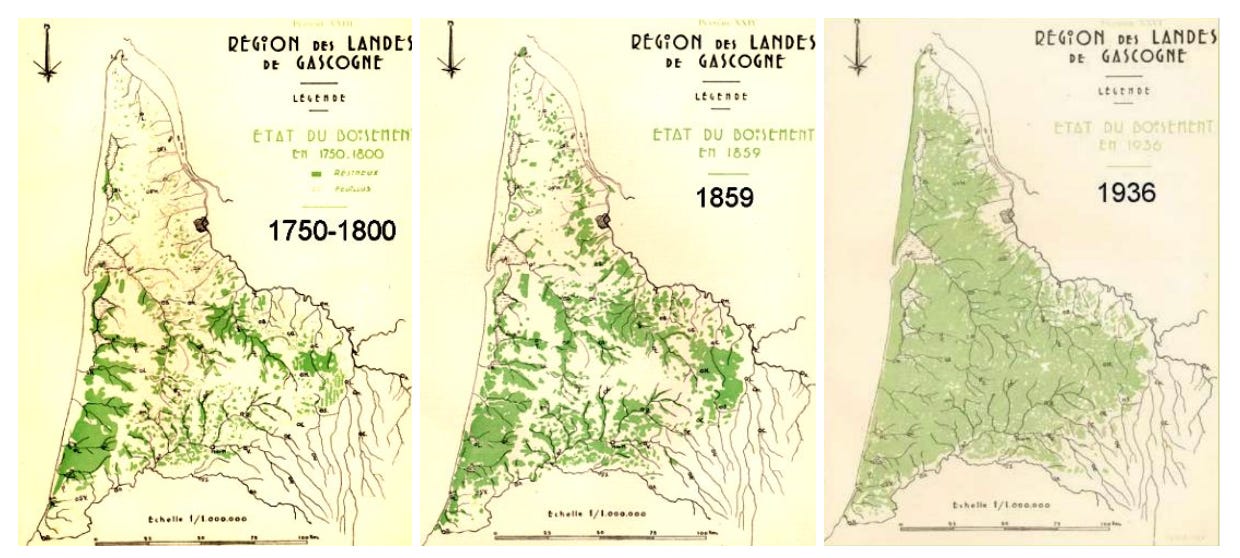
Similar dynamics are at play with all of the other extreme climate events that have captured headlines this summer. Fire weather, intensified by anthropogenic warming, played a major role in the wildfires that raged around Madrid and Bordeaux. But as my colleague Emily Bass recently wrote, “[r]egional land-use histories across Europe illustrate how recent wildfire disasters emerged from specific ecologies, management decisions, and local policy precedent.”
Rural depopulation, afforestation, and fire suppression over the last 150 years created the conditions that allowed those fires to burn as widely and intensely as they did. Bordeaux sits at the edge of a vast, manmade forest. “The wetlands were drained and what was a heterogeneous open landscape was replaced with far more continuous forest cover,” Bass writes. “The land conversion created what is still one of Europe’s largest planted forests with more than one million hectares (2.5 million acres) made up primarily of maritime-pine grown for timber, pulp, and resin.”
Even were there a knob that was easily turned to limit global temperatures, reducing wildfire risk across Mediterranean Europe will require far more than that, including efforts to manage fuel loads on abandoned agricultural lands, changes to forestry practices and EU afforestation policies, and a major shift in fire management practices to emphasize fire prevention rather than suppression.
Huge fires burning across Canada’s remote boreal forests, by contrast, can’t be attributed to land use change or fire suppression. My former colleague Zeke Hausfather published a good analysis recently demonstrating that the historic scale of those fires was almost certainly attributable to climate change. The consequences were widespread. An estimated 150 million people experienced at least one day of unhealthy air quality (above 100AQI) in North America. Reliable early mortality estimates from exposure to PM2.5 and other particulate pollutants are not yet available from the 2026 Canadian fires but a similar episode in 2023 was estimated to have affected as many as 350 million people across North America and Europe and ultimately resulted in over 80,000 premature deaths.
Those 2023 fires were truly exceptional, about four times larger than the 2026 fires and combining with unfavorable winds to spread toxic air pollution not only across heavily populated parts of the eastern seaboard but much of western Europe. But it is also worth putting those 80,000 deaths due to inhalation of particulate pollution from Canadian wildfires in perspective. Indoor particulate air pollution, primarily due to the use of wood, dung, and other biomass for cooking fuel in poor countries, kills 2.8 million people annually, every year, no matter the climatic conditions.
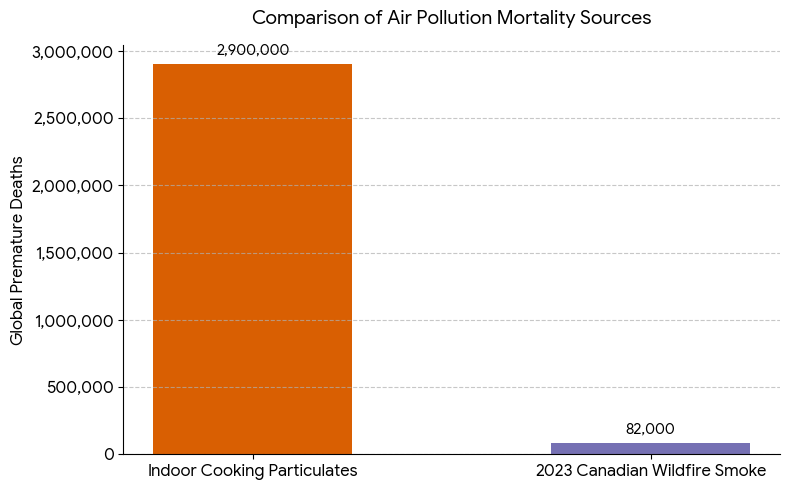
So while bigger and more intense wildfires across boreal forests in Canada, Siberia, and other regions, and premature deaths due to exposure to smoke from those fires, are plausibly attributable to warming resulting from the combustion of fossil fuels, the far greater death toll due to inhalation of indoor air pollution is largely attributable to the absence of fossil fuels. Clean cooking fuels, primarily liquified petroleum gas (LPG), could eliminate virtually all of those deaths, at a cost of around $10 billion annually for five years according to the United Nations Environment Programme.
As with air conditioning, a rich world doesn’t actually have to choose between reducing emissions that will someday help to mitigate wildfires around the world and eliminating deadly indoor air pollution. The added emissions from LPG would be de minimis, as is the cost. But there is also no globally influential, multi-billion dollar movement to bring an end to indoor air pollution (the global environmental movement’s annual spending alone, ironically, would probably be sufficient) and too often, both government and private efforts, overly mindful of the climate impacts of fossil fuel combustion, focus their efforts on biogas and other non-fossil based clean cooking technologies that are costly and impractical.
Finally, then, the tragic floods that have killed thousands in Nepal. Within hours after the source of the flood, the collapse of a massive Himalayan glacier, became known, a range of experts in major media outlets immediately leapt to the conclusion, based on little knowledge of what had actually precipitated the collapse, that climate change was to blame. A multiday heat wave and long-term melting of glaciers and permafrost beneath them were obviously the cause. A few days later, several geomorphologists examining better images of the failure zone observed that the collapse had been caused by a clean, structural fracture in the bedrock underneath the glacier, at the very least complicating the role that climate change might have played in the disaster.
The observed structural failure doesn’t eliminate the possibility that climate change contributed to the disaster. But it does make any potential contribution far more uncertain than virtually all of the initial reporting and analysis suggested. Climate change was an easy villain to seize upon and a far more convenient explanation than grappling with the many non-climate related human factors—large populations moving into an area prone to catastrophic flooding, the huge buildout of hydropower in the steep river valleys below unstable high mountain slopes, and the lack of early warning systems to give people a shot at getting out of the way. There will be more analysis in the coming weeks, no doubt, about the role that permafrost and meltwater penetration might have had in the structural failure. But the damage, to some degree, has already been done, turning a tragedy that should instruct us about the human cost of poverty and the imperative of development into an environmental story about the excesses of rich world consumption and emissions.
“Shifting Baselines” Aren’t the Problem
That anthropogenic warming driven by fossil fuel consumption has clearly played a significant role in all of these events excepting, perhaps, the floods in Nepal is reasonably clear. A world without global warming would still have had heat waves across Europe and wildfires in the vast northwoods of Canada. But they wouldn’t likely have been as intense and widespread.
The New York Times’ David Wallace-Wells, in recent years, has taken to calling the normalization of such events over time “the shifting baseline syndrome.” It is a slightly less evocative version of the older idea that a frog in a pot of water that is slowly warming won’t get out until it cooks to death.
The problem with both notions is that neither humans nor frogs actually behave this way. The claim that a frog will comfortably luxuriate in warming water until it dies is an urban myth. The notion of a shifting baseline syndrome, as Wallace-Wells uses it, is only slightly less dubious. There is some evidence in the conservation literature that people do normalize environmental change of various sorts. But there is no evidence that normalizing the changing climate has reduced awareness or concern.
Strong majorities of Americans believe that climate change is affecting extreme heat (64%), wildfires (63%), droughts (61%), flooding (58%), and hurricanes (58%). Nor is there much evidence that younger cohorts who never experienced the more moderate climate of the past are less likely to be concerned about these events or to believe that climate change is making them worse. To the contrary, younger cohorts are more likely to believe that climate change is happening, that it is human caused, that it is a serious problem, and that governments should do something about it.
Nor is it the case that a raging climate has been imposing ever greater costs upon society that the public has normalized or failed to notice. The real driver of normalization, rather, is adaptation. The climate may be hotter and more extreme than it was a few decades ago. But we have also become far more resilient to it. Despite the warming climate, climatic extremes are less deadly to most publics around the world, and most especially the American public, than ever before. As Alex Trembath demonstrated in The Argument last year, deaths attributable to extreme weather or climate related disasters in the United States have fallen precipitously.
Public alarm about climate change hasn’t changed much over the last 35 years, not due to a shifting baseline syndrome or organized science denial but because virtually every American has become far more resilient to climate impacts. Americans, young and old, will tell pollsters that they are concerned about these risks. But compared with their many more prosaic social and economic travails, most Americans simply don’t care that much or prioritize climate action that highly.
Given these facts, there was never good reason to think that the climate issue, as a discursive frame and organizing political imperative, could ever succeed in carrying the agenda it has been asked over the last generation to carry. Even in less geopolitically fraught times, national interest, the exploitation of domestic resource endowments, and domestic social and economic concerns were always going to take precedence over sweeping and sustained multilateral action to jointly cut global emissions.
Despite the sustained political effort to galvanize action, explicit climate policies over the last three decades have had little impact on emissions or warming. Improving energy productivity, sectoral shifts in the structure of advanced developed economies, slowing population growth, the coal to gas transition, and a range of other economic and technological factors mostly account for observed decarbonization globally and nationally. The key drivers of improved climate resilience—rising societal wealth, urbanization, infrastructure, and improving technology—have similarly proceeded independently of climate policy making.
The implications for climate policy-making and politics are significant. Absent something on the scale of a nuclear winter, there is no plausible anthropogenic climatic shift that could conceivably overwhelm the vast improvements in societal resilience to climatic extremes that long term modernization, urbanization, and industrialization have wrought. Nor, given the centrality of high levels of energy consumption to both economic growth and modern living standards, will the world rapidly abandon fossil fuels in the name of saving the climate.
The Climate Advocates Are Politics Takers
Two decades after Al Gore’s An Inconvenient Truth moved climate change to the center of the Democratic Party’s political and economic agenda, eight years after Alexandra Ocasio-Cortez arrived on the national political stage touting the Green New Deal, and five years after President Biden’s “whole of government” climate commitment, the world is no closer to either a climate catastrophe or a climate breakthrough than it was when Gore started making the rounds with his famous slide show.
For progressive environmentalists, climate change was the issue that would “change everything.” Existential fears of climate change would not only motivate the transformation of the global energy system but make possible a future that was more equitable, less consumptive, and less capitalist.
Yet the politics of climate action over the last generation has told a very different story. The climate issue has always been a politics taker, not a politics maker—the sort of issue that benefits or suffers from various shifts in political fortune but does not determine them. In good economic times, and when left of center political parties are in power, we can expect to see substantial public investment in clean technology and modest regulation of fossil fuels and other polluting activities. When times are tough and right of center parties are in control, the pendulum swings back.
Even so, climate progress has not fallen neatly along these political lines anyway. Consider that while much of the French Left, after a summer of heat and fire, has deepened its degrowth delusions, much of the French Right, including presidential front-runner Marine Le Pen, has rallied around nuclear energy and air conditioning subsidies. The latter efforts would plausibly reduce emissions and improve resilience to climate extremes in contrast to the former, which would almost certainly increase the vulnerability of the French public to heat waves without appreciably impacting the warming climate.
The story is similar in the United States. Shale gas and nuclear energy have traditionally been Republican, not Democratic energy priorities and account for much of America’s declining emissions and low carbon electricity respectively. The Trump administration’s pedal to the metal approach to the permitting and build out of liquified natural gas export facilities, meanwhile, is likely to place upward pressure on domestic natural gas prices while offering global importers like Japan and western Europe an alternative to increased coal use. Both developments will likely be decarbonizing. Even President Trump’s ill-conceived live war with Iran and trade war with almost everyone may unintentionally speed the global shift away from fossil fuels.
So as the pendulum begins to swing back toward Democratic control of Congress and, perhaps, the presidency, the best thing that pragmatic left of center policy-makers could do to reset the climate agenda is to recognize the politics-taking nature of the issue. Calls to bold climate action are unlikely to win Democrats many votes.
At best, centering the issue just distracts from concerns and priorities that are far more salient and favorable for Democrats. At worst, ill-conceived climate and energy policies can cost Democrats dearly, when they impose cost or inconvenience on the public. In either event, explicit climate policy-making has limited ability to bend the arc of the very robust long term and global macro-economic, demographic, and technological dynamics that will ultimately determine the pace of decarbonization and adaptation.
The good news, though, is that neither the philippics nor the agenda are necessary to make progress on the problem. Building resilience to a changing climate and limiting the amount of warming we will face in the future requires neither. Instead, traditional Democratic priorities—growing the economy, building infrastructure, improving public services, and developing and commercializing better technologies—hold the key to making progress.
These have long been staples of American liberalism and the Democratic Party. And all have been making us safer from the climate and decarbonizing the economy since long before anyone had ever heard of climate change. For the last twenty years, Democrats have imagined that the best way to achieve these objectives was by making them subsidiary to a sweeping climate agenda when the opposite has been the case. Climate resilience and mitigation are best pursued when they are subsidiary to an agenda that centers growth, technology, infrastructure, and state capacity.