

By Jennifer Hernandez and Vijaya Ramachandran
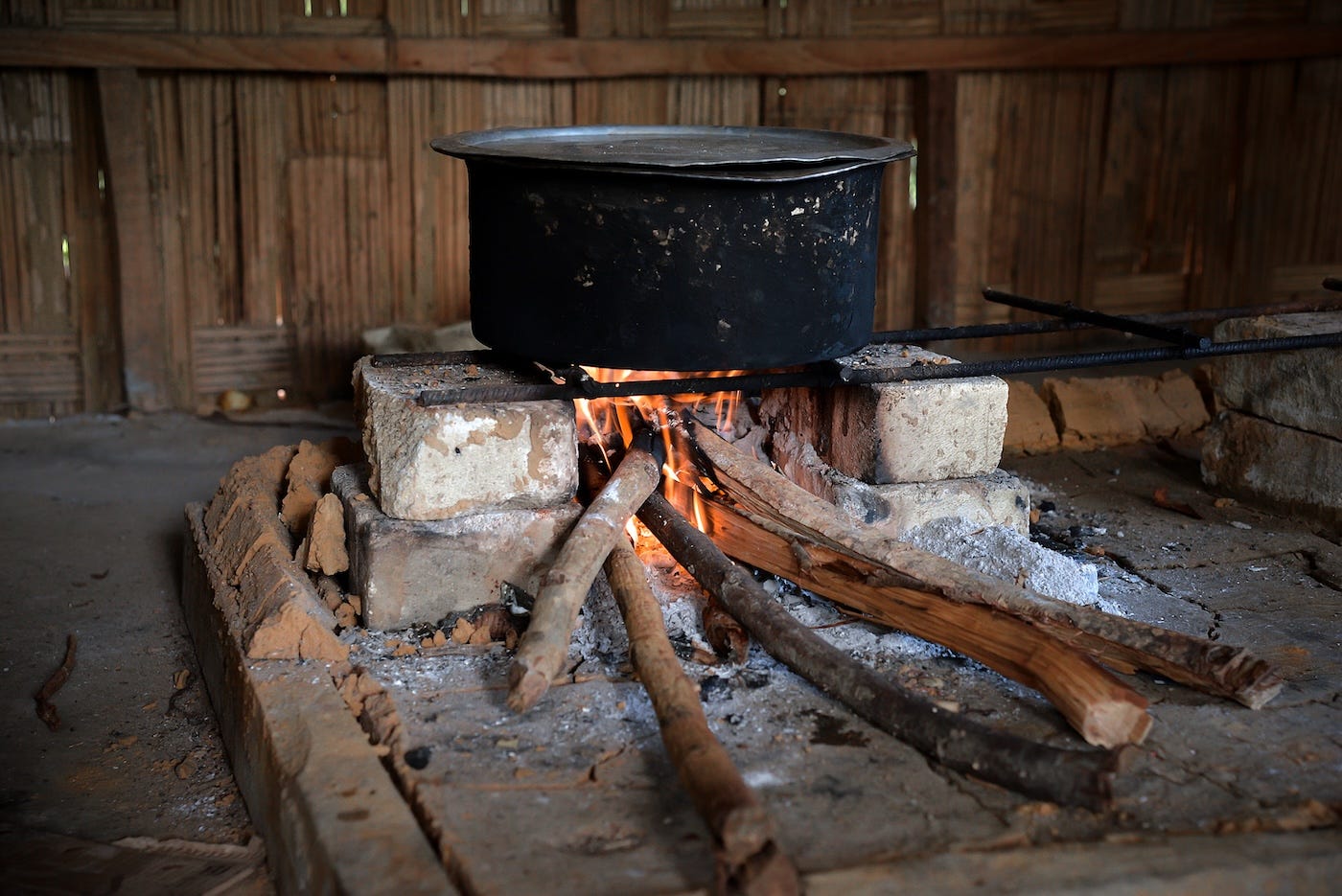
Climate policy often clashes with the needs of poor households. Nowhere is this clearer than in the debate over clean cooking. For nearly three billion people, daily cooking still depends on wood, charcoal, dung, crop residues, coal, or other solid fuels. The smoke from those fuels is not an abstract environmental problem. It is a direct health risk, especially for women and children who spend the most time near household fires. Liquified petroleum gas (LPG) is a solution: compared with wood, charcoal, dung, and coal burned indoors, it produces far less household air pollution and can sharply reduce exposure to fine particulates and soot. For families facing daily smoke exposure, the health gains can be large and immediate. But LPG is not a zero-carbon fuel, thereby making it a target for climate activists.
Kirk Smith vs Paul Ehrlich
While almost everyone has heard of Paul Ehrlich and his sensational (and wrong) views on overpopulation, few people are aware of the late Kirk R. Smith, a professor of global environmental health at the University of California, Berkeley. Smith helped establish the modern science of household air pollution. He was a major contributor to international climate science, including the Intergovernmental Panel on Climate Change. Yet he refused to treat climate policy and human health as competing goals. Smith never lost his focus on practical solutions for people living with severe health risks in poor countries.
Beginning in the early 1980s, Smith studied the consequences of cooking with solid fuels in poorly ventilated homes. He and his colleagues documented the links between household smoke and serious illness, including childhood pneumonia, chronic lung disease, and cardiovascular disease. His work on clean cooking in India helped transform household air pollution from a largely overlooked problem into a major public-health and development priority. Smith worked with Indian researchers to measure women’s exposure to smoke from traditional cooking fuels such as wood, dung, charcoal, and crop residues. That fieldwork helped establish the scientific basis for understanding household air pollution as a serious cause of respiratory and cardiovascular disease, especially among women and young children.
Smith’s central contribution was to show that the health problem was not merely “indoor smoke,” but dirty combustion that affected entire households. In India, where hundreds of millions of households relied on solid fuels for daily cooking, this meant that exposure was both widespread and lifelong. His research emphasized that improved biomass stoves could reduce some pollution, but often did not reduce exposure enough to meet health-protective standards. Smith argued that genuinely clean fuels—especially LPG—were essential for rapid health gains.
Smith was an influential advocate for expanding access to LPG for poor households. He viewed LPG as a practical, immediately available fuel that could sharply reduce household air pollution, lessen the burden of fuelwood collection, and improve the daily lives of women and children. His collaboration with Indian scientists and policymakers helped support one of the world’s largest clean-cooking efforts, which provided LPG access to roughly 80 million households.
Smith’s approach was pragmatic. He argued that clean-cooking policy should be judged by actual exposure reductions, health outcomes, affordability, and sustained use—not simply by whether a fuel was classified as renewable. Subsequent research in rural India has reinforced the importance of sustained LPG use, noting that a connection to a gas line is not enough if households continue to “stack” fuels by using wood, dung, or crop residues alongside LPG.
Smith’s legacy in India is that he linked environmental science with practical public health interventions. By documenting the risks of solid-fuel cooking and making the case for clean fuels at scale, Smith helped shift clean cooking from a niche stove-design issue to a central question of health, gender equity, air quality, and development. Smith and his collaborators showed that household air pollution was among the world’s largest environmental health risks, contributing to millions of premature deaths each year. The burden fell disproportionately on poor women and children. For households that rely on solid fuels, LPG is the most immediately available clean-cooking substitute.
That conclusion sometimes sits uneasily with climate activists in the West who treat any expansion of fossil-fuel use as inherently suspect. But Smith warned that “improved” biomass stoves do not meet health-protective air-quality standards in real-world use. A stove that is marginally better than an open fire may still leave households exposed to dangerous levels of pollution.
The World Health Organization makes the same point: for households relying on solid fuels, LPG is among the cleanest alternatives that is widely available at scale. This does not mean LPG should be treated as a permanent end point for energy policy. It means that, in places where electricity, biogas, ethanol, or other genuinely clean options are not yet affordable and reliable, LPG can be an important bridge to better health and lower household pollution.
Health, forests, and policy realism
There is one important additional benefit to clean cooking. In many poor communities, the use of wood and charcoal puts pressure on forests and local ecosystems. The contrast between Haiti and the Dominican Republic illustrates the point. The two countries share the island of Hispaniola and have similar environmental conditions, but they have followed very different cooking-fuel paths. The Dominican Republic shifted much more of its household cooking away from wood and charcoal and toward LPG or electricity, while Haiti has remained heavily dependent on charcoal. Forest outcomes have diverged sharply. Clean cooking is relevant not only for health, but also for land use and forest conservation.
Smith was concerned that restricting LPG access in poor countries in the name of climate change could push hundreds of millions of people back toward biomass or coal for cooking. His argument was not that climate change is unimportant. It was that climate policy should not ignore near-term health damage or impose unrealistic solutions on households that lack affordable alternatives. In his view, opposing LPG in the name of climate policy could be ethically questionable if it blocked one of the few proven, scalable ways to reduce the world’s largest household environmental health burden.
Smith’s views represented a nuanced perspective on fossil-fuel use. Subsidizing gasoline for wealthy consumers is not the same as helping a poor rural household replace a smoky biomass stove with LPG. The climate implications, equity implications, and health implications are different. A targeted LPG subsidy for poor households must be evaluated as a public-health intervention, not as a generic fossil-fuel subsidy.
Policy lessons
Clean-cooking programs have helped tens of millions of poor households gain access to LPG, reducing reliance on solid fuels and improving the prospects for women’s and children’s health. Implementation challenges remain: connection to LPG does not always mean sustained use, especially if refills are unaffordable or distribution is unreliable. But the experience demonstrates that large-scale clean-cooking transitions are possible when public policy, distribution systems, and household affordability are aligned.
Poor households need safe, reliable, and affordable energy now. Where grids are reliable and power is affordable, cooking can be done with electric cookstoves. But until those options are broadly available, rejecting LPG can leave families dependent on fuels that are more dangerous for health and often worse for local forests.
A more constructive climate and development policy must place human welfare at its center. It should support LPG cooking fuels today, invest in electric and renewable alternatives, and judge interventions by measured outcomes rather than slogans. Kirk Smith’s work is valuable because it points toward that kind of practical environmentalism: one that takes climate change seriously while also taking seriously the lives of people exposed to dangerous smoke every day.
The same principle applies more broadly. Energy policy should not be reduced to a choice between climate and development goals. Healthier and more prosperous societies are generally better able to invest in environmental protection, forest restoration, and cleaner energy systems. Climate policy should support energy transitions within poor households, to improve health outcomes and alleviate the burden of poverty.
It has been reported (OurWorldinData.org) that 2-3 million people die from indoor air pollution from using the fuels mentioned in the article - every single year. Mostly Africa & Southeast Asia and mostly women and children. Our climate/energy policies are killing people now - it's immoral !