

By Seaver Wang
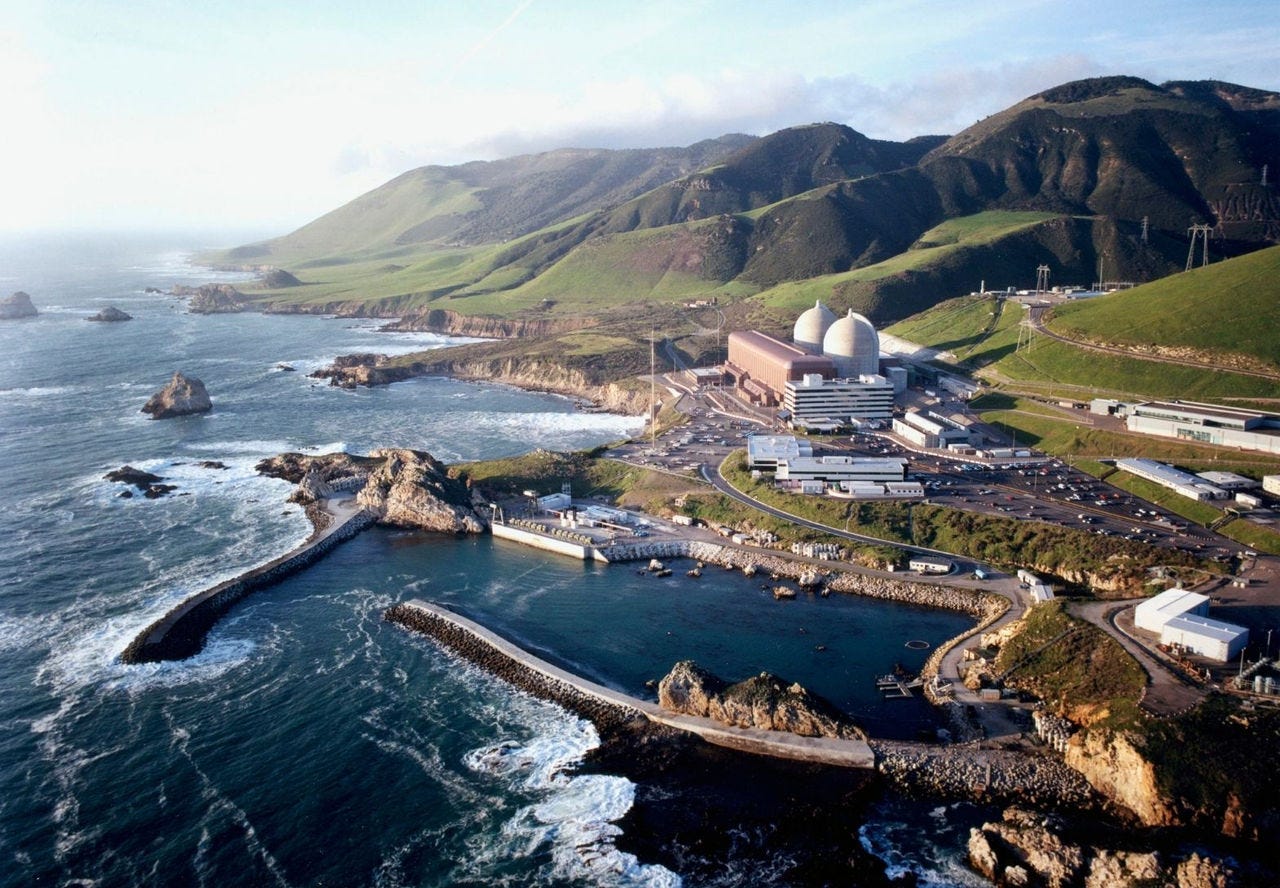
In the summer of 2022, the California legislature and Governor Gavin Newsom successfully passed Senate Bill 846 to extend operations at the Diablo Canyon nuclear power plant in San Luis Obispo until at least 2030, avoiding the plant’s planned 2025 closure and preserving the state’s largest single source of clean electricity generation. Diablo Canyon provides around 9% of California’s annual electricity generation and around 17% of the state’s low-carbon electricity generation.
Despite the law’s passage, Diablo Canyon must clear several regulatory hurdles to continue operating to 2030 and beyond. Most importantly, the plant must secure an operating license renewal from the U.S. Nuclear Regulatory Commission (NRC), which would grant Diablo Canyon federal permission to continue operating for 20 additional years, not just five years. But before the NRC can consider Diablo Canyon’s license renewal application, the power plant must first secure state regulatory approvals from the California Coastal Commission and the Water Board. In the meantime, the plant has temporary permission to continue operating while it awaits its permit approvals.
Currently, the California Coastal Commission poses the most serious impediment to the state’s efforts to extend operations at Diablo Canyon—largely over the issue of fish larvae. Established in 1976, the California Coastal Commission is tasked with considering whether coastal developments align with the California Coastal Act’s policies for marine ecosystem protection. While the Commission is also considering other factors, a primary issue before the Commission is the power plant’s impact on small marine organisms that pass through the seawater cooling system’s intake filters. Changes in temperature and pressure over the five minutes of transit time required for “entrained” organisms to pass through the cooling system may kill a considerable fraction of the organisms unlucky enough to be drawn into the cooling system intake.
Yet the entire effort to assess marine ecosystem impacts represents a futile attempt to quantify the unquantifiable. Whether for zooplankton like copepods or krill or young salmon or the anchovies, saury, or rockfish eaten by albacore tuna, California fishery datasets dating back to 2000 or the early 1990s show no pronounced decline in fish or zooplankton populations. The Coastal Commission staff’s report offers no evidence whatsoever of declines in more local nearshore fish or marine life. In short, no data exists today that the Diablo Canyon plant’s annual intake of less than one cubic mile of seawater has had any measurable impact on any adult fish population.
Nevertheless, anti-nuclear groups and environmental groups have seized upon this opportunity to accuse Diablo Canyon of posing terrible and intolerable risks to California’s vibrant marine life, calling upon the Commission to overrule its own staff recommendation and deny permission for Diablo Canyon to continue operating.
While not necessarily swayed, the Commission may be showing some signs of indecision. Despite the clear public and environmental benefits of relicensing Diablo Canyon relative to the uncertain and minor impacts on marine life from the plant’s seawater cooling approach, the Coastal Commission decided last week to extend its deliberations, postponing a final vote on Diablo Canyon until December 2025 at the earliest. But from the perspective of a marine ecologist, the Commission frankly has no need to deliberate further. The Commission should make the obvious rational decision to support its own staff recommendation and grant Diablo Canyon’s extension as proposed.
Missing the Forest for the Technocratic Trees
Much of this brow-furrowing scrutiny of Diablo Canyon’s impact on fish eggs and larvae is both excessively stringent and overly pessimistic, and may influence the Commission to make a decision that runs counter to the interests of the California public. The Commission’s fundamental scientific methodology for assessing seawater cooling system impacts is outdated, highly uncertain, and fails to take into account the broader context of the California Current ecosystem.
The issue before the Commission is a decision related to the continued operation of a single power plant, but any impacts on the coastal California Current marine ecosystem from seawater cooling withdrawals scale with total seawater entrainment. Yet, the retirement of other coastal power plants—mostly gas-fired turbines—has reduced total seawater entrainment from 17 billion gallons per day in 2007 to 4 billion gallons per day in 2025. Diablo Canyon presently uses seawater at a rate of 2.5 billion gallons a day.
Outrage by anti-nuclear and environmental groups over Diablo Canyon’s marine life entrainment impacts thus amounts to performative hand-wringing over unknown and likely negligible effects upon a California Current ecosystem that has remained one of the world’s most vibrantly productive and biodiverse coastal ocean regions over Diablo Canyon’s entire operational history. Regular National Oceanographic and Atmospheric Administration, academic reports, and grant proposals for future research make it clear that scientists see the dominant factors influencing this extensively-studied California coast ecosystem as fishing, climate change, and El Niño and La Niña variations, easily swamping any impacts from a single power plant.
At the same time, state regulators’ approach for assessing potential marine ecosystem impacts from seawater entrainment is also flawed. Specifically, the Commission’s scientific approach for estimating fish larvae entrainment—the Empirical Transport Model (ETM) using calculations of the Area of Production Foregone (APF)—is both highly uncertain for the Diablo Canyon coastal area specifically and clearly biased towards overestimation in general. This approach is not widely used to assess power plant cooling water intake impacts anywhere except California.
Indeed, this obscure entrainment marine impacts calculation may possess broader future implications for the state of California. In 2022, the Coastal Commission unanimously denied the Poseidon Huntington Beach desalination facility—a project supported by Governor Newsom—over the plant’s likely entrainment of marine organisms. Given that these ETM/APF calculations will likely influence permitting of future coastal facilities like desalination plants, the Commission should take decisive steps to significantly revise or replace the ETM/APF method for assessing entrainment impacts from proposed infrastructure projects.
Moving forward, an improved methodology could account for local ocean physics including at multiple depths, more accurately survey small marine organisms, and adopt average rather than maximum parameters for factors like entrainment mortality and larval development rates. Relative to a more reasonable scientific middle ground, overly conservative analyses add unnecessary costs and hold back infrastructure progress. Particularly when such assessments possess serious methodological shortcomings, the social costs of overactive environmental risk assessment likely far outweigh any marine conservation benefits.
When it comes to the imminent decision on Diablo Canyon’s permit application, the Commission must understand that the ETM/APF method itself subjects assessments of marine life entrainment impacts to considerable sources of error. Many of those sources of error, explained below, bias calculated metrics towards overestimation of ecosystem effects.
Some discharged cooling water is recirculated
First, the calculations do not account for the significant recirculation of discharged seawater from Diablo Canyon right back to the intake—2.5 billion gallons a day of output to match the 2.5 billion gallons a day taken in, with the cooling system outlet located just a couple hundred meters up the coast from the intake. Some volume of just-discharged water arguably ends up flowing back through the cooling system again. In practice, this recirculation likely reduces the volume of fresh seawater entrained over any given period of plant operation. However, the Commission’s impact assessments do not account for this factor at all.
Fish larvae may survive more than assumed
Second, the Commission staff pessimistically assume 100% mortality of all entrained organisms, despite themselves citing a 1983 study of the now-decommissioned Moss Landing power plant cooling system that observed mortality for some fish larvae species as low as 50%. In other words, for some species, the Commission might be overestimating impacts on entrained organisms by as much as a factor of two, based on an analysis at a totally different power plant whose operating practices 40 years ago may not resemble the characteristics of Diablo Canyon’s system. Furthermore, these analyses only studied larvae from a handful of species.
Additionally, the staff acknowledge that only a subset of marine life is even at risk of entrainment in the first place. Their past reports concede that “most abundant fishes in these studies had egg stages that were not likely to be entrained; they either have demersal/adhesive eggs or are internally fertilized and extrude free-swimming larvae. Squid paralarvae are also unlikely to be entrained because they are competent swimmers immediately after hatching.”
Sampling biased towards overestimation
A third set of issues relate to the ecological surveys that form the very basis for entrainment impact assessments in California over the past couple decades. The ETM/APF method strives to assess fish eggs, larvae, and plankton lost based on the furthest possible distance from which ocean currents could bring these organisms to the Diablo Canyon intake before they grow too large or become sufficiently strong swimmers to avoid entrainment by the seawater intake. This approach relies on local boat surveys of small marine organisms using fine mesh nets, paired with relatively simple assessment of local current speeds.
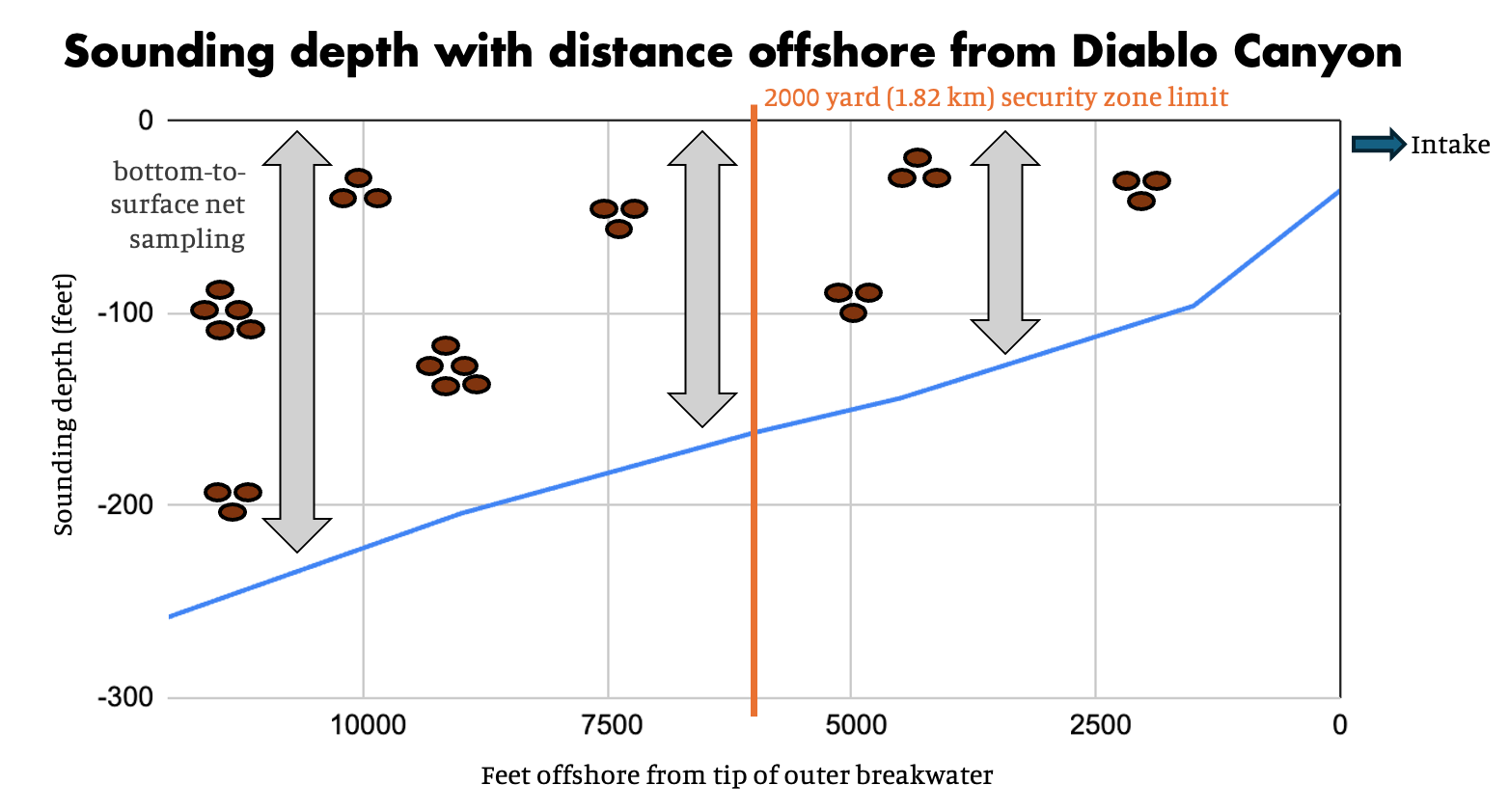
The problem is that the local boat sampling method used bottom-to-surface net casts at distances up to 3km offshore, creating a high risk of overestimating entrainment for larvae and eggs far offshore and at depths up to 250 feet. If clusters of fish larvae further from shore and at deeper depths account for a disproportionate weight of the small organisms sampled using nets, then this sampling approach may attribute Diablo Canyon with entrainment of organisms that are actually quite safe from the intake (Figure 1). Diablo Canyon’s seawater intake is located in a restricted shallow artificial bay less than 20 feet deep, at a point of the California coast where the water depth increases rapidly to 114 feet at 1000 yards and to 162 feet at 2000 yards. Such surveys may thus be predominantly sampling deeper organisms subject to slower current speeds that would not in fact place them at high risk of entrainment.
On a longer timescale, sampling uncertainty is skewed by the massive seasonal variability in fish larvae concentration as shown by the surveys themselves. Fish larvae populations predictably peak in the spring, when upwelling ocean nutrients coincide with better light conditions and warmer temperatures for phytoplankton and algal growth. Yet the entrainment study calculations appear to calculate ecosystem impacts using average or mean larval concentrations that are highly sensitive to peak values, when median values might more accurately reflect conditions outside of spring months. Such choices not only disproportionately influence entrainment calculations, but also neglect to consider the reduced real-world ecological impact of entrainment during springtime when overall larval concentrations are richest and regional food availability is superabundant. Insofar as larvae entrained by Diablo Canyon during spring removes some food matter from the ecosystem, this is inconsequential at a time of the year when the environment is hardly food-limited. The scientific analysis also implicitly assumes that dead larvae and plankton expelled by the cooling system possess no ecosystem value as a food source, when they most certainly do.
Ocean physics reduce the area at risk
The fourth set of issues relates to the methodology’s oversimplistic consideration of local physical currents. Importantly, the ETM/APF method doesn’t account for the known tendency of nearshore currents in this part of the California Coast to change speed and direction regularly. The California Current is a highly dynamic physical environment with strong seasonal and sub-seasonal variation, coupled with a rugged coast and islands in the immediate vicinity of Diablo Canyon that also affect local hydrodynamics. Such complexities likely significantly reduce the APF—the effective surrounding area from which marine organisms could be entrained—while giving larvae more time to become strong swimmers. Yet the studies the Commission references assume that currents in any direction towards Diablo Canyon remain steady for the several days over which new larvae are at greatest risk, effectively maximizing the calculated APF.
Obvious Benefits Outweigh Undetectable Marine Impacts
Ultimately, the entire approach for estimating entrainment impacts on marine life is imprecise, attempting to assess effects that are essentially beyond our scientific ability to accurately isolate amidst far larger seasonal, interannual, and long-term changes in the region. Commission staff writings essentially admit as much: “We do understand generally that changes in marine life populations are affected by a wide range of factors—ocean temperatures, rates of upwelling and availability of nutrients, El Niño versus La Niña periods, etc., which makes it highly speculative to associate ETM/APF results with changes in population.” Indeed, Diablo Canyon surveys suggest that El Niño years reduce the size of the crudely-calculated affected ocean area by 25%. To speculate about the adult fish population effects of a marginal loss of larvae on top of typical expected losses from predators, disease, competition, and the harsh natural environment is to hunt for a needle in a haystack of needles.
For now the Commission has, based on their own discretion and interpretation of California statute, deliberately chosen to err on the side of pessimistic bias by utilizing the ETM/APF methodology. Meanwhile, the broader California context has seen decreasing marine impacts from seawater cooling entrainment over the past decade by a factor of more than four, with power plant seawater usage dropping from 17 billion gallons per day in 2007 to 4 billion gallons per day today. In any case, coastal seawater entrainment for cooling is a consideration whose ecological effects are utterly dwarfed within the vast variations in the California Current environment caused by factors like fishing, climate change, natural climate variability, agricultural runoff, and coastal ship traffic.
One can only hope that the California Coastal Commission makes the rational decision not to overfixate on uncertain impacts that are both small relative to other ecosystem factors and scientifically impossible to detect. In comparison, the clean energy, economic, and societal benefits of Diablo Canyon are quantifiable. Yielding to anti-nuclear activists’ demands that the plant close would sacrifice an amount of clean electricity generation greater than that lost by demolishing every wind turbine across California. The Commission should act on its own staff’s recommendation to approve PG&E’s coastal development permit to extend operations at Diablo Canyon. Despite adopting a relatively pessimistic approach to gauging potential impacts, the staff has favorably assessed PG&E’s “out-of-kind” mitigation proposal to compensate for the loss of marine organisms from cooling water intake operations. Overestimation of marine life impacts only shifts this calculus further in Diablo Canyon’s favor, making the staff’s recommendation to approve PG&E’s permit application all the more appropriate.
Fish larvae kill is a totally bogus issue. What counts is the effect on the adult population. Most fish species are density dependent, meaning the adult populationis based on the number the environment can support, In these cases, larvae kill at an NPP will have nil effect on the adult population. Most plants enhance loal popualtions via the warmwater discharge. Pls see
https://jackdevanney.substack.com/p/cooling-towers-are-not-cool