

By Adam Stein
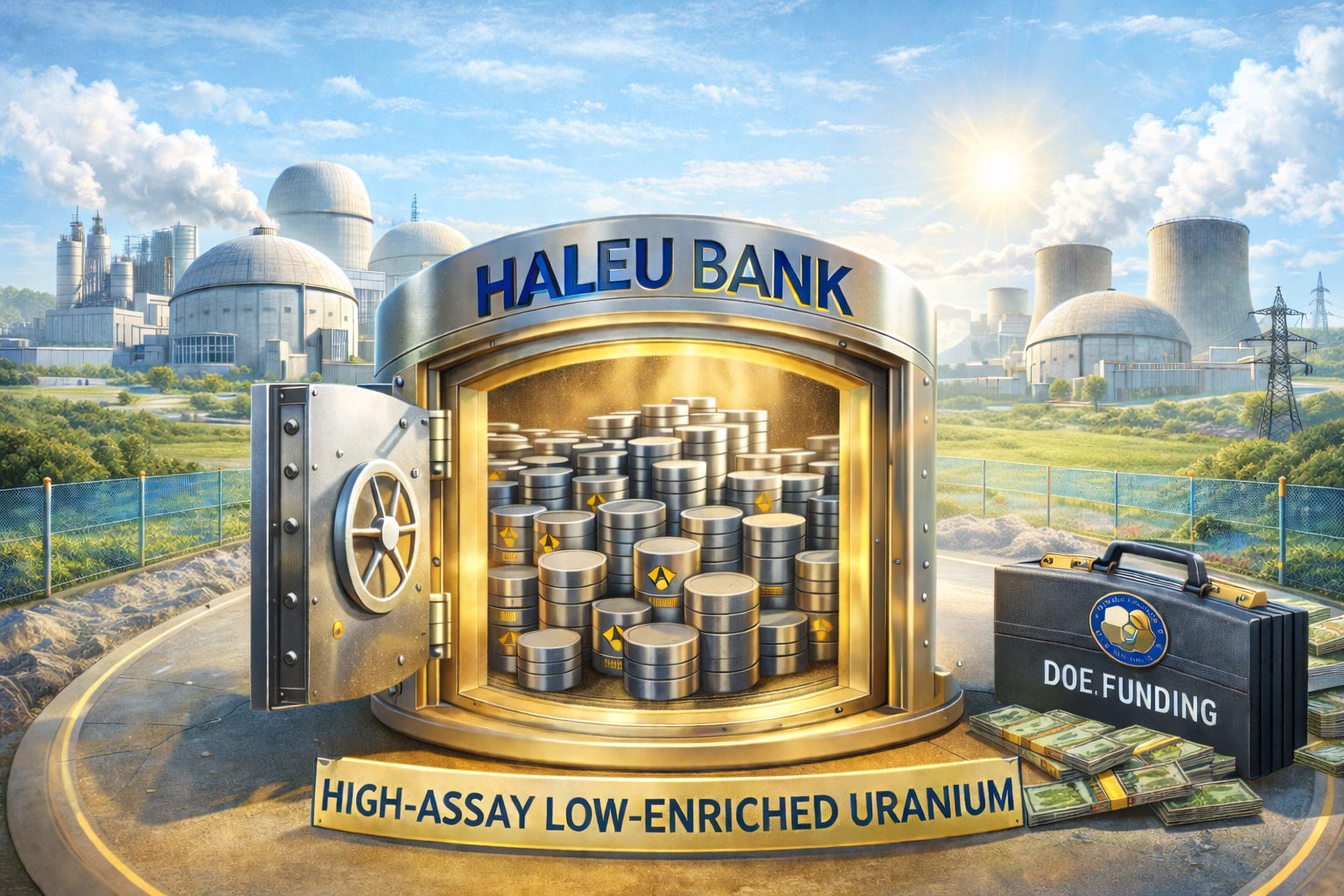
This week, the Department of Energy announced $2.7 billion in grants to expand domestic uranium enrichment.This is a positive step because enrichment capacity is critical to sustain current reactors and enable growth. But, after years of concern about nuclear fuel supply, the move is being treated as a turning point for advanced nuclear power in the United States.
It isn’t—at least not in the way markets actually work.
The central constraint on advanced nuclear deployment has never been whether the U.S. can technically enrich uranium. Centrus Energy has already demonstrated pilot-scale high-assay low-enriched uranium, or HALEU, production at its Ohio facility. The real question has been whether anyone would reliably produce HALEU at scale and on schedule. That problem remains unresolved because the federal government has still not done the one thing Congress explicitly directed it to do: buy the fuel.
The HALEU availability program was established in 2020 and funded in 2022 to allow the government to purchase and hold enriched uranium. But the federal government still does not purchase any enriched uranium to strategically ‘bank’ as a reserve.
This matters because nuclear fuel markets do not behave like ordinary commodity markets. They are thin, capital-intensive, and highly sensitive to timing risk. Enrichment facilities are long-lived assets designed to operate for decades, not to serve small, intermittent orders. Producing limited quantities of HALEU for first-of-a-kind reactors, without firm, multi-reactor, multi-decade contracts, makes little economic sense. From an enricher’s perspective, that is not a bridge to a future market—it is a stranded-asset risk.
Advanced reactor developers, meanwhile, are structurally incapable of solving the problem themselves. Companies planning demonstration or pilot reactors can not credibly commit to buying enough HALEU to justify new enrichment capacity. Their projects are capital-constrained, schedule-uncertain, and still moving through licensing. Expecting startup-scale developers to anchor a national fuel supply chain is unrealistic.
This bilateral investment trap is exactly what the HALEU availability program was meant to resolve. By aggregating demand across projects and time, and by acting as the initial purchaser of enriched uranium, the federal government could convert fragmented future demand into a single, bankable signal. Enrichers would see durable offtake. Developers would see fuel availability without over-committing scarce capital years in advance. That was the design.
Instead, the absence of early purchase commitments has forced the government into a series of increasingly improvised responses. DOE has launched a Fuel Line Pilot program to identify, qualify, and allocate fuel for Reactor Pilot Program participants. The effort is pragmatic and necessary, but also revealing. Rather than drawing from an existing reserve or established supply channel, the department is assembling fuel pathways reactor by reactor, stitching together short-term solutions to meet immediate needs. This is what fuel security looks like when procurement replaces planning: resourceful, labor-intensive, and fundamentally non-scalable.
The same pattern is evident in the government’s use of the Defense Production Act. DOE has convened a fuel supply consortium under DPA authorities to accelerate enrichment and fuel fabrication capacity. The step underscores the seriousness of the challenge and also reveals the consortium’s limits. The consortium coordinates industry and reduces bottlenecks, but it does not provide the long-term purchase commitments that make large-scale investment viable. Even extraordinary authorities cannot substitute for offtake. Capacity can be encouraged, but without near-term contracts, it cannot be fully mobilized.
The scale of the problem makes this unavoidable. Even under conservative assumptions, future U.S. enrichment needs are five to ten times larger than today’s domestically available capacity, with HALEU accounting for most of the growth. Advanced reactors alone could require tens of millions of separative work units annually by mid-century. Current U.S. HALEU production is measured in hundreds of kilograms, not thousands of tons. The gap is not philosophical. It is arithmetic.
Skeptics argue that uncertainty cuts the other way: what if advanced reactors fail to deploy at scale? Why stockpile fuel that might go unused? This confuses fiscal caution with system risk. Fuel represents a tiny fraction of total nuclear project costs, but its absence halts projects entirely. A small amount of excess fuel capacity is far cheaper than stalled reactors and stranded capital.
Strategic reserves exist for exactly this reason. They are built before scarcity becomes acute, not after. The Strategic Petroleum Reserve and long-term defense procurement follow the same logic: when markets cannot coordinate under uncertainty, early commitment matters.
The mistake now would be to confuse activity with resolution. Funding enrichment capacity is necessary, but it is not sufficient. Markets do not form around announcements. They form around contracts.
Congress recognized that reality when it directed the creation of a HALEU availability program. Until the federal government actually buys fuel and lets the market build around that signal, the HALEU problem will remain what it is today: unsolved, despite the spending.