


The climate watchdogmatists are at it again.
That’s what I’ve taken to calling the Revolving Door Project, Public Citizen, Drilled Media, and other groups associated with the progressive climate movement, purportedly focused on employment ethics and media watchdogging.
The thing to understand about these groups is that their concerns are not ethical but ideological. Climate watchdogmatists ascribe to the worldview of the climate emergency—the notion that climate change is not merely important but existential, and that binding limits on carbon emissions should be proscribed in regulation, usually through non-legislative pathways like lawsuits, executive actions, and social pressure campaigns. Now, it might seem confusing why a group like the Revolving Door Project would be leveraging a government employment ethics operation to pursue climate targets. The way to resolve that confusion is to understand that the ethics agenda is fake and the climate agenda is real.
The watchdogmatists’ sleights of hand are omnipresent if you look for them. But every once in a while they escape containment, usually by inflicting collateral damage on other climate advocates.
In 2024, for instance, a cadre of climate activists went after the integrity of sociologist Holly Buck for questioning the efficacy of the activists’ “disinformation” campaigns. Suggesting Buck was advancing Big Oil propaganda, as Public Citizen’s Aaron Regunberg did, was particularly brazen. Climate hawks leapt to her defense, as well they should have.
The latest such drama concerns my former colleague Jesse Jenkins. Jeff Hauser from the Revolving Door Project (RDP) initiated a campaign against Jenkins, for the infraction of working as a part-time clean-tech advisor and CTO while running an academic research lab at Princeton, and for accepting research funding from the oil and gas industry.
Many observers asked why Hauser should care about Jenkins’s remuneration in the first place, since RDP’s mission is “to scrutinize executive branch appointees to ensure they use their office to serve the broad public interest.” None of the parties involved in this episode is an executive branch appointee, or public official of any kind, so it is indeed unclear why Jenkins’s activities caught Hauser’s attention.
At least, it’s unclear to those who don’t understand that the watchdogmatists’ ethics mission is fake.
Climate activists like Regunberg and Genevieve Guenther went after Buck not because of some obvious ethics breach, but because she “uses fossil fuel talking points,” or ideas they consider verboten. Hauser went after Jenkins not because of some new or newsworthy ethical breach, but because Jenkins posted a qualified defense of an op-ed in which Matt Yglesias argued Democrats should be friendlier to oil and gas interests.
The persistent strategy here is to launder a particular climate agenda through seemingly unrelated advocacy agenda. Watchdogmatists like RDP use purported ethical frameworks to delegitimize ideas they consider ideologically unacceptable. It’s a deliberate short-circuiting of liberal discourse and an assault on philosophical pragmatism, which holds that ideas should be evaluated on their merits, not categorically dismissed for alleged affiliative or financial concerns.
Climate watchdogmatism is not an ethics operation gone awry; it is, rather, the inevitable logic of the climate emergency.
As Guenther has argued, climate targets demand that no new fossil fuel production come online anywhere in the world ever again. As the media activist organization Covering Climate Now has argued, this “scientific realism” should override any countervailing political priorities. A climate movement that sincerely ascribes to these premises would inevitably target the careers and reputations of any influential figures who differed with their ideological views.
The challenge for those outside watchdogmatist circles is not to parse their faux-ethical accusations. It is, rather, to interrogate the logic of the climate emergency at the center of the accusations. Because while the climate emergency may manifest most bizarrely in reputational attacks on climate advocates, it is pervasive across the progressive advocacy community, and in all cases should be regarded with suspicion.
The era of the climate hawk may be over, inasmuch as climate advocates have finally internalized the public’s apathy over the issue and are pursuing more oblique pathways towards decarbonization and climate resilience. But if the erstwhile hawks aren’t careful, they may allow the watchdogmatists to crowd them out, by dismissing democratic politics entirely and enforcing the climate emergency through other means.
Discourse vs. Reality
A huge amount of modern climate activism is downstream from the Merchants of Doubt-style corporate conspiracy theorizing advanced by academics like Naomi Oreskes and Eric Conway. The core idea here is that fossil fuel industries produce propaganda to influence energy policy and to hoodwink consumers into using oil and gas. By attacking the fossil fuel industry’s “social license to operate,” and by policing “fossil fuel talking points” even when invoked by non-industry representatives, the watchdogmatists hope to neuter this propaganda and achieve a net-zero utopia.
The watchdogmatists’ discursive approach, in which reality is entirely socially constructed, is the foundational premise for the public relations and litigation campaigns against Big Oil “disinformation.” The climate problem, according to the watchdogmatists, is not that fossil fuels are chemically dense sources of useful energy, plentifully distributed in the Earth’s crust and relatively easy to dig up, store, transport, and combust. The real problem supposedly is fossil fuel industry propaganda and misinformation. Indeed, arguing that fossil fuels are abundant and useful is one of many “fossil industry talking points” identified by the climate watchdogmatists. To utter such talking points is, definitionally, to engage in a campaign of disinformation, the only purpose of which could be to “shill” for the fossil fuel industries. It’s a circular, stupid logic, but one that’s proven highly effective for climate activists over the last decade or so.
It’s been so effective that it only ever seems to attract widespread outward critique when climate experts themselves become collateral damage. Much to my frustration, no one seems to care, for instance, that the formal position of the institutional environmentalist movement is that exceeding 350 parts per million carbon in the atmosphere is unconstitutional. This is a pretty sweeping practical outcome of the climate watchdogmatists’ worldview! But since it’s the logic of the climate emergency operating conventionally, it doesn’t seem to register. Conversely, when activists aim at less conventional targets, like Buck or Jenkins, the broader climate commentariat becomes more interested in the rationale behind RDP and Public Citizen’s erratic watchdogging.
Defending Buck and Jenkins in these episodes is admirable, but it does kind of miss the point. To take seriously the accusations of ethical breaches, even in service of debunking them, is to grant the watchdogmatists far more legitimacy than they deserve. The issue is not that Jeff Hauser is mistaken about Jenkins’ conflict of interest. The issue is that Hauser has an illiberal climate emergency agenda and is using the guise of ethics watchdogging to advance it. Conceding that RDP’s activities are a worthwhile pursuit, and are merely off the mark in the case of Jenkins, not only legitimizes RDP’s purported watchdog operation, but actually legitimizes the climate emergency politics upon which the climate watchdogmatists’ discursive project is predicated.
Just consider what it looks like to defend Jenkins on the narrow technical charge that he’s a shill. UC Santa Barbara Professor Leah Stokes, for instance, backed Jenkins up on Twitter, writing that “It is possible to have a different theory of change on decarbonization, the clean energy transition, affordability, etc—and not attack people’s motives, credibility, etc.” But the moral relativism Stokes endorses here did not, conspicuously, extend to Yglesias’s originating argument, which Stokes took the time to attack herself. The actual substantive arguments here—about the usefulness of climate targets and about Democrats’ attitudes towards oil and gas—get suppressed by negotiating narrowly over the drummed-up ethics accusations. This is how the climate emergency lives to defame another day.
My former colleague Zeke Hausfather, likewise, argued that the attack on Jenkins is evidence that RDP has “clearly lost its way.” So I want to be very clear about this: RDP has not lost its way. RDP’s revealed mission, at least when it comes to energy and climate, is to oppose all-of-the-above energy politics and enforce the standard-issue keep-it-in-the-ground agenda. Attacking Buck and Jenkins is not a deviation. It is, if somewhat shameless, entirely consistent with the logic of the climate emergency.
The Widening Gyre of Shills and Deniers
I have some direct experience with this. I’ve been accused of shilling for nuclear energy, for the oil and gas industry, for big agriculture, and beyond. It’s become rote and, in my view, deeply lazy on the part of the accusers. The charge is obviously selective, and ignorant. Breakthrough has always published our funding, 100% of which comes from charitable philanthropy, on our website. But perhaps since I have advocated for nuclear energy while also criticizing the idea of the climate emergency, these attacks on my reputation somehow rarely seem to marshall the defenses enjoyed by Buck, Jenkins, and other climate pragmatists in good standing. C’est la vie.
Multiple times over the past few years, RDP has published what it probably intends as blistering takedowns of the Abundance Movement, focused on the ideas and participants of the Abundance conference that I helped organize. In 2024, RDP’s Dylan Gyauch-Lewis wrote a kind of exposé of the Abundance Movement, charging that the organizers of Abundance 2024 had—quelle horreur—connections to wealthy philanthropies.
As others in the abundance movement have pointed out, unlike the Breakthrough Institute, the Revolving Door Project does not make its funders public. This should influence how seriously we take their general strategy of accusing their ideological opponents of opaque, nefarious connections to corporate paymasters.
Nevertheless, they persisted. RDP doubled down during our conference last summer, publishing this hilarious corkboard diagram on their website to expose the alleged conspiracy behind Abundance:
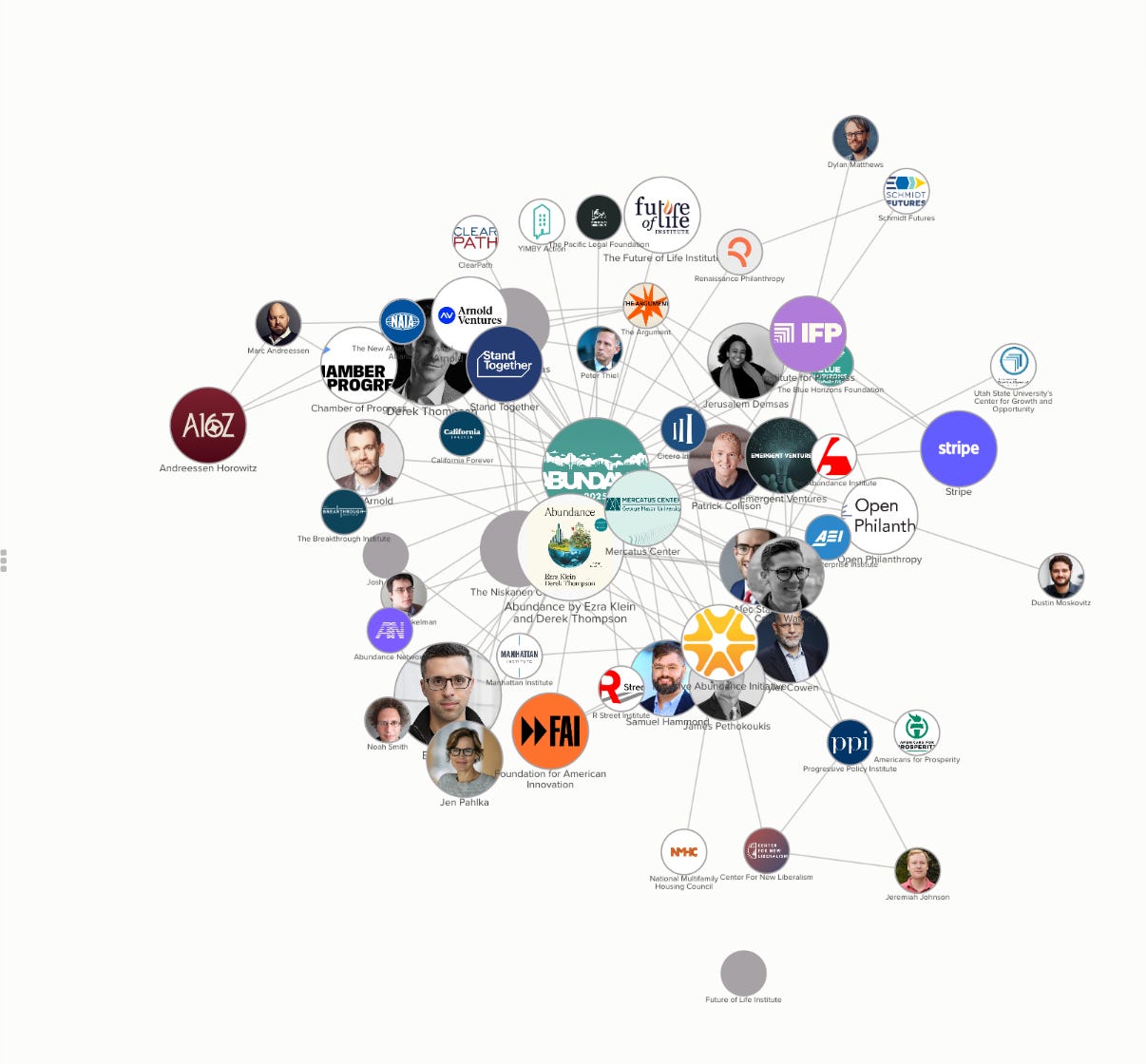
Why is RDP going after the Abundance Movement, which contains relatively few present or former executive branch appointees? The same reason RDP went after Jenkins and Buck and me and Yglesias: Because they disagree with the ideas.
Now, disagreeing about ideas is of course fine, and in fact ideal in a free pluralistic society. What’s pernicious about RDP and their allies is the way in which they use the jargon of ethics to suppress other ideas. Climate watchdogmatists’ strategy is not to defeat Abundance or all-of-the-above energy politics on the merits, but to sabotage the credibility of their ideological opponents.
It’s a fundamentally anti-liberal project. But what’s arguably worse is when those of us outside the activist groups let them get away with it, by conceding that their ersatz watchdogging is primarily an ethical pursuit instead of an ideological one. We should make these concessions no longer, and instead recognize the watchdogmatists’ arguments for what they are: a vehicle to enforce the much more pervasive, but just as illiberal, project of the climate emergency.
There are a few heuristics we can use to recognize the bad-faith argumentative sleight-of-hand employed by the fake watchdogs. For instance, when an activist accuses someone of using fossil fuel industry “talking points” or “tropes,” it’s a telltale sign that the accuser is trying to short-circuit a substantive conversation. Dismissing an argument as a “talking point” is simply a way to avoid engaging with it. Likewise, when the climate watchdogmatists allege that one party is “shilling for,” or has nefarious “ties” to, certain other parties or industries, this should generally be understood as a tactical distraction more than a meaningful intervention. As we at Breakthrough have documented, the term “climate denier” has long since stopped signifying anything meaningful about adherence to mainstream science, and is now deployed as a conspicuous all-purpose epithet for figures who deviate from the climate movement’s keep-it-in-the-ground politics.
All of these labels are the language you use when the targets are demonstrably not on a fossil fuel industry payroll or actually affiliated with any of the nefarious organizations or individuals that they are being linked to. So if any of these people ever accuses you of being a “shill” or a “denier,” you can be reasonably confident that person has turned their brain off.
Climate Hushers vs. Watchdogmatists
Heatmap’s Insider Survey, released earlier this month, captures an important phase shift in climate politics. As Rob Meyer wrote in an incisive headline summarizing the survey, “Climate Insiders Want to Stop Talking About ‘Climate Change.’” This is a welcome development, but not one everyone is happy about. The watchdogmatists at Covering Climate Now already have a term for it—climate “husherism”—that has been amplified by Senator Sheldon Whitehouse, among others.
So here we have the two opposing factions in the post-climate hawk era: the hushers who acknowledge the low priority the voting public places on climate change, and the watchdogmatists who, politics be damned, seek to jam the climate emergency down the public’s throats through any mechanism at their disposal.
And fake ethics enforcement is just one of those mechanisms.
Having abandoned straightforward legislative actions like a carbon tax, climate activists are now working to enforce climate targets through employment ethics enforcement, yes, but also through liability lawsuits, population stabilization campaigns, limits on Federal Reserve liquidity relief, Clean Air Act rules, executive emergency declarations, and beyond. So it’s not just that we should stop taking the watchdogmatists seriously. It’s that we should guard against the more widespread strategy to smuggle the climate emergency through a variety of unrelated policy instruments.
None of this is to say that ethical breaches are impossible or immaterial. Muckraking and watchdogging in general are worthwhile pursuits. But climate activists, as a group, have long since abandoned the liberal virtues of those pursuits, instead channeling the language and tactics of ethical enforcement to advance a very particular ideological agenda.
The risk of merely policing the watchdogmatists’ most outlandish attacks, or in indulging illiberal activism as long as it doesn’t implicate other climate advocates in good standing, is that doing so allows the logic of the climate emergency to persist. And make no mistake: that logic is at odds with a pluralist, durable liberal democracy. Without cultivating an alternative to the logic of the climate emergency—one in which climate change is a serious but not existential problem that must be managed through technologically and economically inclusive politics—the climate watchdogmatists will continue to rear their heads.
Thanks, Alex. As an close-up observer to the debate over climate over the past few years, I have generally wondered how the climate movement would deal with a few critical realities that manifest over time: 1) very large parts of the population do not care (or at least not enough to de-prioritize other goals) and 2) the consistent failure to meet the ambition of targets set. For a long time, I feared that the only response would be impositon of harsh constraints by increasingly illiberal elites and doubling down on unrealistic goals. But now I think that the movement as blown itself out through hysteria, which is a shame because it discredits reasonable action on a serious problem.
One historical analogy is that of communism. The world had many agitators, and the true believers worked for decades to gain traction for their global movement. They were convinced that the masses would rise up. But that never happened. Instead, what did happen was that in one group of countries (namely, the West) workers gained rights and income and eventually achieved many goals through slow changes and accommodation with capitalism. In the other countries, a small vanguard of dedicated believers willing to use massive force took over and created their version of the system they sought. In my view, it did not turn out to well, but the point is that when persuasion did not work, the strength of their belief led them to justify the use of force for the populaitons "own good."
I see this dymanic on all sides of extremist views. I want the world to be a certian way, which is so obviously right that everyone should see it. When the world (inevitably) diverges from my benevolent vision, then I become frustrated and the use of hard power becomes acceptable.