

The national debt has topped $40 trillion.
In response, the bond market is demanding higher interest from the U.S. Treasury. On Wednesday, looking at the bond market and worrisome signs of inflation, the Federal Open Market Committee’s 12 members unanimously supported a quarter-point hike in interest rates, the first since 2023. But it won’t be the last. Many economists fear that we are facing a sustained period of higher interest rates.
Nuclear energy was not the cause of any of this, but it could be the victim. Higher rates will hit a capital-intensive industry, and raise its high costs yet higher. This is bad news, but there is a Breakthrough Institute proposal that could ameliorate the problem, called Accelerating Commercialization Through Incentivizing On-time Nuclear, or ACTION.
ACTION addresses interest costs in two ways. It lowers interest rates for projects that hit certain milestones, which is intended to shorten the period for which money is borrowed before operations, and lower the rate at which it is borrowed. As the underlying interest rates rise, ACTION becomes ever more important.
Nuclear reactor construction costs are highly sensitive to interest rates; in fact, the cost of money ranks in importance with the cost of concrete, steel or skilled labor. If it is high enough, the cost of money could be more important than those ingredients. This is the industrial version of the lesson that high schools try to teach about credit cards in financial literacy classes: interest on debt compounds and can get out of hand. And rising rates are making front-page news as they shake up the bond markets.
A recent study by the New York State Public Service Commission and the New York State Energy Research and Development Authority on what policies would be needed to achieve Governor Kathy Hochul’s goal of building new nuclear capacity concluded that interest costs were second, behind only tax credits from Washington. But Dr. Adam Stein, director of Breakthrough’s Nuclear Innovation program, pointed out, “if interest rates go high enough, that order could be flipped. In many cases interest is already a larger portion of total project cost than capital is.”
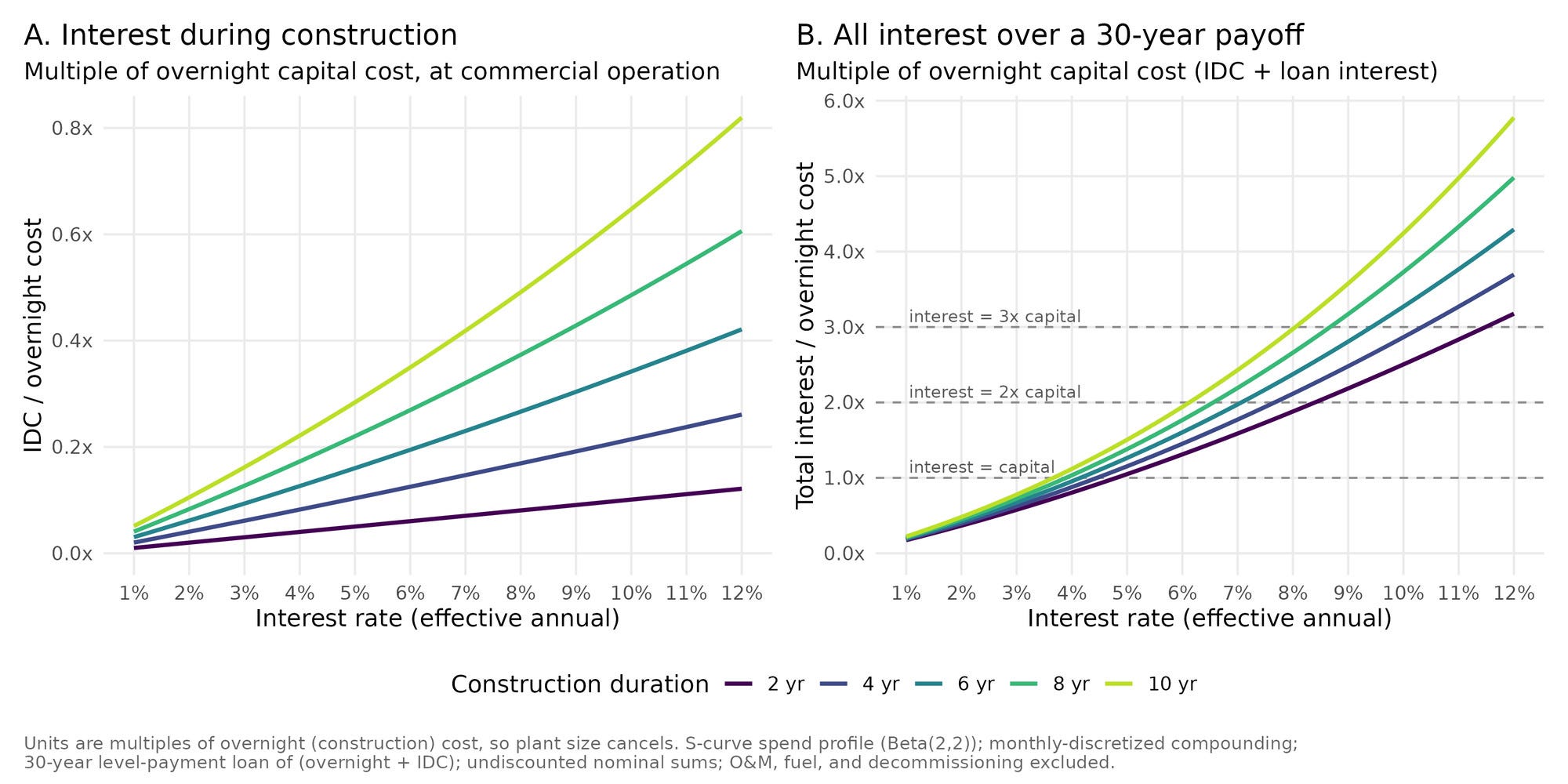
All major private-sector projects carry the expense of borrowing money during the construction period, but nuclear plants, because they take longer to build, feel this most strongly. Reactor manufacturers talk about “overnight cost,” meaning how much a builder would have to pay for materials, labor, specialized equipment, engineering work, and other expenses, but this isn’t the way a developer sees the problem, because overnight cost omits the cost of borrowing money over the period when those costs were incurred until the day the plant starts producing.
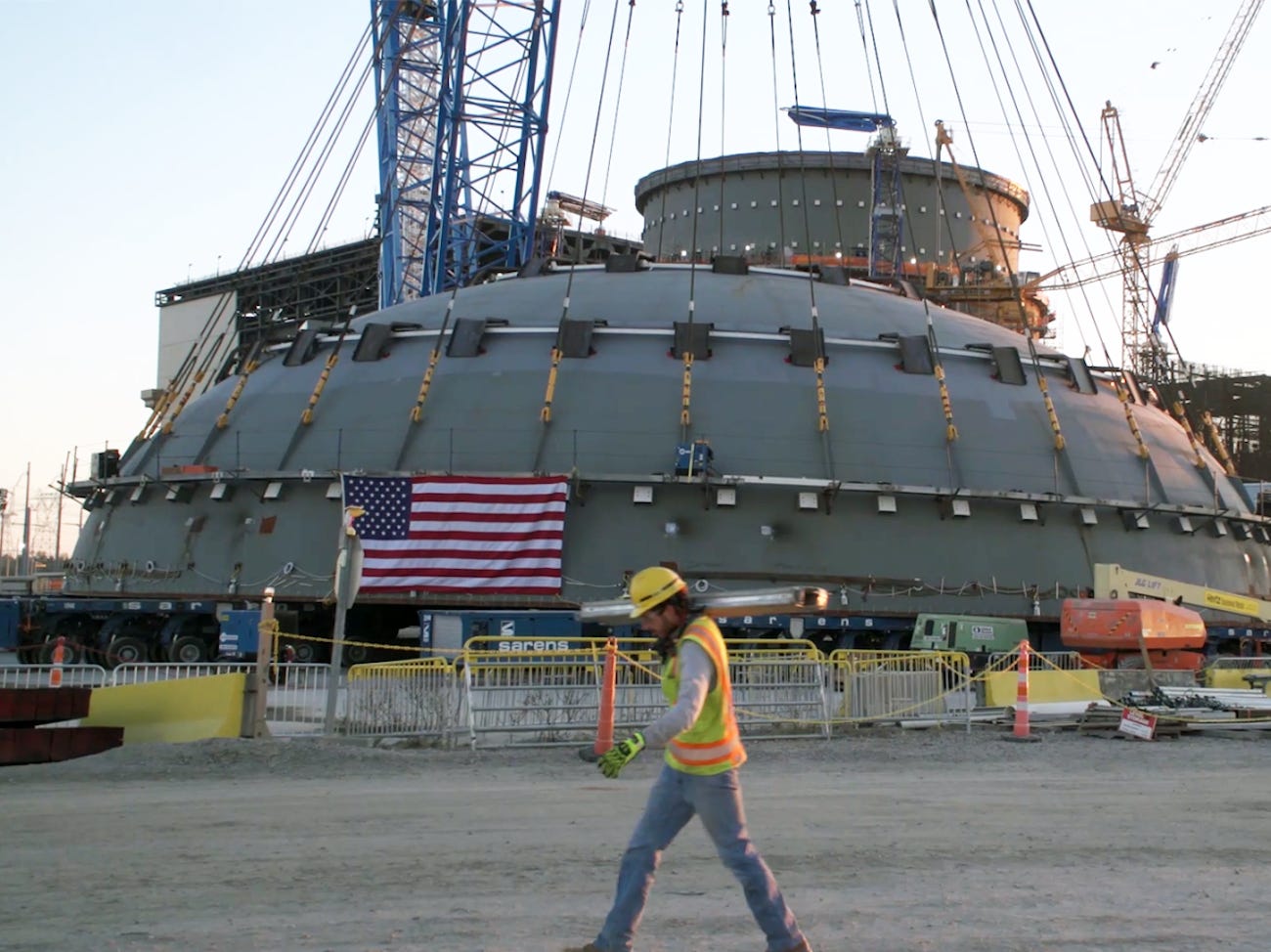
And those can be substantial. Georgia Power said it spent $3.53 billion in interest on its portion of Vogtle 3 & 4, and it owned only 46 percent of the project, meaning that interest costs approached 20 percent of its expense. And it had an advantage: The Department of Energy offered a loan guarantee, essentially co-signing on the project, which allowed the utility to borrow money at a lower rate.
Georgia Power is hardly the first. In the 1980s, near the end of the Long Island Lighting Company’s struggle to finish its Shoreham nuclear plant and get it licensed, flaws were discovered in the emergency diesel generators, setting back the project by weeks. Interest on the $4 billion already spent (some of it on interest) was about $1 million a day.
A company with a lower credit rating than an old-line utility like Long Island Lighting or Georgia Power—for example, a start-up company developing data centers with reactors in tandem—would face even higher rates.
Whatever the relative position of the most credit-worthy companies and the riskier ones, all will probably be paying higher interest rates in the coming years. The Federal Reserve and other central banks are facing stubborn inflation, brought on by higher fossil fuel prices and other factors, and even before that happens, investors are demanding higher rates of return when they buy Treasury bills.
The Treasury rates on 30-year bonds bottomed out in 2020 at less than 1.7 percent but are now at 5.23 percent and expected to rise. And that is only the rate that Uncle Sam pays; interest rates on loans that the federal government makes have been between 0.375 percent and 2 percent above that.
Potential developers already have their eye on interest rates. High interest rates change the competitive rankings among power generation technologies and give an advantage to power plants that are cheap to build but have a higher fuel expense. That means hand-to-mouth plants that consume vast amounts of fossil fuels.
As interest rates rise in the general economy, the ACTION proposal would become even more helpful.
Savings would increase with project size. At current interest rates, the approach could save $160 million in project finance costs on a $2 billion project and $780 million on a $10 billion project. And at a relatively low cost to the federal government, such a program could support more than 25 projects simultaneously.
That is an important point because over years of stagnation, the industry has lost its supply chain for hardware and skilled workers. To lower costs, the industry will need a stream of projects.
The milestones would be independent of particular technology, because they refer to steps that each project must take, regardless of reactor type.
For example, there are two main routes to licensing: a construction permit, or a Combined Operating License, known as a COL. A construction permit means that the project has an approved site (which may have been approved years earlier, and “banked” for use later, as a way to speed up the time between decision to build and project completion) and has enough of a design completed to provide assurance that a safe plant can be built. A COL means both an approved site, and a pre-approved design, so that if the plant is built according to the plans, an operating license will be issued promptly. Notably, the Westinghouse AP1000 has an approved design, and the Trump administration is trying to arrange a loan program for key components for ten of them.
Both the construction permit and the COL are easily identified starting lines.
A second milestone, already in use to judge how long construction took, is when workers begin pouring nuclear-grade concrete. That represents a more significant step than digging a foundation, putting in pipes for cooling water, and other generic construction activities.
Towards the end of construction, technicians load fuel and begin “power ascension,” slowly raising power levels in the core. The initial criticality, the first time the core sustains a chain reaction, is another milestone, although it may be at a power level that is a tiny fraction of operating capacity.
And the fourth, easily understood, is synchronizing the generator to the grid, and putting out power. The proposal is for the federal government to lower the developer’s interest expense by 0.25 percent at each milestone, for a total reduction of 1 percent.
Setting milestones for privately developed projects is not a new concept for the federal government; NASA did it for Commercial Orbital Transportation Services, for example. That was a program begun in 2006 to encourage private companies to build spacecraft that could carry cargo to the International Space Station. Rather than award a cost-plus contract, the space agency offered payments to three companies as they reached progressively more advanced milestones. One failed and two succeeded, and NASA’s conclusion was that the program had developed the capacity that the space agency needed, at lower costs.
Building a nuclear reactor is a different kind of project than the development of a supply chain for rockets that can carry cargo to orbit. But in some ways, milestone-based incentives are better suited to projects like nuclear plants, because such incentives will help mobilize private capital.
There is a synergistic effect to lowering interest costs for nuclear projects: as it makes projects more feasible, it helps developers attract commercial financing.
The years of payments on a construction loan even before construction has been completed are not the only reason that nuclear plants are sensitive to interest rates. Energy demand overall is highly sensitive to economic growth, which slows or reverses when interest rates are high. During the Great Recession of 2008-2009, total energy consumption fell by 5 percent. Energy consumption also fell during recessions in the early 1980s and in 2001. But blunting a nuclear buildout doesn’t require a drop in electricity consumption; simply slowing down or stopping demand growth would accomplish that. In periods of low growth or no growth in electricity demand, owners of older reactors are likely to retire them. The opposite is true today: owners are investing in raising legacy reactors’ output and getting license extensions to let them run for up to 80 years.
High interest rates present various sectors of the economy with a variety of challenges, but the largest will be felt by capital-intensive sectors, including nuclear. Anything that mitigates the high cost of debt should be high on the list of policy options aimed at assisting new nuclear construction.
