

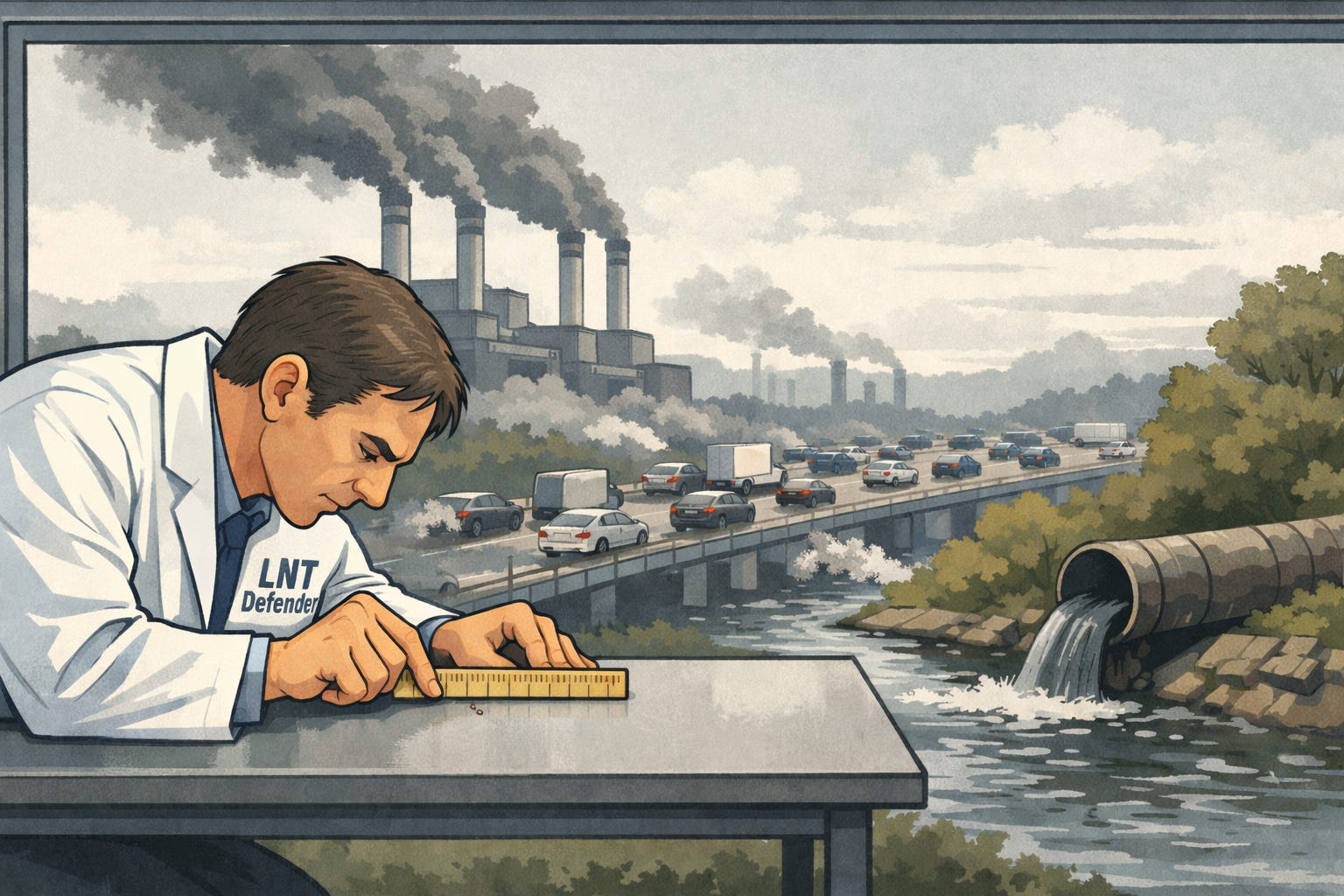
If you want to know why progress on nuclear energy was so halting during the Biden years, despite the administration’s support for the technology, Katy Huff’s recent Scientific American essay is as good a guide as any. Huff was Assistant Secretary for Nuclear Energy at the Department of Energy during the Biden Administration and is a professor of nuclear engineering at the University of Illinois. Her essay takes aim at President Trump’s executive order last May directing the Department of Energy and Nuclear Regulatory Commission to reconsider the use of the controversial Linear No Threshold (LNT) radiological health model to set standards for public and occupational exposure to radiation.
LNT is the primary dose-response model that regulators use to determine how much allowable radiation exposure is acceptable from nuclear energy, nuclear medicine, and many other applications that involve some necessary or potential risk of radiation exposure. It is controversial because it assumes that the relationship between exposure to high doses of ionizing radiation and cancer incidence, which is well established, can be extrapolated to cancer risk at very low doses, which is unproven.
Pursuant to last year’s executive orders, a number of outlets reported in January that DOE was abandoning the ALARA (As Low As Reasonably Achievable) standard, the long-standing regulatory approach to limiting low dose exposure to radiation that requires additional measures to reduce potential exposure whenever possible, even when the dose is already extremely low. DOE is also expected to raise the maximum annual dose of radiation that the public can be exposed to as part of its New Reactor Pilot Program at Idaho National Laboratory, although those standards have not yet been formally released. This month, the NRC may endorse those standards as part of a sweeping revamp of its rules and regulations.
With those latter rule changes pending, Huff has published a scathing critique of the reset, arguing that in the absence of new research proving that there are no negative health effects at low doses, and extensive public input into any proposed new standard, changing the NRC’s health standards “effectively demands that NRC’s decision-making be political rather than scientific” and is hence “unethical.”
Huff insists that she is defending science over politics. But her position is, in fact, no less political than that of the Trump administration and far more extreme. She argues for a strict precautionary approach to radiological health risk while insisting that any change to this approach requires new research to falsify a hypothesis (LNT) that is both unproven and likely unfalsifiable. Meanwhile, she obfuscates the actual consequences of changes to public dose standards, which are minimal even accepting the LNT hypothesis, and claims, without evidence, that doing so will result in the loss of public confidence in nuclear energy.
Each of these claims is dubious, reflecting long-standing norms that have informed nuclear policy-making and regulation. Taken together, those norms have not only hampered nuclear energy but have likely also resulted in significantly higher overall public health burden from America’s energy system, rather than reducing it. The current reconsideration of LNT-based regulations for low dose exposure to radiation and ALARA are long overdue.
A Tale of Two Backgrounds
At the crux of the controversy around the LNT model are two biophysical factors that confound efforts to establish an epidemiological relationship between exposure to low doses of ionizing radiation and negative health effects. The first is that humans are constantly being exposed to significant population-level radiation: from the sun, other natural sources such as radon, and anthropogenic sources such as X-rays and CT scans. Cumulatively, these sources of radiation exposure substantially exceed the doses that both the public and workers in the nuclear industry are exposed to from normal operations of nuclear plants and even from many potential accidents in which radiological material might escape containment.
The second biophysical factor is that the background rate of cancer incidence and mortality in all human populations is high. In rich countries where most people survive childhood diseases, infections, food borne illnesses, and other traumas and maladies that historically accounted for a large share of human mortality, about 40% of the population will get some form of cancer over the course of their lifetime and about 20% will ultimately die from it. Most cancer incidence is attributable to lifestyle, genetic factors, and random mutations as cells reproduce. A small percentage of cancers are caused by environmental pollutants of any sort. An even smaller percentage of that small percentage could conceivably be caused by exposure to radiation emanating from nuclear reactors.
Together, these two background factors massively confound any effort to reliably estimate what effect exposure to low doses of radiation has on public health. Everybody is exposed to background radiation that is significantly higher than low dose exposures that they might be exposed to from nuclear reactors. And large numbers of people will die from cancers caused by other factors. As a result, even when tracking very large populations exposed to low doses of radiation over a very long time period, it is extremely difficult, if not impossible, to identify a statistically significant increase in cancer incidence or mortality above the background rate experienced by populations that have not been exposed to excess low dose radiation.
Huff argues that more research is required before negative health effects from low dose exposures can be ruled out, arguing for a proposed National Academy study to attempt to resolve the question. But as Breakthrough’s Adam Stein and PJ Seel note in a recent Bulletin of Atomic Scientists article, there is little reason to think that more research of this sort is likely to resolve basic epidemiological questions.
So Huff is arguing a double standard, insisting that the current health standards are justified by this uncertainty but that changing them requires certainty in the form of new research proving a negative—that no health effects exist from low dose exposures that can’t actually be observed epidemiologically. Huff claims that this position is scientific, not political. But that claim is plainly absurd. Science simply can’t resolve the uncertainty about radiological health effects at low dose exposures. The decision to regulate low dose effects that are unavoidably speculative is no less political than the decision not to do so. Huff prefers a more precautionary approach than the Trump administration. But that is a conflict over social and political values, not science.
Low Doses, Low Stakes
One of the ironies about the “angels on a pinhead” debate about LNT’s validity at low doses is that even granting that LNT is valid, the public health stakes associated with low dose exposures that might conceivably result from either nuclear operations or most plausible accident scenarios are very low.
Imagine two representative samples of 10,000 Americans, a control group that is not exposed to any additional radiation from nuclear energy and a test group that is exposed to an acute dose of 100 millisieverts (mSv), the threshold below which it is likely impossible to detect any statistically significant increase in cancer incidence or mortality from radiation exposure. In the control group, which has not been exposed to any additional radiation, we would expect around 4000 people to contract cancer at some point in their lifetime and about 2000 people to die from it. Among the test group, we would expect around a 1% increase in cancer mortality, or around 2100 total cancer deaths among our sample of 10,000 people,
Keep in mind that all 10,000 people in both groups will die from something, many of them will die from cancer, and many other drivers of both all-cause mortality and cancer mortality are far greater factors. Nonetheless, a 1% increase in cancer mortality is not insignificant.
But it’s also important to understand that 100 mSv is actually a very high, and indeed unprecedented, dose in the context of civilian nuclear energy, about ten times greater than the average cumulative dose that people living in the areas contaminated by the Chernobyl accident were exposed to over the subsequent twenty years, three times greater than the dose that people evacuated from the exclusion zone in very close proximity to the Chernobyl plant were exposed to, and twice the dose that people who illegally moved back into the exclusion zone in the years following the accident were exposed to.
These exposures occurred in the aftermath of an accident that was, by far, the worst in the history of civilian nuclear energy—stemming from an obviously dangerous design prone to runaway reactions, built with no containment system, and operated by a negligent, totalitarian government. The result was a meltdown and radioactive fire that burned openly for three weeks. Even so, the UN Scientific Committee on the Effects of Atomic Radiation concluded in 2008 that other than a handful of deaths associated with plant staff and emergency workers who received very high doses responding to the accident and 6000 preventable thyroid cancers (Soviet authorities chose not distribute iodine tablets in hopes that the world wouldn’t learn about the accident), “there has been no persuasive evidence of any other health effect in the general population that can be attributed to radiation exposure.”
No other civilian nuclear accident has ever been remotely comparable. Despite the catastrophic earthquake and tsunami that crippled the plant, the Fukushima accident, occurring at reactors with multiple containment systems that all operating commercial reactors today feature, released about 10% as much radiological material into the environment as Chernobyl. Three Mile Island, which suffered a partial meltdown, released such minimal radioactive material that even at the perimeter of the power plant, someone standing at the fenceline and taking no preventative action for a week as the accident unfolded would have received less than half the annual background radiation dose typical for the region.
These three cases are the only major accidents in the 65 year history of commercial nuclear energy. So the 100 mSv threshold for observable effects is well beyond that which any significant population anywhere in the world has ever been exposed to from either normal operations of commercial nuclear power plants or an accident. And it is 10,000 times greater than the average dose that someone living near an operating nuclear power plant in the US would receive.
Moreover, there has been no suggestion by any responsible party that radiological health standards for the public or workers actually be raised to 100 mSv, or anywhere close. To the contrary, the new standards proposed by the Department of Energy that Huff is raising alarm about, and that was the subject of an alarmist National Public Radio story by Geoff Brumfeld last week, will likely raise the maximum allowable dose from nuclear plant operations that the public could be exposed to from 1 mSv to 5 mSv, twenty times lower than the 100mSv threshold for observable radiological health effects.
To put that in the context of our hypothetical test and control groups, raising the standard from 1 mSv to 5 mSv means that among our representative test sample of 10,000 Americans, 2005 would die from cancer over the course of their lifetimes, versus 2001 under the old rules, versus 2000 people in the control group… if this unobservable effect exists at all.
Radiological health experts typically frown upon associating a specific number of additional deaths with such low doses given how speculative the entire proposition actually is. But that demonstrates my point. Given the low dose and extreme uncertainty that there is any effect at all, there is no appreciable difference between a 1 mSv maximum dose and a 5 mSv maximum dose. Both doses are far higher than anything that any nuclear reactor would likely expose the public to in anything other than a worst-case accident and yet are still de minimis in relation to a dose that one might reasonably expect to have significant public health consequences.
A 5 mSv maximum dose is equivalent to about 18 months of exposure to background radiation in most parts of the United States or 12 months in a high elevation location such as Denver, Colorado. It is about half the dose that an individual would receive from a pelvic CT scan or one-fifth the dose that they would receive from a full body PET scan. Compared to the maximum allowable dose for the nuclear workforce, which DOE has not proposed to change and which DOE’s long running million person study has found has not experienced any increase in cancer mortality compared with the general population, it is ten times lower.
Tellingly, precautionary claims such as those made by Huff typically avoid specifying just how little is at stake in terms of benefits to public health from regulating radiation exposure at such low levels, typically warning of increased risk relative to stricter standards without referencing the absolute risk associated with these exposures, and then arguing that there is no harm from enforcing more stringent standards so long as they are achievable.
But the harms from overly conservative precautionary regulation of low dose exposures are plain to see. Conventional air pollutants from fossil fuels, by some estimates, kill as many as 300,000 Americans annually. James Hansen and colleagues have estimated that between 1971 and 2009, nuclear power plants saved over half a million lives in the US. Had the build-out of nuclear energy continued in the decades after Three Mile Island, many more lives surely would have been saved.
Exactly how much over-regulation based upon overly conservative exposure limits increased the cost and undermined the deployment of nuclear energy over the last 50 years versus other factors is hard to quantify. Some progressive nuclear advocates, for instance, downplay the significance of regulation, arguing that the effect was modest. But even they generally acknowledge that regulation played some role.
So it is possible that changing radiological health standards will not appreciably change the economic picture for new nuclear technology. But given how little is actually at stake in terms of radiological health consequences to doing so, it seems to me that a broader, and arguably more appropriate and precautionary approach to safeguarding public health actually dictates that we relax the standards and find out. To do otherwise effectively prioritizes avoidance of marginal, speculative, and unobservable radiological health risks over reducing public exposure to actual environmental pollutants produced routinely by the US electricity system that we know are resulting in substantial public health cost and mortality today.
The Public Confidence Game
One thing that Huff’s essay does demonstrate is that it’s not just nuclear opponents who support the precautionary status quo. There is a substantial constituency within the nuclear energy establishment, as well as the pro-nuclear wing of the Democratic Party, that supports extreme conservatism when it comes to radiological health risk, even while knowing that broadly adopted radiological health standards enforce dose limits that are far below any level that might begin to result in significant public health consequences.
There are multiple reasons for this. But I would argue that the primary reason that so many experts and policy-makers who should know better persist in the misguided defense of indefensible radiological risk conservatism is a folk theory about public opinion that overstates public concern about nuclear energy, misunderstands how the public forms opinions about the technology, and confuses public opinion with elite opinion.
Huff rehearses much of this logic in her essay, arguing that relaxing low dose radiation standards without new research will “undermine public support for new nuclear reactors” and that the public will not “meekly accept weaker radiation standards without explanation.” But as Kenton de Kirby and I demonstrated in Nuclear Cognition, our comprehensive review of fifty years of survey research, cognitive science, social psychology, and political theory on the subject, this view simply misunderstands how the public engages with and thinks about nuclear energy.
What decades of survey research reveals is not a deep, entrenched, or irrational fear of nuclear energy but low salience and, resultingly, inchoate and inconsistent attitudes. Most people responding to survey questions about nuclear energy have given little if any thought to the subject before they are contacted. “Don’t know” is often the most common response. Question order and wording has an outsized effect on responses. Simply differentiating nuclear energy from nuclear weapons by adding the words “for electricity” to the question often results in substantially higher support.
Nuclear accidents have had little bearing on US public opinion. Support for nuclear energy, for instance, fell faster in the years before the Three Mile Island accident than afterwards. Instead, the strongest predictors of overall public support for nuclear energy have been the price of gasoline and perceptions of energy scarcity. Just as importantly, elite cues and conflict have mattered far more than irrational psychology. These two factors, taken together, explain much of the waxing and waning of public support for nuclear energy over the last 50 years.
The decline in public support for nuclear energy in the late ‘70s and early ‘80s followed a decade of growing elite opposition, starting in the anti-nuclear environmental and student movements of the 1960s and then expanding to media and Democratic elites. It stayed comparatively low from the early 1980s collapse of energy prices through the 2010s, during an era in which nuclear energy was highly contested by the two parties. Over the last decade, it has begun rising again as support among Democratic elites, primarily due to concern about climate change, has grown and energy prices have risen.
So changing radiological health standards to better align them with reasonable protection of public health, or revamping a byzantine NRC regulatory paradigm that has done little to actually improve nuclear safety in recent decades, is not likely, in and of itself, to have much bearing upon public confidence in nuclear energy. What does matter is the posture of opinion elites, most especially those on the center-left.
The irony when Democratic elites like Huff and former NRC Chairman Chris Hanson, who featured prominently in NPR’s coverage, raise concern that changes to the rules will undermine public confidence is that it is a self-fulfilling prophecy. What Democratic elites say about these changes has far more bearing on public confidence than the changes themselves.
My point, to be clear, is not that if only policy-makers like Huff and Hanson had faith that these changes will not appreciably affect public health, the public would have faith too. Rather, it is that Huff and Hanson actually know that these changes won’t appreciably affect public health, even granting that the LNT hypothesis holds. The chances of large populations being exposed to either 1 mSv or 5 mSv of ionizing radiation from a nuclear reactor is very low and the consequences of public exposure to 5 mSv of ionizing radiation versus 1 mSv are indiscernible epidemiologically and insignificant.
Yes, the likes of Ed Lyman, the Union of Concerned Scientists long-time anti-nuclear gadfly, will continue to show up on NPR and in the pages of the New York Times to insist that public health and safety are being compromised. And yes, a significant release of radiation from a nuclear plant would surely spark local, if not national concern. But the relative level that federal standards for low dose radiation exposure are set at won’t have much bearing on either.
We know from three decades of Ed Lyman that Ed Lyman will do Ed Lyman no matter what this or any other administration or the NRC or the Department of Energy does. Insofar as a low dose release of radiation sparks public concern, there is little reason to think that the precise level at which the NRC sets its health standards will much inform how the public responds.
The public confidence game, in these ways, is circular and well past its sell date. We are over fifty years past the era when the radiological risk norms that both Democrats and much of the nuclear industry continue to adhere to were established. The anti-nuclear movement is dead. The soft energy path is a fantasy. Fear of the unknown when it comes to nuclear energy and radiation may still be around, but new research suggests that it has substantially attenuated.
For nuclear industry leaders today, the challenge and opportunity is not to sustain public confidence but to deliver the goods—clean, reliable, cost-competitive nuclear reactors fit for purpose. Dispensing with outdated radiological health regulations will likely be necessary to deliver innovative nuclear technology expeditiously.
For Democrats, this moment demands charting a plausible path toward decarbonization and serving fast-growing energy demand while avoiding public backlash in response to high electricity prices and an unreliable grid. Cheap, scalable advanced nuclear energy makes threading that needle far easier. We are unlikely to get it without right-sizing radiological health standards and the vast regulatory framework and infrastructure that has grown up around those standards over the last generation. Arguing about speculative cancer deaths from speculative future low dose radiation releases that may not even exist, when verifiable harm is still being caused by fossil fuels, does not serve the public good.
Huff concludes her essay by complaining about the lack of public and expert input to the new standards, comparing the current process unfavorably to the last NRC reconsideration of LNT, in 2021. But that process took 6 years and resulted in no change to any health standard. Hanson’s NRC, meanwhile, took almost 7 years to promulgate a new licensing framework for advanced reactors that proposed modest changes from the agency’s long-standing, highly conservative rules for licensing large light water reactors. This is not a recipe for modernizing nuclear regulation or launching a nuclear renaissance.
Bottom-line, there is simply no reasonable basis for the claim that the changes to radiological health standards currently being discussed by the Trump administration and the NRC will be material to the public’s health. Nor that updating those standards will spark a backlash from the general public. It’s time to get on with the business of reform at the NRC and building a globally competitive 21st-century nuclear industry.
It is important to distinguish between acute and chronic nuclear radiation doses. I assume that the discussion of a 100 mSv dose in this article refers to an acute dose, i.e. one received in a fairly short period of time. Since the average background dose of high energy radiation from all sources, not just nuclear energy, is 2.4 mSv per year, anyone living to 80 will receive on average a total lifetime, i.e. chronic, dose of 192 mSv.
There is some evidence that low radiation doses such as this can have a positive rather than a negative effect, a phenomenon known as radiation hormesis. The Taipei incident, in which rebar accidentally contaminated with cobalt-60 was, starting in 1982, used to construct over 1700 apartments in and around Taipei City, Taiwan, is a case study of this. The radioactive state of the first few buildings was not discovered until 1992, and a full survey was not completed for several years after. In the 20-year period from 1982 about 10,000 people were subject to chronic nuclear radiation amounting to on average about 400 mSv, and significantly greater in many cases. The cancer deaths in this group from all causes were very significantly less than would have been expected in a typical, non-nuclear scenario. Additionally, congenital birth defects were significantly lower than would have been expected. See Journal of American Physicians and Surgeons, Vol. 9, No. 1, Spring 2004 for details.
It is worth noting that the BEIR VII report, which is the effective ‘bible’ of LNT released in 2006 by the US National Academy of Sciences, does not appear to make any mention of the Taipei incident, even though it is likely to have been known to at least some of its authors.
Ted makes two major claims:
1) LNT is not falsifiable
2) Replacing LNT with another harm model would not make much difference.
Both are wrong.
LNT which denies our well established ability to repair DNA damage is easily falsified. You can't do it by looking at near background dose rates because as Nordhaus says low dose rate radiation is such a weak carcinogen that you can't separate its effects from all the more powerful confounders.
The way you falsify LNT is compare high dose exposures, both high dose rate (acute) and low dose rate (chronic). LNT is in the ball park on the former because that was what it was calibrated on and in very high dose rate exposures (eg atom bomb survivors) our DNA repair systems are overwhelmed.
But LNT's predictions when the same or larger doses is spread more or less evenly over months and years (radium dial painters, Taipei apartment dwellers) are off by many orders of magnitude. It only take one solid counter-example to destroy any scientific hypothesis. LNT is easily falsified.
Replacing LNT with a radiation harm model such as Sigmoid No Threshold (SNT) that does recognize our ability to repair radiation damage would be transformative. In a large release such as Chernobyl, large areas will be contaminated by cesium-137, which means those areas will experience significantly elevated dose rates for many decades. Four years after Chernobyl, 300,000 people were forcibly evacuated from areas where the contamination would result in an additional cumulative life time dose of 100 mSv, near the lower end of detectable harm from an acute dose.
The average additional dose rate if they had been allowed to stay would have been less than 2 mSv/y, less than the difference between moving from Miami to Denver. Thanks to our DNA repair system. We have never reliably detected increased cancer when the dose rate stays below 20 mSv per DAY regardless of the cumulative dose. But LNT says the only thing that counts is the cumulative dose, regardless of how rapidly or slowly that dose is received. 300,000 people had their lives uprooted for no reason.
If SNT replaced LNT as the basis for our radiation protection system, and we redid all the EPA risk calculations, any activity which produced 5 mSv/y or less to the Most Exposed Person would be Below Regulatory Concern. Evacuation in a Fukushima or even larger release would be both unnecessary and a big net negative.
Replacing LNT with a model that recognizes are ability to repair DNA damage, a model that follows the science, would be transformative. See https://gordianknotbook.com/download/a-plug-in-replacement-for-lnt/