

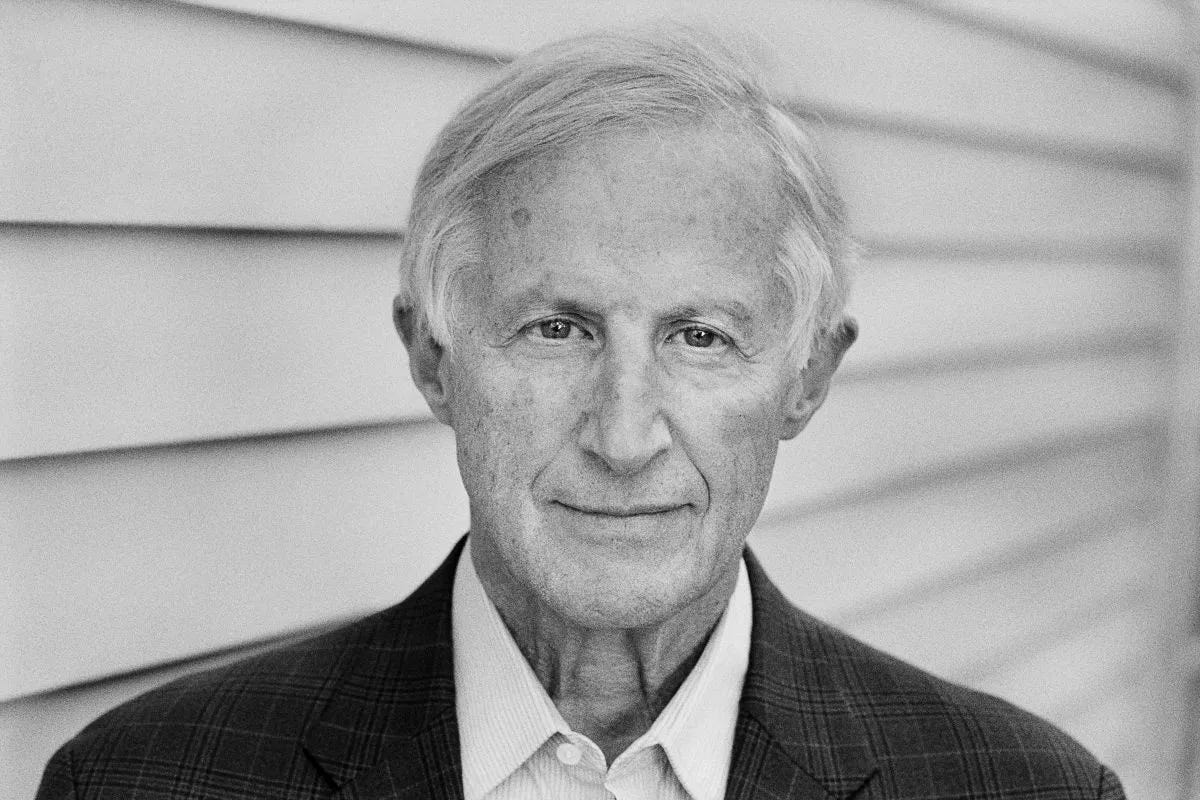
In the winter of 2005, I went to the Yale School of Forestry and Environmental Studies (now School of the Environment) for a panel discussion about The Death of Environmentalism. Amidst the whirlwind of speaking engagements and interviews that attended the controversy, I’d not even thought to tell my uncle Bill that I was coming. But as I walked onto the stage and looked out at the audience, there was Bill, right there in the front row with my aunt Barbara, beaming.
I’m sure he thought a lot of that essay was bullshit. A lot of it surely was. But he was also one of the first people to understand, long before I did, its importance. It was a full-throated attack on ecoapocalypticism and embrace of technology, innovation, and adaptation. And it had come from inside the environmental movement.
Almost fifteen years later, I was among the handful of people he invited to join him as his guests when he received his Nobel Prize. I hadn’t expected it. I was, Bill let me know (not in a bad way), standing in for my late father, who had always been a key sounding board—the person Bill counted on to help him ground-truth, politically and legally, his academic work. But Bill also told me that he saw me as the person in the family who was carrying on both of their legacies, pragmatism being, in his estimation, something of the family brand.
There are moments in a career, and a life, that mark a gestalt shift. Bill was central to two of them for me, in the first case demanding, without ever saying so, that I, a sudden and somewhat accidental public intellectual, take my work as seriously as he did, and in the second, helping me understand that I had become, again somewhat unwittingly, the keeper of a family legacy that was larger and more important than my own work.
I’m far from the only person Bill deeply influenced. He was a wonderful father, teacher, and mentor. His work covered far more ground than the corner of it that my work overlapped with. He was impeccably polite and always thoughtful. And he didn’t suffer fools, and so, you didn’t want to make him suffer.
OG Climate Pragmatists
I like to refer to my father as the original environmental lawyer and Bill as the original environmental economist. There are, no doubt, others who would claim those titles. But it is safe to say that the Nordhaus brothers were doing environmental law and economics, respectively, long before either label existed. Not bad for two kids who grew up in the intellectual hotbed of Albuquerque, New Mexico, population 40,000, during and after the second world war.
Of the two, Bill was the more obviously brilliant. Family lore has it that the future economist devised a point system for the three brothers to bid on the best bed during a multi-week European family trip when they were teenagers. He studied with Robert Solow at MIT, where his doctoral group included three others, Joseph Stiglitz, George Akerlof, and Robert Hall, who would go on to win Nobel prizes, and a fourth, Martin Weitzman, who should have. At 26, he was hired as an economics professor at Yale. At 32, he received full tenure.
I’ve written elsewhere about my father’s role in the development of federal environmental law and policy. Bill’s role in bringing economics to environmentalism and environmental concern to the study of economics was, inarguably, even more foundational.
Almost a decade before Julian Simon made his famous bet with Paul Ehrlich, Bill had already demonstrated why industrial societies, thanks to price mechanisms and market forces, would not collapse due to the exhaustion of natural resources. Over a decade before James Hansen and Bill McKibben introduced the issue to Congress and the American public, Bill had published the first serious exploration of the societal risks, responses to, and costs of climate change, and notably, the first suggestion that the world might attempt to limit warming to 2 degrees above pre-industrial levels.
Yet when I asked the colleagues and collaborators he had brought to Stockholm as his guests for his Nobel ceremony what they thought his most important work had been, none mentioned either paper. Only one named his DICE model, for which the prize had been given. All the others named his paper on the extraordinary decline in the historic cost of lighting, from which he estimated the true economic benefit of technological change.
What distinguished Bill’s work was not just his technical brilliance as an economist but his creativity. His gift to the Nobel museum was the Roman oil lamp that he had acquired to estimate the amount of labor that was necessary to produce an hour of light two thousand years ago. The DICE model, for which he won the prize, was no less a labor of love. In this era of vibe coding, it is hard to appreciate the technical challenge of building the early energy and climate models, first with computer cards and primitive computers, and eventually integrating economic activity, emissions, climate change, and damages into the DICE model.
Climate change marked a new sort of environmental problem, one that was truly global in scope and rife with uncertainty and collective action problems. Bill’s singular contribution was to make the problem legible and tractable, to break it down into its principal components. How much will it cost society and how much will it cost to mitigate it? What factors will determine those costs, and what levers do societies have to pull to address them? It’s all there, technically in the DICE model and conceptually in that original 1975 paper.
The Degrowth Troll
In the years after he won his Nobel Prize, there has been something of a backlash to Bill’s work from the environmental Left. He had no interest in social media. But if you search for his name on Twitter and Bluesky, you will quickly discover that he supposedly didn’t think we needed to concern ourselves with global warming because “Most economic activity occurs indoors.”
The claim misrepresents a paper he published in 1991 that evaluated the sectors of the economy that might be directly, versus indirectly, impacted by climate change. But the trolling was not remotely limited to social media. The week he received his Nobel Prize, Foreign Policy published a long essay by a leading degrowth advocate, Jason Hickel, titled “The Nobel Prize for Climate Catastrophe.” In it, Hickel bizarrely insists that the DICE model itself was responsible for three decades of climate inaction. “The models showed that if we were to rapidly reduce carbon emissions in line with what scientists say is necessary to avoid climate breakdown – by putting a high tax on carbon, for instance – it would significantly slow down the rate of economic growth.”
Around the same time, a heterodox economist named Steve Keen made something of a name for himself with the similarly titled “The appallingly bad neoclassical economics of climate change.” Like Hickel, Keen’s criticisms, which were widely featured in mainstream publications like Bloomberg, Reuters, and The Guardian, took aim at various methodological issues in the DICE model (the meme about most economic activity occurring indoors was first formulated by Hickel as 4% in his 2018 Foreign Policy essay and then inverted by Keen).
But the original sin for both, and many others who piled on, was Bill’s original debunking of the Limits to Growth analysis. “Economics went astray from the path towards biophysical realism in 1776, with the publication of Smith’s Wealth of Nations,” reads the abstract from one recent Keen lecture. “[B]ut the weapons of mass distraction… were crafted by Neoclassical economists, commencing with Nordhaus’s uneducated dismissal of the Limits to Growth.”
“While Nordhaus has spent most of the past four decades calling for gradualism to preserve the conditions for economic growth,” Hickel wrote in Foreign Policy, “the IPCC calls for radical and immediate action in order to preserve the conditions for life. Growth versus life. The conflict between economics and science has never been clearer.”
The methodological criticism, in other words, was mostly window dressing for the underlying ideological objection, which is that there was no point in balancing economic growth and environmental protection because unless we ended economic growth, environmental catastrophe was going to inevitably destroy the economy. That notion has travelled under a variety of banners (e.g. Limits to Growth, steady-state economics, ecological economics, degrowth). Anybody with even a little bit of familiarity with post-war environmentalism will recognize that these claims long predate Bill’s efforts to integrate the consequences of climate change into macroeconomic growth models and, indeed, scientific understanding that the climate was warming due to human emissions of greenhouse gases.
Turning the Dials on DICE
That doesn’t mean that there are not many legitimate methodological criticisms of DICE. Nicholas Stern famously criticized the DICE model’s use of a social discount rate derived from private markets. Martin Weitzman argued that Bill’s approach failed to account for low probability catastrophic risks in the tails of the climate risk distribution. Others objected that the DICE damage function modeled a smooth, continuous relationship between rising global temperatures and economic damages, failing to account for the possibility of non-linear tipping points. On the less catastrophic side, economists Robert Mendelsohn and Matthew Kahn believed that DICE failed to account for the dynamic adaptive capacities of human societies.
Bill had thought longer and more coherently about these questions than just about anyone else and, in my admittedly biased opinion, had compelling answers to most of them.
Stern framed his objection as an ethical one. We should value the welfare of future generations equally to that of current generations. Bill took a different view of the ethics of social discounting, arguing that low social discount rates implicitly required poorer people today to pay for the cost of mitigating climate change for richer generations in the future. That debate kicked off two decades of technical work on social discounting. Bill in recent years modified his social discount rate to reflect a lot of that work. But he never accepted Stern’s intergenerational equity claim, which he saw as deeply unfair to present generations, most especially the global poor.
The Stern debate, in turn, led directly to Bill’s debate with Weitzman about catastrophic risk. Weitzman largely agreed with Bill’s criticism of Stern’s near-zero discount rate. But he argued that conventional cost/benefit analysis couldn’t properly capture tail risks and tipping points, the sorts of things that potentially could result in economic catastrophe. Tail risks, he argued, if properly accounted for, could result in a much higher social cost of carbon. But because those risks were, by Weitzman’s own reckoning, unquantifiable, he didn’t think there was much to be done about it other than to buy more insurance by paying a higher carbon price, a practice that Bill adapted in the most recent version of DICE by adding an uncertainty premium into his damage function.
I had my own arguments with Bill. I thought he tended to overemphasize the efficacy of pricing and underestimate the value of innovation, even though DICE consistently found that the rate of assumed technical change had a huge impact on the cost of mitigation and hence, the cost-effective level of emissions reduction that might be achieved. The conditions under which carbon pricing was efficient—only when the price was globally harmonized and revenue neutral—struck me as far more restrictive than his top line conclusions suggested. And I thought he, for a long time, underestimated the political challenges associated with pricing carbon even at the comparatively modest levels that DICE generally found to be optimal.
Bill didn’t deny any of these issues. He was skeptical of efforts to endogenize learning in integrated assessment models. In later years, he proposed carbon clubs to address the collective action problems that bedeviled the prospect of a harmonized carbon price. And he, like a lot of people, became more cognizant of just how serious the political challenges of taxing carbon are. “Carbon taxes have proven a toxic mix with politics,” he told the New York Times after the passage of the Inflation Reduction Act. “Subsidies, by contrast, are catnip to the elected.”
But the important thing to keep in mind around the various debates and criticisms that followed his climate work was not what he might have gotten wrong but the fact that none of us would have had a language to talk about the economics of climate change without the basic framework that he conceptualized in 1975 and formalized in 1992.
You can absolutely turn the dials differently on the DICE model and get a very different result than Bill did. Turn up climate sensitivity and the damage function and the social cost of carbon will be much higher and the economically optimal level of future warming much lower. Turn the discount rate down and future costs of climate change are much higher. Turn up the assumed rate of technical change and the cost of mitigation is much lower.
Bill made his own judgments about where to set those parameters, and was extremely transparent about what they were based on, publishing voluminous documentation on every parameter in the DICE model. He also, critically, made DICE open source, so that others could set the dials differently.
Don’t like the quadratic function that Bill used to estimate climate damages? Insert your own function and see what happens. Interested in endogenizing technological change in DICE? Use his code to build a better mousetrap. Over the course of the last 35 years, hundreds of scholars used DICE to do exactly this, testing different parameters and functions to see what would happen.
In this, what was most important about DICE as a tool was not the top line estimates of the social cost of carbon or the economically optimal level of future warming that Bill used DICE to estimate. Nor was it his conclusions about the economic efficiency of a global carbon tax. Rather, it was that, in the face of enormous uncertainty about almost every facet of the problem, DICE elucidated which factors the economics of climate change was most sensitive to.
Insofar as we are able to have a coherent public debate about any of these questions, we can thank Bill for making that possible. And insofar as there is now a generation of economists who have used DICE to push on questions such as discount rates, tail risks, and endogenous innovation, we can also thank Bill.
That, ultimately, is the highest compliment one can pay to a scholar. Bill didn’t just put some interesting ideas out into the world. He created an entire field, defined the central questions it would pursue, and inspired a new generation to go further and deeper to answer those questions.
He also inspired me, and helped me figure out who I needed to be in the world. He was immensely generous to me personally and intellectually. I am forever indebted to him.
Rich combination of loving tribute and crisp rhetoric about complex ideas. I tip my hat!