

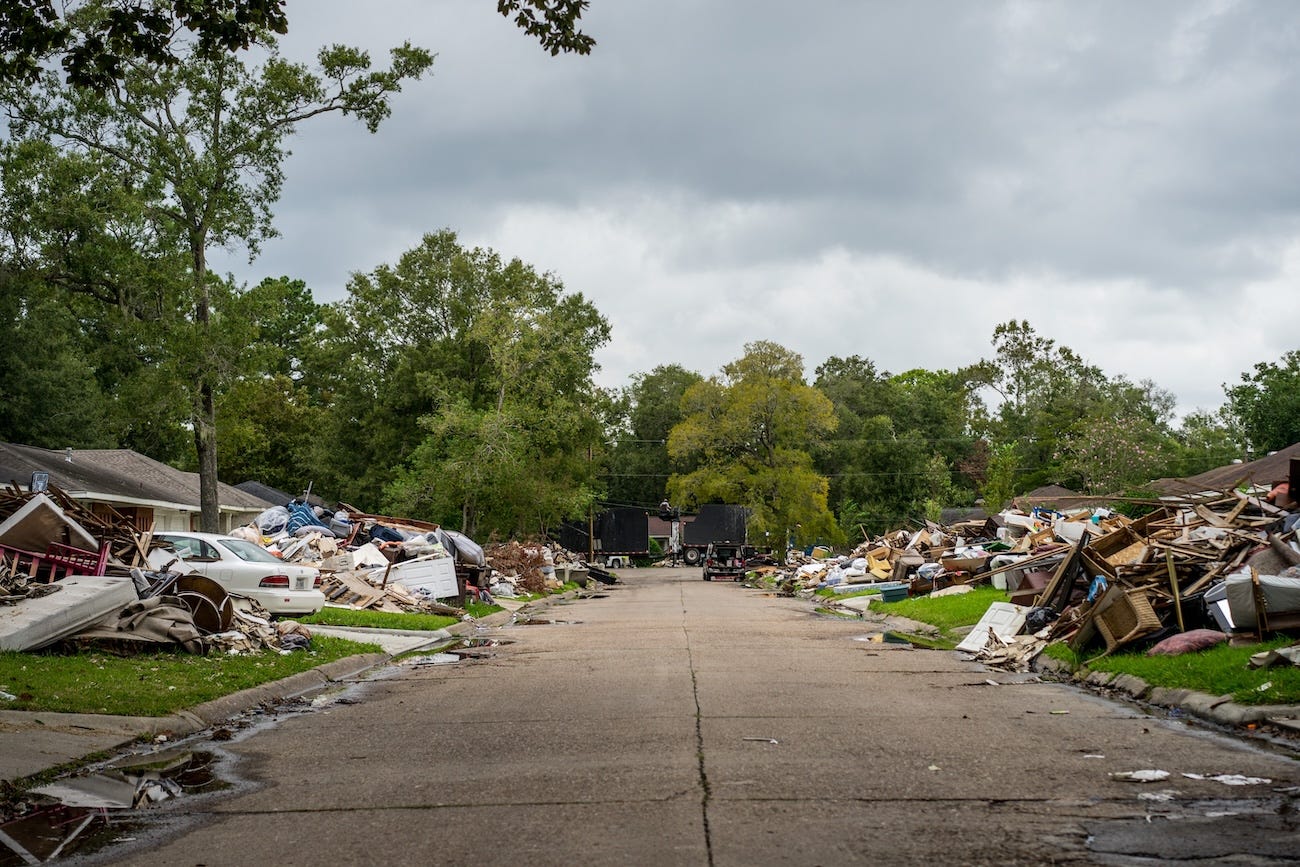
On Monday, the Supreme Court heard a threshold question in Suncor Energy (U.S.A.) Inc. v. County Commissioners of Boulder County: whether cities and counties can sue oil companies for climate damages under state law, or whether federal law bars those suits before they begin. Dozens of similar cases are pending in state courts, seeking billions from energy companies for harms caused by global climate change.
While the Suncor complaint itself is vague on how to determine the precise economic damages caused by the defendants, subsequent litigation has relied more and more on event attribution that apportions the increased likelihood of a natural disaster, and its proportional economic harms, to the effects of global warming and even to specific emitters.
In May of this year, the Breakthrough Institute filed an amicus brief in Suncor, petitioning the Court to reverse the Colorado Supreme Court’s ruling that localities and other private parties could sue emitters under state tort law.
Then in July, the National Academies of Sciences released a report summarizing the state of the climate impacts attribution literature. As the NAS report concludes, the attribution methods that were becoming common when Suncor was filed in 2018 are “no longer considered best practice” and nowhere near justiciable under current US law.
What the Court rules in Suncor, which we will not know for certain until next year, could have a range of ramifications for state and local climate liability cases, and for the legal validity of claims relying on climate attribution science.
The trouble with climate attribution science
The NAS report provides a useful update on the state of climate impacts attribution science. As the authors note, attribution science is now mature enough that studies are published within days of an event. The report found, with high confidence, that heat extremes and large-scale heavy rainfall become more likely and more severe due to planetary warming. But while these extreme climatic events cause real-world damage, the report does not support converting that estimate into a monetary figure, since such a conversion cannot be made with the same level of confidence.
Among other scholars, the NAS authors credit the work of Breakthrough Institute senior fellow Patrick Brown for advancing a major correction to the attribution literature.
Earlier attribution studies took an event’s total losses and multiplied them by the fraction of its probability that warming was responsible for. As Brown’s 2023 paper argued, this method assumes that an extreme weather event would have caused zero damage in the absence of global warming, which is almost always false. The main driver of extreme weather events remains the natural variability of the Earth’s climate, while climate change can be said to—in some cases—influence those events on the margin. Likewise, the total damage of any weather event is largely a function of exposure and vulnerability: the amount of wealth and infrastructure in harm’s way, and how resilient (or not) it is to climatic events.
Extra heat, energy, and moisture associated with anthropogenic carbon emissions can be estimated to have influenced an extreme weather event relative to a counterfactual. These estimates are contested, but they certainly tell us little about the “impact x fraction of attributable risk” (IFAR), or the portion of the social cost of an extreme event that can be attributed to global warming.
As the NAS authors conclude, this IFAR method “likely biases the cost of extreme event impacts” and is “no longer considered best practice.”
Suncor does not involve claims relying on single-event attribution, but it could clear the way for cases that do. There are dozens of climate litigation cases in state and local courts, many of which share the same kind of error the Academies have just flagged.
An analysis of the Sabin Center for Climate Change Law’s database on climate litigation shows five damages suits of this kind were filed between 2005 and 2016. 34 have been filed since 2017, eight in 2024 alone. About 30 are pending now. Most are on hold until the Supreme Court rules on Suncor. In each one, a city, county, state or tribe is suing oil and gas companies in state court.
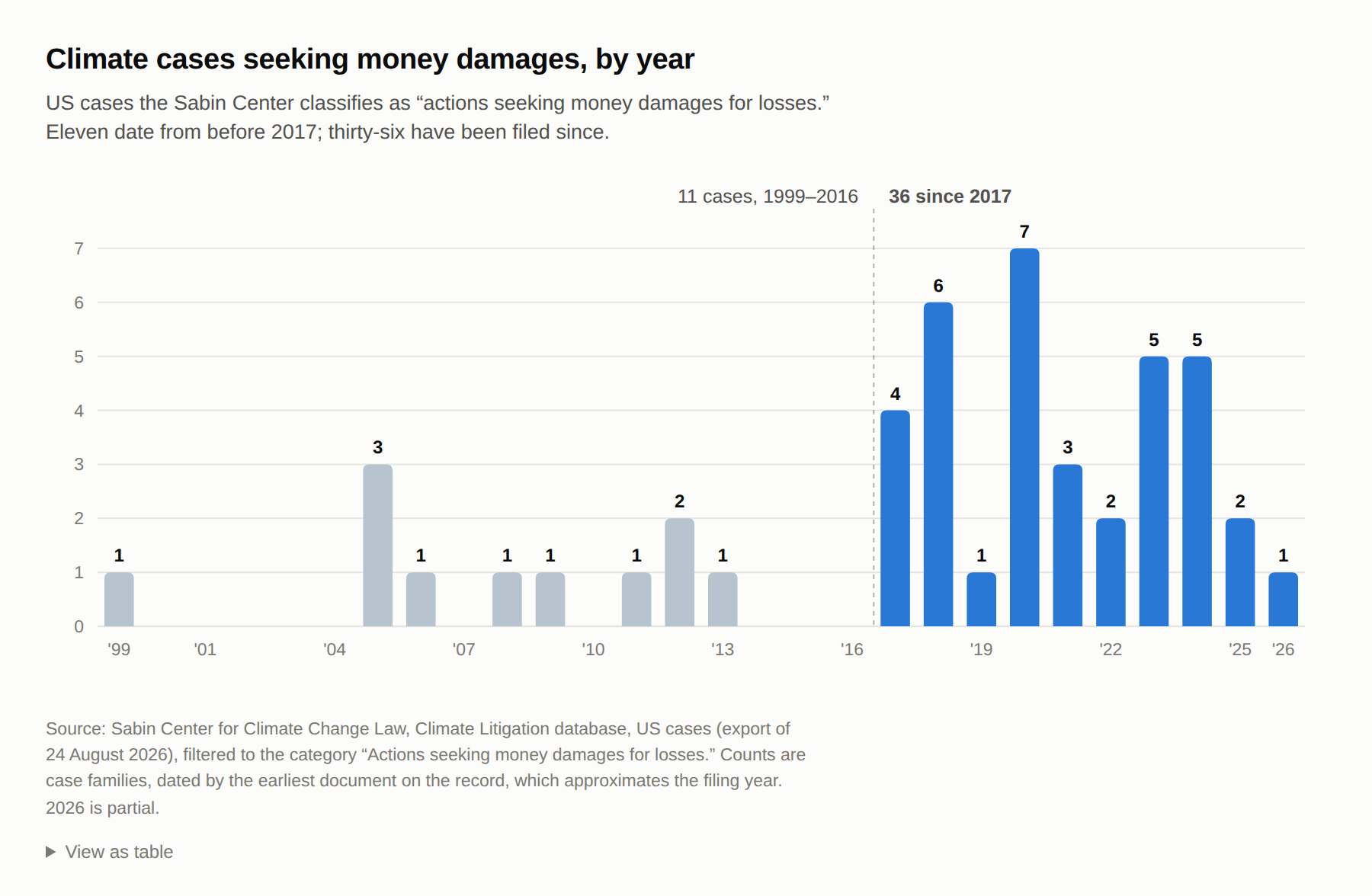
Though climate liability and damages litigation is in its third decade, no court has resolved the practical complaints within these cases. American courts have never awarded climate damages or ruled on how to calculate them. The cases that have reached appellate courts have been decided on grounds of removal and preemption, and they have been resolved without anyone examining the methodologies. The Court’s ruling in Suncor v. Boulder will be no different. It will not decide whether a share of emissions is a good enough answer to who caused the harm. It will decide whether anyone gets to ask.
The science is out, but the jury is in.
The first studies to put a dollar figure on an event used IFAR, multiplying the whole bill by the share of the event’s probability attributable to warming. The Academies show the limits of these methods by working through how they were applied after Hurricane Harvey, which hit the US Southeast in 2017. Harvey caused about $90 billion in damage. Published attribution studies had put the fraction of the storm’s rainfall risk attributable to warming at roughly three-quarters. A 2020 paper in Climatic Change multiplied the two and reported $67 billion in damages attributable to climate change.
That is the calculation the Academies now recognize as severely limited because of the counterfactual it assumes. Using IFAR treats events as absolute. Either it happens and does its full damage, or warming never occurs and the damage is zero. But a storm made marginally worse by warming is still just a storm. If warming turned a 249-millimeter rainfall into a 250-millimeter rainfall, the attributable damages are only those caused by the additional millimeter of rainfall, not the damage done by the whole storm. In Brown’s example, the standard method assigns such a storm’s full $10 billion in damages to warming, though the extra millimeter caused only $100 million of it.
The complaints substitute a share of emissions for a share of the damage, replicating the same issue. A company’s share of historical emissions tells you how much of the warming it caused. It tells you nothing about how much of a county’s drainage bill is due to warming, rather than subsidence, or development on a floodplain, or local population growth since a sea wall went up. Multiplying the bill by the emissions share assumes all of it is the result of climate change, and that damage rises linearly with tons of greenhouse gases emitted.
The Academies recommend a different approach: model how damage actually responds as intensity rises, instead of assuming it scales. Instead of multiplying by a change in probability, they multiply by a change in intensity—how much hotter it got, how much more rain fell. Notably, Brown argues the same objection applies. Treating a rise in intensity as if it produced a proportional rise in damage assumes a relationship nobody has established, and these methods have not been examined as closely as the ones they replaced.
Boulder County’s litigators do not provide a figure for what Suncor and Exxon owe; a jury would decide that if the case reaches trial. The complaint lists some costs from recent extreme weather events: more than $100 million in damage to county roads and bridges from the 2013 flood, $27 million in damage to city property, and $24.6 million to buy out flooded homes. The complaint argues that climate change caused by the defendants’ emissions worsened these disasters, so the defendants should pay their “share of the costs” without ever calculating that share.
13 of the 39 climate lawsuits we identified cite Richard Heede’s Carbon Majors data as the source for each company’s emissions. Heede produces these figures by adding up what each company sold and converting it into the emissions released when those fuels were burned. That figure indicates roughly how much warming a company’s products caused, not how much of the county’s bill warming caused after a severe storm.
A court that lets one of these cases go forward will eventually have to pick a number, and it has no good way to do it. The FAR method used to derive costs from emissions is no longer accepted by the leading scientific authorities. If they reach trial, a judge will decide whether an expert’s method for pricing the damage is reliable enough to put before a jury, and the jury will pick a number. Once one court accepts a method, lawyers in the next case will point to it.
The legal test for expert evidence asks whether a qualified expert’s method is reliable enough to put before a jury. But that test is built for settled fields, where the judge ratifies a consensus rather than choosing one. For Hurricane Harvey, the 2020 Climatic Change paper gave a best estimate of $67 billion in damages attributable to climate change, with a likely range of $30 to $72 billion. A regulator can set a figure in that range and revise it later. But while neither the NAS, Brown, nor any climate impacts research body has settled on how to calculate such a figure, a jury will return just one number.
Whatever number the first court picks will outlive the case that produced it. While science corrects itself through replication, litigation simply relies on precedent. Suncor v. Boulder has the potential to set a standard for the 30 more climate lawsuits waiting for decisions.
In other words, no method for calculating damages from emissions is settled. Courts that rely on one would effectively set a standard rather than apply it. 30 courts doing that separately are unlikely to reach the same answer, and companies will have to defend the same conduct under each one.
Open-ended retroactive liability raises the cost of capital for infrastructure financed over decades, and those costs reach consumers. Justice Carlos Samour, dissenting when the Colorado Supreme Court allowed Boulder’s case to proceed, called it a “patchwork of inconsistent local standards that will beget regulatory chaos.”
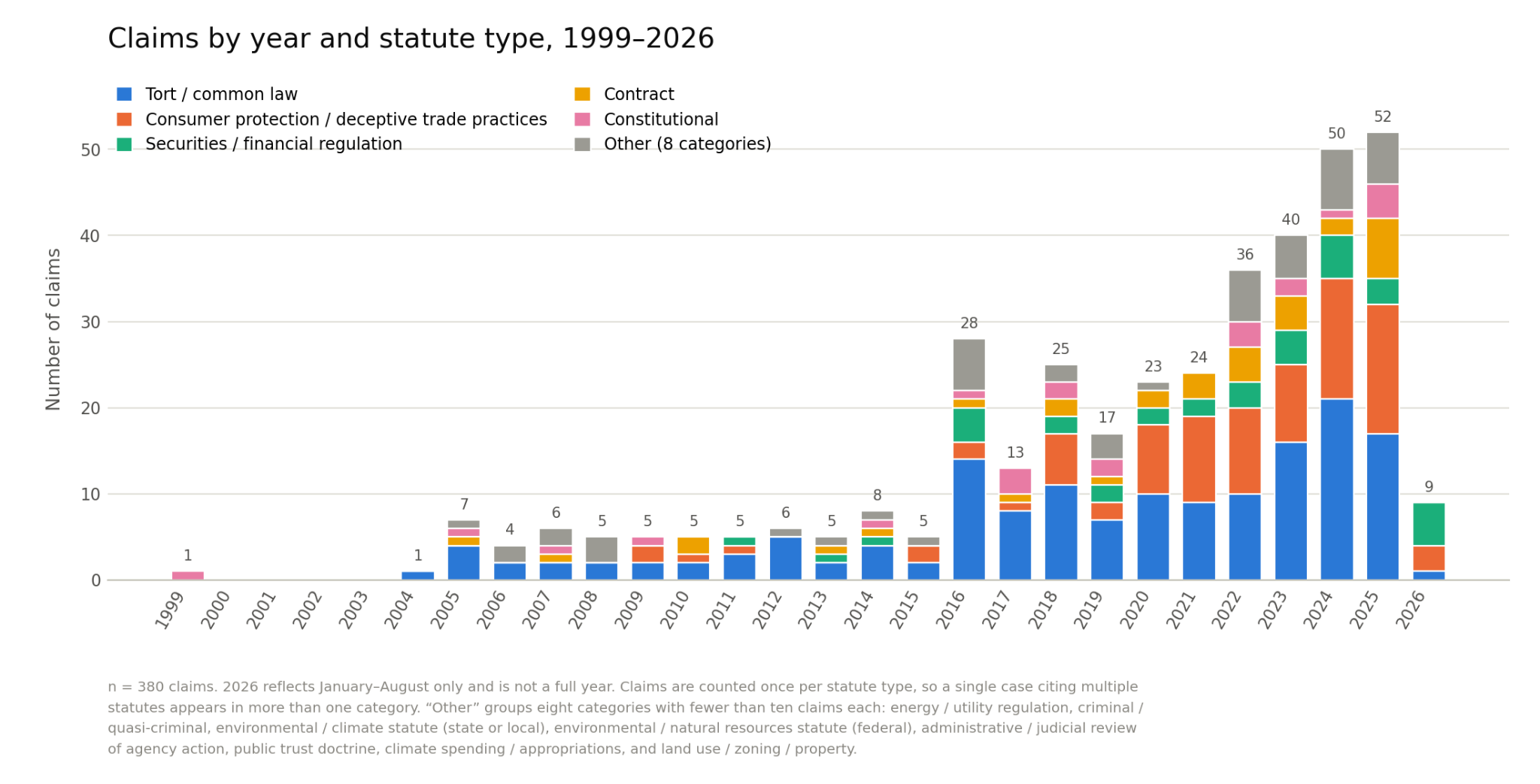
It appears that climate liability litigators are wise to the flaws in attribution science, having begun to move on from tort claims to claims over consumer protection. As our analysis of the Sabin database shows, consumer protection suits are mounting, while tort claims may have already peaked.
Climate policy legislated, not litigated.
The NAS report provides a helpful corrective to the activist litigators who treat climate attribution as settled science and climate liability as settled law. Neither is the case. Attribution science does not and cannot provide justiciable claims of harm, let alone put a dollar amount on those harms. The mechanism of harm is simply too disintermediated and uncertain for such a calculation to take place.
To the extent law and policy impose penalties on emitters, those penalties need to be legislated, not litigated, and they need to be prospective, not retroactive. No robust scientific or legal principle can produce the monetary legal liability that climate litigants are demanding.