

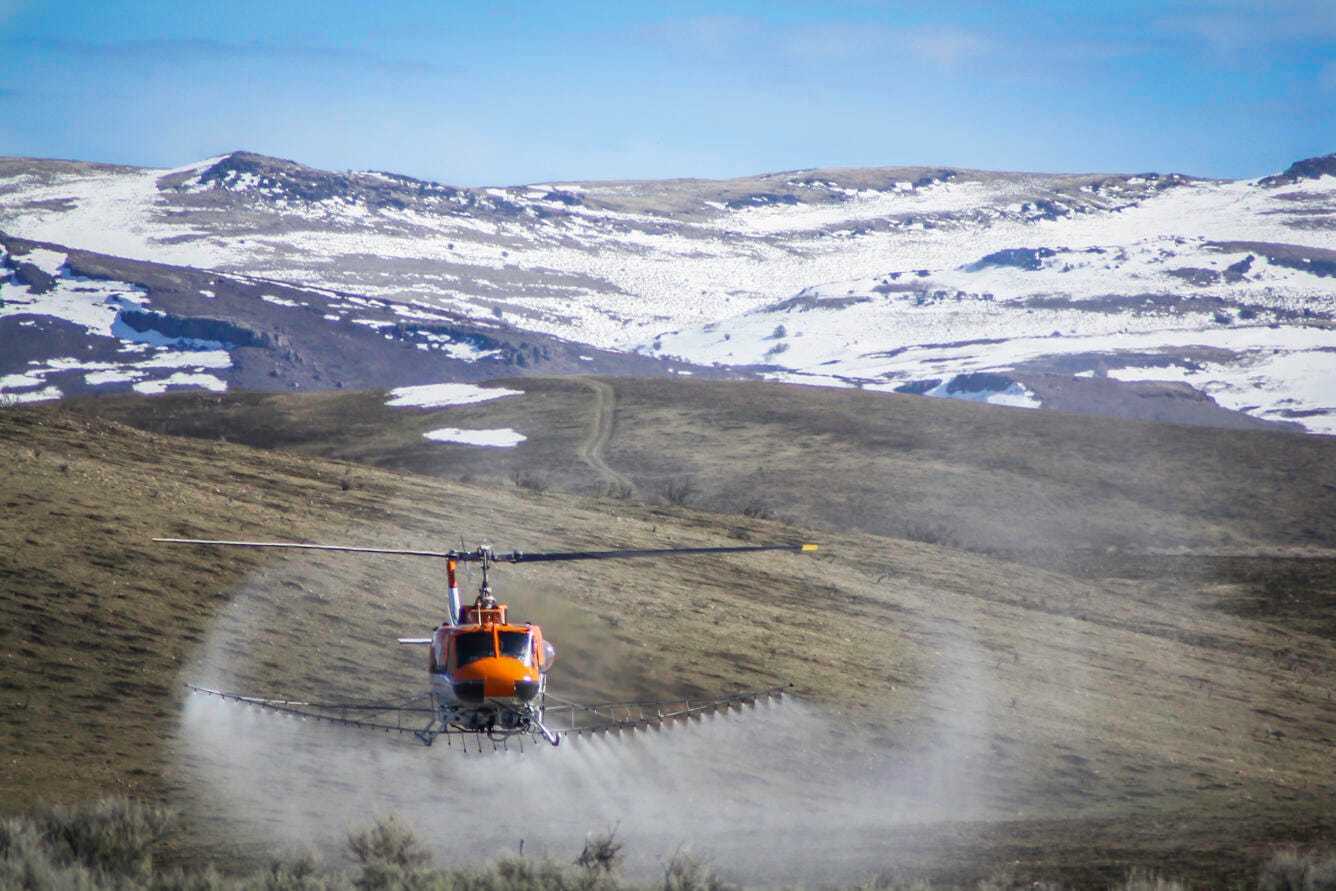
A recent Mother Jones’ investigation ran under the headline “We Are Bombarding America’s Forests With Roundup.” The authors claim that the use of herbicides as part of post-fire vegetation control efforts are a malicious plot turning national forests into tree farms and dead zones.
For many, this story might invoke images of aerial clouds of glyphosate blanketing forests, reminiscent of propeller planes leaving trails of DDT in their wake. And yet, today, glyphosate, the active ingredient in Roundup and other herbicides, is used sparingly on National Forest System land. While it can be sprayed aerially, the U.S Forest Service most often applies glyphosate via targeted methods. Crews use backpack sprayers or ground equipment to spot-treat specific vegetation to support post-fire regeneration of trees for timber production, manage invasive species, and reduce hazardous fuels for fire management.
In some settings, manual removal or other non-chemical methods can produce better ecological outcomes; but, in others, herbicides, like glyphosate, represent the best and most cost-effective way to support forest management. And despite the alarmism from Mother Jones, glyphosate use in California and the rest of our National Forests is vanishingly small, has minimal environmental impacts relative to alternatives, and is crucial to conducting the forest management projects needed to mitigate wildfire risk and protect ecosystems from invasive species.
Glyphosate use, whether on farmland or in national forests, isn’t wholly without ecological effects. A 2024 study found glyphosate-based forest vegetation management can alter nutrient patterns in understory plants. However, the existence of ecological effects is not itself a good argument against use. Whether vegetation control is done with chainsaws or herbicides, active forest management will have ecological impacts. So do unchecked invasive species and catastrophic wildfires.
Annual Forest Glyphosate Use, In Context
Public reporting on herbicide use, much less specifically glyphosate use, in the U.S. has been inconsistent over the years and today is totally unavailable. As recently as this June, Democrats in Congress asked the Forest Service to publicly report its current and planned use of glyphosate-based herbicides on federal forestlands. Even so, it’s safe to say glyphosate is used on a tiny fraction of America’s public lands.
In 1994, the United States Forest Service said less than 0.1% of National Forest land was treated with chemical herbicides in a typical year. Over a five year period from 2000-2004, the Forest Service applied a total of 173,000 pounds of glyphosate on around 84,000 acres, or about 2 pounds per acre. Across the Forest Service’s roughly 193 million acres, that works out to 0.009% of National Forest System land treated with glyphosate each year on average.
The Forest Service hasn’t regularly published national data on pesticide use broken down by active ingredients on public lands since 2004, making year over year trends on glyphosate use hard to track. Public lands agencies besides the Forest Service reported herbicides were used specifically for invasive plant management on just over 2.5 million acres from 2007 to 2013. This represents 0.5% of the nearly 500 million acres of public lands managed by the U.S. Bureau of Indian Affairs, the U.S. Fish and Wildlife Service, the U.S. National Park Service, and the U.S. Bureau of Land Management. Glyphosate was far and away the leading active ingredient both in terms of amount applied and area treated.
Still, these national glyphosate-use statistics are pretty old. So, understandably, Mother Jones attempted to provide a more recent accounting, reporting 266,000 pounds of glyphosate was used in California’s forests in 2023. This has led to renewed calls to oppose the Forest Service’s use of herbicides.
The problem? The vast majority of glyphosate use in forest contexts in California happens on private forestland, not in National Forests. This caveat is important because while states can impose restrictions on pesticide applications on private land or go so far as to restrict use of a specific pesticide altogether (though none have done this for glyphosate), the Forest Service has no regulatory oversight over private landowners or commercial timber practices on private property.
Using the same publicly available data as the Mother Jones analysis, we found that about three-quarters of California’s reported forest glyphosate use by weight occurred on private land. Only about 5% could be definitively assigned to National Forest land, leaving roughly 20% of reported use occurring in areas where there was a mix of private and public ownership. To better estimate use in these mixed-ownership areas, we conducted an additional spatial analysis and found that roughly 18% of California’s reported forest glyphosate use by weight occurred on National Forest land.
That works out to about 47,000 of the 266,000 pounds reported statewide. But even that figure can make glyphosate use on public lands sound more extensive than it is. Our analysis estimates roughly 16,750 glyphosate acre-treatments on National Forest land that year. Compared with approximately 20 million acres of National Forest land in California, that is equivalent to less than 0.1% of the land base. And because the state reports cumulative acre-treatments rather than unique acres—meaning the same acre can be counted more than once if it is treated repeatedly—the actual share of National Forest land treated could be smaller still.
Glyphosate can be applied at higher rates per acre in forestry than in agricultural settings, in part because forest vegetation management can involve controlling shrubs, hardwoods, and other woody plants. Application rate measures how much active herbicide is applied to an acre in a single treatment. Historical Forest Service data from 1998-2016 show that glyphosate used for site preparation or conifer release in the Pacific region averaged 2.4 lbs of acid equivalent per acre per application in the Pacific region, higher than typical application rates for many agricultural uses. But forestry herbicide applications vary considerably by purpose. Invasive-plant management on public wildlands often involves targeted treatments using a range of herbicides at much lower average quantities per treated acre relative to crop-production systems.
A higher application rate does not necessarily mean more intensive herbicide use over time. Especially when used for site preparation before planting, herbicides are typically applied once or twice over a rotation, which can be between 30 and 80 years depending on the species. By contrast, for some crops, multiple agricultural applications are used within a single year.
Application rates also differ substantially among herbicides, making pounds alone a poor measure for comparing how extensively different chemicals are used, or their cumulative effects. For example, in California forests, imazapyr looks much smaller than glyphosate in pounds but far closer to it in treatment acreage. Glyphosate accounts for about 2.84 million reported pounds and 1.32 million acre-treatments from 2000 through 2023, compared with imazapyr at about 498,000 pounds but 972,000 acre-treatments. Glyphosate use was nearly six times greater by weight, but only about 1.4 times greater by cumulative treatment acreage.
All of this context changes the picture considerably. California’s 266,000-pound figure is not evidence that state and federal land managers are broadly spraying glyphosate across public forests. Most reported forestry use occurs on private land that’s already engaged in commercial timber production. And while glyphosate is one of the widest used herbicides by weight, it is much less dominant by treated acreage.
Whatever the legitimate debates over where and when herbicides should be used, the scale of public-land use is far smaller than the rhetoric of forests being “bombarded” with glyphosate would suggest.
The Uncomfortable Pros of Glyphosate Use in Forests
Glyphosate binds strongly to soil and does not substantially bioaccumulate, with a 30 day average half-life in temperate soils and water. In addition to low soil persistence, glyphosate has broad-spectrum efficacy, low volatility, and poses lower risks to non-target organisms than many alternative pesticides. This makes glyphosate a favorable product that forest managers rely on for a range of public and environmental benefits including forest regeneration, invasive-species control, and fuels management for wildfire risk reduction.
Aiding forest regeneration. In the Pacific Northwest, glyphosate is used against native shrubs, as well as grasses and broadleaved weeds when preparing timber sites for replanting. Controlling these species down to the roots can allow planted trees to reestablish and thrive. Hand-weeding or mechanical removal can do this work, but it’s far more expensive, time-consuming, and labor intensive.
A 25-year California research program led by the Forest Service found herbicide treatment was the most effective vegetation-management method studied on conifer plantations, domestic grazing was ineffective under the conditions studied, and large-machines worked only when followed by herbicide. Further illustrating what a ban would look like, litigation in the 1980s led a federal district court to temporarily prohibit herbicide use on National Forest lands in Oregon and Washington that was in effect until 1989. As a result, the Forest Service’s J. Herbert Stone Nursery in Oregon reported hand-weeding costs after the ban reaching as much as five times prior total weed-management costs.
Critics argue that using herbicides to favor planted conifers can suppress the more diverse mix of native trees, shrubs, and other vegetation that would otherwise regenerate after a fire. Those tradeoffs are real. But, planted forest regeneration and native ecosystem restoration are different objectives entirely. According to the latest National Forest System inventory, only about 4% of NFS forest land is planted rather than naturally regenerated, roughly 6 million acres nationally. Management objectives—whether reestablishing planted trees destined for timber production, restoring a diverse native understory, or controlling an invasive species—matter when evaluating useful tools.
Controlling invasive species. Allowing invasive species to persist can lead to ecological consequences like the decline of threatened and endangered species, reduced plant diversity, degraded wildlife habitat, degraded water quality, and decreased opportunities for recreation on public lands. For example, since its North American introduction in the late 18th century, Tree-of-Heaven threatens native ecosystems across eastern U.S. National Forests by secreting root toxins and acting as the primary host for the destructive spotted lanternfly—an invasive insect that devastates forest understories, agricultural crops, and timber species. Because simple cutting causes the invasive tree to aggressively resprout, land managers across Wayne, Allegheny, George Washington and Jefferson National Forests have used targeted “hack-and-squirt” applications to deliver glyphosate directly into the tree’s sapwood, killing the root network while protecting surrounding plants.
Invasive species can be controlled in other ways, including mechanical removal, hand weeding, prescribed fire, grazing, and biological controls, and herbicides are not necessarily the best option in every setting. A 2023 Forest Service-led systematic review of 165 studies found that invasive-plant treatments, including herbicides, could produce positive, negative, or neutral effects on native vegetation depending on the species, treatment, intensity, and duration. As one example, both glyphosate treatment and hand-pulling reduced English ivy, but plots where ivy was pulled by hand subsequently had more native seedlings and greater plant diversity than sprayed plots. The researchers suggested that soil disturbance from pulling may have helped the planted native seeds establish.
But that result does not generalize to every invasive plant or landscape. Manual removal can disturb soil, facilitate reinvasion, and become prohibitively expensive at larger scales. Many environmental reviews conducted by the Forest Service evaluate “no-chemical” alternatives. These reviews typically find that relying exclusively on hand-pulling or mechanical clearing costs significantly more per acre, limits the total acreage that can be treated under a fixed budget, and requires years of repeated labor compared to chemical treatments, all especially true for managing root-sprouting perennials. Other considerations like presence of desirable native vegetation, proximity to waterways, and chemical resistance can determine whether glyphosate is an appropriate tool amongst a broad slate of options for integrated vegetation management in forests.
Reducing wildfire risks. While not a leading hazardous fuel treatment strategy in the way large scale mechanical thinning or prescribed fire are, herbicide use can contribute to wildfire-risk reduction in some circumstances. BLM used herbicides while seeding following Idaho’s 280,000 acre Soda fire in 2015 to prevent exotic annual grass invasion and build fuel breaks to help stem the spread of future fires. In fire behavior simulations for areas dominated by exotic annual grasses, simulated flame height, fire spread rate, and heat were all reduced in areas treated with herbicides.
Critics often point to an EPA evaluation that found that glyphosate is “likely to adversely affect” 93% of listed species and 96% of critical habitats. This finding is not equivalent to concluding that existing glyphosate applications are causing population-level harm to 93% of endangered species. Further, avoiding herbicides will not eliminate risks to endangered species. Catastrophic wildfire can itself destroy critical habitat and threaten already-small populations. A 2017 wildfire in Arizona killed 217 of the 252 remaining Mount Graham red squirrels. Meanwhile, the U.S. Fish and Wildlife Service has identified catastrophic wildfire as a major threat to species including the southern Sierra Nevada fisher and Sierra Nevada red fox. While glyphosate, or any other hazardous fuel treatment, won’t outright prevent catastrophic wildfire, it is a tool that can reduce the severity of future fires in some landscapes.
The Bottom Line
Obviously it is possible to remove unwanted vegetation—invasive plants or hazardous fuels contributing to wildfire risk—from our forests without herbicides or machines or other technologies. But, doing it all by hand takes time, money, and labor. The reality is that we need to rapidly scale up active management of our forests in the face of growing wildfire and biological threats. Glyphosate offers real advantages in some situations.
There isn’t one-size fits all vegetation-management technique that is better for the environment. For a tiny infestation near a stream, manual treatment might clearly be preferable. For a steep 2,000-acre area being seeded after a fire, the calculus is completely different.
Good forest management requires balancing the ecological risks of treatment against the ecological risks of leaving vegetation unmanaged. Banning or rejecting herbicide use in national forests outright could result in higher forest management costs, slower restoration, and worse ecological outcomes without delivering meaningful environmental benefits.

Thanks for looking into this, Emily! I looked deeper into what the Lassen is actually doing in this post https://forestpolicypub.com/2026/05/11/are-we-bombarding-americas-forests-with-roundup-a-look-at-the-next-layer-down-of-a-mother-jones-piece/
This LA Times story looks at both sides.. https://forestpolicypub.com/2026/07/10/id-rather-my-house-burn-down-than-get-cancer-two-california-communities-fight-to-save-their-forests-la-times/
I do wonder a bit why this has become "a thing" at this point in time. Unless the point is to say "hey without herbicides we'll have brushfields, and so the ecosystems will transition, just like the climate doomers said"?