

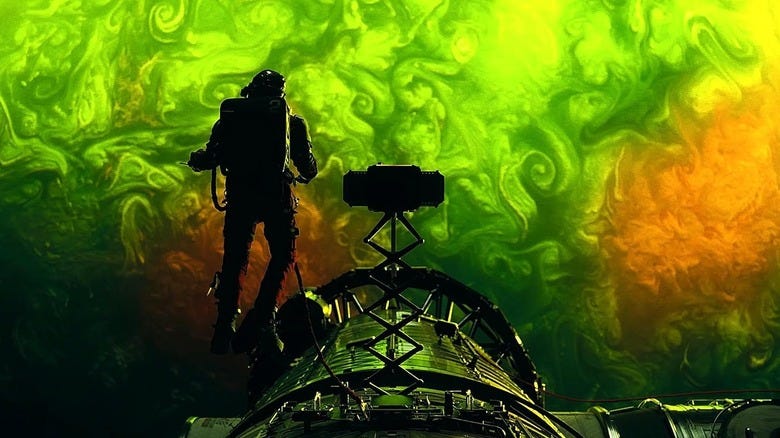
The recent film adaptation of Andy Weir’s novel Project Hail Mary opens with an astronaut coming to consciousness, alone on a spaceship, almost 12 light-years from Earth. What follows is a saga where that man, Dr. Ryland Grace (played by Ryan Gosling), seeks to engineer a solution to a crisis on his planet, inspired by the exploration of a distant solar system with the help of an alien friend.
But despite the plot’s distance from our own planetary reality, its statement on humanity and nature is profound. Mankind has dominion over Creation. And exercising technological power to bring out the potential of nature, with humility and love, is foundational to human and natural flourishing.
A mission for stewardship
The movie’s story is premised on a global cooling crisis in the near future. Scientists observe extraterrestrial microbes that metabolize solar radiation—called “Astrophage”—forming a film around the Sun. If the trend persists, a catastrophic ice age will arrive in a few decades, leading to famine and ecological collapse. Astronomers also find that this phenomenon is occurring on other stars too, with the lone exception of Tau Ceti.
Dr. Ryland Grace, a disgraced scientist turned schoolteacher whose heterodox astrobiology proves useful for the Astrophage crisis, is sent on a mission—the titular “Project Hail Mary”—with two other astronauts to investigate what makes Tau Ceti immune. Due to the distance and fuel constraints, the spacecraft can’t return. The astronauts are expected to send their findings back with remote probes and sacrifice themselves to save Earth and humanity.
After waking up from an induced coma, Dr. Grace finds that he’s the only surviving astronaut on the spacecraft. The pilot and engineer died mysteriously sometime before his coma lifted. But, Grace is not alone. Soon arriving to the Tau Ceti system, he finds that another spacecraft, manned by a benevolent alien we come to know as “Rocky,” is on a similar mission for his planet, Eridia.
Working together, Grace and Rocky investigate the Tau Ceti system, finding that a microbial predator—“Taumoeba”—is keeping Astrophage in check. With this knowledge, they develop Taumoeba for deployment on their own homes, and after feats of science, Grace and Rocky successfully send the engineered Taumoeba back home to save their planets.
Technology, humility, and love
Project Hail Mary not only suggests that technology is key to addressing our problems—it also shows how to approach active, technological management. The dominion ecology of the movie is centered on three elements of stewardship: the use of technology for cultivation, the humility of the good scientist and nature manager, and the love of home.
Clearly, the power of technology is a central theme of Project Hail Mary. The characters see the real threat that Astrophage pose—limiting Earth’s human carrying capacity in the near future—not as an immovable biophysical reality but as a technological challenge. Grace’s mission develops a technological solution that uses a natural predator-prey control mechanism, breaking the prior limit.
This story has overlap with the real world. As ecomodernists have long shown, the Malthusians and neo-Malthusians who model and discuss hard biophysical limits of human prosperity have been proven wrong again and again by technological progress.
Thomas Malthus’s insistence that England’s population growth would outpace food production was rebutted by early agricultural advancements in Britain. President Jimmy Carter’s concerns about peak oil were reprimanded by the technological advancement of fracking led by the likes of George Mitchell and Harold Hamm. And the infamous, late Paul Ehrlich’s disastrously wrong predictions about human population growth were roundly disproven by leaders of the Green Revolution like Norman Borlaug, who developed high-yield wheat through experiments in Mexico that likely saved hundreds of millions of lives. Project Hail Mary tells a similar story. Through the discovery and engineering of Taumoeba, Grace seeks to understand and work with nature to then shape it for the common good.
Grace’s particularly humble approach to technology and nature is notable. His dominion over nature isn’t one of a rationalist, top-down tyrant inflicting his will. Rather, Grace’s approach is one of respect—he recognizes that Tau Ceti can teach him something. Through careful investigation and trial and error, he and Rocky find an ecology in the solar system that they then use to engineer and iterate planet-saving technology. Grace is confident and takes risks, but his approach is bound by a respect for the limits of his knowledge. The Jurassic Park story and the disastrous real-world release of cane toads in Australia are the negative corollaries to Grace’s technological humility. The introduction of moose to Colorado and the construction of Dutch sea walls are positive corollaries—bold acts of natural dominion that elevate nature with a respect and love for it.
And it is love of home, for people and nature, that animates Grace and Rocky in the final analysis. Both characters have a love for the natural world manifested in their joy at knowing it through science. But their mission to save their planets with engineering is guided by a deeper love for their particular homes and communities.
In flashbacks, the audience learns that Grace was extremely resistant to the “Project Hail Mary” mission. Indeed, the duty was forced on him by a technocratic autocrat tasked with saving the world. As Kody W. Cooper observed, an abstract love of humanity didn’t initially compel Grace for the mission. But by loving his neighbor, Rocky, Grace awakens his love and duty toward his planet and his people.
Over the course of their developing friendship, Grace and Rocky discuss their relationships with their people and their homes. Rocky clearly has deep bonds with his romantic interest on Eridia, but absent an old girlfriend, Grace doesn’t have a corollary. We do see early glimpses of Grace’s longing for home in flashbacks to scenes with his students and as he often returns to a simulator that shows landscapes on Earth. But Grace’s innate love of people and home is developed by the sacrificial love Rocky shows him. When Rocky falls into a temporary unconsciousness after he saves Grace from spacecraft troubles, Grace works alone to engineer Taumoeba to save Earth and Eridia. After developing a particular relationship with Rocky over the course of their mission, Grace is prepared to take radical action to save the planet he’s always loved.
In doing so, Grace distinguishes his first duty to save Earth from his friendship with Rocky, while taking heroic actions to save him. As Grace embarks back to Earth after Rocky generously gives him extra fuel, he comes to a technological problem in his ship that he realizes would doom Rocky’s spacecraft too. But before backtracking to save his friend and abandoning hope of returning home, Grace is sure to send his Taumoeba samples back to Earth, ready to be used. The Taumoeba are deployed on Earth, and Grace ends up on Rocky’s planet of Eridia, with a terraformed landscape built for him, and the Eridians working to build a ship so he can return. In the end, it’s love and duty toward his people and his home, awakened by Rocky, that motivates and guides Grace.
Applied dominion
Despite the catastrophism of the climate alarmists, Earth doesn’t face the same degree of ecological challenge as represented in Project Hail Mary. We won’t see temperature averages change 10-15°C within thirty years that would require interplanetary alien microbe deployment, thank goodness.
What we do have are serious natural challenges and opportunities that require the daring of ambitious technologists exercising a humble and loving dominion. Recent history is replete with successes against these challenges, from the aforementioned Green Revolution and fracking boom to the rapid COVID vaccine development in Operation Warp Speed. But these projects aren’t inevitable—they require resolve and, often, public policy. With deliberate attempts to aim high and reject the hard biophysical limits of degrowthers, innovators can call out the potential of nature for the good of itself and everyday people. We need more of our own “Hail Mary” projects.
Facing the challenge of climate change will require ambitious ventures of natural stewardship. It’s true that a lot of the adaptation and mitigation work climate change requires can be accomplished with existing technology and approaches—active forest management, building energy infrastructure, and agricultural modernization. But now that global temperature averages are higher than any period in the last 100,000 years, climate change will require the humble, confident, and careful innovation of novel mitigation and adaptation technologies to be deployed where localities want. Marine cloud brightening can cool ecosystems and save coral reefs, as Australia is experimenting with right now. Glacial stabilization technology could slow the sea level rise that would drive mass migration and immense human suffering. Carbon dioxide removal through ocean enrichment could improve fisheries while mitigating climate change.
A similar opportunity exists for energy and industry. Massive public investment in research and commercialization made natural gas and solar the cheapest energy available. These projects have advanced both emission reductions and energy abundance. National projects to replicate this success to drive down the cost of even denser and cleaner energy resources like nuclear and geothermal could lead to three simultaneous outcomes. American industry would expand with new sources of cheap industrial heat and electricity. American families and families throughout the world would have lower energy costs. And by displacing higher-emission and higher-land-use resources, emissions and ecosystem loss would be mitigated. As the Breakthrough Institute’s Ted Nordhaus has pointed out, Secretary of Energy Chris Wright’s DOE has taken admirable steps to do just this, especially in nuclear development.
Directly addressing climate and energy challenges is only the beginning. There are many more projects of natural dominion, including active projects to support Great Salt Lake restoration with precipitation enhancement, to functionally de-extinct woolly mammoths for reintroduction to the Arctic, and to use gene drives to control mosquitoes and invasive species.
On each of these fronts, nature managers have chances to both reactively address challenges and proactively take opportunities to actively steward the Earth. But amassing the political will behind these projects will require a new consensus on the human person, technology, and our relationship to nature. As popular culture like Project Hail Mary shows, that consensus is already emerging.
A pro-human ecology
As other reviewers have identified, there are strong Christian themes throughout Project Hail Mary. A man named Grace embarks on a sacrificial, likely fatal mission to save the world. He’s even delivered by a spaceship called “Mary.” The story’s ecological message is built on the same ground.
The Christian story says that the same characteristic that gives every human being inherent and equal dignity—the image of God—gives humanity the right and responsibility to tend the Garden. Grace exercises this office in the story by investigating Tau Ceti, engineering Taumoeba, and sending it back home to renew nature and support people. As leaders on the Right and the Left are embracing public Christianity, this conception of the human person offers a pro-human, techno-optimist ecology that transcends partisan affiliations. I’ve called it “an environmentalism of dominion.”
Dominion ecology offers a positive alternative to the misanthropic environmentalism of Paul Ehrlich. As the Breakthrough Institute’s Alex Trembath recently wrote, Ehrlich’s anti-humanism manifested in deep cruelty directed toward the poor, families, and mothers. His legacy is one of forced sterilization and abortions, and an anti-humanism that unfortunately still pervades parts of the environmental movement. All of this arose from Ehrlich’s deeply warped view of the human person. As we rethink ecology for this century, leaders on the Right and the Left should embrace the human person’s dignity and responsibility to tend the Garden. In doing so, each must overcome elements in their coalitions inclined toward dehumanization, lest we repeat the evils of misanthropic environmentalism.
Our environmental politics should reject Ehrlich’s lies. The human person is good. Our home is good. And technological ingenuity, inspired by nature, can elevate people and ecosystems by realizing the good of each.
Because of technological ambition, the present already has mRNA vaccines, abundant food, and cheap natural gas and solar. With a common good techno-ecology, the future could have woolly mammoths, dense clean energy in abundance, and a more stable climate, governed and enjoyed by thick human communities. Let’s advance more projects of dominion in the pattern of Dr. Ryland Grace and Norman Borlaug. The future of people, and nature, depend on them.
Isaiah Menning is the External Affairs Director at the American Conservation Coalition, a nonprofit organization building the conservative environmental movement. Follow him on X @IsaiahMenning.

Whoo hoo, Isaiah! I thank you so very much for a fascinating look at a movie, at the importance of technology, at what you call the emerging consensus of technology and ecology and at using the word love throughout.