

The Aluminum Tech Stack
Downstream manufacturing mastery requires upstream scale

As suicide drones wing through the skies of the Middle East, bringing a sizable share of global oil and gas shipments to a grinding halt, the strategic significance of electrified technologies looms indisputably large. The proof is now in the pudding that solar panels are helping countries reduce exposure to natural gas scarcity and resultant price spikes, that electric vehicles are valuable for de-risking oil import dependence, and that mass-produced fleets of armed drones are disruptively changing how militaries fight wars.
Tremors in energy prices, suspension of industrial facilities such as aluminum smelters and fertilizer plants, and munitions shortages facing the combatant countries raise larger questions around resilient and competitive industrial production in an era of uncertain geopolitics and rapid technological change. The crisis has revealed the energy vulnerability of North American to European to Middle Eastern economies, compounding preexisting insecurities over the changing global landscape of industrial mass production.
In contrast, China’s position today inspires envy. Early large-scale bets in solar and EV deployment but also in drone production and managed, diversified gas sourcing have made China the manufacturer of record across a wide spectrum of highly-coveted to markedly mundane supply chains. China now generally defines how global political elites think of industrial might.
A growing number of technological and clean energy futurists now see China’s successful pursuit of batteries, solar power, computer chips, and electric motors as synonymous with its manufacturing mastery. Such arguments seek to shift the framing of this “electro-industrial stack” from a mere set of climate-friendly gadgets to the very essence of 21st century geopolitical and military power. Expertise and innovation sparked by iterative improvements and networking of electric vehicles, drones, and robots, they argue, catalyze vertical integration and competence across a whole ecosystem of other manufacturing industries.
But the purveyors of this thesis mistakenly assume that upstream inputs—critical minerals, key metal inputs, and chemicals—fall obediently into place in response to demand pull from value-added, feature-rich consumer products. In reality, metals and chemicals production require muscular industrial policy of their own to succeed, yet carry the potential to either constrain or catalyze downstream innovation. Whereas batteries, solar cells, semiconductor chips, and rare earth magnets are modular and democratized commodities with rapidly-improving performance, their supply chains are a series of bespoke, energy-intensive, large-scale metallurgical and chemical industries often heavily concentrated in China and viewed as uneconomic or uninvestible almost everywhere else.
If solar panels, batteries, and rare earth motors are the future key to national power, why is it only possible to manufacture them competitively in a single country? Part of the answer is that key tests of industrial mastery lie upstream in the ability to commercialize hard tech—including difficult chemical and metallurgical industrial processes—at vast economies of scale. Other countries seeking to rebuild such process knowledge must explicitly define their alternative to China’s model in these sectors. If governments and political elites hope vague prioritization of the “electrotech” technologies themselves can deliver industrial competitiveness, their misdiagnosis may well lead to profound disappointment.
Metals all the way down
For all the teeth-gnashing that visionary Chinese industrial strategy has lapped the West in electric vehicles and drones, relatively few analysts have sought to dissect how China’s market share of unglamorous bulk raw material inputs and intermediates across its minerals, metallurgy, and chemicals sectors actually directly enables their market share in these finished, shiny consumer products.
Critical minerals get their nod, to be sure. In his widely-read essay “The Electro-Industrial Stack Will Move the World,” venture capital manager Ryan McEntush acknowledges “mineral sourcing and refining” as among the core areas of expertise that companies like BYD have built and calls for “software-native mineral and metal companies that operate at machine speed” to compete accordingly. Similarly, in an essay from September 2025, blogger Noah Smith devotes a line to the importance of these upstream supply chains: “If you want to be able to defend your country, you simply have no choice but to secure the Electric Tech Stack. And this includes securing the minerals that are necessary to create the Stack.” But such inputs are too important to address with a terse handwave—all the more so because these key commodities do not benefit from the kinds of software and consumer technology playbooks that commentators like McEntush and Smith laud the electrotech stack products for.
A hundred kilos of bagged 99.9999999% (9N) pure polysilicon chunks or a pallet of 99.7% aluminum foundry ingots are not “tested in simulation, updated over the air, and improved continuously as telemetry feeds back into design.” Nor does a kilogram of gallium or neodymium-iron-boron alloy powder benefit from the same cost learning curves as the semiconductor chips or wind turbine rotor drives that they go into. It is hard to imagine how AI will be particularly useful for mastering rare earth separation from mined ores in the face of arcane process knowledge, protected IP, and Chinese restrictions on technical secrets.
These ingredients of “electrotech” technologies are not themselves small-format, modular, robot-assembled, feature-rich, and digitally-connected but rather products of scaled industrial processing and refining. Strong demand pulls and industrial policies supporting manufacturing of the final technologies are not sufficient to establish dominance in their upstream supply chains and secure their end-to-end manufacture from mined ore to the microchip—a lesson that the U.S. is now learning in the wake of the CHIPS Act and one that Japan, South Korea, and Taiwan have grappled with in solar and battery manufacturing.
In fact, the critical industrial capability allowing China to eventually scale its solar, battery, rare earth permanent magnet, and computer chip industries was, arguably, a co-benefit of China’s achievement of producing 15 million metric tons per year of domestic primary aluminum (Figure 1). China passed this threshold in 2010, notching quadruple the aluminum output of global production runner-up Russia and more than quintuple that of Canada, in third place.
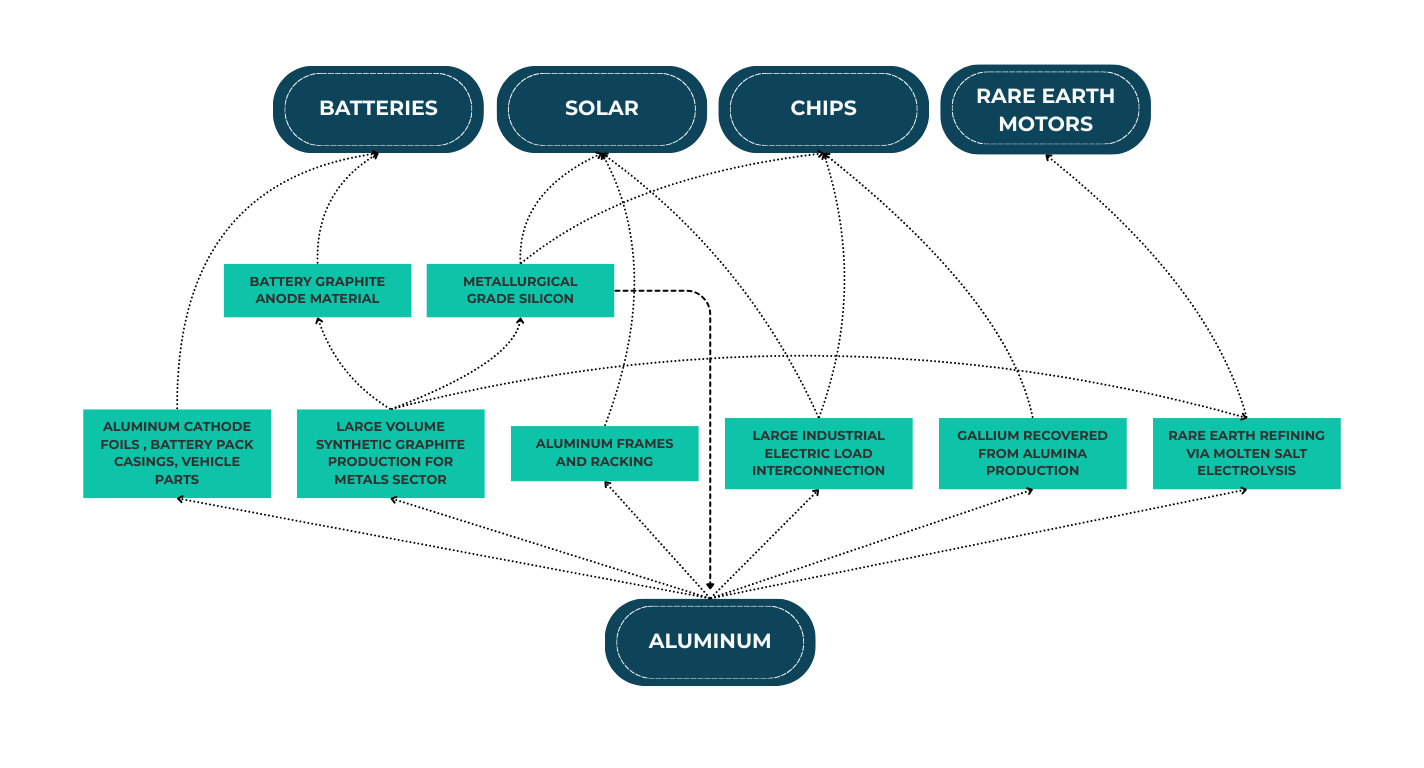
Considering aluminum as the foundation of the electrotech stack is more likely than not a little absurd, but it helps illustrate that pinpointing the electrotech stack as the essence of national industrial strength is overly narrow.
Today, the automobile manufacturing sector—a competitive industry where automakers have traditionally used hedging instruments to guard against swings in steel and aluminum prices—accounts for around one quarter of Chinese domestic aluminum consumption.
Meanwhile, China’s ability to produce 15 million tons of primary aluminum a year requires around 6 to 7 million tons of carbon anodes for the aluminum smelting process. The production route for these carbon anodes shares many commonalities with the industrial processes for synthetic battery graphite anode material—which makes up around 80% of the global battery anode market. China’s vast aluminum industry indeed catalyzed a network of standalone carbon anode plants whose capabilities and technical experience translated to battery applications. Every lithium-ion EV battery pack also directly uses around 30 to 50 kg of aluminum in cathode current collectors (and 50 to 80 kg of graphite), depending on battery size.
Provincial grid planners and engineering firms accustomed to cumulatively building one to two million tons of new aluminum smelter capacity yearly from 2007-2011 likewise gained experience in power plant construction and large industrial grid interconnections that supported a wave of comparably electricity-intensive solar and semiconductor-grade polysilicon refineries. Every kilometer of high-voltage power lines in turn requires around 12.9 tons of aluminum conductor cables.
For high-performance semiconductor chips and power electronics, China recovers the critical element gallium as a byproduct from its immense fleet of alumina (aluminum oxide) processing plants, which perform 62% of the world’s refining of aluminum-bearing bauxite ores into alumina. By regulation, Chinese alumina plants are required to extract gallium during the alumina refining process. Circa 2012 the world’s largest producer of gallium was the Aluminum Corporation of China (Chalco).
Finally, the electrolysis of rare earth oxides into rare earth metals borrows significantly from aluminum process knowledge, with Chinese researchers having regularly tested and adapted approaches from the latter for the former. An experienced chemical engineer transferring from Chalco to China Northern Rare Earth Group would adapt to rare earth metal refining relatively quickly. Indeed, Chalco’s Rare Earth and Metals division was one of three state-owned rare earth producers merged into the new China Rare Earth Group in 2021.
Rare earth refining, along with metallurgical-grade silicon (MGS) smelting and electric arc furnaces for steelmaking, again makes substantial use of graphite electrodes. Because metallurgical silicon is widely used in aluminum-silicon alloys, some MGS smelters in China are even co-located with aluminum smelters. With all this laid out, aluminum’s place in the electrotech industrial network appears increasingly coherent.
The shared ingredients behind electrotech
The advantages of heavy industrial process knowledge for competitiveness in electrotech stack and other technologies extend well beyond aluminum, of course.
While many observers have focused on chronicling the Chinese success in manufacturing iPhones and electric vehicles, the upstream supply chains feeding into batteries, solar cells, chips, and magnets are themselves crucial. The raw materials at the center of these technologies importantly determine the performance or form factor of the final product—the size or thinness of the silicon wafer, the capacity and longevity of the battery, and the strength of a permanent magnet motor.
Across graphite, battery active material synthesis, aluminum, metallurgical silicon, solar-grade polysilicon, solar wafers, gallium, rare earth oxides, and rare earth magnets, China manufactures around nine to ten times the volume as the next-largest global producer. This amounts to an extraordinarily powerful industrial ecosystem, built upon technical expertise but also vast old-school industrial plants and an abundance of baseload electricity generation.
For instance, in the solar, chip, and rare earth magnet supply chains, certain steps are almost obligatorily co-located. Neodymium-iron-boron alloy powders can react with both air and water and spontaneously combust, restricting transportation to short distances and forcing magnet production facilities to be located near rare earth metal refineries. Competitiveness in rare earth permanent magnet production thus depends heavily upon competitiveness in rare earth metal refining, a technically-challenging metallurgical step with miniscule to nonexistent profit margins.
Similarly, China’s share of solar manufacturing is most formidable precisely at the “ingot/wafer” step—the growth of monocrystalline high-purity silicon ingots, followed by the slicing of those ingots into solar wafers. Ingots are so sensitive to damage and contamination that solar and semiconductor wafer manufacturers typically perform wafering at the same facility, such that most industry publications refer to “ingot/wafer” capacity as a single step. Co-location of wafer production and solar cell manufacturing also possesses additional synergies, incentivizing vertically-integrated solar manufacturing.
Many of these relevant upstream commodities that Chinese firms have mastered are also highly electricity-intensive—enough to be classified as “congealed electricity,” a term traditionally used to describe the energy-intensity of aluminum production (Figure 2). Synthetic graphite battery anode material requires a little more electricity per ton to produce than aluminum, with electricity accounting for one-third of the cost of the graphitization step. Metallurgical silicon and rare earth metals are likewise “congealed electricity” due to the electricity requirements of their smelting and refining, respectively. Nickel metal for stainless steel production, a global market that Chinese-Indonesian mining and refining joint ventures have turned on its head in the last ten years, is more than three times as electricity-intensive as aluminum. Meanwhile, the Siemens process for polysilicon refining, which Chinese producers first adopted when taking the solar-grade polysilicon market by storm, is more than five times as electricity-intensive as aluminum smelting, with electricity accounting for 40% of the process cost.
Figure 2: Electricity consumption of major current and proposed industrial processes, in kilowatt-hours per ton of metal or material produced. Emergent proposed processes include hydrogen electrolysis and green steel production via the green hydrogen direct reduced iron electric arc furnace (DRI-EAF) and molten oxide electrolysis routes.
China sourced the energy to feed these growing industries mainly from coal and hydropower. In many cases, China had already achieved dominance in these electricity-intensive commodities by 2015 if not 2010, well before the country began adding noticeable margins of wind and solar electricity onto its grid. While reporters and analysts are now uncritically lavishing attention on recent and future announced shifts of new marginal industrial capacity towards hydropower, wind, and solar, few seem interested in considering how Chinese industry climbed to its current level of production in the first place. After all, it is far easier for Chinese policymakers to experiment and tighten clean energy standards when already sitting atop the commanding heights of the supply mountain.
The unvarnished truth is that Chinese industrialists used the country’s last great wave of coal-fired and environmentally-unabated heavy industry buildout to master process knowledge across a whole host of strategically valuable capabilities. As Ember energy strategist Kingsmill Bond and energy systems professor Jesse Jenkins put it during one recent conversation, China invested its coal power wisely as an “endowment” to take the lead in important emerging industries.
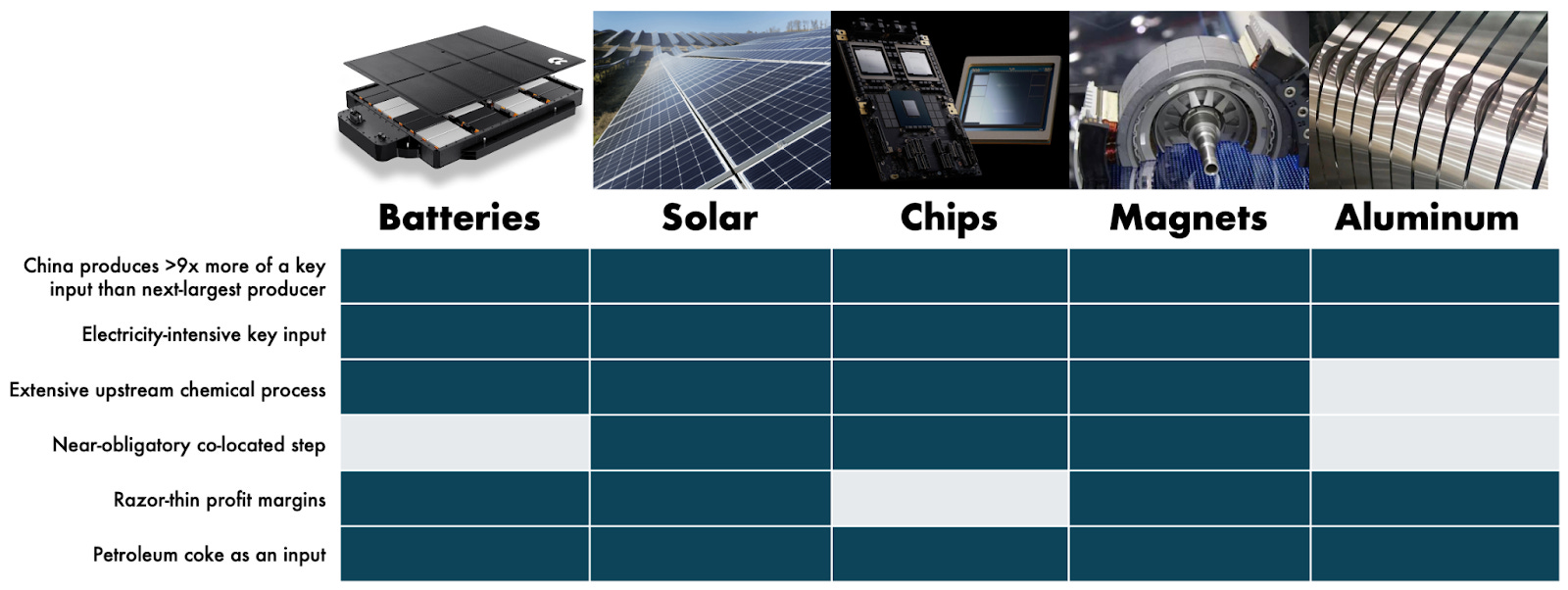
Runaway Chinese success in charismatic and futuristic sectors like electric vehicles and drones must be understood as part of a larger story spanning flat glass, PVC materials, magnesium, and silicones, where survival on thin profit margins hinges upon fairly traditional pillars of scaled heavy industry: vertical integration, cheap energy, and cheap feedstocks.
Amusingly, batteries, solar and semiconductor polysilicon, rare earth permanent magnets, and aluminum all use petroleum coke as an input—for battery graphite, metallurgical silicon, and carbon anodes, respectively. While some might scoff at petroleum coke’s significance relative to the more important industrial factors listed above, all of the electrotech stack products would be much more expensive if their production had to make use of non-fossil alternatives.
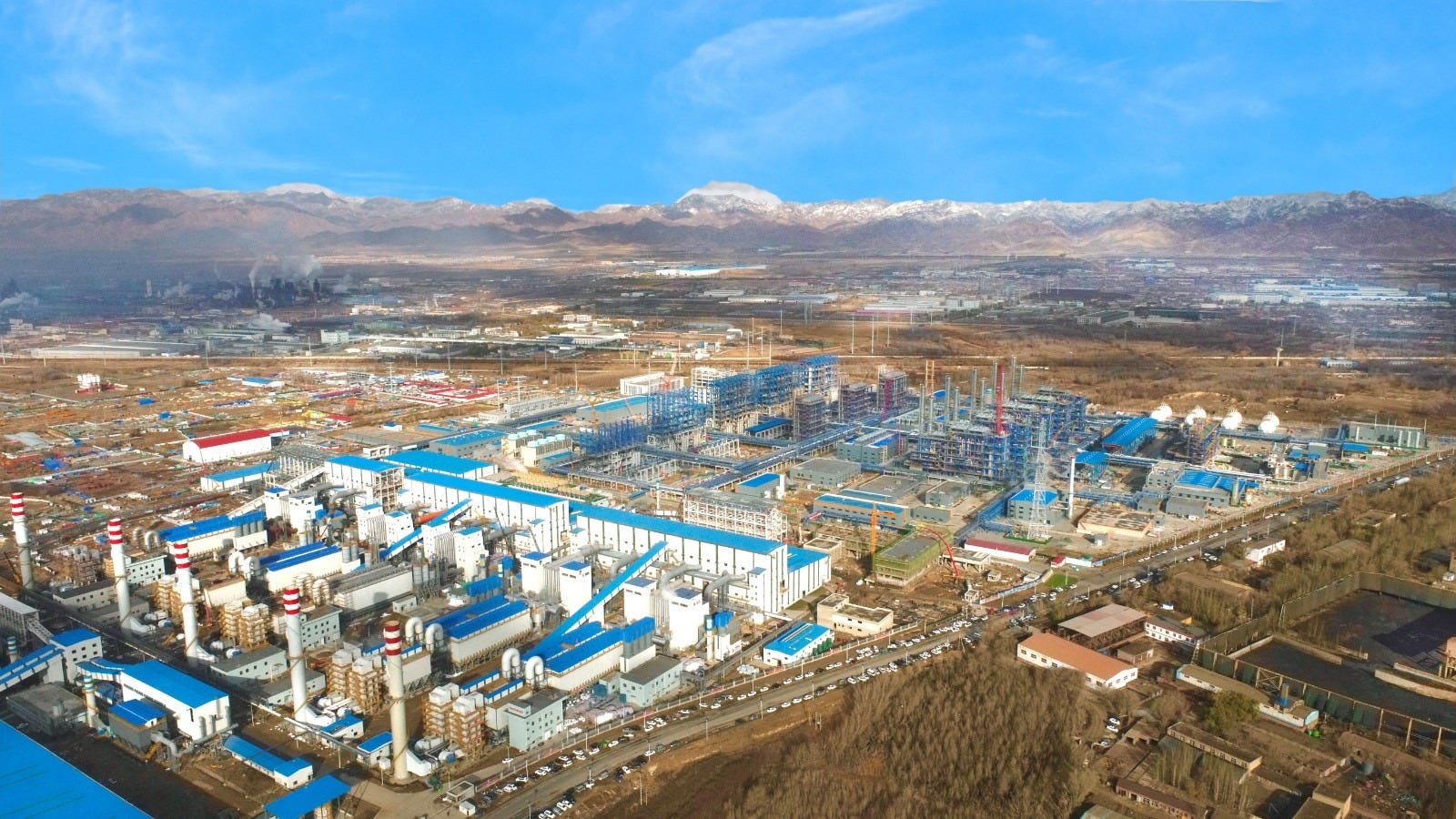
What all of this conveys is that competitiveness in these industries is built upon sprawling process plants of furnace halls and distillation columns just as much if not more so than they are upon manicured, automated “dark factories” and clean rooms. The ability to build a new greenfield metallurgical plant or chemical plant is as critical as the ability to build a shiny, vast, robot-equipped auto manufacturing complex. It should be worrying, then, for the European and North American commentators ruminating over industrial power, that their countries struggle much more with the former than the latter.
The hard industrial choices ahead
The important if obvious realization from a closer look at earlier supply chain steps is that batteries, solar cells, chips, and magnets are not in fact very useful for reproducing themselves. “If you want to be able to defend your country,” as Smith puts it, it is clear that it must be able to mass-manufacture drones. However, mastery of electrotech, industrial dominance, and the capacity to produce a million drones monthly fundamentally depend on regaining some ability to scale upstream components and materials that global investors now casually speak of as oversupplied and uninvestible outside of China. The temptation with electrotech thinking is to focus overly on deployment, software, AI, product iteration, and final assembly and continue letting someone else figure out the difficult unglamorous steps of polysilicon or lithium refining.
It is not yet clear that the mass-manufacturing of drone swarms needs to be particularly solar-powered or even clean. In fact, the expectation that the electrotech discourse sets up is the same old wine in new bottles as the climate movement presuming that any new heavy industrial capacity developed upstream should be maximally electrified and decarbonized. The similar consensus among many climate-minded policymakers in Europe or North America ten to fifteen years ago that fully low-carbon industries were the optimal and preferred way forward may bear some partial responsibility for the current industrial disparity that political elites are now worrying about today.
Cheap industrial electricity is indeed critical, making solar and batteries useful but far from sufficient. Hurdles like super greenhouse gas emissions from aluminum and rare earth metal smelting, the use of coal as a reducing agent for metallurgical silicon and nickel production, and the basic difficulty of accommodating large flat heavy industrial electricity consumption with entirely variable renewable sources remain imposing. The challenges of competing with low-cost Chinese industrial market power in these commodities only entrench such decarbonization obstacles further.
If everyone were to follow the actual Chinese industrial dominance recipe of investing their own fossil endowments into rebuilding process knowledge—as observably practiced through the 2010s—the world can likely kiss carbon budgets goodbye (perhaps building a lot of hydropower as some silver lining). Indeed, if elite thinkers remain insistent that the only path to competitive national industry is a pure green path, they must understand this remains a yet untraveled path that China itself is only just starting to experiment with.
In one interview, Kingsmill Bond dismissed harder-to-decarbonize industrial sectors while emphasizing the enormous progress on emissions and electrification that governments could capitalize on immediately: “People often focus on hard to solve sectors and that’s great and I salute [those folks] but actually we shouldn’t forget that we can already get solar and wind to around 70 or 80% of electricity demand and we can already electrify around 75% of our economy.”
What planners and commentators must keep in mind is that many of the electrotech stack’s supply chains happen to reside heavily in the hardest 30%. Even assuming fully green electricity is indeed cheap, green metals, by all accounts, will not be. If policymakers remain determined to simultaneously pursue environmental performance alongside strategic security and competitiveness, then fostering such alternative ex-China production will neither be cheap, nor emerge naturally from free market outcomes.
Selectively framing the future of industrial mastery around the most photogenic technologies risks ending up with an incomplete recipe—one can’t just pick a few favorites, trace their supply chains back to their roots, prioritize those inputs too, and call it a day. Recall that technologies like Siemens process polysilicon refining, lithium-iron-phosphate batteries, and even early techniques for rare earth metal refining were originally innovated in countries like Germany and the United States with considerable public sector support. A failure to scale manufacturing outside China owes a great deal to broader industrial conditions—higher-cost energy, higher-cost feedstocks, higher plant capital costs, atrophied engineering and technical expertise, halfhearted investor interest in hard tech, and a policy and regulatory environment non-conducive to dynamism or economies of scale.
As goods like aluminum and graphite electrodes illustrate, strategic industries are interconnected and linked to “non-strategic” industries in surprising and unpredictable ways. The broader aim of industrial policy is to cultivate an energy-industrial ecosystem that can effectively procure upstream capabilities on its own to adapt to the evolving technological cutting edge. The operative test of such an ecosystem may well be whether it can build and commission a new metallurgical or chemical plant as necessary. The challenge for Japan, India, the United States, or the European Union will be developing a non-Chinese formula for bringing that plant into operation.
 | A guest post by
|
Industrial obsolescence in advanced countries is due to ‘broad industrial conditions—higher-cost energy, higher-cost feedstocks, higher plant capital costs, atrophied engineering and technical expertise, halfhearted investor interest in hard tech, and a policy and regulatory environment non-conducive to dynamism or economies of scale.’ These costs price out capital, and capital is an irreplaceable component of china’s industrialization, the complex interplay of different domains know how and material can’t be planned, it has to be iterated with market bound corporations. This cost burden exacerbates the imbalance of heavy investment in software technology, which get sold globally but not deployed domestically. The key variable is state capacity, specifically the forecast of infrastructure and other externalities whose provision will reduce the costs and allow capital to iteratively determine latent comparative advantage with automate/exit decisions.
Annoyingly this post wanders from solar panels implied as good to softly telling at the end there is doubt they can power economy. Solar panels are regressive, they require extensive surface degradation, provide intermittent power and little of it, and must be replaced frequently. They exist only as a political anti oil symbol and cannot be afforded as electrification and automation proceed. Intensification of energy and all production is an independent objective to increase conservation as economy scales. We can’t run ahead of surplus but we can persistently skew resources toward intensity.
Economy is to the point where fallacies no matter how big their voting cattle must be criticized head on. Industrial policy has become a central fallacy of liberalism in advanced countries, we cannot go back, automation is inexorable rise of productivity in the base. We must develop competent state agencies, without them all the grand spending schemes from debt or tariff is waste. Infrastructure must equip capital to detect and develop latent comparative advantage.