

America needs to generate more electricity, and that means transporting more electricity, too. Historically, transporting more electricity has required building transmission lines. But tech companies, environmental groups, and renewables developers are enthusiastically endorsing three grid-enhancing technologies (GETs) that they believe offer faster, cheaper alternatives to the slow, costly work of traditional grid expansion: dynamic line ratings, topology optimization, and advanced power flow control.
At a high level, GETs use digital technologies to give utilities more insight into or control over the grid. Their small price tags and short deployment timelines are making GETs especially popular with policymakers who want to rein in ballooning energy bills while also capturing the economic activity that comes with an expanded, more accessible electric grid. In essence, our elected officials want more energy now, and for a fraction of the price of traditional energy infrastructure.
Organizations from Amazon and Tesla to the Rocky Mountain Institute are telling policymakers that GETs can do just that. They claim that “upgrading” the existing grid network with GETs can expand the grid in under a year with payback periods of weeks or months, potentially yielding over $5 billion in annual production cost savings that would materialize as lower electric bills. According to a research commentary from MIT’s Center for Energy and Environmental Policy Research, “supporting [GETs] adoption may be the closest energy policy analog we have today to finding a $20 bill on the table.”
If only it were that easy to undo decades of systemic underinvestment in a transmission network long enough to stretch from Earth to the Moon. GETs are near-term complements to, not substitutes for, an expensive and extensive transmission buildout.
Results from a few case studies and a more nuanced explanation of how GETs work can help policymakers and non-technical members of the public appreciate GETs for what they are: innovations that deserve policy support as tools for grid modernization, not as “non-wires alternatives” to transmission lines.
Dynamic Line Ratings (DLRs)
Dynamic line ratings are a new class of transmission line ratings—estimates of the maximum amount of electricity a transmission line can carry without overheating. Line ratings are key metrics for transmission operators, since lines that regularly approach their thermal limits need closer monitoring and often trigger new investments in grid expansion studies.
Dynamic line ratings are best understood as the most accurate of 4 rating methods. In order of increasing accuracy, they are: static ratings, seasonal ratings, ambient air ratings (AARs), and dynamic line ratings (DLRs).
Static ratings assign each line with a single maximum value and typically err on the side of caution. Seasonal ratings approximate how colder, windier winter weather cools a transmission line, allowing it to carry more electricity without overheating than it could in summer. AARs look at local weather conditions and calculate ratings based on the recorded temperature. This finer spatial and temporal scale provides more accuracy than the seasonal approach. Lastly, DLRs improve on AARs by measuring both temperature and wind speed in real-time using sensors installed on individual wires. These data are used to calculate a highly accurate, localized rating.
But, despite frequent claims that DLRs universally unlock new capacity on the grid, more accurate data does not necessarily mean more capacity.
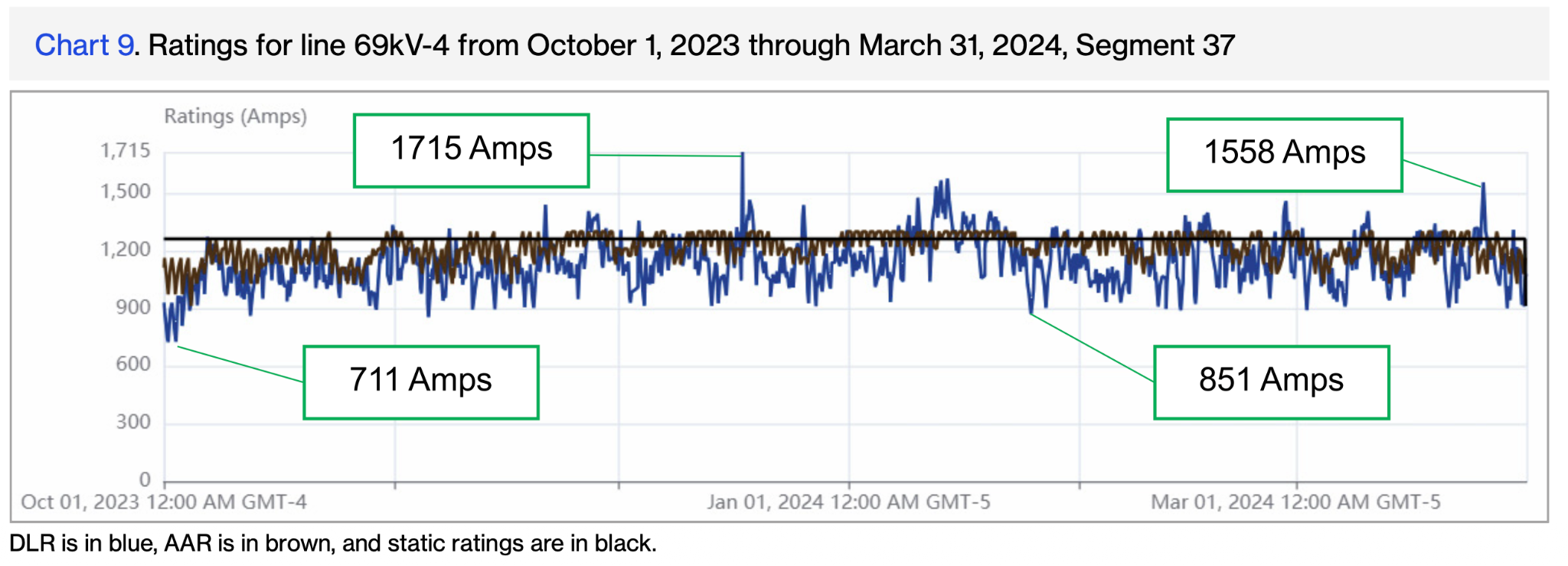
In certain cases, static ratings overestimate capacity, whereas the more accurate rating systems—both AARs and DLRs—demonstrate constrained capacity due to factors not represented in the static systems. A study performed by the AES Corporation—a utility and power generation firm—found that DLRs and AARs correctly identified lower capacity in certain lines—especially lines in less windy areas—than what static rating systems assumed.
For example, in figure 1 below, both AARs and DLRs consistently rated the specific line as lower capacity than the static rating. This line, according to AES Ohio, runs through “a narrow, low-wind and high vegetation corridor,” meaning that there was less wind available to cool down the line. Wind tends to cool a line more than low temperatures, so the lack of wind here made a pronounced difference.
Data from another segment on this 69kV line emphasizes another key feature of DLRs: their benefits are relative, not absolute. Figure 2 compares the line’s DLR and AAR to its seasonal rating, showing the summer-winter transition (upper) and the winter-summer transition (lower). As might be expected from more accurate rating systems, the DLR and AAR don’t see a step change on a single calendar date. But, in this case, AES’s winter rating exceeded the line’s real carrying capacity captured by the more accurate AAR and DLR.
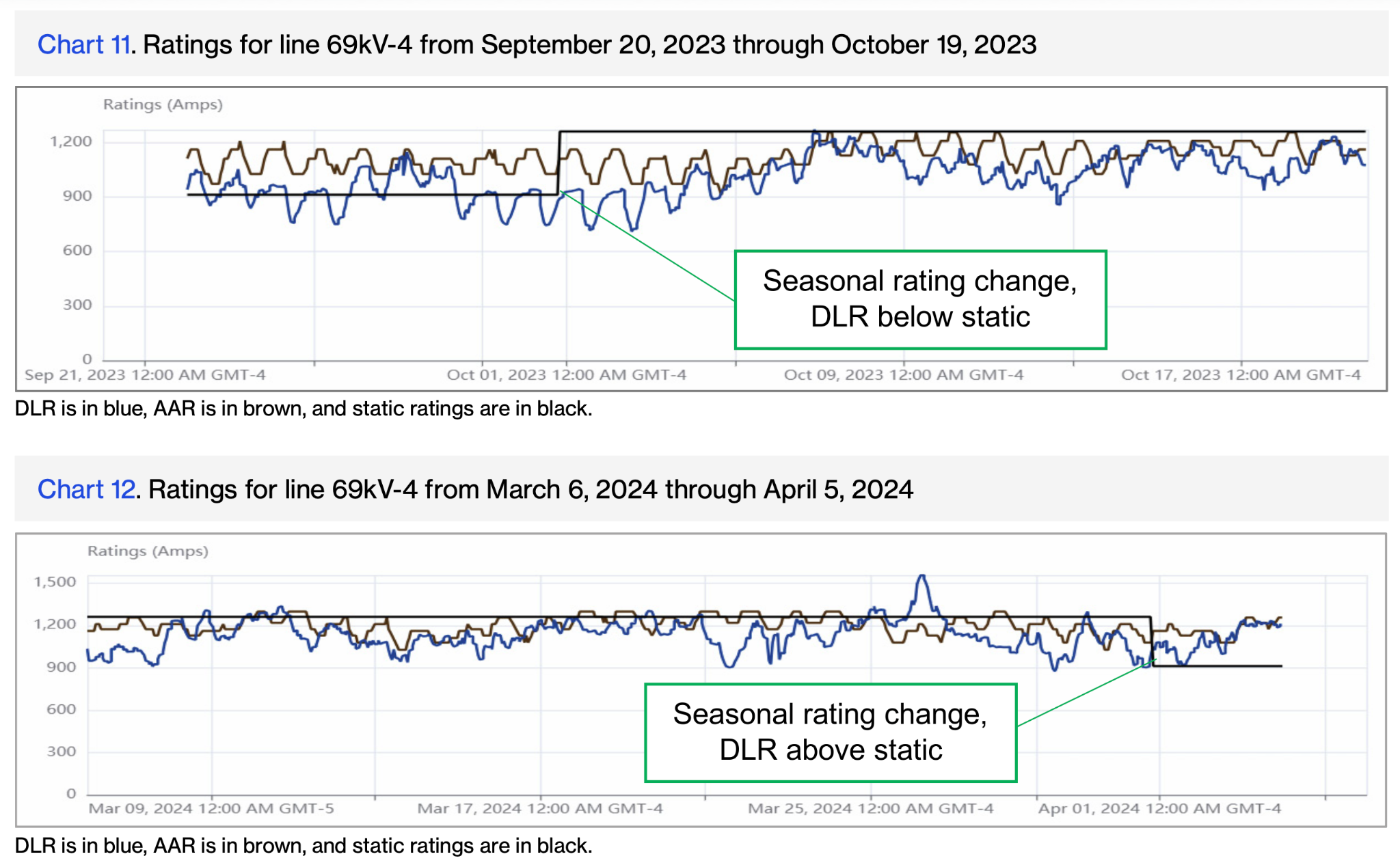
If the real carrying capacity of a line is less than expected using cruder static, seasonal, or ambient air ratings, its dynamic line rating will show inferior performance. This is good. Such information is extremely valuable for grid operators, even if it doesn’t unlock new capacity on a line. This “situational awareness,” in AES’s words, lets the utility know that the segment from Figure 1 may need especially close monitoring or benefit from reconductoring. And the high winter rating in Figure 2 may indicate that AES is systematically overestimating how much electricity its wires can carry in the winter, potentially warranting a reevaluation of how it calculates seasonal ratings. Further, because a transmission line is only as strong as its weakest link, even favorable DLRs on other transmission line segments can be constrained by the conditions of a single quarter-mile swath—a far more nuanced picture than the prevailing view that DLRs unlock capacity for every transmission line they’re deployed on.
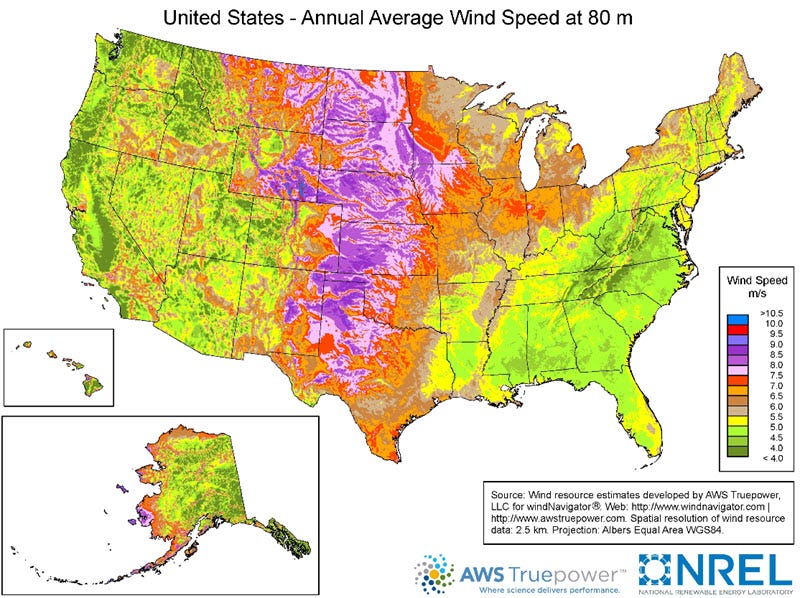
Lastly, because the freed-up capacity from DLRs stems mainly from wind chill, DLR potential varies across the nation based on wind speed and topology. The regional spread of potential for wind energy offers a rough estimate for DLR potential. Results from early DLR demos in windy Oklahoma or Texas should not be generalized to the entire nation. But some of the most-cited national estimates do just that. Their results are therefore highly overstated. State and national policymakers should evaluate DLR potential in their own territory before assuming their adoption can miraculously increase grid capacity.
What About Topology Optimization and Advanced Power Flow Control?
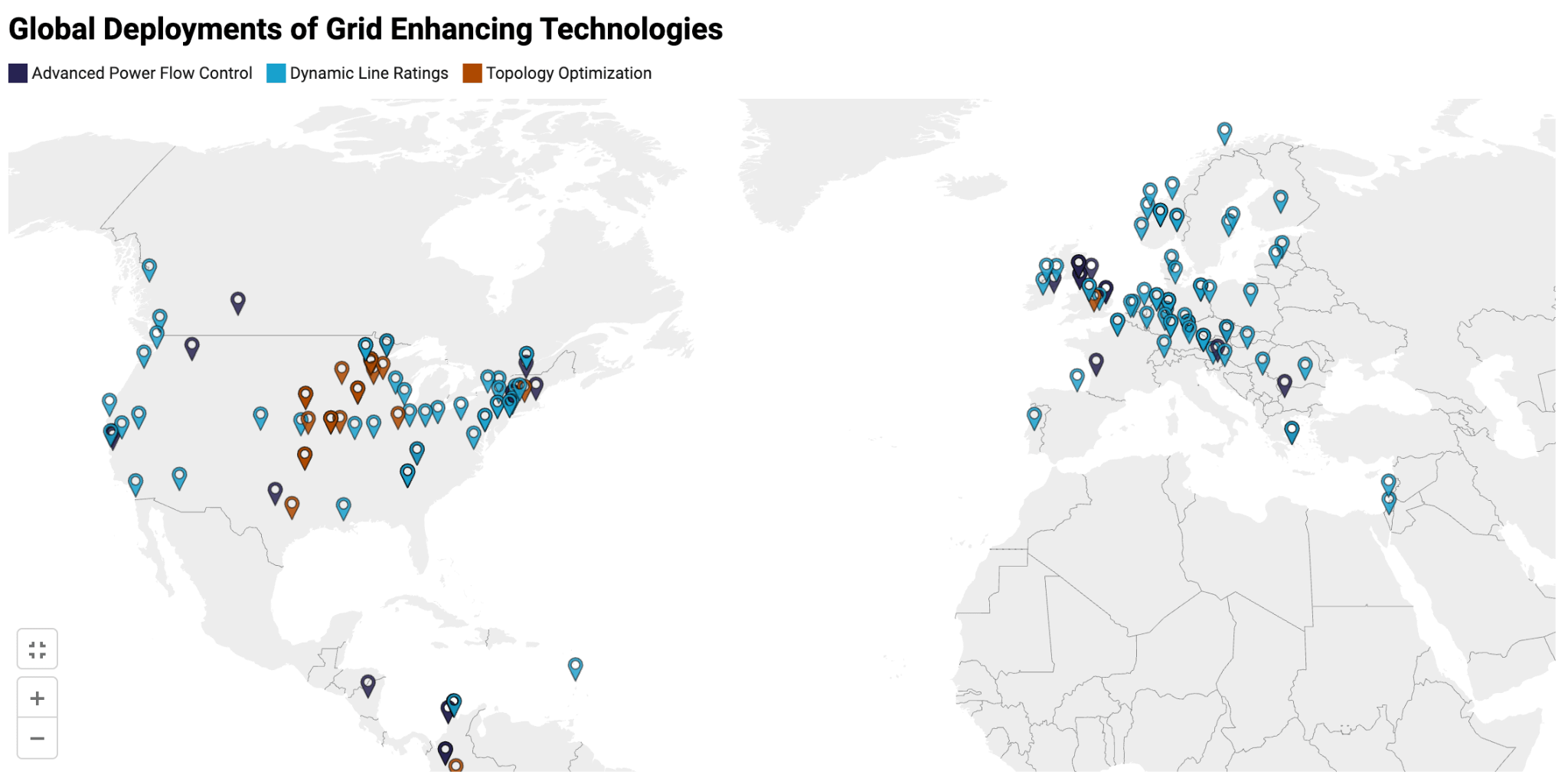
Compared to DLRs, topology optimization (TO) and advanced power flow control (APFC) have seen less adoption in the U.S. or globally [Figure 4]. Still, communication from policymakers and advocacy groups emphasize the ability of TO and APFC to substitute for new energy infrastructure.
When a utility sees a line getting repeatedly congested, that usually prompts a utility to build more transmission to relieve the constraint. While DLRs are praised for their ability to “unlock” more capacity on existing lines, interest in TO and APFC stems from a belief that they will allow operators to circumvent congestion like you would avoid a busy freeway, thereby reducing curtailment of cheap renewables, and lowering production costs without building new lines.
This is nominally true, but overeager estimates leave out the most important limitations.
Traditional grid operations use a grid digital twin primarily for monitoring. TO takes that to the next level, turning grid operation from a mostly reactive role to an active one.
If TO is the brains of grid operation in the digital era, APFCs are its muscles. Power flow control has historically used bulky electro-mechanical devices like breakers that are mostly limited to switching on and off. Their sluggishness is another reason why the role of grid operators has historically been limited, only intervening to avoid significant incidents. APFC capitalizes on recent improvements in power semiconductor technologies to interact with the grid at “grid-speed.” This unlocks a range of new applications, mainly for operators to fine-tune the grid at a much more granular level than what was previously possible.
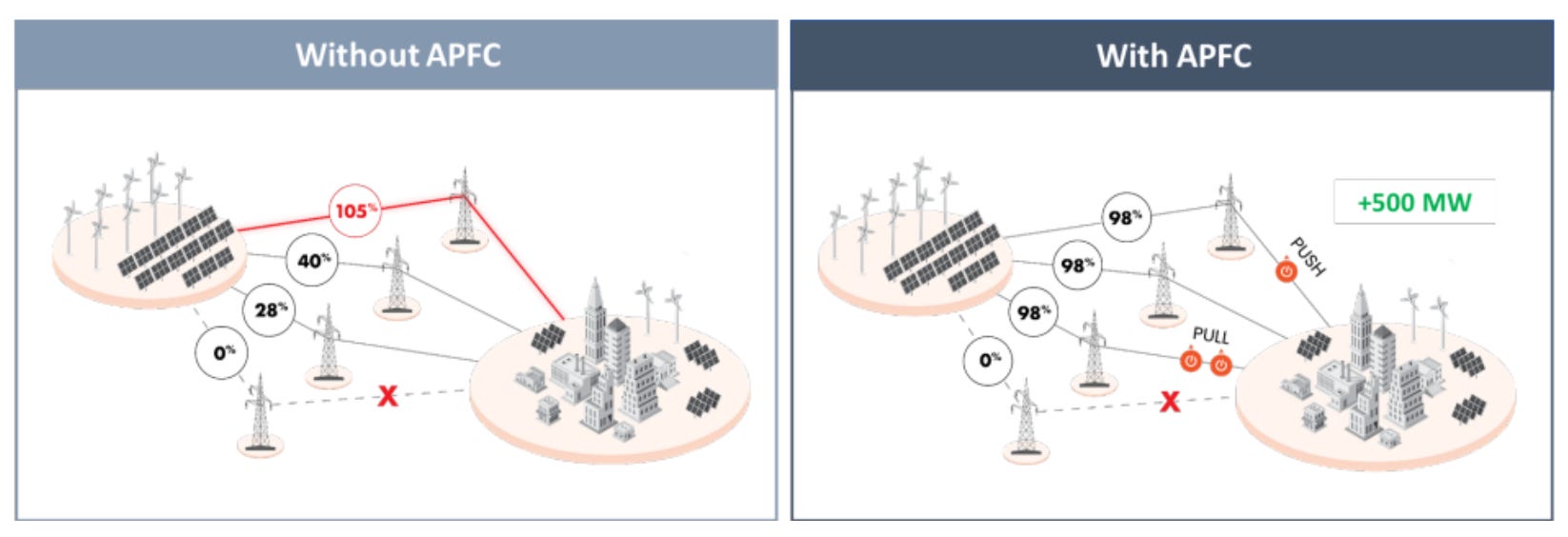
Figure 5 above shows an example of congestion being rerouted using APFC. In the counterfactual without APFC, the grid operator would likely have curtailed the solar and wind and, in their place, turned on a different generator with ample transmission capacity but that is likely more expensive.
At the same time, the above diagram reveals a limitation of TO and APFC. After APFC activation, three lines are loaded at 98%. In practice, that leaves almost no safety margin. So even though the depicted intervention relieves the constraint (the red wire in Figure 5’s left box), TO software would have tested the intervention, identified it was not safe, and chosen to curtail the renewables instead of putting the grid into an unstable mode. This is a real and documented consideration. The Southwest Power Pool piloted TO software in 2018 and made explicit to reject actions that cause a line to be loaded over 95%.
Additionally, actively interacting with complex electricity flow can easily spiral into unexpected disruptions. This is especially relevant in today’s highly interconnected grid. PJM, the largest grid operator in the country, raises concerns that TO “may shift a problem, or some level of congestion, to another part of the system.” In other words, large-scale adoption of TO in PJM could inadvertently worsen grid conditions for its neighbors. PJM also warns that real-time network changes can distort energy markets, which rely heavily on day-ahead predictions and long-term hedges against the exact congestion that TO and APFC relieve. It’s counterintuitive, but congestion relief isn’t necessarily good if it’s unpredictable and decoupled from the aspects of grid operation that are layered on top of the wires. In other words, TO and APFC need to overcome coordination and economic challenges in addition to those of electrical engineering. So while both technologies show promise when deployed, there remain steep barriers to implementation at scale that often get swept under the rug.
Adding enough excess transmission lines to provide significant headroom and redundancy is a common solution to both constraints. Say that a hypothetical new transmission line was added to the system in Figure 5, decreasing the current lines from being 98% loaded to 70% loaded. With the addition of more transmission, TO might find the APFC intervention safe to pursue, thereby reducing renewable curtailments, lowering production costs, and so on. This dependence is well documented across multiple case studies. Under mandate by California’s SB 1006, Southern California Edison studied feasibility of GETs across its entire service territory. It found zero suitable targets for APFC, citing “insufficient alternative routing options to meaningfully redistribute power” as the first reason for those results. Britain’s National Energy System Operator (NESO) raises that the island country’s “corridor-shaped landmass limits the number of alternative transmission routes available to redistribute power efficiently.”
Put differently, a grid with excess transmission capacity is a key enabler for TO and APFC to be utilized to their fullest potential. Yet these GETs are being misconstrued as ways to avoid the investments needed to build the environment in which they would thrive most.
Conclusion
Recent years have seen Congress and state legislatures introduce scores of bills focused on studying, subsidizing, and prioritizing the use of GETs over planning new transmission. Meanwhile, the prospects of Congress passing a bipartisan permitting and transmission reform package are getting slimmer by the day.
A more accurate view of GETs treats them as tools for grid modernization, an evergreen pursuit that warrants policy support and private investment in its own right. Contrast this with marketing GETs as near-term solutions to load growth and rising electricity bills that risks collapsing if load growth doesn’t materialize as fervently as expected or if supposed cost reductions from GETs don’t materialize.
Put simply, GETs will benefit from more transmission, and transmission will benefit from more GETs. Policymakers need to pursue both with an acute sense of urgency, understanding that enhancing the grid is nothing more than a stopgap measure until the country can expand it.
