

The long-overdue abandonment of RCP 8.5, the IPCC’s much criticized and implausible emissions scenario has, rightly, shined a light on how climate modeling and emissions scenarios are constructed and used by scientists, policymakers, journalists and advocates. The making of scenario sausage turns out to be a dodgy business, rife with all sorts of unexamined assumptions both within and across scenarios. These, in turn, produce a wide range of highly speculative outcomes that actors across the political spectrum can select from to support their priors.
It should be entirely unsurprising, then, that the abandonment of RCP 8.5 has had little apparent impact on the well rehearsed debates that have raged in the years leading up to the change. Was RCP 8.5 always implausible or was it made implausible by climate policy and falling renewable energy costs? Did scientists really think of and describe it as business as usual or was it always understood to be a worst case thought experiment? If the former, was it an honest misunderstanding or were there strong perverse incentives to represent RCP 8.5 in that way? Does the abandonment of RCP 8.5 suggest that climate change might not be so bad or does 2 or 3C of warming herald catastrophe anyway? Is 5C of warming off the table or are there other plausible ways that the world might hit the extreme warming levels implied by RCP 8.5 even if the RCP 8.5 pathway to those warming levels is not plausible?
The answers to these questions are, in my view, pretty obvious if you don’t have an ax to grind. Yes, RCP 8.5 was always implausible. Yes, many scientists and other experts represented it as business as usual. Yes, there was a lot of confusion and genuine misunderstanding among many scientists who were using RCP 8.5 but also, yes, there were perverse incentives not to ask too many questions about it. No, catastrophe is not assured at 3C of warming but yes, you can still conceivably end up with higher warming by the end of the century if you assume high end climate sensitivity, deep reductions in sulfur dioxide emissions, and climate feedbacks that all impact warming in the same direction.
What almost all of that misses, though, is just how speculative and ungrounded the entire climate scenario enterprise is.
Can’t Get There From Here
The problem with IPCC scenarios and modeling isn’t just with RCP 8.5. Across the full range of outcomes, many scenarios simply don’t make sense. The low emissions scenarios, for instance, frequently assume low population growth, slow economic growth, and fast technological change. This combination of factors is every bit as implausible as the combination of high population growth, high economic growth, and slow technological change necessary to produce RCP 8.5. That is not simply because the world does not appear to be on either trajectory. Rather, in both cases, the component factors necessary to produce these futures are not compatible with one another.
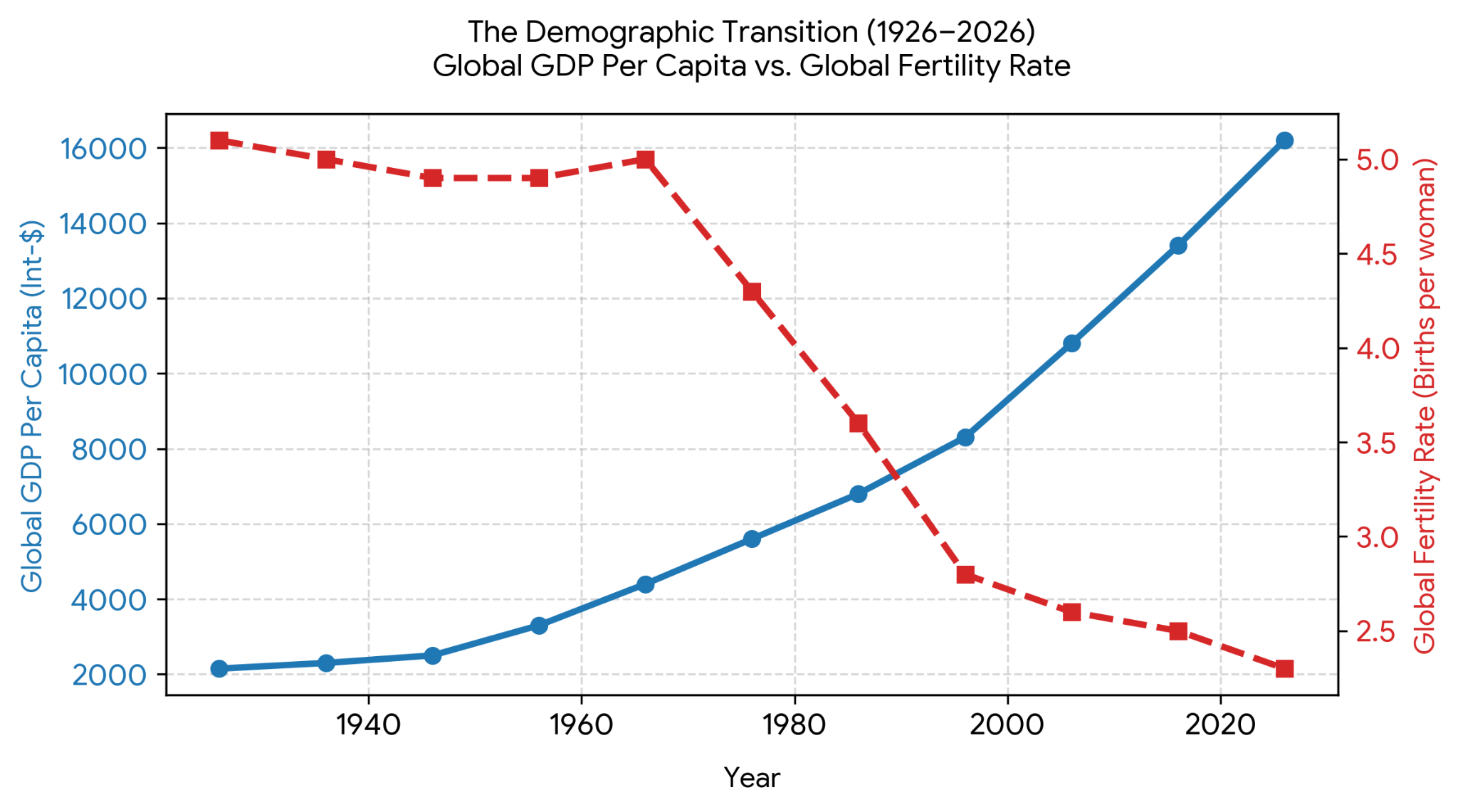
Consider that the relationship between economic growth and declining fertility is among the most robust in the modernization literature. As societies urbanize, shifting from agrarian economic relations to manufacturing and services, women and families have very strong incentives to have fewer children and direct more household resources towards educating them.
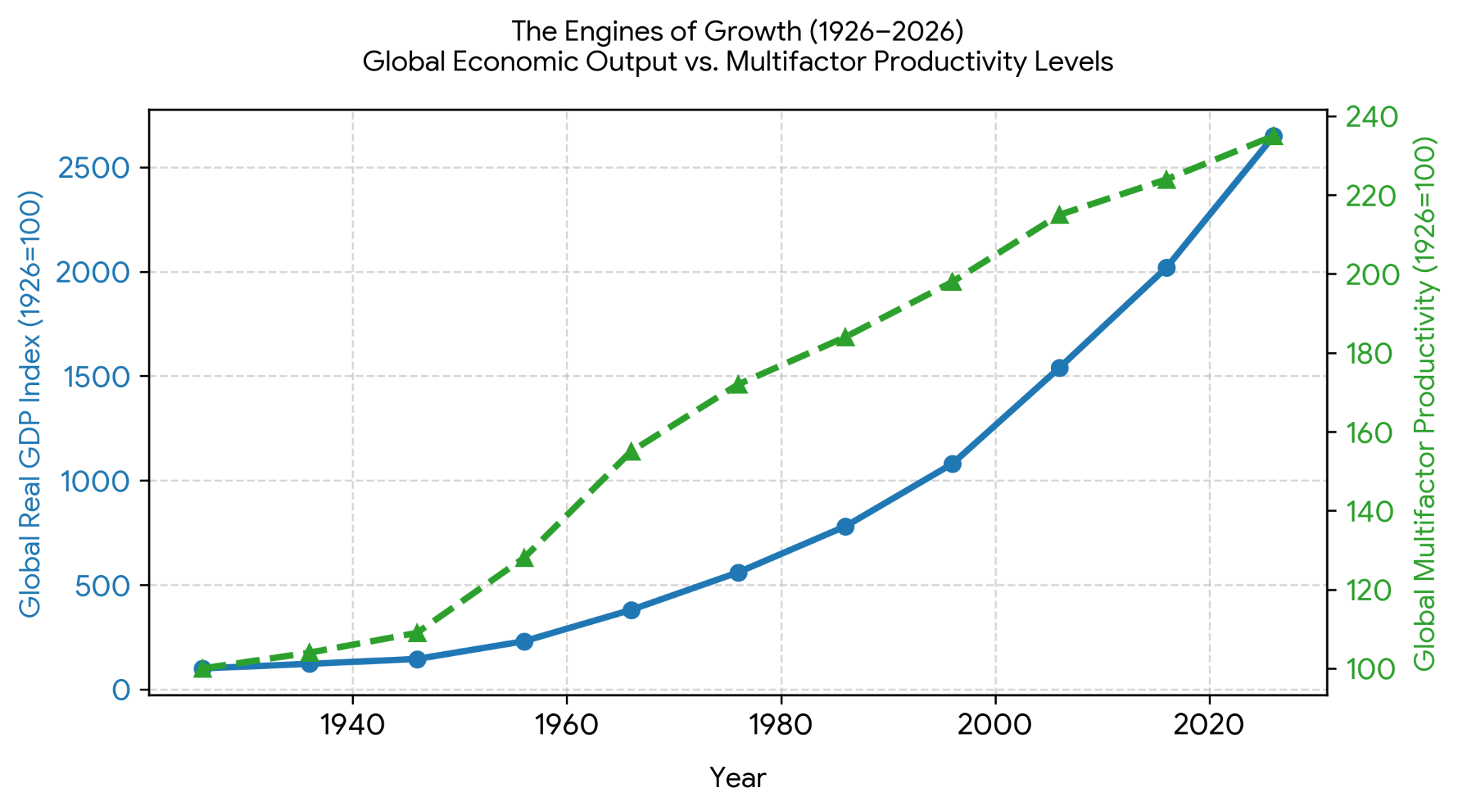
The relationship between the rate of technological change and economic growth, similarly, is not only robust but foundational in the neoclassical economic literature. Technological change accounts for the vast majority of long-term economic growth. High and sustained economic growth rates bring faster rates of technological change along for the ride and vice versa.
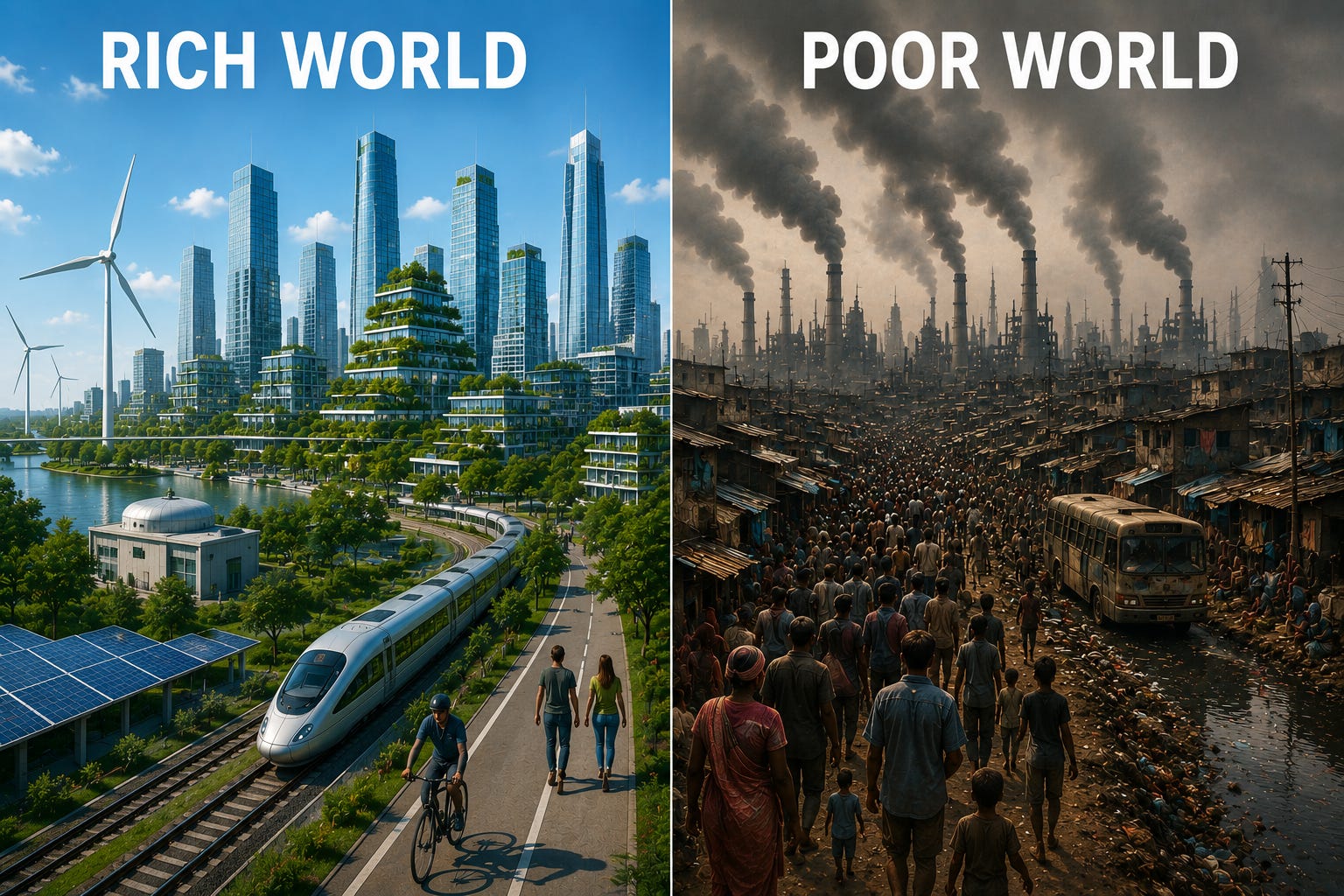
Taken together, these two relationships have very significant implications for plausible climate futures. A rich world at the end of this century will almost certainly be a less populous one than a poor world and, of necessity, more technologically advanced. This is not a future where the world digs up every bit of coal that it can find and burns it. The converse is true as well. A poor world will almost certainly be a more populous and less technologically advanced one. This is not a world in which a small and shrinking population lives lightly upon the Earth while making a quick transition to clean energy.
For all the talk of feedbacks in the climate system, we’re not very good at thinking about, much less modeling, feedbacks in our socio-economic systems. That problem becomes even more pronounced once we use emissions scenarios—which estimate emissions and radiative forcing over the course of this century based upon speculative (and sometimes fantastical) socioeconomic trajectories—to model climate impacts on society. Doing so requires making dozens of socioeconomic assumptions to estimate both how evolving socio-economic conditions will translate into global emissions and hence warming, and then how those same evolving conditions will shape vulnerability, resilience, and adaptation to the climate change that results.
PATPAT Not IPAT
IPAT (Impact = Population X Affluence X Technology) has been the long-standing framework through which environmental scientists have understood how human activity impacted the environment. It provides a useful conceptual framework for decomposing the factors that contribute to environmental impacts. But it has two deep and related flaws.
The first is that population, affluence, and technology operate on both sides of the equation, affecting the consequences of environmental impacts every bit as much as causing them. So IPAT can just as easily be expressed as PATPAT (Population X Affluence X Technology = Population X Affluence X Technology).
The second is that the decomposition breaks down when we try to use the equation, conceptually or practically, to understand change over time. You can decompose an environmental impact into the factors that contribute to it at any given point in time. But over time, the factors don’t move in the same direction and feedback into one another in ways that blur the lines between them. So, in the case of global emissions, population growth and economic growth increase emissions while technological change blunts those factors, decoupling them from emissions. Economic growth and population growth each independently increase emissions. But faster economic growth rates result in slower population growth rates. Technological change accelerates economic growth which in turn slows population growth.
Similar interactions come into play when considering the human and economic impacts of climate change. Economic growth both results in higher economic damages associated with climate extremes and makes human populations more resilient to those extremes. It slows overall population growth and draws larger populations toward economic opportunity in coastal regions and floodplains where they are more exposed to climate risk. Technological change accelerates economic growth, putting more wealth in harm’s way, increases societies’ adaptive capacities, and results in richer societies, which are also more resilient to climate extremes.
The feedbacks fold back upon each other across the emissions and impacts sides of the equation. This is, of course, exactly what you would expect in a complex, emergent system encompassing the physical climate, the global economy, and the intersection of the two in millions of actual places. Emissions scenarios and impacts modeling can only, at best, give us a very high level and rough approximation of what might happen. At the very least, we ought to demand that these efforts make a reasonable effort to check whether the scenarios they are producing are coherent. A rich world in 2100 is very unlikely to be one with 12 or 13 billion people. It will almost certainly not be one that is heavily dependent on coal.
Or consider global agriculture. Any projection of the impact that climate change will have on agricultural production and food security requires dozens of assumptions about both the emissions levels that the global economy will produce decades from now and how population, economic development, food preferences, agricultural technology, and much else will evolve over many decades. Even if that future does bring 5C of warming, that world is also almost certainly one in which the scale, intensification, and productivity of global agriculture is far greater, even if climate change has resulted in some non-trivial reduction in future yield growth. Technological change (e.g. agricultural productivity improvement) operates on both sides of the IPAT equation, both reducing emissions from the agricultural sector and improving the resilience of the sector to climate change.
Science Fiction Versus Science
Past, of course, is only prologue. Perhaps in the face of a baby bust, nations will increasingly incentivize (or coerce) women to have more children. Or technology will bring us artificial wombs. Or artificial intelligence will bring about an economic singularity without any significant energy technology breakthrough, leading our robot overlords to dig up and burn all the coal. Perhaps a global government managed by a priestly caste of scientists will perfectly redistribute wealth and resource consumption while engineering a planned transition to a low carbon economy. But these developments are, at this point, science fiction, not something that policy-makers or anyone else should take very seriously. Where, one wonders, are the scenarios reflecting the muddle of our present and future—a baby bust, secular stagnation, mixed economies, slow but steady long term decarbonization, and a rising tide that floats all boats but some far more than others?
The problem with the IPCC scenarios can’t be reduced to one bad apple scenario. The construction of scenarios has been ad hoc. Historically, the climate scenario community has sought to produce a range of anthropogenic forcing and temperature outcomes suitable for modeling impacts and then layered on top of that the mental models of the scenario builders (e.g. a rapacious capitalism making babies and burning coal in roughly equal measure vs various post-growth and egalitarian imaginaries).
The resulting scenarios have largely failed to produce plausible futures, meaning futures that can reasonably be extrapolated from the ongoing evolution of social and economic relations as we actually observe them. Worse, it has enabled a cottage climate impacts industry to manufacture sensational climate impact claims that don’t consider those impacts in the social and economic contexts that could conceivably produce them.
I have increasingly come to the view that human societies will be more resilient to climate extremes in a rich world with 5C of warming than a poor world with 2C of warming. But neither of these futures is particularly likely. Because of the way that population, economic growth, and technological change feedback into each other, the range of possible outcomes, and hence the design space for climate policy efforts is far narrower than that. It’s hard to get much beyond 3C of warming or below 2C of warming without the science fiction described above. The greatest failure of the IPCC’s scenario making enterprise has been to obscure this basic dynamic rather than illuminating it.
So may variables, so many unknowns. Among them population. There are population projections that show substantial declines in population beginning towards the end of this century. The trend in lower fertility seems real. Seems overall this would be helpful mitigating climate change. Less ag/land use needed. Higher standard of living but environmental impact offset by technology. Wondering about the probability/consequences of this aspect of the equation.
interesting hypothesis: development in the next period could skew higher to lower population and higher technology, or lower to higher population and lower technology, and either way likely to add 2-3C temperature with little impact.
possibly that makes sense. if technology and secondary wider/wiser diffusion of it result in mild rise of fertility in most countries and larger fall in fertility in Africa. it's also possible that technical understanding of climate sources and priority to adjust them improves, resulting in decreasing exacerbation of warming later in the period.
tangent: isnt the formula impact = tech X pop X wealth implausible on the face? wouldn't it be impact = pop X wealth / tech X intensity of wealth?