

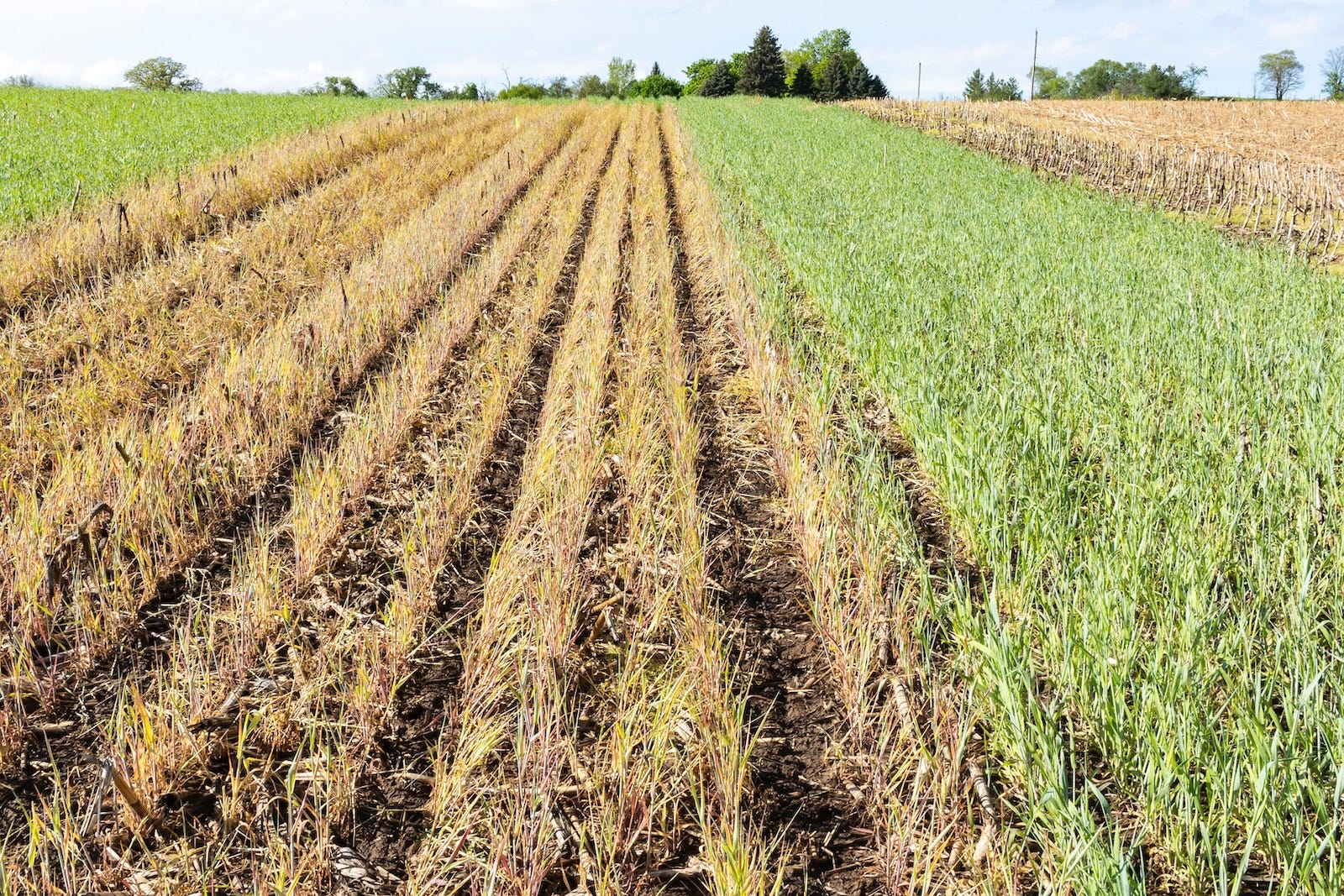
In April, the White House proposed eliminating funding for one of the country’s oldest agricultural research programs. The Hatch program provides over $250 million annually to agricultural research centers at land-grant universities and colleges in every state, allocating it through block grants based on each state’s rural and farming population. The President’s budget proposal for 2027 says that universities use the so-called “formula funds” to conduct too many “pet projects” like research related to the needs of transgender people and environmental justice.
The White House is right that federally-funded research is misallocated. But the problem is not that agricultural research has been captured by “woke” ideology. It is that the federal government spends too little on research that helps farmers produce more food with less land, lower costs, and less environmental impact. The Trump administration’s proposed budget would only make that failure worse.
In real dollars, U.S. public spending on agricultural research has declined by a third since peaking in the early 2000s. What’s often overlooked is that the share of R&D spending that is focused on farm production is also declining. The state agricultural experiment stations (SAES) that use Hatch funds devoted about two-thirds to production-oriented research in the 1970s and 80s, but only about one-half today. Instead they’ve diversified the research that they support to include more work on nutrition, environmental protection, economics, and other topics.
Production-oriented research is arguably more important than ever. Farmers are under pressure from intensifying global competition, extreme weather and disease risks, and high and volatile input costs. Consider, for instance, that fertilizer and diesel prices have risen about 50% since January with the onset of the Iran War.
One of the few reliable ways to improve the economics of farming is to raise productivity: getting more output from each acre, animal, ton of fertilizer, or unit of feed. That kind of progress comes from better seeds, animal breeding, pesticides, equipment, and farm management, much of it rooted in agricultural research. Decades of studies have found that public agricultural R&D, much of it funded by the federal Department of Agriculture (USDA), has made large contributions to U.S. productivity growth, generating about $20 in social value for every $1 invested. With declining R&D funding, however, productivity growth in U.S. agriculture has slowed.
Proposed White House Cuts Would Worsen Problem
The President’s budget calls not just for cutting Hatch funding, but for reducing overall funding for agricultural R&D grants. That will only make it more difficult to develop the innovations to revive productivity growth.
In theory, USDA could do more with less by reallocating funds to programs that best support farm production. USDA Secretary Brooke Rollins has signaled that this is her intention, announcing new R&D priorities explicitly focused on farmers—including “Increasing Profitability of Farmers and Ranchers.” Ironically, though, the programs the White House is pushing to cut are among those most focused on farm production.
USDA’s Hatch program provides funds that universities and agricultural experiment stations primarily use to support productivity-oriented research, with about 60% of funding going towards this area. For example, researchers at Utah State University have shown that grazing cattle on a mix of grasses and legumes can reduce the need to apply nitrogen fertilizer while maintaining animal performance, reducing costs for ranchers as well as environmental impacts. And Hatch-funded plant breeders in South Dakota have developed new oat varieties with higher yields and greater disease-resistance.
It may be easy to critique the program for awarding funds based on a rudimentary formula. There’s little reason to think that allocating funds to universities based on the rural and farmer population in their state would result in the best research. And surely this allocation could be improved. However, one of the only comparative assessments finds that this formula-based Hatch funding boosts farm productivity more than competitive funding. For one, it provides universities with the long-term certainty they need to make major investments, such as in field sites, new facilities, and long-term experiments. For another, university research leaders generally know better what research is relevant for farmers in their region, with its unique soil, climate, and pests, than the distant administrators of USDA’s competitive programs out in Washington, D.C. and Kansas City.
Competitive grant-making programs serve a critical role too and can be highly productivity-oriented.The Crop Protection and Pest Management Program (CPPM) allocates a larger share towards productivity-oriented research, nearly 70% in 2025 and even more in other years. The small competitive grant program, with about $20 million in funding in 2025, supports research and farmer education projects that address high-priority pest issues using integrated pest management—approaches that combine biological, targeted chemical, and other strategies. However this program too is on the chopping block for the White House. Their budget proposal for 2027 recommends zeroing out funding for this program.
In contrast, USDA’s Agriculture and Food Research Initiative (AFRI) awards a smaller share of its funds, about half, to productivity-oriented projects. To be clear, AFRI supports a wide range of valuable projects. Grants are awarded based on a selective review process: the program provided only 19% of funds that applicants requested in fiscal years 2022 and 2023. In fact, over 70% of applications recommended for funding by peer reviewers weren’t funded because of the program’s limited budget. And the program supports thousands of projects with potentially national significance including over $150 million in basic science.
A Better Path
Cutting agricultural block grants for universities makes little sense if the goal is to align federally funded research with broader national goals like improving farmers’ productivity and international competitiveness. Eliminating Hatch funding may prevent universities from directing federal funds to a handful of politically charged projects. But it would come at a great cost to farmers and agricultural science.
Congress, for its part, has taken a more grounded view. It has largely maintained funding for the program for years, though it has not kept pace with inflation. Looking forward, House Republicans recently advanced a funding bill for 2027 that would largely maintain funding for both Hatch and AFRI, as well as most other research programs. Many in Congress recognize that Hatch’s formula funding, by directing funds toward projects informed by stakeholder needs, is complementary to the competitive merit-based grants that focus on nationally-determined priorities.
Washington should protect and, where appropriate, expand the parts of the federal agricultural research portfolio that are most clearly tied to farm productivity. This can and should be done while letting university-based researchers, in consultation with local agricultural stakeholders, determine what types of projects matter most for their region. Instead of trying to wrest control of research funds and centralize it under competitive programs, federal policymakers should incentivize more research that is productivity-oriented or otherwise aligned with national goals. For example, they could provide additional funding for Hatch funding recipients that commit more of their funds to crop protection, animal health, or other national priorities.
The administration is right to expect more from federally funded research. If Washington wants a more productive and more competitive farm sector, it should rebuild agricultural research around the problems farmers actually face. That means funding more of the work that helps farmers cut losses, control inputs, and raise output. It also means resisting the temptation to confuse ideological screening with serious reform. The decline in productivity-oriented research has largely gone unnoticed and unaddressed. The administration’s proposed cuts would make this reality worse.

I'm reluctant to use tax payer money for anything because it never reflects what product is actually of value to each taxpayer, which, yes, is actually the taxpayers fault for letting it happen. The need for to give merchants (including farmers) the expertise to provide products to their customers is crucial, so why do they need more information than the expertise of the makers of products that will enable the farmer? BTW, the hatred the environmental movement has towards the chemical industry is also an important factor reducing food abundance and ironically, food safety.