

The clean energy benefits of permitting reform to the United States over the coming decades far outweigh whatever remaining influence Donald Trump has on the country’s energy system in his last two years in office.
The Bipartisan American Affordability and Jobs Act (BAAJA) offers key reforms on everything from permitting to power plant interconnection to national transmission planning to provisions that ensure data center projects pay a societally fair share into their regional grid infrastructure.
Yet as Congress prepares to vote on this pivotal federal legislation after the elections, negotiations continue to revolve around how the White House could intervene in energy projects over the next two years. Based on the latest reporting, Congressional Democrats are “still waiting for key assurances that the Trump administration would end its blockade against permits for wind farms and some other forms of clean energy.”
So it’s urgent for members and their staff to recognize that a more efficient environment for building vast clean energy infrastructure is not worth jeopardizing over questions of what a lame duck administration might or might not do.
Democrats on the Senate Energy and Natural Resources Committee have claimed the Trump administration “is slow walking and stalling” 73 gigawatts (GW) of solar, 43 GW of batteries, and 46 GW of wind (Figure 1). In contrast, to shift the electricity sector fully to low-carbon electricity, modeling studies estimate that the United States would have to build between 900 and 1360 GW of additional solar capacity, 120-200 GW of battery storage, and 500-1680 GW of wind projects. The stalled projects amount to less than one-tenth the volume of solar and wind that the country would need to build over coming decades to shift the power grid to low-carbon generation—and much of this stalled capacity will still eventually move forward.
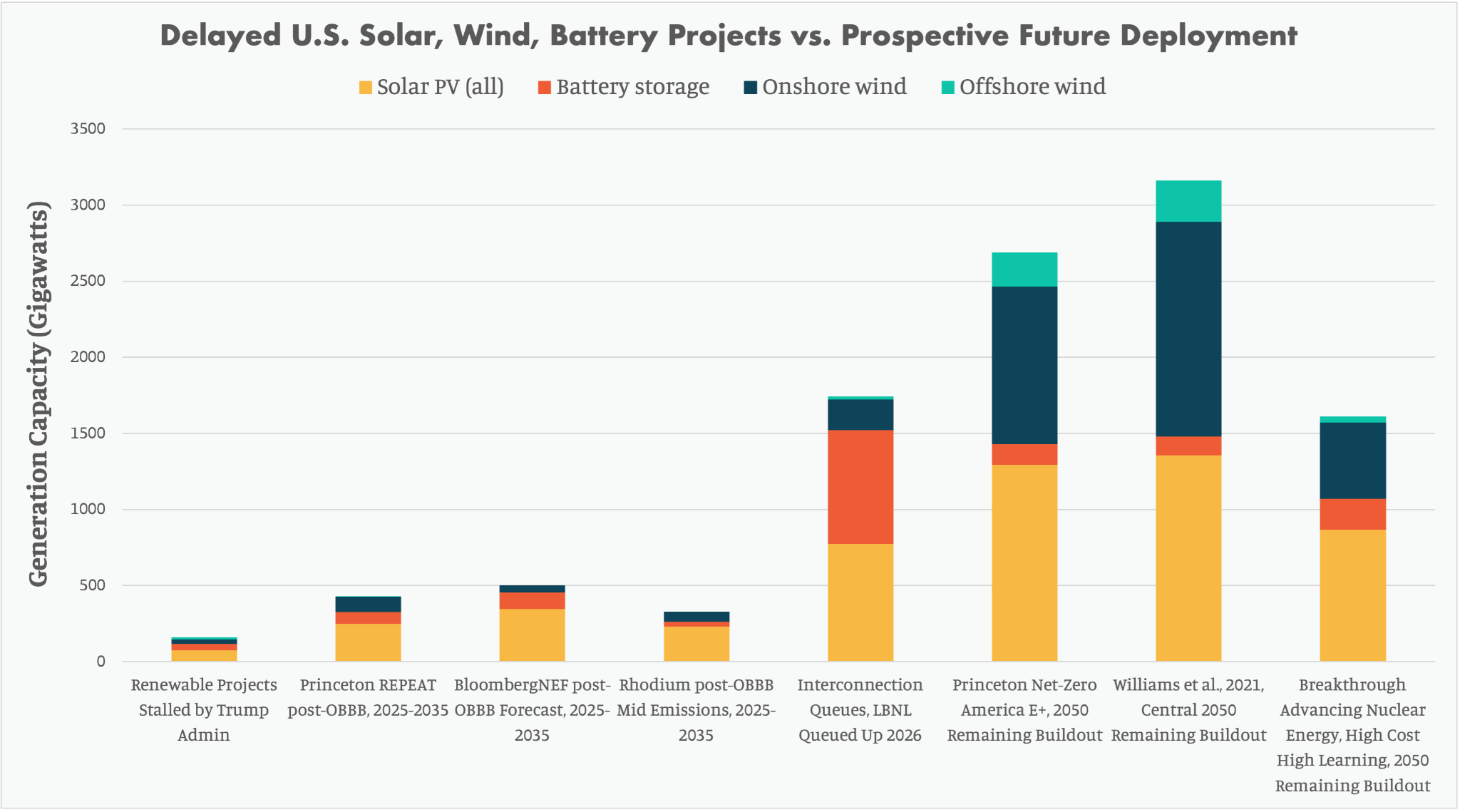
Figure 1: Relative to the scale of wind, solar, and battery capacity waiting in interconnection queues nationwide and the future capacity needed to potentially decarbonize the U.S. power grid, the volume of projects currently “slow-walked or stalled” by the Trump administration is small.
Meanwhile the now-unfolding phaseout of federal solar and wind tax credits has lowered forecasts of the solar, wind, and battery capacity that the United States might build over the 2025-2035 period. The energy sector requires a structurally different environment to meaningfully revitalize deployment—stakes that greatly overshadow what amounts to a relatively small “blockaded” slice of stalled solar and wind capacity.
Indeed, BAAJA also promises a game-changing regulatory environment for other promising low-carbon technologies including nuclear, carbon capture and storage, and especially geothermal power, which receives special attention in the bill text. At the same time, renewables and batteries are expected to grow healthily in every future scenario from the interconnection queue, which reflects presently commercial technologies, to Breakthrough’s own “Advancing Nuclear” modeling, which identifies pathways under which nuclear power might generate as much as half of US electricity by midcentury.
The BAAJA draft bill provides that catalytic environment by, among other measures, improving the efficiency of the regulatory and interconnection processes nationwide, while granting the industry firm certainty—within 9 months of passage—that the federal government will not be able to interfere with future clean energy projects that manage to secure their permits. Forfeiting the decades-long clean energy benefits of the permitting deal out of fear over what President Trump could do in his last two years in office would be a strategic mistake.
The Whole Clean Energy Ball Game Is Post-Trump
Accommodating rising electricity demand without saddling households with high power bills, modernizing the nation’s aging transmission network, and deploying clean energy at increasing scales all amount to a national power infrastructure campaign that will span decades. That present and future of America’s energy system evolution will overwhelmingly be a clean technology story, with much of that potential straining to be unshackled from the constraints of opportunistic lawsuits and regulatory red tape.
Over the past three years, clean energy technologies accounted for nearly 93% of newly-built generation and storage capacity across the United States (Figure 2). The marginal new electricity that these newly-built plants will generate on the U.S. grid each year will likely be at least 80% low-carbon (Figure 3). Meanwhile, capacity waiting in the country’s interconnection queues—the region-by-region approval process for giving new energy projects the green light to connect to the grid—is at least 85% dominated by clean technologies (Figure 4). Any policies that make power plant construction easier will heavily favor new clean energy buildout.
Figure 2: Actual new electricity generating capacity added to the U.S. grid in 2024 and 2025, in gigawatts, alongside planned 2026 capacity additions as reported by the U.S. Energy Information Administration (February 2026). Wind, solar, and battery installations overwhelmingly dominate recent new construction.
Figure 3: Rough calculation of marginal annual U.S. electricity generation from capacity newly deployed in each stated year, based on Figure 2. This aggressively assumes a 60% capacity factor for gas, while using 2024 EIA capacity factors for wind and solar. Nuclear generation shows 2024 data for Vogtle Unit 4.
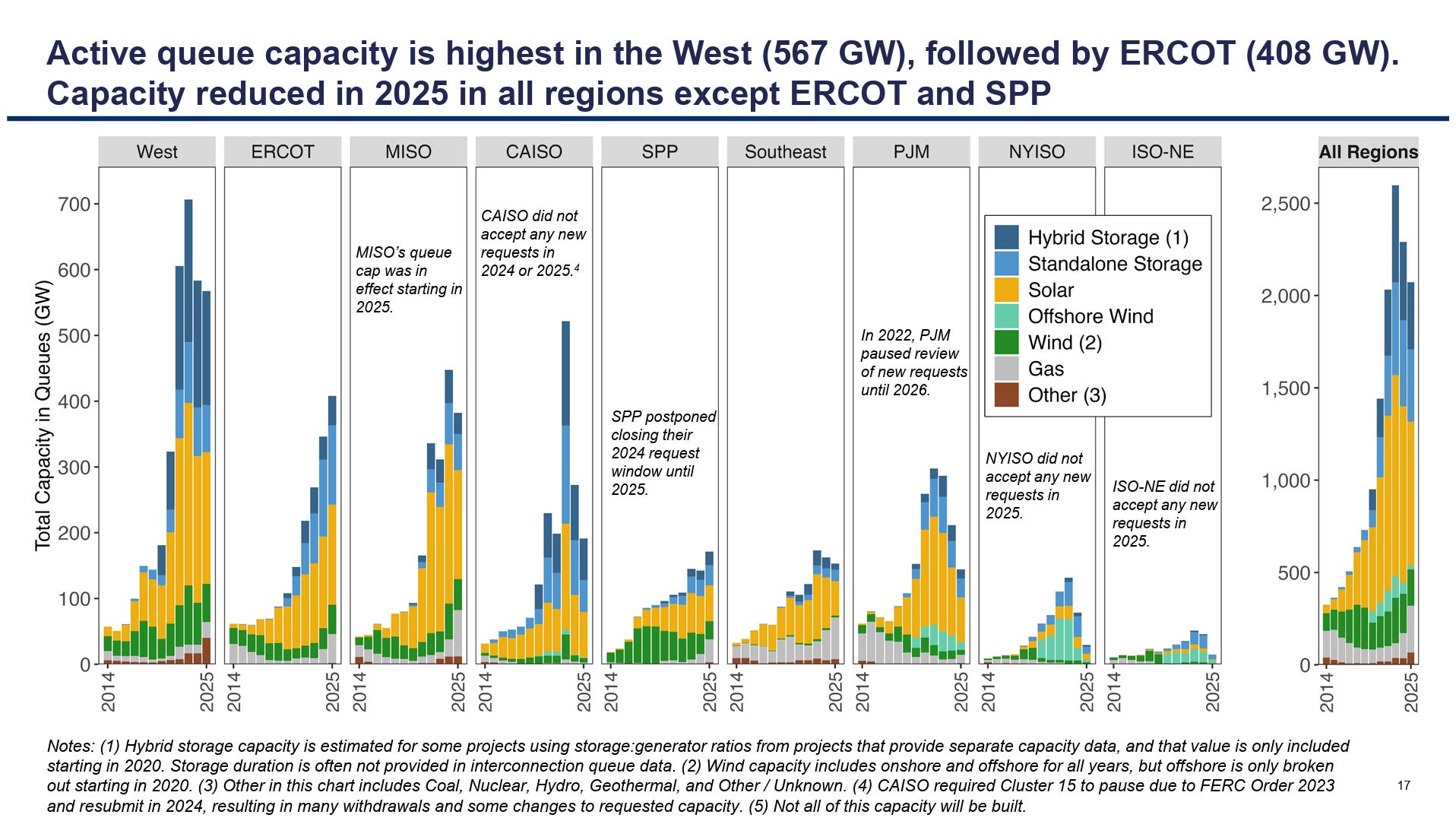
Figure 4: Nationwide and regional interconnection queue capacity over recent years, from the Lawrence Berkeley National Laboratory’s Queued Up: 2026 Edition report. In 2025, clean energy technologies accounted for over 85% of total queue capacity.
The BAAJA text includes a valuable provision requiring regional grids to offer a new interconnection option based on a fixed fee, helping accelerate interconnection queues that are predominantly filled with solar, battery, and wind projects. Streamlined permitting for high-voltage transmission projects would help reduce costs and speed up interconnection by opening up new headroom for new projects to connect to the grid at lower cost.
Such provisions would benefit hundreds, and eventually even thousands, of gigawatts of new clean energy capacity. The national map of where many solar projects are awaiting interconnection today illustrates just how federal permitting reform could disproportionately benefit clean energy deployment. Prospective capacity is disproportionately weighted in Western states where significant swaths of land remain federally-managed, with energy projects subject to NEPA review (Figure 5). Red lines show a handful of proposed major interstate transmission lines, for which BAAJA would also facilitate environmental review processes, potentially encouraging a blossoming of new transmission proposals. Previous analysis of the Inflation Reduction Act had warned that over 80% of modeled emissions reductions by 2030 depended upon expansion of transmission capacity beyond its recent growth rate of 1% per year. Such metrics highlight the degree to which transmission limits are increasingly constraining domestic power generation additions.
As evidenced by actual construction and interconnection queues, the country’s energy markets are heavily selecting for clean energy additions. At the same time, the further scale of new construction required to forge a pathway to U.S. power sector decarbonization remains immense. Relative to this larger long-term picture, currently-stalled projects are too small in scale to warrant missing an opportunity to permanently and dramatically improve the national development environment for the whole renewable energy sector.
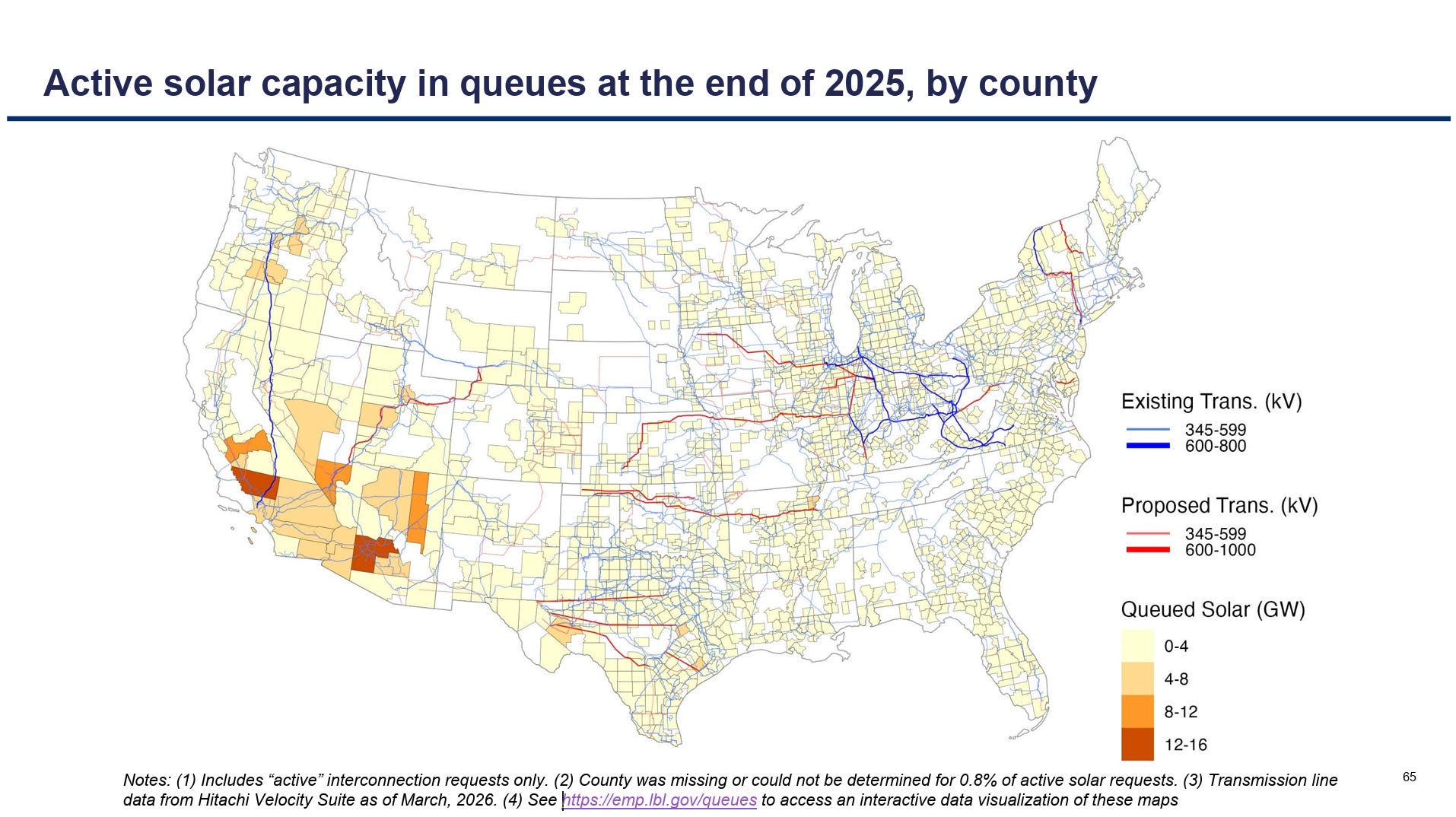
Figure 5: Nationwide map of solar capacity waiting in interconnection queues, by county, alongside major proposed high-voltage transmission projects, from the Lawrence Berkeley National Laboratory’s Queued Up: 2026 Edition report. Counties with the highest volumes of prospective solar projects are concentrated in Western U.S. states with high shares of federal land.
Expanding Clean Energy Frontiers
Whereas the permitting bill arguably offers strong net positives for wind and solar no matter what the White House commits regarding delayed projects, its provisions are unambiguously positive for other clean energy technologies. The United States already leads the world with 1.66 GW of new geothermal power purchase agreements, with next-generation technologies accounting for 61% of that pending capacity. Just days ago on September 24th, Fervo Energy achieved commercial power output at its first plant in Utah, marking a world-first for enhanced geothermal systems. The permitting bill would accelerate geothermal mapping, preliminary testing, and geothermal energy leasing on federal lands, likely lending further momentum to a clean energy technology already showing major promise. Faster scale-up of a successful U.S. commercial geothermal sector would, in turn, encourage spillover development of next-generation geothermal projects globally—an American gift to the energy transition.
Such prospects should remind policymakers that U.S. clean energy progress has the potential to accelerate decarbonization efforts worldwide. Breakthrough Institute modeling that incorporates nuclear technology cost improvements with built capacity finds a potential national market ranging between 185 and 469 GW of advanced nuclear by 2050. All domestic nuclear projects—including much of the associated supply chain such as fuel enrichment and manufacturing facilities—must undergo federal permitting and can thus benefit considerably from greater NEPA efficiency and permitting certainty.
Long duration storage technologies like iron-air batteries, another innovation that American technology developers are spearheading, would see their own gains from faster interconnection and from policies like the exemption of federal innovation grants from NEPA review. Faster transmission project development will meanwhile facilitate deployment of grid-enhancing technologies like advanced transmission cables, line-monitoring instruments, and advanced power flow controllers that more efficiently redirect electricity. All of these technologies possess their own export potential, conferring global benefits well beyond the United States.
On the Right Side of History
In taking the measure of what a BAAJA political deal offers for energy transition efforts, policymakers would do well to contemplate the key timelines and scale confronting the U.S. energy system—over the next couple of years and over coming decades.
At present, a new solar or wind project in the United States must regularly wait three to four years after submitting an interconnection request before being able to execute an interconnection agreement. If sued under NEPA, an energy project might spend a median of three years before obtaining a court decision that, based on historical data, tends to uphold the reviewing agency’s original environmental analysis in around 3 out of every 4 cases. Individually, such timespans are already increasingly exceeding anything the Trump administration could inflict upon the same project over its remaining tenure.
And while old-fashioned environmental groups worry that a permitting deal could also benefit fossil energy infrastructure, the Trump presidency is likewise running out of time to develop fossil fuel projects. While the administration sold new offshore oil and gas leases earlier this year, for example, leaseholders are unlikely to even finish years-long mapping of oil and gas in those areas before Trump’s term ends. Long lead times for pipelines, offshore oil and gas exploration, or new coal mines make it increasingly unlikely that the administration can plan and permit new major ventures before leaving office, particularly as a carousel of priorities like trade, conflict in the Middle East, AI, and macroeconomic policy compete for attention. Nor is private sector development interest certain amid unprecedented geopolitical turmoil and oil and gas market volatility that could rapidly change course, leaving projects with a much-weakened market case.
To be clear, oil and gas do likely benefit from BAAJA too. Durable, national energy infrastructure permitting reform cannot work if it isn’t bipartisan, giving both parties and all industries some skin in the game. Nor is more oil and gas activity the unmitigated black-and-white emissions ill that many of BAAJA’s opponents insist, considering the messiness of the energy “mid-transition.” Conventional natural gas plants remain key to balancing and supporting rising renewable energy deployments, with their emissions falling as they operate less over time—helping manage variable generation until clean, firm alternatives or carbon capture become sufficiently cheap. In regions like New England, increased pipeline capacity can still displace dirtier marine-shipped gas and oil. And it would remain both geopolitically and environmentally favorable for Europe, Japan, Korea, Taiwan, and India to consume American LNG instead of coal or Russian gas. Indeed, Europe and East Asia account for over one-half and one-quarter of U.S. LNG exports, while currently buying 46% and 48% of all Russian LNG exports.
New Rhodium Group forecasting suggests that even under current U.S. policies, the country is on track to reduce national annual greenhouse gas emissions by 616 to 769 million metric tons of CO2 by 2030. Even accounting for U.S. oil and gas exports, arguments that BAAJA risks raising emissions are essentially insisting that U.S. permitting reforms would reverse decarbonization trends that are gaining momentum globally, somehow producing worse outcomes than Rhodium’s worst-case assumptions. In the face of increasing clean energy deployment and a permitting status quo that already grants gas pipelines and oil drilling advantages over transmission lines and geothermal projects, such claims simply are not quantitatively credible.
In the context of ongoing negotiations, the scaling trajectory for clean energy technologies in the U.S. means that reforms enacted by this Congress can produce benefits that compound across decades over an expanding volume of projects. Even at its most arbitrary, this administration can only exert power over the nearest corner of this growing wedge. Laying the legislative foundation now will give both federal professionals and the private sector the earliest opportunity to plan for such growth.
In contrast, a breakdown in negotiations would postpone crucial reforms, shifting these self-amplifying energy system payoffs further away from reach. There’s reason to worry the political stars might not align like this for many years, with cascading climate policy effects. The policymaking effort and political capital spent reconstructing a fresh permitting package would also prevent a future Congress from pursuing the next key national opportunity, be that in the energy sector or elsewhere.
The remaining immediate energy project anxieties standing between lawmakers and a successful permitting and transmission package are small potatoes. Now is the time for Congress to seed a future clean energy harvest that future generations will thank them for.
