


Thanks to supply chain disruptions stemming from the war with Iran, California drivers, long accustomed to the nation’s highest pump prices, are now paying even more exorbitant sums for gas than usual—up to $8 a gallon in some locations. Part of this eye-watering price tag is due to the state’s strained refining capacity and other market quirks unique to California. But part of it is due to a program called the Low Carbon Fuel Standard (LCFS). As of January 2026, the program adds 17 cents to every gallon of gas.
The LCFS requires fuel suppliers in California to reduce emissions from transportation by either using low-carbon fuels in their supply chain—and thus receiving a LCFS credit—or by purchasing low-carbon fuel credits from producers elsewhere. The system works, in theory, by incentivizing the substitution of fossil fuels with supposedly less emissions-intensive products like biofuels and electricity.
The program could reduce emissions, in theory, but, in reality, California’s LCFS sends billions of dollars to biofuels linked to deforestation that, by some estimates, release more carbon over their lifecycle than the fossil fuels they replace. In short, California is charging drivers a premium to make emissions worse.
But there is a further irony to the LCFS program. The California credits are, in large part, for biofuels that would have been produced and sold anyway thanks to the Renewable Fuel Standard, a federal mandate. So, not only does LCFS fail to actually reduce emissions, it is overcharging Californians for a biofuel incentive program that does not incentivize new biofuels.
This is, paradoxically, better, emissions-wise, than the alternative. When the program fails to drive new production, it merely forces drivers to pay extra for biofuels that have already done their damage. When it succeeds, it forces drivers to pay to make emissions worse.
With more states looking to follow in California’s footsteps and launch their own versions of LCFS, it is critical for California legislators to reform the program. A good first step will be to make sure that drivers are not forced to pay extra for fuels that are already receiving federal credits through an additionality requirement. Still, actually reducing emissions from California’s transportation sector will require far larger policy changes.
The Renewable Fuel Standard already drives most U.S. biofuel use
The federal Renewable Fuel Standard (RFS) is the main policy shaping the U.S. market for ethanol and bio-based diesel (including biodiesel and renewable diesel). The program requires oil refiners and fuel importers to blend specific amounts of renewable fuel into the nation’s gasoline and diesel supply each year.
Instead of requiring each refinery to physically produce or blend those fuels itself, the RFS works through a credit system. When a company produces a gallon of renewable fuel, it generates a tradable credit called a Renewable Identification Number, or RIN. Refiners and fuel importers must acquire enough RINs each year to meet the federal mandate, either by blending in renewable fuel themselves or by buying RINS from others.
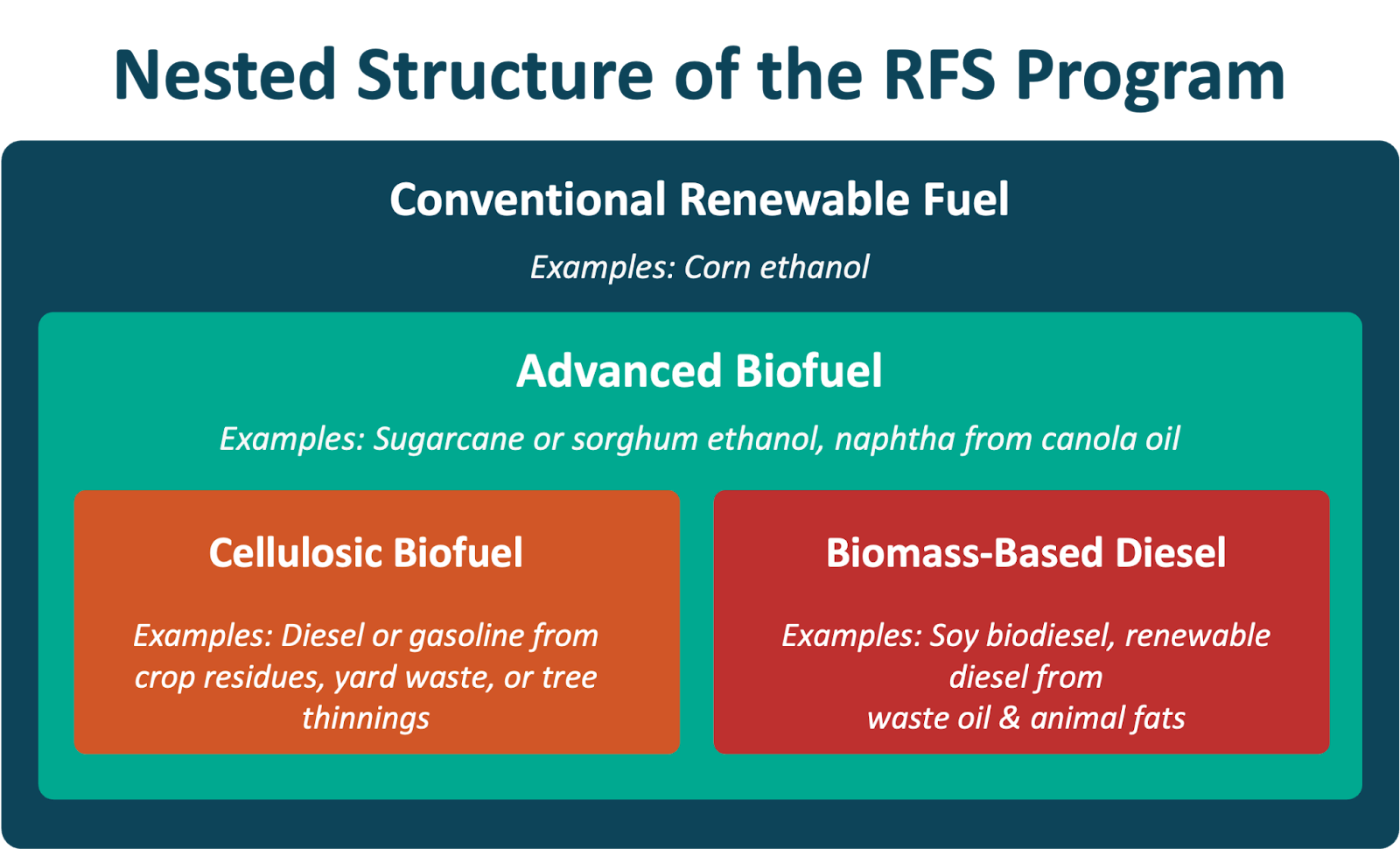
The EPA sets several renewable fuel mandates for each year. These include an overarching mandate covering all renewable fuels as well as mandates for specific categories of fuels: advanced biofuel, bio-based diesel, and cellulosic biofuel.
The RFS explicitly required about 3.4 billion gallons of bio-based diesel in 2025. But because the program’s mandates are nested, it actually incentivized more. Biodiesel and renewable diesel generate RINs that can count not only toward the bio-based diesel requirement but also the advanced and total renewable fuel mandates. In fact, these fuels are often the lowest-cost way for refiners to meet the larger advanced biofuel requirement and to fill any remaining gap in the overall renewable fuel mandate.
The programs’ influence on biofuel use can hardly be overstated. It sets a very high floor for biofuel use. Nearly all corn ethanol and 80% of all bio-based diesel use nationally was tied to RFS compliance in recent years, from 2022–2024. Put another way, the program effectively requires about 15 billion gallons of ethanol and 4 billion gallons of bio-based diesel. EPA’s new renewable fuel targets for 2026 and 2027 will require even more, nearly 5.5 billion gallons of bio-based diesel.
Why the LCFS credits are often redundant
The LCFS works by requiring fuel suppliers to reduce the average carbon intensity of the fuels they sell. Fuels below the benchmark generate credits; fuels above the benchmark generate deficits. Those credits are tradable, creating a market that rewards low-carbon alternatives. California fuel sellers have historically passed on about 100% of the costs of compliance to consumers; right now the LCFS adds about 17 cents to a gallon a gas, and is expected to rise to 25 to 40 cents a gallon by 2030 as the benchmarks become more stringent.
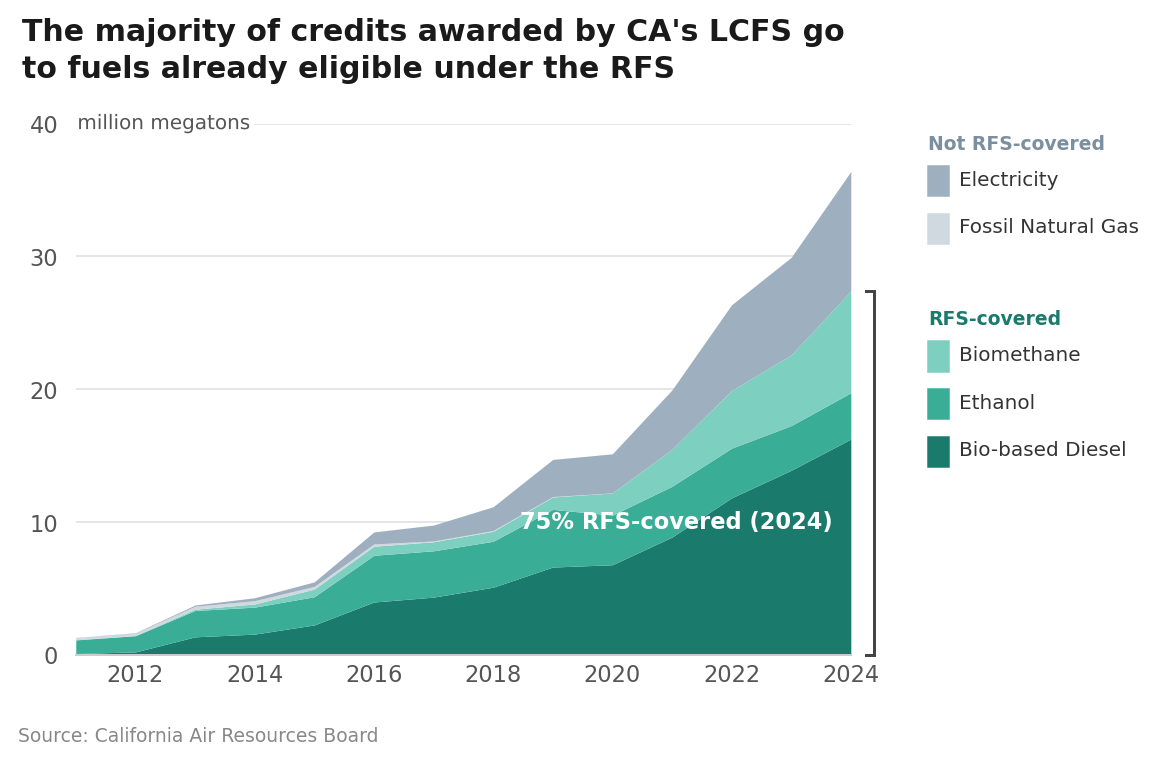
Because the RFS already requires vast quantities of bio-based diesel and ethanol to be sold, the majority of LCFS compliance dollars paid by California drivers—nearly two billion dollars just in the last year—is likely going to biofuels that would have been produced anyway. As of 2024, 75% of LCFS credits were going to either bio-based diesel, ethanol, or biomethane—all fuels covered by the RFS.
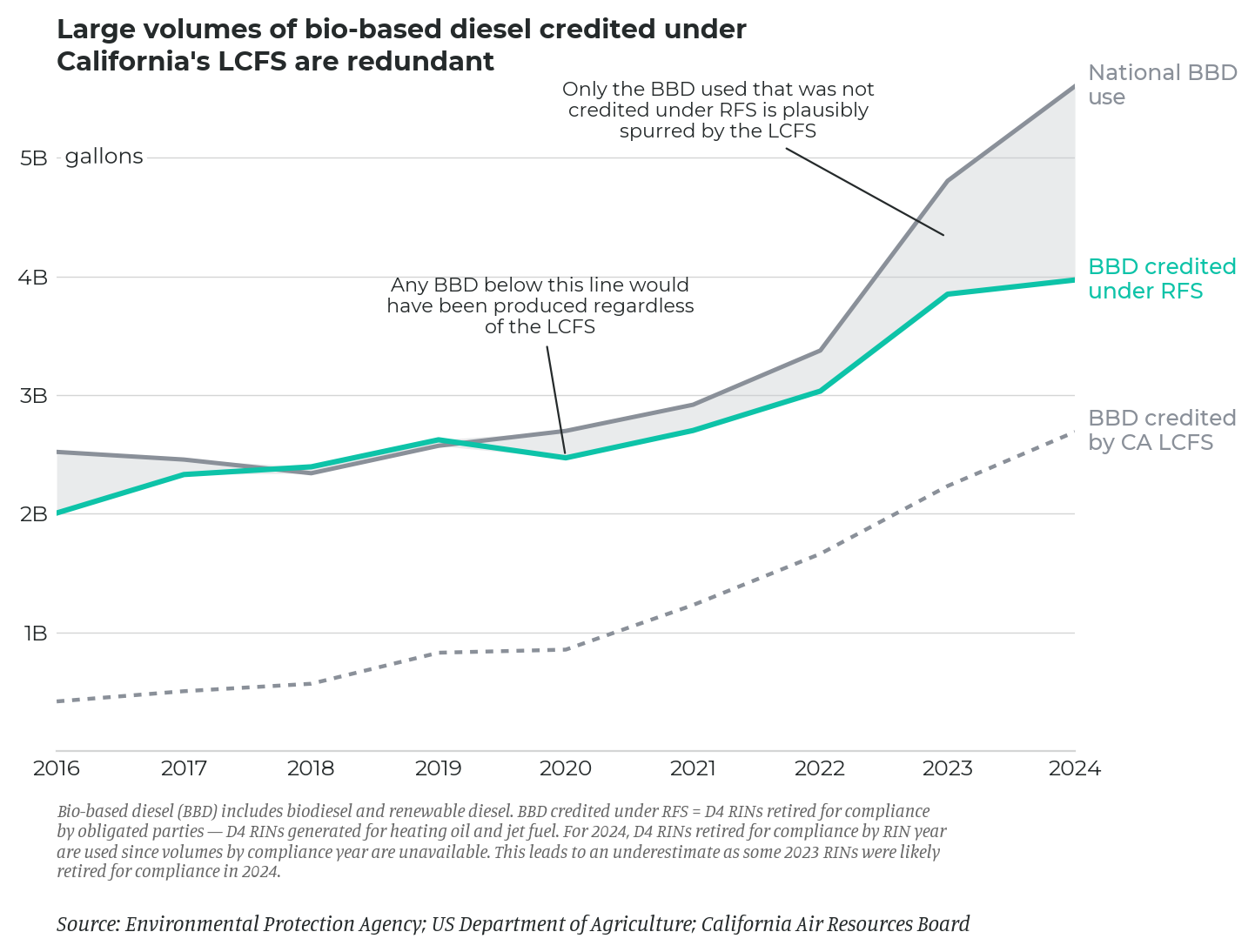
By just comparing nationwide fuel sales to the volumes credited under the RFS, we can see that at most 60% of bio-based diesel credited under California’s LCFS in 2024 was produced because of the program or, in other words, was additional. As the figure below shows, the vast majority of national bio-based diesel use was required by the RFS: only the remainder, about 1.6 billion gallons, could have plausibly been spurred by the LCFS. Yet the program still allowed companies to earn credit revenue for over 2.5 billion gallons. It’s possible that even more of the diesel would have been produced anyway since the RFS also increases its market price, making it more profitable to produce even without any government incentives.
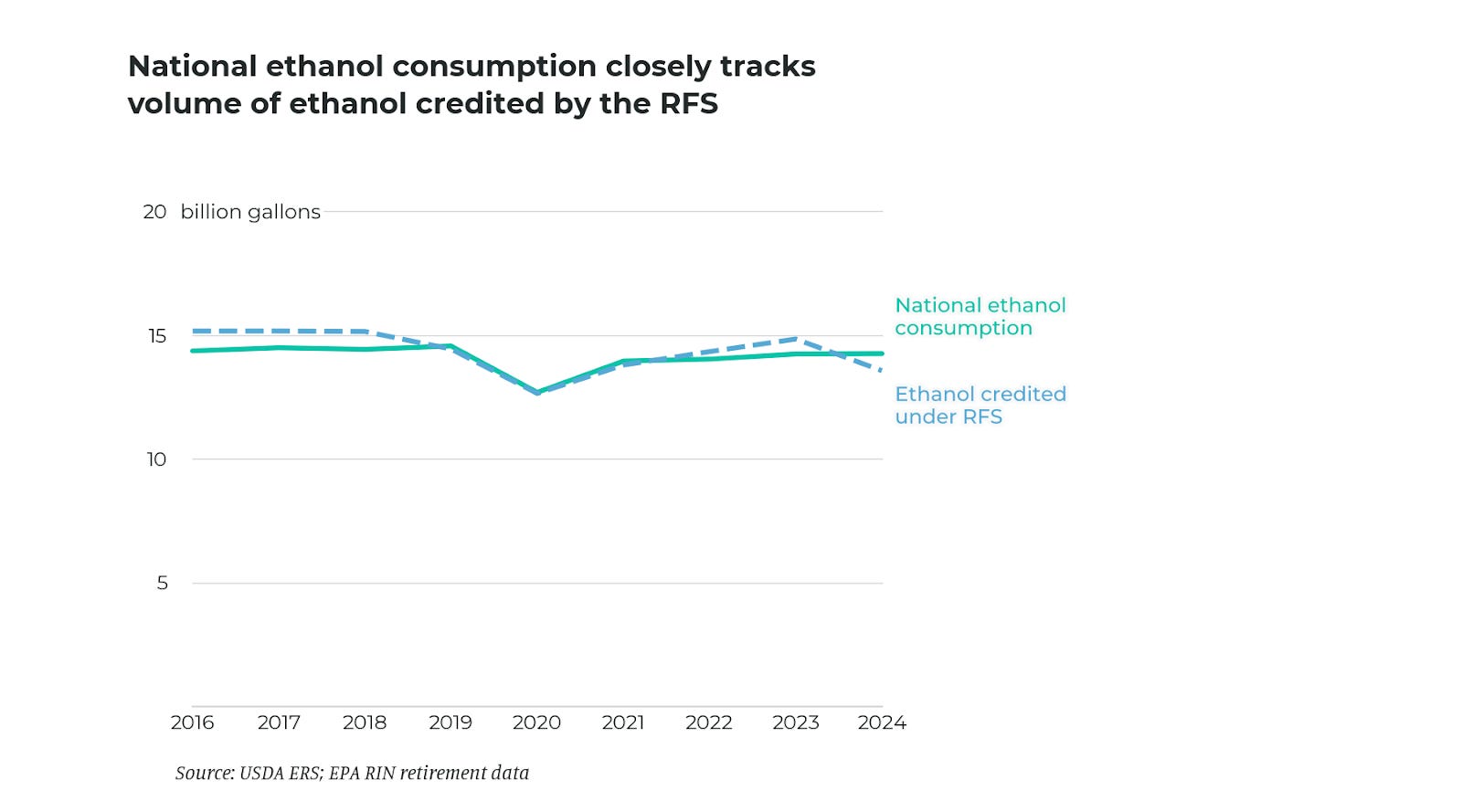
Ethanol is even worse—virtually none of it is additional. This is because there is an effective ceiling on how much ethanol can be blended into the gasoline supply—only flex-fuel vehicles can use blends above E15, and they make up a small fraction of the fleet. Therefore, there is no reason that the quantity of ethanol consumed in the US should be above the quantity mandated by the RFS, even if there were very lavish additional subsidies. This is borne out by the data, as shown below.
In other words, California drivers are not buying cleaner fuel—they are buying the same fuel, at a higher price, that would have been sold in another state. The LCFS subsidy does not reduce emissions so much as it moves them.
Policymakers should add an additionality requirement
As California goes, so do many other states. Legislatures and agencies in Oregon, Washington, and New Mexico have modeled their clean fuel programs after California’s. Other states, from Minnesota to Massachusetts, are considering their own programs too. California’s LCFS, however, has set a poor precedent by subsidizing biofuels that would already have been produced.
The state agency in charge of the program, CARB, is unlikely to consider any changes having just passed a series of controversial reforms in 2025. Likewise, Governor Newsom is unlikely to roll back a major environmental program while preparing a campaign for president as well as throwing his support behind ethanol, practically a prerequisite for any presidential contender. The legislature and the next governor, then, must push for reforms.
The most straightforward reform is to add an additionality requirement. California should not award LCFS credits to biofuels already needed to satisfy the federal RFS. The state could take a range of different approaches. It could credit only biofuel producers who couldn’t sell the RINs generated from their fuel. Or it could require financial data indicating that a fuel would not be profitable to produce without an LCFS credit. Or it could simply cap the amount of LCFS credits for fuels eligible for RFS compliance, especially corn ethanol and conventional biomass-based diesel.
This need not be revolutionary. Some of the projects that the LCFS supports are already highly additional and would not be pursued without the program’s support. Nearly 30% of credits are now awarded to a wide range of electrification activities. Hundreds of millions of dollars in LCFS revenue have been used to offer electric vehicle rebates. While many high-earners receiving the rebates would have bought an EV regardless, thousands of low-income households received larger rebates that likely enabled them to buy an EV. LCFS credits also help cover the high capital costs of installing fast chargers, including for trucks. While these costs have constrained widespread deployment, the LCFS now supports over 5,000 fast chargers.
Making the LCFS more additional would provide more support for electrification. Governor Newsom has already proposed a $200 million EV rebate program, but California is estimated to need far more: roughly $16.5 billion in EV charging and related electrification investment by 2030. Reforming the LCFS would not close that gap on its own, but it could further shift support toward fast chargers, charging at multi-unit dwellings, and other infrastructure needed to make EV ownership practical.
California should still pursue lower-carbon transportation. But it should stop making California drivers pay more for performative decarbonization, cutting emissions on paper while real-world fuel use hardly changes. In fact, reforming the LCFS would accelerate the state’s climate goals and pave the road for others to follow.

