

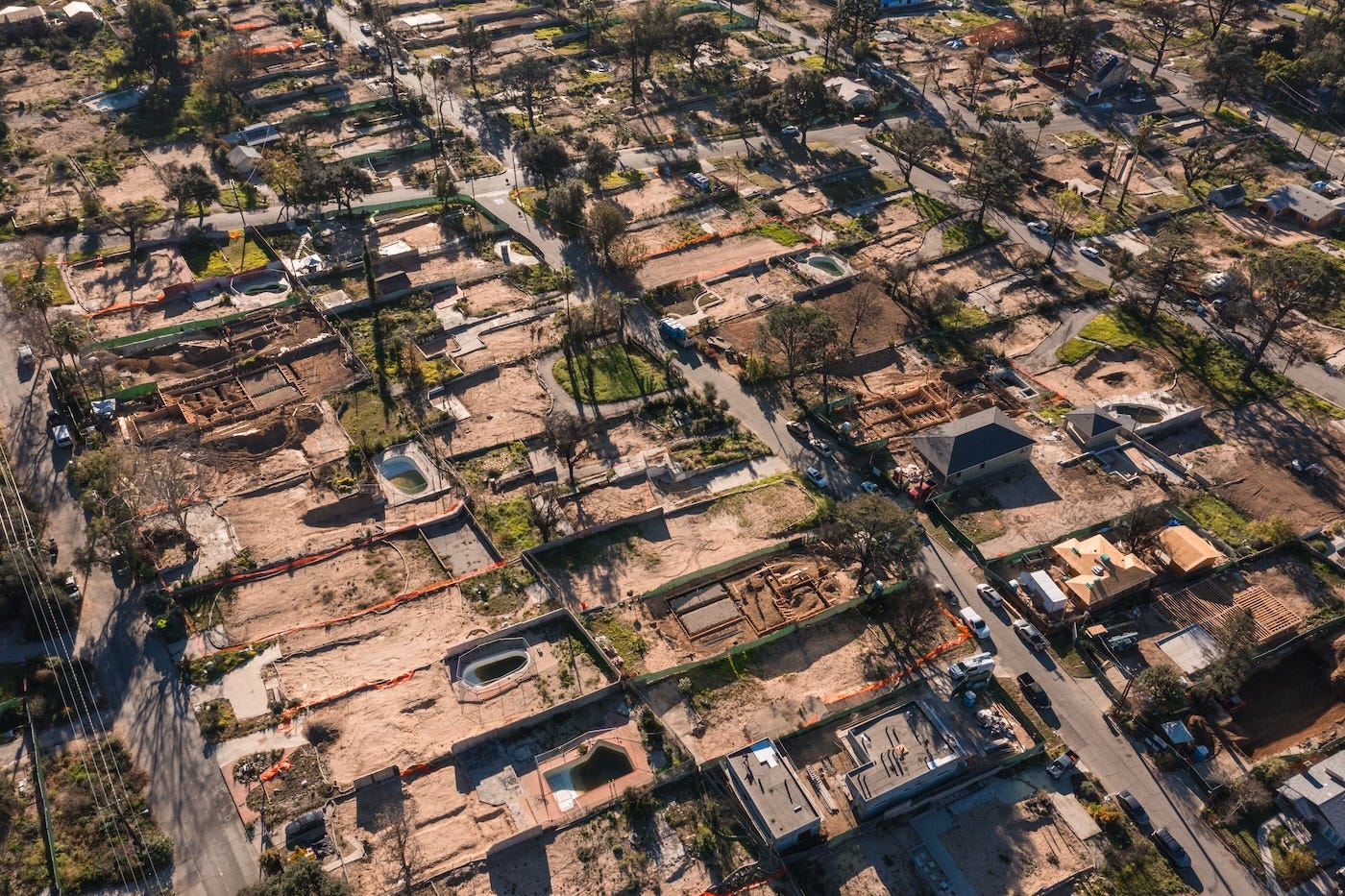
Property insurance is a crucial climate resilience tool. A functioning home insurance market sends signals about where it is safe to live, where it is not, and what investments you should make to protect your home. As California faces ever-growing wildfire risk, maintaining a healthy insurance market is more important than ever.
Jane Kim and Ben Allen, the two candidates on the ballot for California Insurance Commissioner, are running on sharply different approaches for how to handle this important climate resilience tool. Allen wants to strengthen competition in the private market, while Kim wants to carve out wildfire risk from the private market entirely and move it into a single-payer, public “Natural Disaster Insurance for All” program.
Kim’s plan is likely to make our wildfire problem worse.
The Insurance Commissioner race arrives at a make-or-break moment for the California insurance market. Thanks to Proposition 103, the 1988 ballot measure that subjected insurance rate increases to the approval of an elected official, California has spent four decades suppressing the market signals that would have guided development away from dangerous areas and into safer ones. Combined with growing wildfire risk from climate change and poor fuels management, this quite predictably led to an insurance crisis: earlier this decade, seven of the state’s top twelve property insurers, representing 85 percent of the market, paused or restricted new business. Meanwhile, enrollment on the FAIR Plan, the state’s insurer of last resort, quintupled over the course of just six years.
In response to this crisis, Commissioner Ricardo Lara promulgated the Sustainable Insurance Strategy (SIS) in 2024—the state’s first serious attempt to let premiums reflect actual risk by finally allowing insurers to incorporate forward-looking catastrophe models and reinsurance costs into their rates. Two years later, it shows signs of working: Insurers are starting to write policies in the state again, and enrollment onto the FAIR plan has slowed.
Restoring actuarial soundness is important not only for the safety of those living in high fire risk areas but for everyone else. When price controls on insurance encourage the development of the wildland urban interface, it puts more structures in harm’s way, multiplies the number of human-caused ignitions, and turns ordinary wildfires into urban conflagrations that blanket low-risk areas in toxic smoke.
There are also implications for affordability. Risk that is not priced into insurance premiums simply migrates into costs elsewhere. Last year following the LA fires, the FAIR plan had to make a $1 billion assessment on the entire privately insured market—including the majority of California homeowners who live in low risk areas—to keep the last resort insurer from going bankrupt. Meanwhile, electricity rates have skyrocketed since 2019, in part because insurers can recover their wildfire payouts from utilities, who pass those costs on to their customers.
California Punts on a Needed Wildfire Reform

From 2019 to 2024, Pacific Gas & Electric’s (PG&E) electricity rates rose by 80% and Southern California Edison’s (SCE) by 71%—more than three times the rate of inflation over the same period. The primary cause of this remarkable increase was wildfire: the cost of vegetation management, grid hardening, liability insurance, and contributions to the state…
Kim’s “Natural Disaster Insurance for All” proposal threatens to undo the fragile progress achieved by the SIS by re-instating the effective price controls that got us here in the first place. In a recently released policy brief, Kim claims that the premiums for this program would be based on risk—but this is very unlikely for two reasons.
First, any public program will face political pressure to suppress rates, which is what notoriously happened with the National Flood Insurance Program. After years of rate suppression, the program had to be bailed out by federal taxpayers to the tune of $16 billion.
Second, universal coverage that is also affordable—which is what Kim is proposing—cannot be truly risk-based. Parts of California are so fire-prone that the actuarially fair premium would exceed what any homeowner could reasonably pay, so guaranteeing those homeowners coverage would require charging them less than the true cost. Someone else has to make up the difference—and that will be homeowners in low-risk areas.
But suppose the program somehow manages to charge actuarially fair premiums to everyone. Then what’s the point? Kim argues that the profits a public insurer would not pay out could be redirected into mitigation. But underwriting profits on California homeowners policies have averaged 2.7 percent a year over the past two decades, and go negative in bad fire years. There is no windfall to redirect.
Nor is it true, as Kim claims, that private insurers have no incentive to invest in mitigation. In a healthy market, firms compete to offer the lowest profitable price in order to win share, which means systematically tracking what reduces losses and rewarding it. A state fund has less reason to continuously innovate, since it faces no competitors to lose share to.
This is not to say the state should have no role in encouraging home fire mitigation. If we restore actuarially sound insurance pricing, some lower income homeowners will be unable to afford their premiums. The state should expand existing programs that help low-income homeowners afford the hardening investments—Class A roofs, ember-resistant vents, defensible space—that both reduce fire risk and lower their actuarial premium.
Perhaps the biggest threat Kim’s proposal poses to wildfire resilience in California is not Natural Disaster Insurance for All itself, but the time and political capital that would be wasted trying to build it. Creating a public natural disaster insurer would require legislation that is very unlikely to pass. The time and political will spent fighting that fruitless battle in the Legislature would be put to much better use healing the insurance market we have.
A functioning insurance market is one of California’s most important climate-resilience tools. The state cannot afford to break the one it is only just starting to rebuild.
