


With domestic electricity consumption rising for the first time in a generation, a debate has erupted over how best to meet this new demand.
One camp argues that the fastest way to deal with load growth is through marginal and distributed improvements—by “getting more out of the grid we already have” with grid-enhancing technologies (GETs), capturing efficiency gains from electrified end-use technologies like heat pumps, and deploying distributed energy resources (DERs) like rooftop solar, battery storage, and virtual power plants (VPPs). The other camp seeks to streamline construction in the bulk power system with proposals to hasten siting and permitting for new transmission lines and interconnection for new power generation and for new large sources of load like data centers, chip fabs, metal refineries, and beyond.
The two approaches are not mutually exclusive; in fact, they can complement each other. Efficiencies and larger net supply can be unlocked on both the supply and distribution ends of the electric power system, and many DERs can indeed deploy quickly, “buying time” for the bulk power supply and transmission that will need to be built out in the coming years and decades.
But some in the first camp tend to pit the approaches against each other. To wit, a new series of reports by Rewiring America argues that tech companies should secure electricity by financing home upgrades, rather than funding new centralized generation. They describe this as a choice over whether hyperscaler grid investment “reinforces a model that concentrates wealth among large energy and technology companies, or builds one that lowers costs, strengthens communities, and centers households.”
Rewiring America assert that nationwide adoption of heat pumps, rooftop solar, home battery systems, and household electrification more broadly will create a new category of flexible grid resources that would not only meet 100 percent data center electricity demand but also improve energy affordability for tens of millions of households and reduce “reliance on expensive infrastructure expansion.”
Neither the analysis nor the grandiose proclamations made in the Homegrown Energy report series should be taken seriously. Rewiring America makes overoptimistic and unfounded assumptions to frame residential electrification as a preferable alternative to investment in the bulk power system. Their findings assume rates of heat pump, rooftop solar, and home battery installations that immediately jump orders of magnitude above the pace of deployment observed in recent years. Moreover, they never discuss how electrifying 68 million homes by 2030 would create significant new electricity demand of its own, overlook what the logistics and operational costs of such a program would look like, and how the country would meet load growth post-2030 having already exhausted all the ostensibly easily-mobilized energy capacity the residential sector has to offer.
Electrification and DERs can absolutely improve the existing power system and certainly deserve policy support. But maximalist studies like these deceive policymakers into believing that home upgrades should be the priority for grid expansion.
In addition to neglecting the need for new bulk supply assets like power plants, transmission and interconnection, and grid-scale storage, residential electrification maximalism poses immediate perverse consequences for homeowners themselves. The city of Berkeley, CA, for instance, is requiring sellers of single-residence homes to “replace fossil-fuel appliances or make other green upgrades as a condition of sale.” Sellers who defer this requirement must pay the buyers a $2,500 credit towards post-purchase retrofits, though the costs of installing a heat pump, for instance, can easily reach $20,000. The requirement amounts to an unfunded mandate on homebuyers in Berkeley, pushing up the cost of retrofits and with it the cost of housing.
Instead, the pathway through the nation’s electricity affordability crisis requires an approach that embraces both the large-scale electricity system and distributed innovations. In a political moment where the anxieties of everyday Americans are coalescing around worries that data centers will spike their electricity bills, policymakers have a golden window of opportunity to leverage hyperscalers’ power-sector investments to finance electrical projects that benefit them and society at large. By framing residential electrification as an alternative to investment in the bulk power system, Rewiring America’s reports present a zero-sum policy agenda that overrelies on distributed energy resources and may only worsen energy cost pressures for American consumers.
Distributed Math That Doesn’t Add Up
The core problem with Rewiring America’s reports is their considerable overestimation of the grid capacity that home upgrades could create.
For heat pumps, Rewiring America’s logic is that the grid is sized to peak capacity, so lowering demand during those peaks means that utilities or hyperscalers don’t have to invest in new peakers to accommodate a large load. They model this by looking at the 10 most stressed hours of the year. During the other 8750 hours of the year, the assumption is that data centers would be powered by making greater use of existing generators. This isn’t outlandish; baseload gas turbine plants operate at 66% capacity on average. Presumably, they could operate during more hours of the year to serve new data centers. Likewise, upgrading inefficient electrical HVAC systems to heat pumps could, at face value, reduce peak demand and free up capacity to accommodate data centers.
Most other methodological choices don’t hold up so well under scrutiny. Rooftop solar estimates, for example, adopt the simplification that every rooftop in the country allows for an optimal south-facing system. This effectively guarantees high-end solar output estimates, by a considerable margin. In addition to eliminating those roofs with facings that diverge quite dramatically from due south, a solar deployment campaign would also have to exclude homes with older roofs or roof materials and homes where systems would not generate economically useful solar output. This home upgrades proposal also overstates the number of homes that would opt in by ignoring reductions in participation from variations in homeowner receptiveness.
Meanwhile, installation capacity may lag behind the targeted level of ambition. Rewiring America repeatedly suggests that home electrification, rooftop solar, and batteries offer faster solutions than centralized infrastructure, citing long lead times for gas turbines and interconnection queues and promoting home upgrades as solutions implementable “on the order of months rather than years.” Months may be a reasonable assumption for each individual instance of home electrification, but Rewiring America’s reports model heat pump installations for 68 million homes and solar-battery systems for nearly 80 million single-family homes by 2030. According to our analysis, this would entail, relative to current deployment rates, an 35-40x increase in residential solar installations and a 170-180x increase in home battery storage installations, to say nothing of the number of certified electricians and other professionals needed to facilitate this level of deployment.
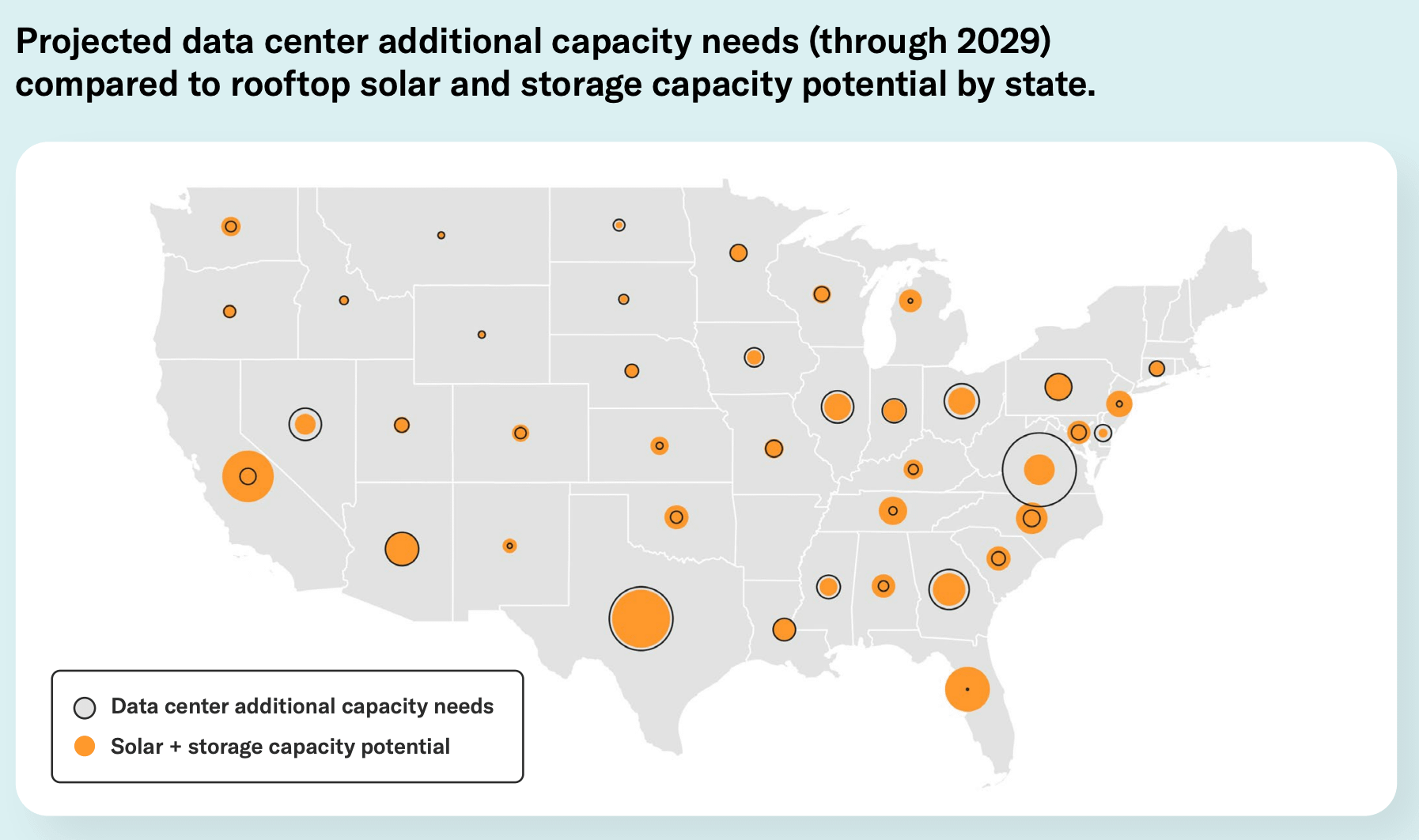
Not only are Rewiring America’s rooftop solar estimates wildly optimistic, they also fail to account for geography when claiming that potential rooftop solar and storage capacity “can meet 100 percent of data center demand growth.” This flashy statistic, found on the first report’s front cover, is based on statistics summed across the entire country: 109 GW of potential solar plus storage capacity compared to 93 GW of expected data center demand. But much of their estimated capacity will simply be far away from new data centers. The figure below illustrates the potential spatial extent of supply-demand mismatches. Residential upgrades leave a huge quantity of data center demand in Virginia unmet, for instance, while rooftops in sunny California and Florida generate far more electricity than locally anticipated data centers require. The report’s headline claims imply diversion of these surpluses to regions in need of this capacity, requiring extensive investments in interregional transmission lines—the same model of large-scale infrastructure expansion Rewiring America purports to caution against.
A home upgrade campaign must also overcome unresolved technical and administrative hurdles facing DERs that will necessarily add implementation costs, extend the deployment timeline, and introduce risks that Rewiring America fails to discuss. Operationally, utilities would have to make substantial distribution network upgrades to usefully leverage residential solar generation, while also overcoming technological challenges around forecasting, coordination, and control. For fully-utilizable home solar and battery systems, utilities may even reasonably demand a grid integration charge to cover supporting system infrastructure. The difficulty of assessing upgrade potential, recruiting participants, and executing projects house-by-house will also add considerable transaction costs to the nominal sticker value of each project’s added capacity. The Rewiring America analyses largely avoid reckoning with these costs.
Beyond ignoring administrative and grid charges, Rewiring America’s second report makes methodological choices that hide trillions in peculiar household spending assumptions. The report, titled “A Policy Blueprint for Energy Affordability,” recommends electrification policies that it claims will deliver “$26,000 in average lifetime savings per home, or $1.5 trillion nationwide” after a 15-20 year payoff period. These are not savings from lower energy bills alone, but rather savings relative to a future where every home nationwide irrationally replaced its appliances with newer “like-for-like” versions. Thus, Rewiring America assumes every fossil-fired stove, water heater, and home heating unit in the country, by default, will be replaced with the latest fossil-fired model. They apply an average like-for-like upgrade cost of $15,000 per home, meaning that—across all 68 million non-electrified homes—homeowners would spend an unnecessary $1.02 trillion, rather than simply retaining their existing appliances. A more honest approach would not count this extraneous upfront capital expense in assessing nationwide lifetime savings from mass electrification, a calculation which ought to stand on its own merits.
Altogether, mass home electrification could offer some opportunities to free up grid capacity as hyperscalers drive load growth nationwide, but not likely anywhere near the extent to which Rewiring America claims and certainly without creating downward pressure on electricity bills.
The Residential Sector: Promising But No Silver Bullet
Additional evidence that upgrading homes is insufficient to meet data center load growth actually comes from Rewiring America’s reports.
The Homegrown Energy “series” actually contains two different scenarios with assumptions optimized to support two different sets of goals. Part II argues that retrofits can be made affordable by modeling heat pump installation in the 68 million U.S. homes without them today, and by assuming a self-consumption battery dispatch strategy that minimizes the exports and imports of energy to the grid.
This contrasts starkly to Part I, which promotes household upgrades as an option to meet data center demand by lowering energy consumption during peak hours. Accordingly, it cherry-picks the subset of 21 million homes where heat pump installation would reduce peak demand and lower prices. These households already have electricity-based HVAC but use less energy-efficient technologies than heat pumps. Naturally, switching from an outdated electrical system to a better electrical system decreases energy consumption—much like swapping incandescent lightbulbs with LEDs. But restraining the scope of analysis excludes the other 47 million households for whom heat pumps would increase electricity consumption—those that currently use gas, oil, wood, or have no space heating and those with window or wall air conditioners or without air conditioning. Yet Part II, which does model heat pump installation for these homes, contains no mention of how such a program would raise peak electricity demand and necessitate new investments in centralized infrastructure.
Part I furthermore treats each state’s rooftop solar and storage as a perfectly coordinated network of grid assets and prioritizes residential exports that provide grid-wide peak shaving, as opposed to Part II’s approach that prioritizes benefits for homeowners over serving systemwide demand. The tension is that a battery cannot aggressively export during peak hours (as assumed in Part I) and also minimize said exports (the assumption in Part II). Residential solar with storage cannot simultaneously optimize for these two differing societal value propositions. In other words, home upgrades can either serve data center demand or lower the costs of home electrification, but they cannot do both.
Lastly, even if Rewiring America’s oversimplified projections for improved efficiency from home electrification somehow bear out, increasing load growth beyond the next half-decade will invariably require new electricity supply and transmission that the ratepayer will have to pay for. Rewiring America’s initiative would equip every household in the country with heat pumps, batteries, and rooftop solar by 2030. But after every gigawatt of reasonable capacity from the residential sector has been leveraged, home electrification can no longer serve as a resource to match virtually assured continued load growth post-2030. To do so will require additional centralized power plants and transmission—the majority built by utilities and paid for through electric bills, or by data centers themselves.
Affordable Electrification Cannot Ignore Infrastructure
The proper balance of attention towards home upgrades and the grid at a system level is ultimately simple. Policymakers should cut through red tape to make home upgrades more accessible for Americans that want them while focusing on channeling utility and data center developer capital investments into the shared infrastructure that supports long-term electricity system resiliency and national economic growth. In short, home electrification and DERs should be pursued on their own merits without overstating broader grid benefits.
The dilemma confronting U.S. politicians for the foreseeable future is that no realistic course of action will substantially lower electricity rates—certainly not immediately. More electricity demand will require more construction, which will in turn require capitalization through shared charges. The costs of merely maintaining and replacing existing distribution infrastructure are already showing up in ratepayers’ bills. The conflict between the transition to clean energy, load growth, and energy affordability is thus an emergent feature of markets adjusting to new demand, not a bug.
With or without clean energy, modernizing the U.S. grid in a time of rising demand will be more costly for many years before those efforts start saving Americans money. Those expenditures represent an investment in a better future that may reduce energy bills in a decade, not tomorrow. Maintaining focus on the long-term arc of the energy system, more than anything, will help keep policy efforts more appropriately balanced between opportunities at the level of the single-family home and those at the level of the macrogrid.
Great piece. I agree that data centers are going to increase costs in the short-term. In the long-term, though, I suspect increases in scale and the fact that data centers operate at higher capacity factors will mean they end up subsidizing everyone else and lowering electricity rates. I'm curious if some sort of deferred depreciation scheme could help to better spread out these upfront costs.