

The July 4 deadline for the Department of Energy’s Reactor Pilot Program (RPP) is just days away, and the program has met its central early test: three advanced test reactors have reached criticality on an extraordinarily compressed timeline.
Antares Nuclear’s Mark-0 reached zero-power criticality at Idaho National Laboratory (INL) on June 4th. Valar Atomics’ Ward 250 followed later that month in Utah, becoming the first DOE-authorized reactor built and operated outside the national laboratory system. And Deployable Energy, in DOE’s Nuclear Energy Launch Pad program, reached criticality at INL yesterday, making it the third reactor to meet the July 4 target. Aalo anticipates reaching criticality this week.
That is real progress. It is also easy to misunderstand.
Following July 4th, the Reactor Pilot Program will likely be treated in one of two narrow ways. Supporters may cast the milestone as proof that advanced nuclear has arrived: that the major barriers have been broken, that commercial deployment is close, and that the program has shown how to move around the slow machinery of nuclear regulation. Critics may take the opposite view: these are small test reactors, many operating at zero or low power, not commercial plants delivering electricity to the grid; therefore, the program is mostly symbolic.
Both reactions miss the point. The Reactor Pilot Program was a test of whether the United States could recreate the innovation cycle for nuclear developers to do what every other complex technology sector depends on: build, test, learn, and improve before scaling.
Stuck in a Narrow View
Most people take a narrow view of the RPP, its functions, and its value. There is no way to cover everything here, but we will expand on some topics that are generally reduced to a polarized talking point, or completely ignored.
These are not commercial reactors.
The Pilot Program was never about making commercial plants by the 4th of July. While companies like Radiant and Oklo entered their “full power” design into the RPP, those reactors are being demonstrated at the INL, not a customer site.
Focusing on the RPP not producing commercial reactors is missing the point entirely. You might be able to make a case that the RPP diverted attention and resources from companies that were aiming at a commercial product in several years. But, outright rejecting that the RPP gets the participating companies closer to a commercial product than they were before is nonsense.
Every product has a prototype; it’s just a matter of whether you admit it or not.
Technology readiness level (TRL) is a concept used to evaluate the progression of a project. NASA first developed TRL, but it has been adopted broadly, including by the DOE, and is used in most industries. You can see the TRL stages below:
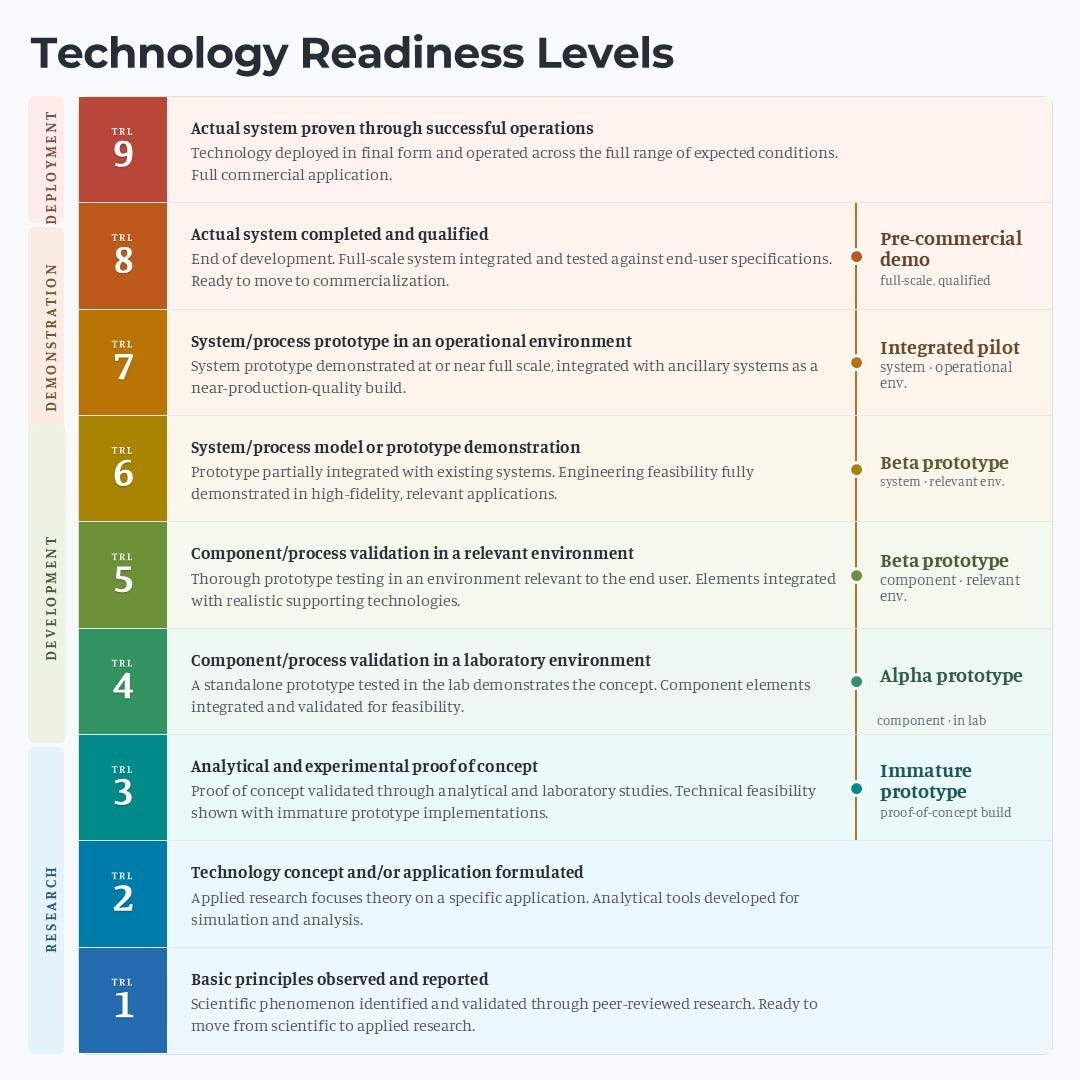
The RPP helps reactors move from TRL 3 to TRL 5 or 6. In the past, many nuclear power projects tried to skip TRL 5-7 and go straight to TRL 8, a full-scale project that is qualified in the real-world through testing. That is where nuclear has often gotten into trouble. When the first real test of a design is also the first commercial project, every unresolved technical, construction, operational, or regulatory issue shows up at the most expensive possible moment.
The RPP does not make these reactors commercial products overnight. But it does move participating developers further along the maturity curve by forcing real hardware, real operations, real safety cases, and real test data into the process earlier. That is not commercialization, but it is a necessary step toward it. A step that has been absent in recent history.
This is all just PR.
Yes, the Pilot Program, in small part, is for PR. Choosing the 4th of July, on America’s 250th birthday, is certainly for effect, and does not match the specific timeline to a specific need. But it is the norm for companies to boast about achievements. If that was the real goal, this is a very expensive way to pay for marketing. Investors are understandably enthusiastic about seeing real-world progress in a field that has been criticized for years for only making paper reactors. For some developers, the deadline served as a forcing function to move away from the typical decade-long development timelines of the nuclear industry in favor of one that takes years. For others, it was simply good PR to be selected for the Pilot out of the sea of developers.
Companies had to consider the cost of participating in the RPP and building a prototype against the value of it, which, as advertised from the outset, did not include selling to a customer, but admittedly did include demonstrating something for investors and public news cycles.
After years of stagnation, and the last major project—Vogtle reactors 3 and 4 near Augusta, Georgia—having major issues, it is odd that some are downplaying the RPP as trivial. It is a bit absurd to suggest no one should have been inspired by past demonstrations and following commercial products, such as landing the first reusable rocket, or the first alternating current generator, wireless charging, or finishing the Hoover Dam. Those were clearly not just for PR.
This step is unnecessary.
Prototypes are not always necessary, but a well-designed prototype is always useful.
The United States has a lot of experience with prototyping reactors. American developers also built many first-of-a-kind commercial projects. Some did not work well and were ultimately decommissioned after a brief existence. The challenge becomes pinpointing, from the start of a project, which step in the figure below is the unnecessary step.
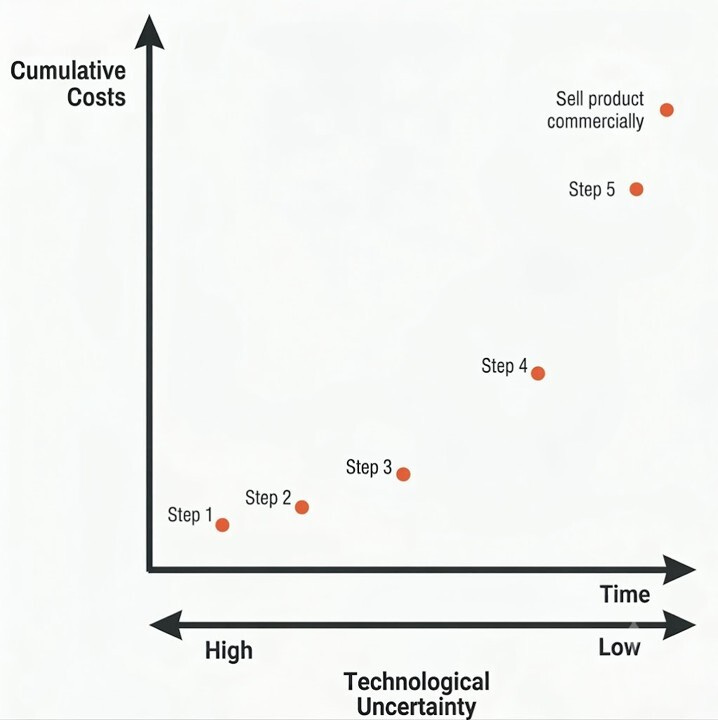
Almost every technical or mechanical product had a prototype that preceded it. The expected value, in terms of building the supply chain, increasing company knowledge, finding opportunities for innovation, and most importantly, catching problems before moving into production, has to be weighed against the cost in money and time. From an accounting point of view it is hard to put specific numbers to most of the benefits of prototyping. Even project risk reduction is hard to define. As the tolerance for project risk decreases, the more you are willing to pay to eliminate tripping points. Most nuclear power projects have very small risk tolerance and want on-time, on-budget guarantees. Conversely, it is easier to put a dollar value on the cost of the parts and labor. Add in the uncertainty related to licensing and permitting for a test reactor, and it is usually easy to make the case that a prototype costs more than it saves.
In other words, we can assess the potential reward from a successful project, but we cannot truly assess the project risk of getting that reward. The risk/reward relationship is unknowable, or at least highly uncertain.
Most major companies that are known for innovation use cost-benefit analyses to inform which concepts should receive attention, but almost never use them to justify skipping the prototyping phase. This is especially true for safety-significant products, like vehicles, medication, manufacturing equipment, or consumer electronics.
This approach is challenging for large reactors. They take years to build and cost billions of dollars. It would be challenging to justify that as an R&D expense alone if it could not also sell power. The result is the first customer becomes the test case, and the design is improved for the second customer. Buyers have rejected this approach after Vogtle. Smaller reactors can be prototyped more easily, just like Boeing can build a prototype airplane to test manufacturing and operations, before finalizing a production-ready design.
How the Pilot Program Fits Into the Innovation Cycle, or, How to Grasp the Holistic View of RPP
The innovation cycle is abstract to most observers, and concepts of innovation abound. It is very tempting to think, “why don’t you just build the final product?” due to near-term consumer demand. But this trivializes the uncertainty of technological innovation, and the effort required to build something new.
An innovation cycle is the process by which a technology moves from concept to product through repeated rounds of design, testing, learning, and improvement. A developer starts with an idea, models how it should work, tests pieces of it, builds larger integrated systems, identifies what failed or did not perform as expected, changes the design or the manufacturing process, and then repeats the cycle at higher levels of maturity.
This is not unique to nuclear.
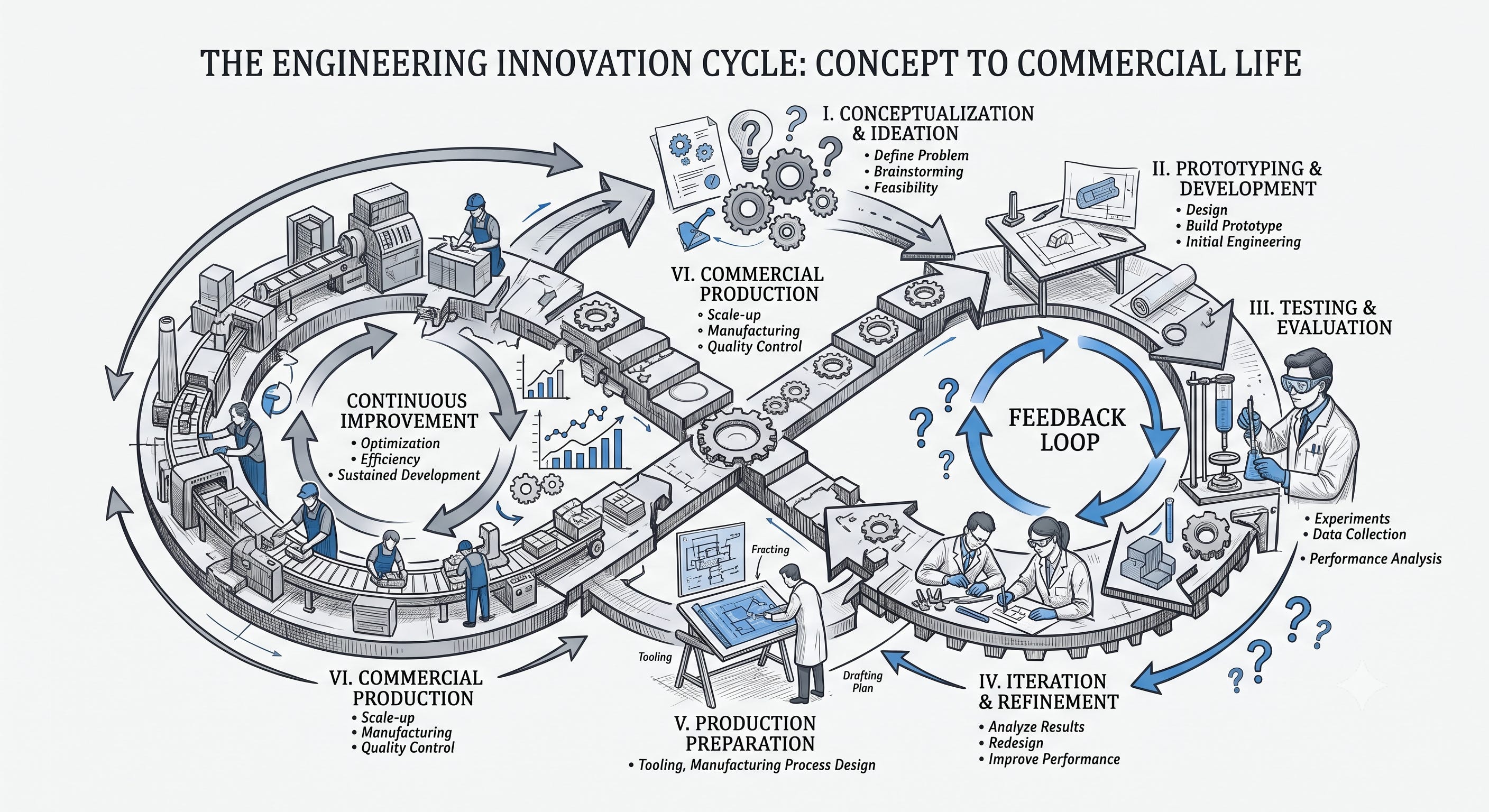
At some point, developers need to learn how the design behaves when the parts are assembled, when operators use procedures, when instrumentation collects data, when construction sequences meet field conditions, and when the system is reviewed under a real safety case. When manufacturing and building the prototype many challenges will be discovered. In the prototype phase they are minor, but if you are building a commercial project you will have to stop working, lose a lot of worker hours, solve the problem, possibly ask the regulator for approval, and then move forward. This happened multiple times in the process of adding two AP1000 reactors at Vogtle.
Building forces you to invest in the equipment, workforce, and processes you will need to build a full commercial product. There is no substitute for this step.
A part might look perfect in the model, but in manufacturing, an edge always forms a bur that needs to be removed by hand. A part might come in from a supplier out of tolerance and not fit, leading to a decision to vertically integrate production of that component. An assembly sequence may be technically possible but impractical in the field. A construction step may require a different tool, procedure, or workforce plan than expected. These are exactly the kinds of problems a prototype is supposed to reveal before a commercial project has to absorb them.
There is a lot that you can’t do with modeling. Test loops for coolant or cycling single components provide very useful component-level data, but cannot provide system-level data, or help with assembly. The Integrated Effects Test is one example of a test built for this purpose.
With full systems, you can test processes that you cannot fully validate at a component level: commissioning, startup, operations and monitoring, regulatory oversight, transients and simulated failure modes. Kairos has been on this path for years, from their Engineering Test Units that are non-nuclear, to Hermes, their first nuclear reactor. (It is odd that many of the people that want developers to go straight to commercial facilities are more negative about the RPP than they are about Kairos, with many prototyping iterations.) But Kairos learned many important lessons in their prototyping iterations, and vertically integrated capabilities to avoid future problems.
Operational prototypes can test criticality, geometry, and get data that you can’t get in a model. When your licensing case for a full-power version rests on validation of your models, this is one of the few options available.
Modeling and simulation are necessary for nuclear projects because that work also supports regulatory engagement. Digital Twins of full-scale facilities are valuable for simulating construction, operations, and maintenance.
Prototyping is a fundamental step towards making commercialization possible. The industry moved away from prototyping reactors because it was an expensive option for large reactors with high regulatory costs. The need for prototyping did not disappear. The opportunity to do it became harder to justify.
Our Take: A Holistic View of the RPP
The Reactor Pilot Program’s success should not be measured only by whether three reactors reached criticality by July 4. That milestone matters, but the more important question is whether the program helped the United States rebuild a practical innovation cycle for nuclear energy: prototypes that generate useful data, a DOE authorization pathway that can be repeated, NRC licensing that can use DOE-generated experience without surrendering independent review, and developers that can turn early test results into safer, better-performing, more commercially credible products.
Seen narrowly, the RPP can look too small to matter or too preliminary to count. Seen holistically, it is one part of a larger shift in the nuclear deployment ecosystem. DOE created an expedited pathway for test reactors. Developers put hardware, capital, and teams behind early nuclear prototypes. Regulators are being asked to think more carefully about how testing, authorization, and commercial licensing should interact. Policymakers have begun to treat nuclear deployment as a serious national priority rather than a distant aspiration.
The RPP should be understood within that larger system. Nuclear deployment depends on many nonfungible pieces: test reactors, commercial licensing, fuel supply, manufacturing, financing, customer demand, regulatory modernization, and workforce capacity. Progress in one area does not solve the others, but it can make the whole system more capable. A narrow view of the RPP misses that. Its value is clearest when it is seen as one component in a broader effort to rebuild the conditions for nuclear deployment.
Companies entered the RPP for different reasons, and the next stage may not fit every technical goal, business model, or development timeline. That should not be read as failure. A useful prototype pathway should help companies determine what they need next, whether that is continued testing under DOE authorization, a move toward NRC licensing, more design work, a different site, or a different market.
The RPP’s influence may also extend beyond the original cohort. Deployable Energy’s criticality through DOE’s new Nuclear Energy Launch Pad initiative suggests that the pilot helped establish a broader idea: advanced reactor developers need a faster, more practical route to build and test real systems. Launch Pad is now the test of whether that idea becomes a standing capability rather than a one-time deadline exercise.
The Reactor Pilot Program was never going to be able to solve every barrier facing advanced nuclear. But the RPP did challenge a piece of the status quo that had become too easy to accept: that nuclear developers had to move from paper designs and component tests directly into full commercial licensing, with little room for reactor prototyping in between.

