


In early 2005, one of the largest public works projects in American history was about to age into eligibility for the National Register for Historic Places. The Interstate Highway system, launched by the Federal-Aid Highway Act of 1956, would reach its 50th birthday in June 2006—the age at which federal law considers a place as potentially historic. The officials who administer the nation’s preservation law needed to figure out how to handle this impending deluge of work. Treated as eligible, the system’s 46,700 miles would trigger historic review for every federally funded repaving and guardrail replacement project.
Rather than absorb the burden, the Advisory Council on Historic Preservation exempted the entire Interstate Highway System from historic preservation rules. The Council adopted a rule relieving federal agencies from the obligation to consider the effects of their actions on the Interstate as a historic property, reserving review only for a short list of individually significant bridges and interchanges. Moving in parallel, Congress passed legislation exempting the bulk of the system from a related preservation requirement that same year.
The exemption solved an immediate administrative problem. But it duly raised a more fundamental one. If one of the most significant public works projects in American history had to be exempted from historic review to keep that review process functioning, the design of the process is exceeding its intended purpose. The National Historic Preservation Act (NHPA) requires federal agencies to consider how their funded, permitted, or otherwise assisted actions affect “historic properties.” Critically, the statute defines that category to include not only sites already listed on the National Register but also any site eligible for listing. Eligibility hinges on whether a property is generally over 50 years old, retains its physical integrity, and ties to a significant historic event, an important person’s working life, a distinctive design tradition, or a body of information important to our understanding of history. Of these criteria, only the 50-year threshold is genuinely objective; the rest invite interpretation, which means a determined challenger can drag almost any property approaching half a century old into a Section 106 review. NIMBY interests routinely exploit this breadth to block development, layering on procedural hurdles that are expensive, time-consuming, and litigious—and that inject substantial uncertainty into project timelines.
The 50-year threshold poses a compounding challenge as America’s mid-century infrastructure ages into eligibility. The post-New Deal building boom produced an enormous stock of highways, dams, federal buildings, and housing, much of which is now crossing the half-century mark. The average year of construction recorded in the National Bridge Inventory is 1964, meaning the average American bridge is more than 60 years old. Each passing year enlarges the pool of properties that challengers can argue require Section 106 review, expanding the surface area for litigation and delay.
Congress passed the Infrastructure Investment and Jobs Act (IIJA) in 2021 to begin addressing a generation of infrastructure decay. The slow rollout of the $1.2 trillion package has revealed a deeper problem: the historic preservation framework built in 1966 to protect a curated set of significant sites has grown into a system whose reach now extends across most of the infrastructure that legislation aims to repair. Congress authorized the largest federal infrastructure investment in a generation, but the federal preservation review system has grown so expansive that new infrastructure spending generates a corresponding surge in review.
That much of America’s roadways, bridges, and buildings are more than 50 years old means that they are aging, not historic. Improving—or rebuilding—our infrastructure and housing will require a system that does not generate endless review over technicalities. Reforming the NHPA is a step in the right direction.
Expanding the Universe of What Counts as Historic
When Congress passed the NHPA in 1966, it broke from sixty years of curated federal historic preservation. The three preceding statutes—the Antiquities Act of 1906, the National Park Service Organic Act of 1916, and the Historic Sites Act of 1935—had identified a small set of obviously significant national treasures (Mesa Verde, Independence Hall, Monticello) for individual designation. In 1966, the NHPA replaced that model with the National Register of Historic Places, State Historic Preservation Officers (SHPOs), and the Section 106 review process, which required federal agencies to consider the effects of their actions on properties on the Register.
The universe of covered properties has expanded steadily ever since.
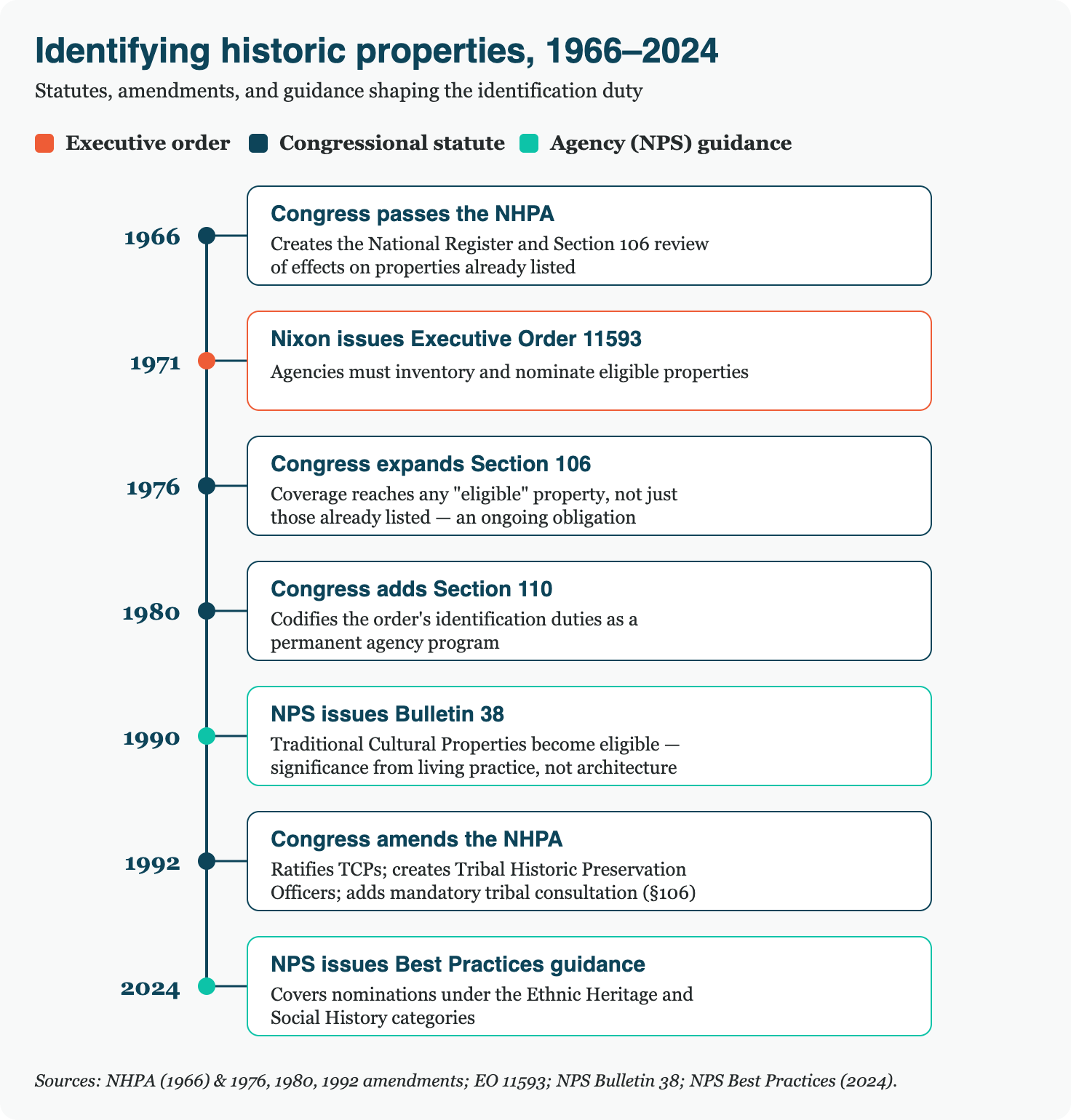
As more kinds of properties qualify as historic, more procedural requirements are being attached to each one. The 50-year threshold exacerbated this expansion, pulling a larger cohort of properties into the system every year, which may have seemed manageable when Congress wrote the statute in 1966, but functions very differently against a built environment dominated by mid-century construction.
Capacity and Delegation
Federal funding for the offices conducting these reviews hasn’t kept pace with the workload. A key role of SHPOs is to survey, evaluate, and nominate significant historic buildings, sites, structures, districts, and objects eligible for the National Register. SHPO Section 106 caseloads jumped 42.7% in a single year following IIJA, reaching 177,400 reviews in FY2023. Between 2020 and 2024, SHPO offices’ share of the Historic Preservation Fund fell from 44% to 32.9%. The workload climbed; the budget for handling it didn’t follow.
The workload has also shifted. When Congress created SHPOs in 1966, they were meant to advise federal agencies on Section 106 compliance—the federal agency was the responsible party, and the SHPO supplied expertise. Over time, the day-to-day review work has moved onto SHPO and THPO staff: identifying properties, assessing effects, drafting findings. The 1992 amendments accelerated the trend by creating THPOs and allowing them to assume SHPO functions on tribal lands. But the THPO appropriation in the Historic Preservation Fund has not kept pace with the addition of new THPOs—five to ten of which are established each year—so each office’s share of the pool has shrunk. Federal agencies still hold formal authority, but the offices doing the work are underfunded relative to the caseload they’ve absorbed.
The Limits of Existing Exemptions
The growing review burden has not gone unrecognized. Over the past two decades, the Advisory Council on Historic Preservation has exempted routine work on one aging sector after another, highways, common bridges, rail corridors, federal buildings, and nearly all of telecommunications. Each of these exemptions concedes that subjecting ordinary maintenance to historic review has become unworkable—leaving intact the review process for large construction projects that would naturally have significant effects.
However, these carve-outs are far too narrow to fully address the scale of the issue. Every exemption only reaches to the edge of the official project boundaries, while the potential effects that can trigger review can extend miles in any direction. The area surrounding these aging infrastructure components is also aging and increasingly eligible for listing on the National Register. For one federally funded interchange reconstruction in Reno, the agency had to evaluate more than 1,400 properties in the project’s path, including over 650 postwar homes that had reached 50 years of age, even though the Interstate itself was exempt from review.
These sector-specific exemptions don’t include maintenance for transmission lines, oil pipelines, and water mains. Laid in the same postwar decades, these systems are now crossing the 50-year threshold just as they most need maintenance and upgrades, and have no exemptions for historic review.
Moving Forward
More money won’t fix process design flaws; we need to rethink how much these regulations are helping to preserve our cultural identity and how much they’re impairing efforts to build a better future.
Maintenance and routine work for transmission and pipelines, which can cross hundreds of miles and sweep large swaths of the landscape into review, should get the exemption they lack. Better still, a single standing rule should exempt routine maintenance within existing rights-of-way across all sectors, rather than carve out one at a time. Environmental review already treats this work as routine: the same corridor maintenance project can qualify for a categorical exclusion under NEPA, yet still face full Section 106 review.
As more infrastructure approaches the review threshold each year, Congress should move away from treating broad classes of postwar infrastructure and development as presumptively eligible for the National Register. Common resource types—including highways, bridges, transmission lines, pipelines, utility facilities, and standard residential and commercial development—should be presumed ineligible absent a showing of exceptional significance. For purposes of federal review, eligibility should require not merely an association with broad historical trends, but a demonstrated national significance or exceptional distinctiveness relative to the thousands of similar resources produced during the postwar building boom. States would remain free to recognize and protect locally important resources through their own preservation programs.
Such a reform would preserve protection for genuinely important landmarks, cultural resources, and public works while preventing ordinary aging infrastructure from being swept into an ever-expanding review system simply because it has crossed an age threshold. And it would help ensure that the money intended to repair the country’s aging systems is spent on repairs, not absorbed by the review.
