

This is a lightly revised version of an article originally published at The Dispatch Energy.
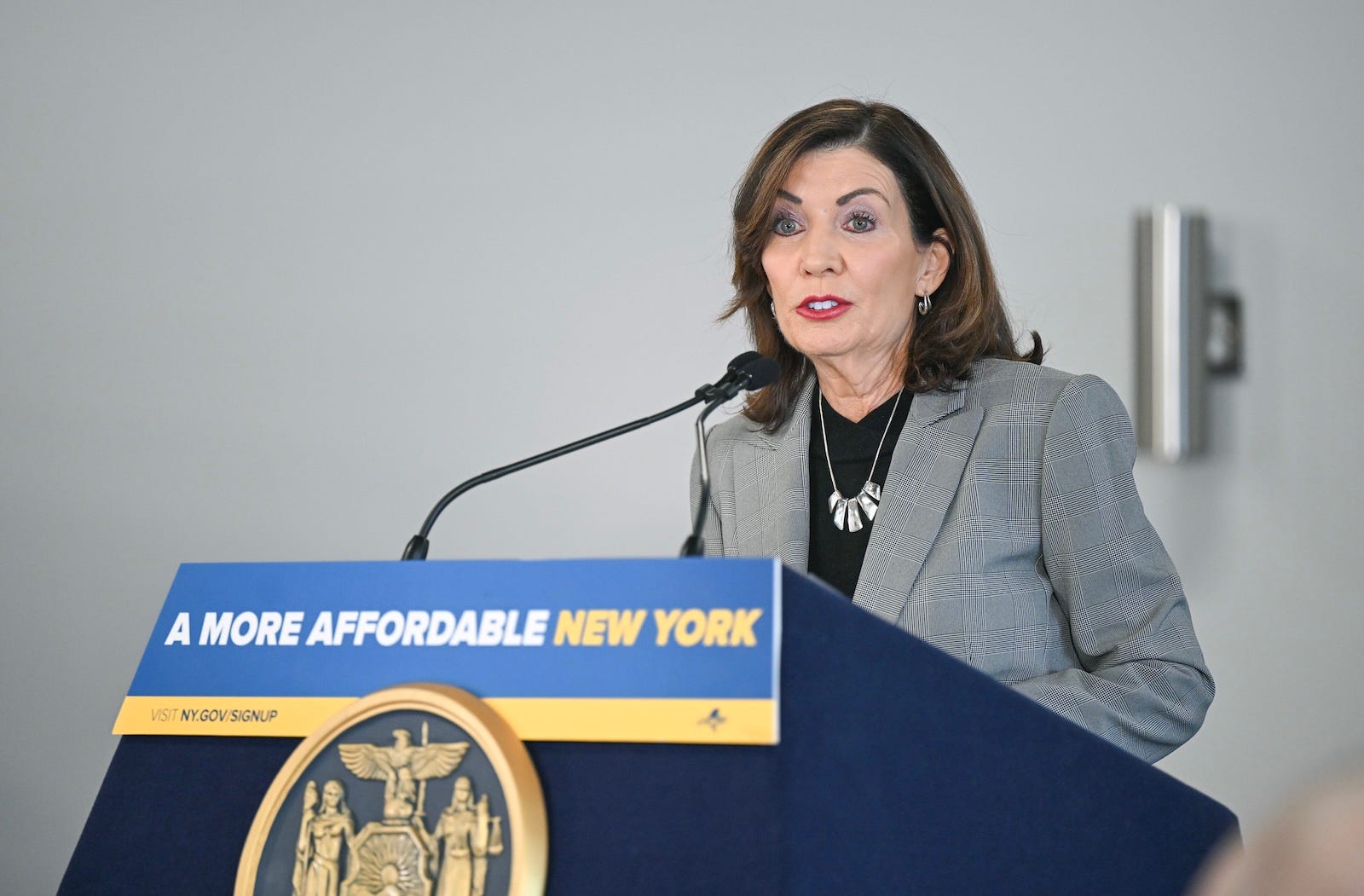
Energy prices are rising everywhere, particularly in blue states, and Democrats are scrambling to build new energy supply—and in doing so, are abandoning the climate politics that have defined the party’s agenda for over a decade. Perhaps no other Democratic official in the country has pursued an energy affordability agenda as aggressively as New York Governor Kathy Hochul, who has reversed her state’s position on nuclear energy and natural gas pipelines while pursuing permitting reform and new AI data centers. It could mark a new dawn for affordability-minded Democrats, if they can navigate the deepening tensions with their erstwhile allies in the climate movement.
Hochul’s recent approval of the Northeast Supply Enhancement (NESE) pipeline, a new natural gas pipeline, signals an important evolution in Democrats’ energy agenda, from the renewables-and-regulations approach that prevailed in the climate hawk era to a revived “all-of-the-above” affordability politics.
In the Ancient Times of, say, 2012 or so, Hochul’s decision on the pipeline wouldn’t have come as a shock. Back then, Democrats explicitly embraced all-of-the-above energy policy, pairing incentives for low-carbon technologies with support for affordable domestic oil and gas supplies. As President Barack Obama said in 2012, “We’ve got to invest in a serious, sustained, all-of-the-above energy strategy that develops every resource available for the 21st century.”
But over the course of the 2010s, climate activists turned against this consensus. “‘All of the above’ is no strategy at all,” declared 18 environmentalist organizations in a letter to Obama in 2014. These groups, and hundreds more, intensified their campaigns against oil and gas production. Tens of thousands of activists showed up to protest the Keystone XL and Dakota Access pipeline projects, while green groups tried to ban oil and gas fracking at the state and federal level. This style of “keep-it-in-the-ground” anti-fossil fuel activism came to a head in 2022, when moderate Democratic Senator Joe Manchin struck a deal to fast-track approval of the Mountain Valley Pipeline as a concession for his vote on the Inflation Reduction Act, a move climate advocates called a “dirty deal.” Environmental opposition was enough to kill the pipeline and permitting deal in 2022, though the project was ultimately approved in the Fiscal Responsibility Act of 2023 and finished construction in 2024.
All of which is to say that environmentalists’ keep-it-in-the-ground politics worked…for a while. The Biden administration revoked the Keystone XL pipeline permit, proposed a moratorium on new oil and gas drilling on federal lands, and paused export approvals of liquefied natural gas. Meanwhile, Democrats across the country pursued bans on internal combustion vehicles and natural gas hookups in new buildings, and other constraints on oil and gas.
Environmentalists and their allies in the Democratic Party did not frame these policies as efforts to drive up the cost of energy, though of course that’s what one should expect from artificial constraints on supply. Instead, they argued that the falling price of solar and batteries means we can make a clean break from fossil fuels. This was the logic behind limits on oil and gas, alongside subsidies and mandates for renewable energy, heat pumps, battery storage, and electric vehicles. And it was always a flawed argument. Though renewable electricity technologies have indeed come down in price in recent years, most energy is consumed outside the electric power sector, in industry, transportation, agriculture, and beyond. Constraining oil and gas supply leads to higher energy prices across the economy, while generous subsidies for renewables can actually increase electricity rates even as the costs of solar panels and wind turbines have declined.
Nevertheless, this strained logic held Democrats together for a time. But then came 2025, the second Trump administration, and the mounting energy affordability crisis. This past year has seen Democrats rapidly shedding their climate bona fides, reversing prior policy commitments and letting the issue go unmentioned in political messaging. As Greg Ip headlined a column in the Wall Street Journal in December, “The Climate Crisis Clashed With Affordability, and Affordability Won.”
The climate movement has been slow to register this shift. Instead, some climate advocates have insisted that their long-standing policy agenda actually provides the solution to the rising energy costs. In a December 2025 report, the League of Conservation Voters argued that their proposals, including rules against pipelines and natural gas hookups, are “driving an equitable and affordable future with clean energy for all.” In The Atlantic this month, UC Santa Barbara professor Leah Stokes argued that lowering electricity costs could be accomplished by pursuing three perennial priorities of the climate movement: incentives for renewable energy, strategic reductions in energy demand, and limits on electric power utilities’ profits.
But the Democrats’ practical energy policy agenda shows the limits of these arguments. California Gov. Gavin Newsom has backed off his state’s commitments to ban internal combustion vehicles by 2035, while also easing environmental regulations on oil production. Pennsylvania Gov. Josh Shapiro struck a deal with Republicans in the state legislature to exit the Regional Greenhouse Gas Initiative, a multi-state cap-and-trade program limiting carbon emissions. Environmentalists keep selling the message that limits on fossil fuels can deliver energy affordability, but elected Democrats aren’t buying.
And that brings us back to New York. Hochul explicitly framed her approval of the NESE natural gas pipeline as a return to the “all-of-the-above” energy policy that environmentalists rejected over a decade ago. And in this case, there’s not even an obvious climate tradeoff. As the Breakthrough Institute wrote in a co-authored letter of support to Hochul, the pipeline is expected to lower both costs and carbon emissions in the region, as increased gas supply replaces dirtier heating oil and lowers the cost of electrification.
But Hochul’s agenda goes far beyond one pipeline. This year, she has also reversed former Gov. Andrew Cuomo’s policy of opposition to nuclear energy, directing the New York Power Authority to build a new nuclear plant upstate. Her administration has also streamlined permitting of electric power and transmission infrastructure and established the Empire AI Consortium, a $500 million public-private partnership to advance power-hungry AI capacity in New York.
Environmentalists have taken note of Hochul’s affordability agenda, and they don’t like it. “It’s inexplicable,” environmentalist Bill McKibben told Politico. “Governor Hochul’s nuclear gamble is a reckless distraction from the clean, affordable energy New Yorkers actually need,” said Alex Beauchamp of Food & Water Watch. In a recent New York Times article, reporter Hilary Howard writes that Hochul’s “focus on affordability has shaped several policy decisions that have undermined the state’s climate goals.”
The increasingly sharp division between Hochul and her environmentalist critics is a sign that Democrats will no longer simply outsource energy policy ideation and implementation to the climate movement. The question is precisely what kind of abundance and affordability politics will fill the gap.
Dear Mr Trenbath:
I have read your excellent article, but it has one serious flaw:
It can be proven that global warming due to rising CO2 levels does NOT exist!
Climate modelers all accept that rising levels of CO2 in the atmosphere will cause global warming, but ALL warming (apart from seasonal changes) since the industrial revolution (and earlier) has been due to decreasing levels of atmospheric SO2 aerosol pollution
Examples of the warming events are the fallout of SO2 aerosols from VEI4 and larger volcanic eruptions, intervals of ~3 years or more between such eruptions, American Business recessions, where decreased industrial activity resulted in fewer industrial SO2 aerosol emissions, and, due to American and European" Clean Air" legislation in the 1970's to reduce the amount of industrial SO2 aerosol emissions into our troposphere because of Acid rain and Health concerns.
As the air became cleaner, the intensity of the solar radiation striking the lower atmosphere and the Earth's surface increased, and warming inevitably occurred.
Further, Dr. James Hansen, Director, NASA Goddard Institute for Space Studies, in his June 23, 1988 hearing before the United States Senate Committee Energy and Natural Resources, erroneously attributed this warming to the "Greenhouse Effect", and this fallacy has been accepted by almost everyone
His "error" has resulted in untold misery for millions of people due to the draconian measures taken to reduce the amount of CO2 in the atmosphere, and trillions of dollars have been wasted in a useless effort!.
The question remains, are you capable of accepting this new paradigm?