

In May 2021, the United States International Trade Commission reported there were over 2,600 data centers across the nation, with at least one in every state. Five years later, the number is closer to 3,000, with at least 1,500 new data center projects being proposed. But the future for data centers is uncertain. What had once been treated as ordinary industrial infrastructure is now being recast as a threat that must be stopped.
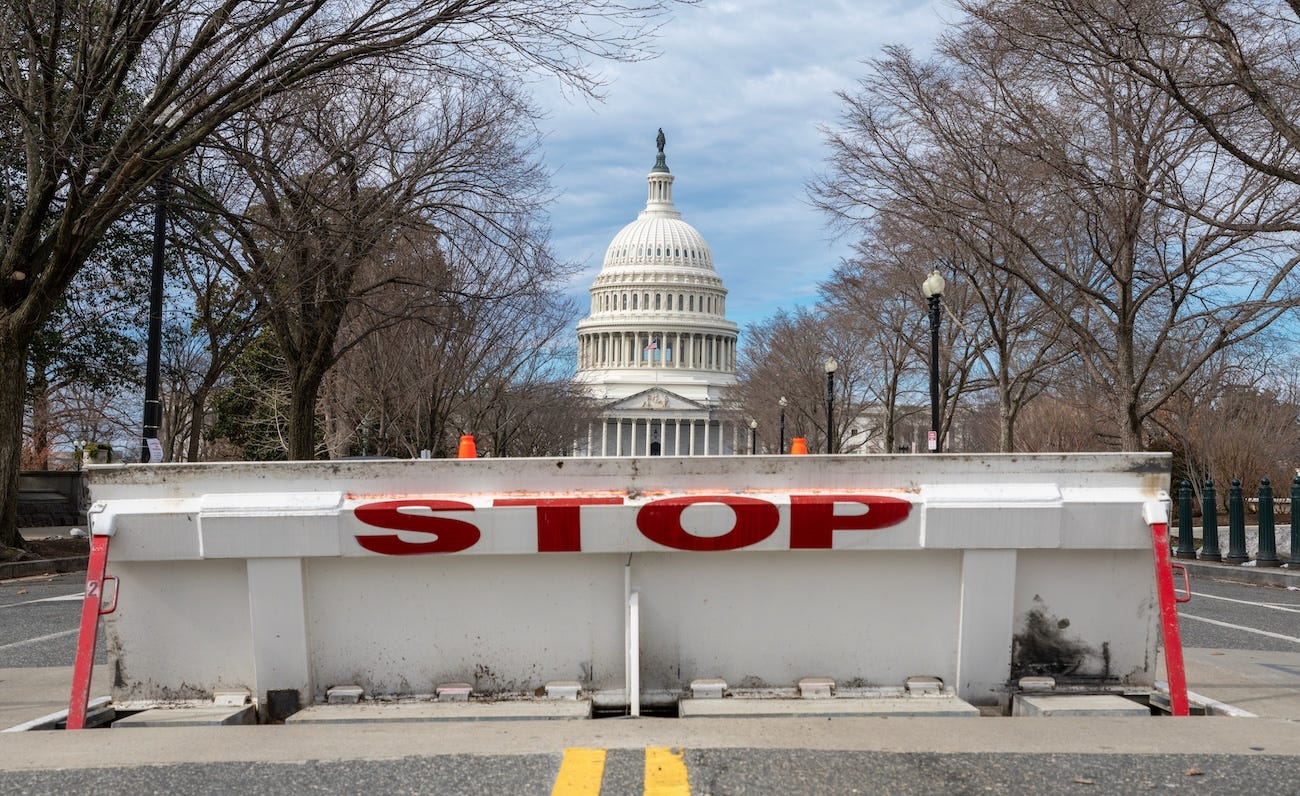
Opponents argue that data centers threaten electricity supplies, water resources, local land use, and neighborhood character. Some of those concerns are concrete, while others are speculative. Many of the concerns, faces, and organizations are familiar, the usual suspects, from earlier fights over energy, housing, transportation, agriculture, and communications infrastructure. Their gospel, that of “Stop,” “Not here,” and “Degrowth,” hasn’t changed, no matter the context.
In communities around the country, local officials are considering or adopting pauses on new construction while they “study” the issue. More than 300 counties have passed these pauses, moratoria, or outright bans on new data centers: DeKalb County, Georgia, extended its moratorium while officials worked on land-use rules. Manitowoc County, Wisconsin, adopted an eighteen-month pause. In Charlotte, the city council approved a temporary pause on new data-center construction. In Virginia, the politics of data centers moved from zoning meetings into statewide debate, culminating in sweeping executive action by Governor Spanberger. While no statewide restriction has been signed into law, sixteen state legislatures have introduced bills banning or restricting new data center projects. The New York state legislature passed the Responsible Data Center Development Act in June, but Governor Hochul has yet to sign it and instead imposed a moratorium through an executive order a month later.
New York’s moratorium, and the “pauses” being pushed around the country, are being presented as short-term fixes. As the logic goes, when the long-term impacts of data centers are known and potentially mitigated, then local governments will lift their stoppages and let the technology in. Never mind that the US already has thousands of data centers, and has had them long enough for their impacts to be measured. The reality is that these “short-term” pauses have a habit of becoming permanent.
Government leaders treat uncertainty as sufficient grounds for prohibition. Instead of identifying whether a proposed project violates property rights, creates a nuisance, evades ordinary law, or imposes outsized costs on the community, officials reject plans wholesale simply because the community—or political class—is not comfortable with the future the technology represents. But that is an impossible test. How can the public, politicians, or even regulators understand the full consequences of a new technology before allowing it to develop?
Paradoxically, a moratorium is supposed to give the public and policymakers the time needed to solve problems, but its implementation prevents people from actually solving the problems.
Even with all of their flaws, we should not create a ban on bans. Some issues are too costly not to try to rein in. Some infrastructure and activities can need a closer look and longer timelines. If a moratorium is deemed necessary, it should have a sunset date. Under a limited set of conditions, moratoria can be a useful and effective tool when what’s being banned can cause massive and irreversible harm. Moratoria should be a temporary and rarely used tool, not a hammer that treats every new innovation, idea, and piece of infrastructure as a nail.
How Moratoria Become Outright Bans
Moratoria appeal to communities and politicians alike because they offer the appearance of responsible action without requiring a hard choice. When a technology is unfamiliar, disruptive, or poorly explained, a temporary pause promises time to study the issue, talk to residents, and exercise democratic control. The word “moratorium” sounds modest. Yet, temporary prohibitions have a way of becoming infrastructure policy. A pause gives opponents time to organize, incumbents time to adapt, and officials a way to avoid defending either approval or rejection. The moratorium becomes politically satisfying because it says, “We heard you, and we acted,” to opponents without requiring the government to show that intervention is actually necessary.
The pattern is familiar across American life. Nuclear power was constrained for decades by state-level restrictions often justified by unresolved concerns about waste, safety, or public confidence. Those concerns were not imagined. Safety is important, and institutions sometimes fail, but restrictions adopted as safeguards hardened into durable barriers, persisting long after the policy conversation changed. In several states, the effective rule became that new nuclear power could not proceed until the Department of Energy and Congress solved a different, national problem first. California, for instance, instituted a moratorium on new nuclear power plants, conditional on the federal government approving technology for the disposal of nuclear waste. California’s moratorium was enacted in 1976 and remains in effect.
This is because moratoria often work in spaces where one institution waits on another to move forward. A moratorium appears to be a local response to a local concern. In practice, it can make the ability to build anything contingent on resolving every adjacent dispute in advance. A community worried about data-center noise demands a pause until energy planning is resolved. A state worried about nuclear waste prevents new reactors until federal waste policy is settled. A city worried about congestion blocks housing construction until transportation improves, even though the absence of housing may worsen the very regional pressures it is meant to address. A pause based on conditionals that may never be met is effectively a standing veto. Even if the conditions were met, nothing stops the locality from finding another reason to block projects.
The political benefits of stopping a project and appeasing objectors are immediate, visible, and legible. Residents can see what did not get built, and opponents can claim victory. Officials can say they prevented harm. Yet, there’s a huge opportunity cost. The counterfactuals cannot be precisely measured, as they are often diffuse, delayed, and difficult to pin down, but they are real. The jobs not created, the tax base not expanded, the power not generated, the homes not built, the services not improved, or the innovations not discovered—these don’t show up at the next public meeting.
In this way, moratoria can be hijacked by incumbent groups that have an economic stake in limiting new technologies. Some supporters are sincere residents worried about real tradeoffs, while others are ideological opponents of the underlying technology. Others are incumbents who benefit when new competitors are kept out. Public choice economics helps us describe this dynamic: regulations that appear to serve the public interest can also preserve economic rents, block new entry, and protect firms that already cleared the gate before it closed.
Moratoria usually do not affect infrastructure already built, meaning incumbents often keep operating while potential competitors are held back. An already-approved data center may continue while future projects are paused. A utility with existing assets may benefit when new generation and transmission are delayed. A business that entered a market before restrictions tightened can suddenly find itself protected by the very rules justified as public safeguards. Once the moratorium is in place, the already existing businesses may even approve of the ban or push for it to be extended. Some companies, like taxi services, get out ahead of new technologies and try to ban them preemptively.
The classic “Bootleggers and Baptists” story captures this logic. Moral reformers supported prohibition because they believed alcohol was a social evil. Bootleggers knew their illicit activities would benefit from banning alcohol because the price of alcohol would rise. The motives differed: Baptists fueled by morality and bootleggers by greed, but the policy served both; together, bootleggers and Baptists joined forces and made a powerful coalition. The Baptists did not approve of the bootleggers; this is a case of some people having good intentions, while others are happy to take advantage, and everyone is left worse off.
Similar coalitions appear whenever new technologies threaten established arrangements. A restriction can be sold in the language of public protection while functioning as a barrier to competition. The same dynamic appears in fights over housing, energy, transportation, and communications. Incumbents rarely have to say they oppose competition. They can say they want more study, more local control, more certainty, more process, or more time. Sometimes those demands are reasonable, while often they are not. The political genius of the moratorium is that it allows a ban to disguise itself under the auspices of caution.
Undermining State Capacity
A free and abundant society should be especially skeptical of prospective bans imposed before actual harms have been shown. Learning occurs through trial, deployment, failure, adaptation, competition, and use. Technologies improve because people are allowed to discover what works. Institutions learn because real experience reveals trade-offs that speculation cannot. State capacity is the ability of governments to “analyze complex policy issues, assess the costs and benefits of different policy options, and make informed decisions.” A robust process of trial, error, and more trial increases that capacity.
Moratoria short-circuit the institutional capacity process by presuming that a government can (and does) know enough in advance to decide whether society (or itself) should be allowed to learn. Doing so elevates preemptive restraint over experimentation, while making the political system the gatekeeper for technological possibility. Such a posture is especially damaging when the technology at issue is part of a broader system. Data centers are not just buildings filled with servers. They are part of the infrastructure of cloud computing, logistics, medical research, finance, communications, scientific modeling, and artificial intelligence. Nuclear plants are not merely industrial facilities. They are sources of firm, low-carbon electricity. Transmission lines are not merely visual intrusions. They are the connective tissue of a cleaner and more reliable grid. Housing is not only a neighborhood change. It is the precondition for affordability, mobility, and growth.
To govern these systems well, policymakers have to ask not only “what might go wrong if this is built?” but also “what goes wrong if it is not?” The second question is usually ignored, but it is no less important. A community that blocks new energy infrastructure may preserve a landscape while increasing dependence on dirtier or less reliable power elsewhere. A city that blocks housing may preserve neighborhood aesthetics while exporting displacement to poorer households and longer commutes. A state that blocks data centers and other industry may reduce local impacts while sending investment to places with fewer environmental rules, weaker labor standards, or more carbon-intensive electricity.
The counterfactual is hard to see in advance, which is why moratoria are so politically tempting. Bans allow officials to treat the visible project as the relevant object of governance while ignoring downstream consequences. But infrastructure policy is always comparative. We should not ask whether a project has impacts. Every project does. We should ask whether stopping it produces better outcomes than allowing people to build under ordinary rules of property, contract, liability, and local nuisance law.
When Can Moratoria Work?
But there is such a thing as a “good” or “justified” moratorium. If something is reversible, then of course we should try things and learn, but if we are risking irreversible damage, then prudence is actually warranted. The pause should address a specific, plausible harm, have a defined scope and expiration date, identify the evidence or institutional capacity needed for reopening, assign responsibility for producing that evidence, and include a presumption that the activity resumes unless the government affirmatively demonstrates a continuing need for restriction.
Moratoria should always have an expiration date and must be actively renewed to prevent them from hardening into bans based on past concerns that are no longer relevant. A moratorium without a deadline, a defined harm, reasonable criteria for lifting it, or an accounting of opportunity costs is simply avoidance.
Some bans or restrictions, like those for gain-of-function research, special nuclear materials, and dangerous weapons, can make sense. The harm caused by allowing free and unlimited access or pursuit far outweighs the benefits. It is reasonable for the US to impose restrictions on disease research that could be weaponized. The same goes for banning unlicensed individuals from accessing nuclear materials. A rogue scientist or an accidental outbreak of a deadly virus could harm thousands to millions of people. Unfettered access to certain nuclear materials could make it easier for paramilitary and terrorist organizations to create low-grade nuclear weapons. Even these moratoria should have to be renewed every so often. The bans may never be lifted, but we should not prevent ourselves the opportunity to lift them.
Governments should not assume that every new technology requires a bespoke regulatory regime before it can proceed. In most cases, the starting point should be ordinary legality: if a project complies with existing rules, respects property rights, bears its own costs, and does not impose clear harms on others, it should be allowed to move forward. Where existing rules are genuinely inadequate, the response should be narrow and retrospective wherever possible: address the specific harm, enforce neutral standards, and make costs transparent. Use liability where injuries can be identified or update zoning where the category truly does not fit, but do not treat the mere arrival of a new technology as a reason to suspend permissionless activity.
The future is uncertain and messy. That is not a reason to hogtie innovation in advance; uncertainty provides reason to preserve the freedom to experiment, build, compete, and learn. Societies do not become capable of progress by requiring innovators and builders to obtain a blessing before acting. They progress by allowing new things to emerge, then addressing real harms as evidence appears.
