

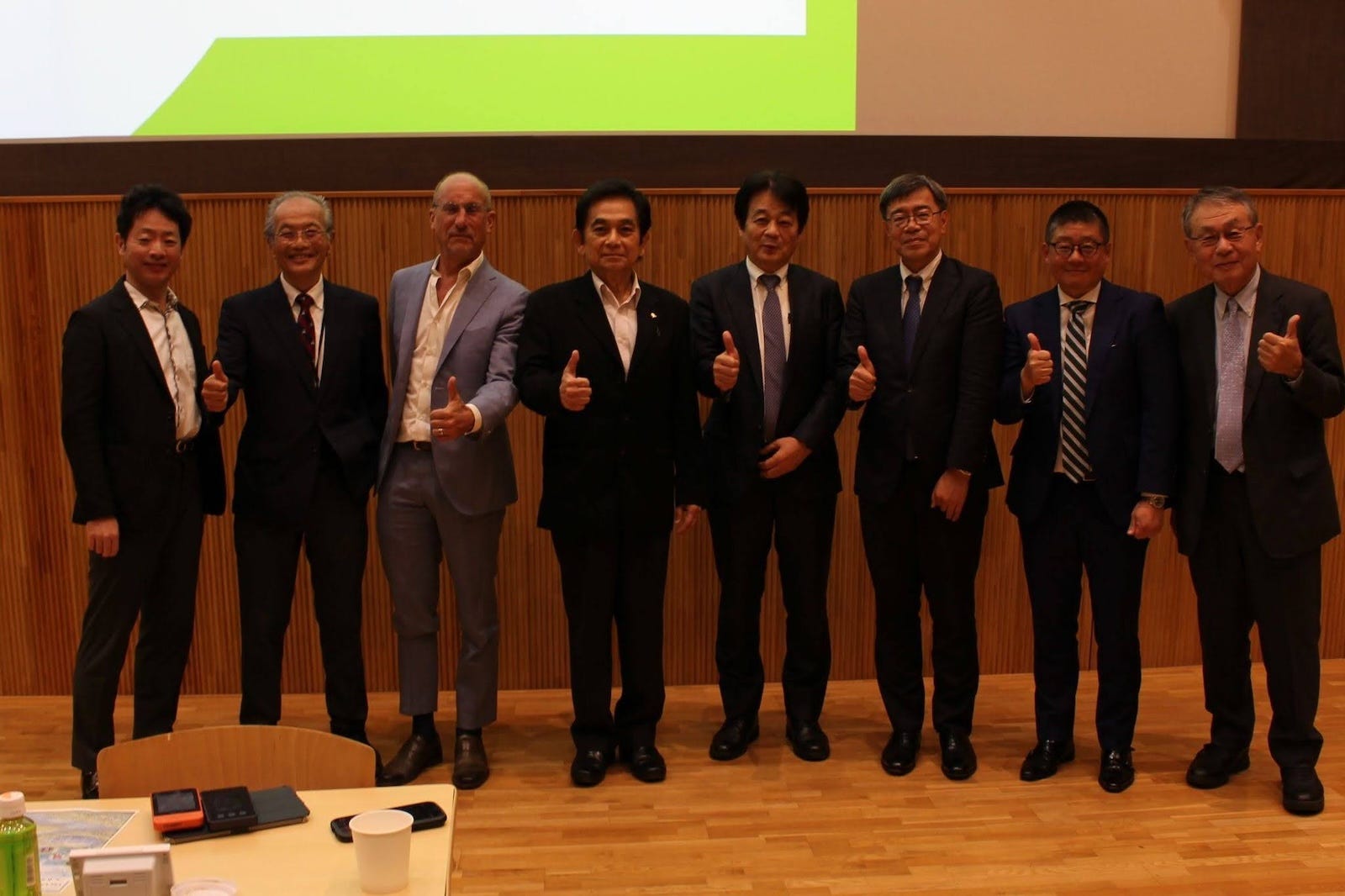
I’m just back from Japan, where thanks to my hosts at the Canon Institute for Global Studies, I’ve had a chance to talk with former government officials, academics, industry leaders, and energy experts about Japan’s present energy crisis. Caught between Washington and Beijing, Japan’s struggles to reconcile economic imperatives, energy security, and climate commitments over the last fifteen years have prefigured the difficult choices that much of the world faces today in the wake of the Iran war. Japan’s domestic energy endowments are extremely limited. It has no domestic fossil reserves to speak of. Its main islands are mountainous and forested, densely populated, and not particularly sunny. Its coastal waters support a huge fishing industry and are deep and stormy, not well suited to conventional offshore wind. After the Fukushima nuclear accident, it shut down its entire nuclear fleet, which once produced more than a quarter of the nation’s electricity.
As a result, the vast majority of Japan’s energy consumption, almost 80%, is fossil-based and imported, half of that from oil, most of which must transit the Strait of Hormuz. Like a lot of places with the means to do so, Japan is drawing down its strategic petroleum reserves to mitigate the immediate impact of the price shock. But the clock is ticking on Japan’s petroleum reserves. Japan is less dependent on the Gulf for its LNG imports but the general run up in LNG prices is adding to the economic pain.
Most of the alternatives are less than appealing. Japan has substantial headroom to increase coal imports and generation with its existing coal fleet. But doing so would effectively eviscerate Japan’s net-zero Paris commitments. Wind, solar, and batteries offer some fuel-saving opportunities for the electricity system. But Japan’s wind and solar resources are not great, its eastern and western grids operate at different frequency, making a national grid that might help balance variability unfeasible, and, functionally, a rapid shift to renewables simply shifts Japan’s energy sector from one geopolitical risk, namely imported oil and gas, to another, imported Chinese green energy technology.
Green energy proponents correctly point out that while the energy technology is imported, the wind and the sun are domestic, and free. Once you build a wind or solar farm, it will produce electricity (albeit variably) for several decades no matter what China does. But China is, increasingly, the sole source of most of these technologies and represents Japan’s greatest geopolitical rival and national security threat. Increasing dependence on Chinese green technology undermines Japan’s independent industrial capabilities, its competitiveness across a growing suite of clean technologies, and its ability to act independently of China in other critical geopolitical domains.
And it’s not like the rest of Japan’s energy system at present features domestic energy sources to balance that dependence. Rather, Japan presently takes an all-of-the-above approach to geopolitical risk, importing oil from the Gulf, coal from Australia, gas from Australia, Southeast Asia, and the United States, and green technology from China.
Unsurprisingly given these realities, Japan has finally gotten serious about restarting its nuclear fleet. After a decade plus of haltingly slow approvals, nuclear generation is now back up to over 9% of Japan’s electricity. That’s still a far cry from close to 30% prior to Fukushima. But it seems likely now, given the energy and geopolitical situation, that Japan will restart most of its legacy nuclear fleet in the coming years, as well as complete two long-stalled new builds.
Japan already runs its LNG-fueled gas plants at relatively low capacity. In response to the current crisis, Japan has issued an emergency waiver allowing dirtier sub-critical coal plants to operate at higher capacity factors in order to conserve costly LNG for load following and firming. Should Japan extend that waiver, it will, in deed if not in word, effectively abandon its net-zero aspirations. Doubling down on green energy won’t change that.
Those net-zero commitments, of course, were never plausible in the first place. I’ve traveled to Japan to engage on energy and climate issues for almost 20 years now. At some point during every trip, I am presented with an elaborate slide deck, sometimes from METI, Japan’s famous industrial planning agency, sometimes from an affiliated think tank, showing how Japan will deeply decarbonize and meet its climate commitments. The plans are impressively detailed and technical, with Sankey graphs and flow charts showing technology by technology how Japan will get there, a triumph, on paper at least, of Japan’s legendary industrial planning bureaucracy.
Over the years, the plans have involved supercritical coal plants with carbon capture, hydrogen-powered vehicles, and now, lots of solar, wind, electric arc furnaces and similar. Ever the uncouth gaijin, I asked my hosts at METI during a visit a few years ago how it was going. They giggled uncomfortably and then, politely, admitted not so well.
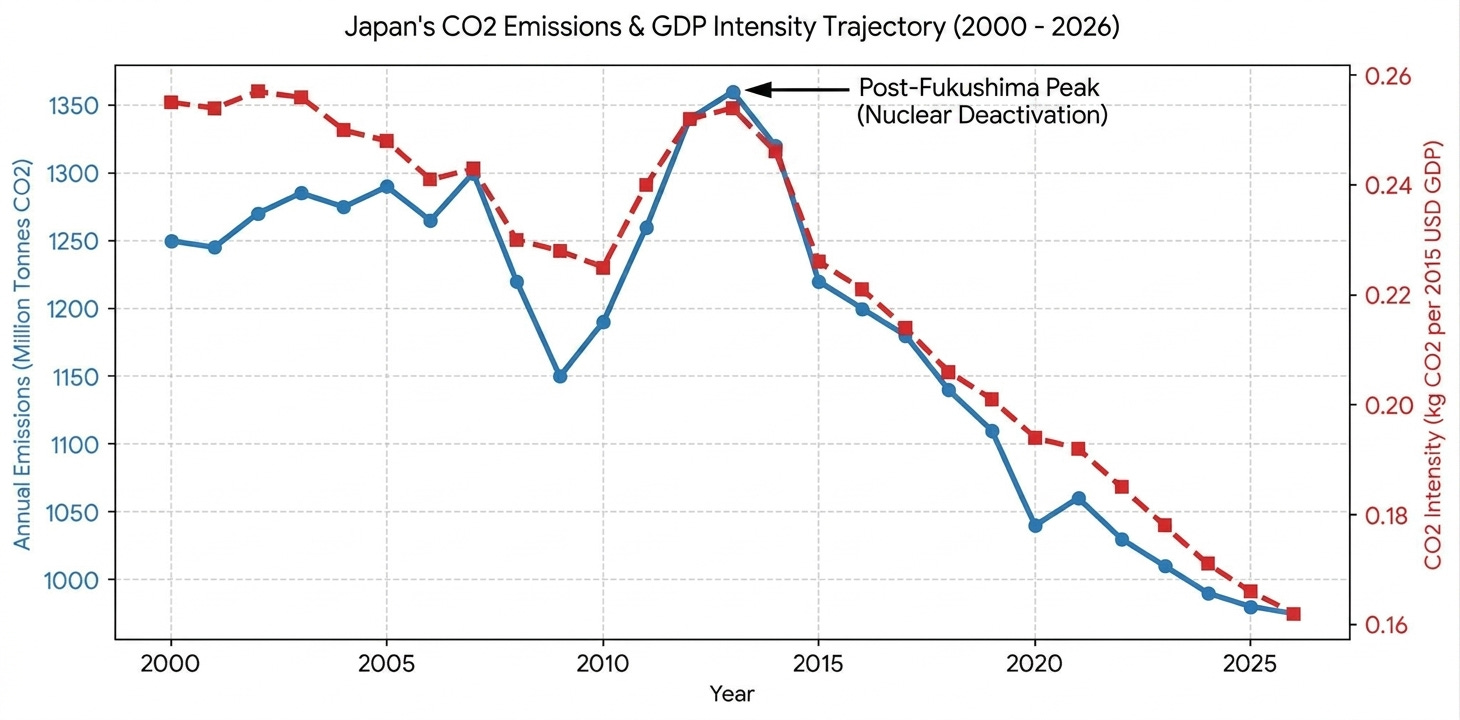
And yet, excepting the extraordinary jump in emissions and emissions intensity after the closure of Japan’s nuclear reactors in 2011, Japan’s emissions intensity trajectory looks like pretty much every other advanced industrialized economy. Its total energy consumption is in structural decline and its emissions (again excepting the rebound following the post-Fukushima closures) has been falling consistently for decades. Running its sub-critical coal plants a lot more in the coming years may slow that trend line a bit. Restarting its reactors will accelerate it. If past is prologue, all of these peregrinations over the long term may look like little more than squiggles in a long, linear evolution of Japan’s energy system from oil, coal, and gas toward ever cleaner energy.
How Japan sustains that trajectory remains an open question. It is already the most energy efficient and electrified economy in the world. If the great global dividing line of the post-post-cold war era is petrostates versus electrostates, as a lot of the left-of-center punditry has recently come to believe, then the archetypal electrostate is Japan, not China. Solar now accounts for 10% of Japan’s electricity, quietly exceeding China’s share of solar electricity—a significant (if costly) achievement given Japan’s less than favorable climate and topography. Yet despite early and quite significant efforts to develop a solar manufacturing industry, Japan has virtually entirely ceded the sector to China. Panasonic, a Japanese company, is a major player in global battery production, but less than 20% of its battery manufacturing is domestic.
It will surprise almost no one that the most obvious path for Japan, to my mind, is more nuclear. Japan has deep technical expertise. Other than the unprocessed uranium itself, the nuclear fuel cycle and supply chain have been fully indigenized. Toshiba, Hitachi, and Mitsubishi all have experience designing and building large nuclear reactors. Japan is one of the few nations in the world with facilities capable of fabricating steel pressure vessels for large reactors.
On the flip side, even before the Fukushima accident, Japan had already largely put its formidable nuclear energy capabilities on ice. Its bubble economy burst in the early 1990s, substantially slowing both economic and electricity demand growth. The post-bubble economy also coincided with a sustained period of cheap fossil fuels globally. Japan then shut down its entire nuclear fleet after Fukushima and, until recently, has only slowly restarted those reactors. It also implemented sweeping electricity market liberalization in the years that followed Fukushima, making the institutional conditions even more challenging for new nuclear.
Nonetheless, much of the technical and institutional capacity that would be necessary for a renewed nuclear push remains intact. Japan’s large regional utilities still control roughly 80% of the nation’s generation assets. Public opinion has rebounded since Fukushima. A majority of the Japanese public now supports nuclear energy.
In the face of increasingly dominant competition from China’s industrially planned manufacturing behemoth, Prime Minister Sanae Takaichi’s administration has taken steps to relax rules designed to discourage the old keiretsu system of interlocking shareholders and investments between large industrial firms. This makes it much more plausible that large utilities, national champion industrial firms like Mitsubishi and Toshiba, component suppliers like Japan Steel, and METI might work together to start building new reactors again.
I have been a very vocal advocate of small next-generation reactors and skeptic of large reactors in the context of the US institutional environment and political economy. The utility sector is too decentralized and liberalized. The capacity to cost effectively build large reactors, and large public works projects more generally, has atrophied. The nation is blessed with an abundance of energy resource endowments, from coal, oil, and gas to wind and solar to geothermal resources. Given these realities, the prospects for dedicating sufficient public resources to building large reactors in multiples significant enough to get good at doing it are not good.
Japan, by contrast, is entirely different. Its domestic energy resource options are practically non-existent. In contrast to its financialized US counterparts such as Westinghouse and GE, its legacy industrial consortiums still make stuff and build things. Its utilities are large and well capitalized. Large reactors make a lot of sense for Japan.
For these reasons, nuclear energy is Japan’s way out of the Hobson’s choice between continuing its heavy dependence on imported fossil fuels and mortgaging its energy future to China. It won’t get Japan to net zero emissions over the next several decades but it will assure that the nation is able to continue to decarbonize far into the future without bankrupting its economy or compromising its national security.
The choices faced by Japan are arguably more extreme than most. But as goes Japan, so goes the world. It is among the most modernized and electrified places on the planet. You would be hard pressed to find any nation that has stronger economic and geopolitical incentives to kick the fossil fuel habit. It has no powerful domestic fossil fuel industry determined to foil efforts to decarbonize in the national and public interest. And yet, it has had limited success doing so.
Nuclear energy is not a silver bullet for Japan or anywhere else. But it is a very critical energy technology for the future of the global energy system. In a decarbonized and energy abundant future, nuclear and solar will have to do the heavy lifting. Other primary energy sources and carriers, including storage, wind, and geothermal can play important roles. What Japan shows, though, is that without nuclear, that future will likely be extremely difficult to realize.
Nuclear power is the silver bullet for all humanity. We can have very cheap and very low CO2 electricity not dependent on an unstable political system. We need only recognize that the harm from radiation has been massively exaggerated for the dose rate profiles incurred by the public in a release. Then we can regulate nuclear like any other source of electricity.
https://jackdevanney.substack.com/p/the-twice-blest-poster
Perhaps but there’s counterpoints. Extensive intermittent faux green energy is incapable of supporting Japan’s economy without a sooner or later crippling cost compared to competitors that choose the N2N path. Their collective political brain was silly enough to close fission plants so nothing can be ruled out, but choosing solar would be another suicidal act, Chinese sourcing is irrelevant. Also extensive energy has the largest environmental impact, and it directly degrades habitat.
Their main problem is not thoroughly using Russian gas. Probably they should transition from gas to fission faster than countries with pipeline sources, but not utilizing Russian gas to gain all the cost savings through the period of fission technology maturation would seem to put Japan at an energy cost disadvantage.
Every country without fail skews their energy mix toward more secure domestic and nearby sources. However nearly no one is or can be completely independent in both material and technology sources for energy, and if they are there are other materials other powers can leverage against them. So moderation in energy independence is prudent. Some is wise too much can be debilitating, as we see in Germany today.
Fission depends on international sources for material to some degree but much more crucial are the sources of processing and generating technology, which is why atoms for peace failed on the first attempt. DJT’s mercantile separation of Terrapower and SINAP collaboration set back American development though not likely fatal. congressional rumbling against Russian fission fuel sources could divert American resources more wisely spent on other fission technology into fuel processing for markets of unknown size and longevity.