

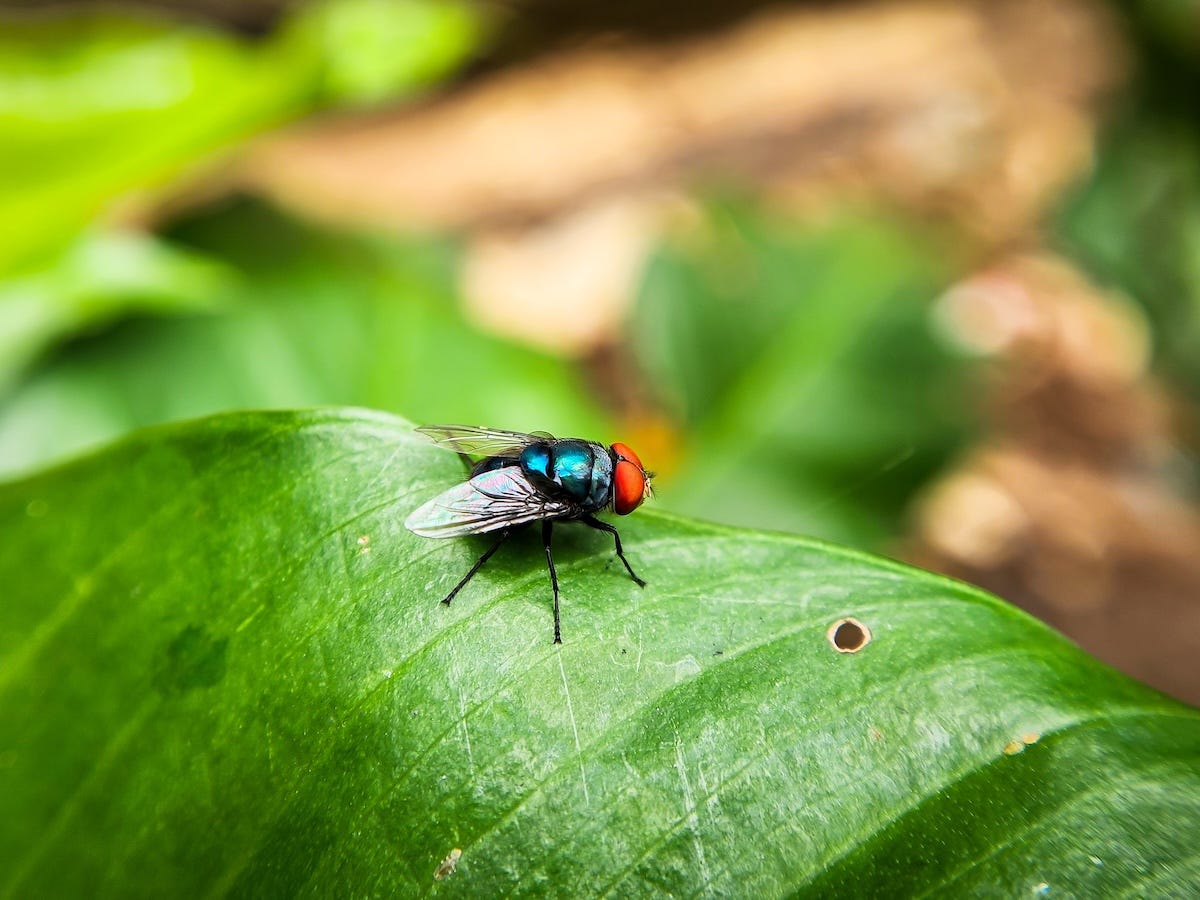
On June 3, a three-week-old calf in Zavala County, Texas, was found with fly larvae feeding on a wound. While the calf recovered, the case reopened a chapter of agricultural history that Americans had largely forgotten: New World screwworm, a parasitic fly whose larvae eat the living flesh of cattle, wildlife, pets, and occasionally people.
The United States eradicated screwworm in 1966, partnering with Mexico and other countries to eventually kill off populations throughout Central America. Yet the fly lived on in South America and managed to cross back into Panama in 2023, spreading north until it reached Texas this summer. By late July, the state had reported more than 40 cases in cattle, dogs, and other animals.
To eradicate the fly again, the government began releasing millions more flies from planes and ground stations. This counterintuitive approach is known as the sterile insect technique, now used for a variety of pests. Factories rear enormous numbers of the target insect, sterilize them, and release them into the wild. When a wild female mates with a sterile male, she produces no offspring. Flood an area with enough sterile males for long enough and the population collapses.
Now genetic engineering could make this strategy far more powerful. In June, the Environmental Protection Agency (EPA) granted emergency authorization and proposed commercial approval for NovoFly, a genetically engineered, male-only strain of New World screwworm developed by the U.S. Department of Agriculture (USDA) and North Carolina State University. While not yet used, USDA plans to incorporate the fly into its sterile insect program as it builds out its new Texas facility. EPA is also reviewing a gene-edited fruit fly, Knockout SWD, designed to suppress Spotted-wing drosophila, one of the most damaging pests of berries and cherries.
Both products turn an insect’s reproductive biology against it. They are living insecticides that search for their own targets without the risks of chemical insecticides. If scientists and regulators can bring these systems from research facilities to the field, they could transform pest control well beyond screwworm.
Developing the trojan fly
The sterile insect technique began with what the New York Times Magazine referred to as “the single most original thought of the 20th century.” In 1937, USDA entomologist Edward Knipling proposed controlling screwworm by releasing so many sterile males that wild females would struggle to find fertile mates. His colleague Raymond Bushland later developed a way to use X-rays to sterilize screwworm pupae while still preserving their ability to fly and mate. USDA soon tested and scaled up the approach, building screwworm rearing factories, creating systems to release the insects from aircraft, and launching a massive eradication campaign. By 1966, screwworm was gone from the United States.
The method works particularly well with screwworm as the females generally mate only once. A sterile male, however, can mate several times per day, suppressing the population.
The sterile insect approach can be effective for other insects too. Programs have since targeted Mediterranean fruit fly, Mexican fruit fly, melon fly, tsetse fly, pink bollworm, codling moth, and other pests.
Regardless of the insect, there has always been a fundamental biological challenge: the females. Sterile insect programs must ensure no fertile females are released. Screwworm facilities handle this by sterilizing the females too, which requires higher levels of radiation than optimal for the males. Programs for other insects sometimes separate and kill the females. Either way, rearing and feeding them is a waste of resources and complicates operations.
Genetic engineering can now handle some of those logistical challenges itself.
Building a better bug trap
The engineered NovoFly contains a genetic switch that kills female embryos. In the breeding colony, workers add tetracycline to the insects’ diet which allows the females to survive and the colony to reproduce. The generation of insects produced for release aren’t so lucky. Without the tetracycline, the female embryos die and the batch develops almost entirely into males, which are still sterilized.
Producing only males could roughly double the number of useful insects generated by a factory and may allow a lower radiation dose, enabling the released males to be more competitive with wild flies.
The other engineered fly under development, Knockout SWD, uses genetics to handle both sex selection and sterilization. The underlying method is called precision-guided sterile insect technique, or pgSIT. It relies on two genetically engineered breeding that produce sterile offspring they mate with one another.
One line carries Cas9, a protein that acts like a pair of molecular scissors. The other carries guide RNAs, short molecules that provide Cas9 with a target in the genome. When the two lines are crossed, their offspring inherit both the scissors and the target for them. Cas9 then cuts genes required for normal female development and male fertility. The females fail to develop normally, while the surviving males are sterile.
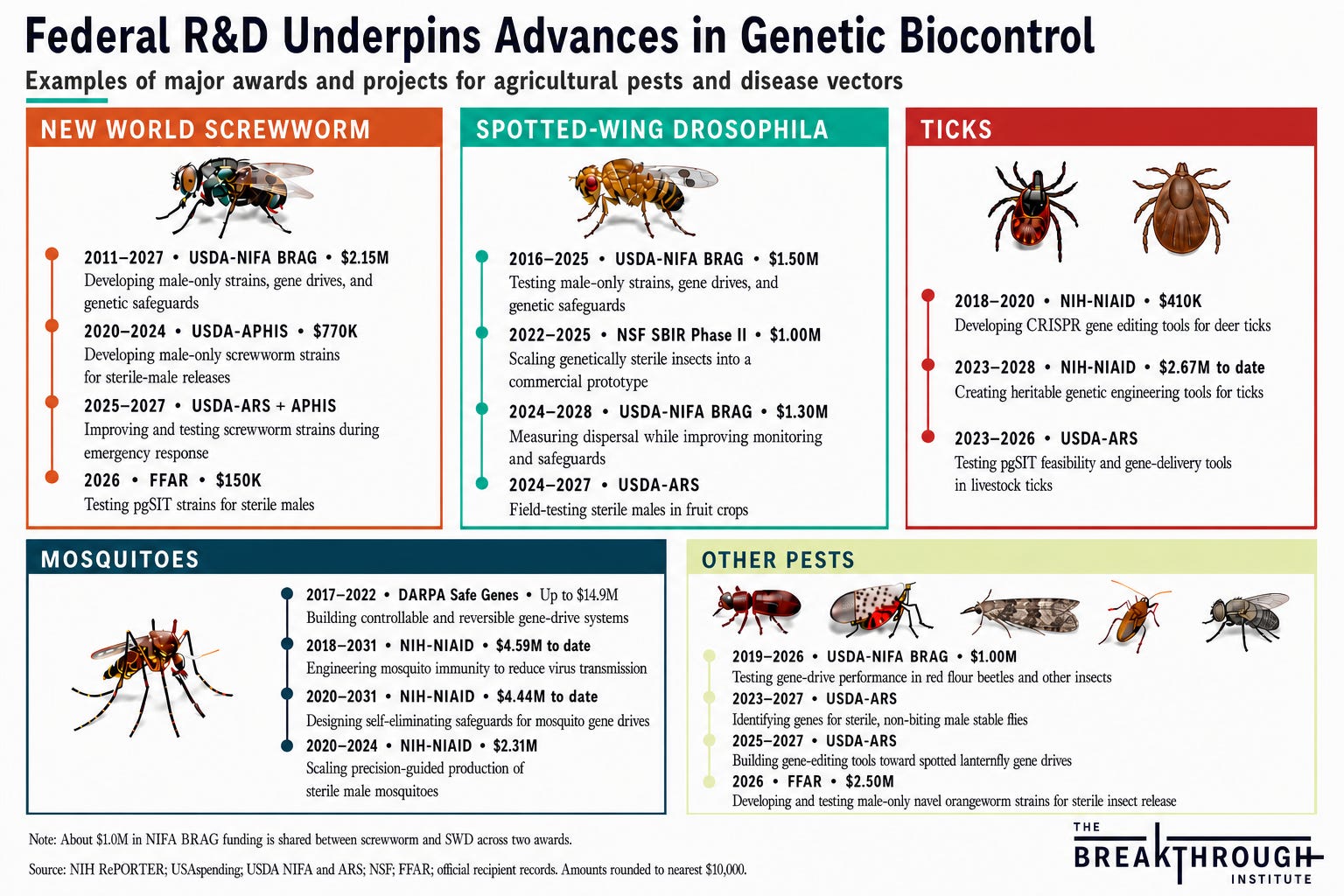
Researchers are now trying to extend this precision sterilization approach to screwworm. The Foundation for Food & Agriculture Research committed $150,000 this summer toward a project with Agragene and North Carolina State University to use CRISPR to produce sterile males without irradiation.
Replacing spraying with egg-laying
Genetic biocontrol, the broader approach that these techniques fit under, gives farmers, ranchers, and other pest managers an alternative to spraying chemical insecticides.
Putting aside the risk some insecticides pose to farmworkers and ecosystems, spraying them is expensive and a logistical pain. Consider the Spotted-wing drosophila. Unlike most fruit flies, which lay eggs in damaged or rotting fruit, Spotted-wing drosophila cuts into healthy, ripening berries and cherries and deposits its eggs inside where the larvae will be protected from insecticides once they hatch.
Growers therefore spray preventively during ripening and harvest, often spraying weekly and rotating among different insecticides to slow the evolution of resistant flies. Unfortunately, some populations of flies have already evolved resistance to several classes of insecticides—pyrethroids and spinosyxns including spinosad, a mainstay of both conventional and organic production.
PgSIT, like other sterile insect technique programs, would allow growers to spray less often by suppressing and potentially eradicating fly populations before they start damaging crops. That can save growers money and also spare bees, predatory insects, and other organisms that might otherwise be harmed by conventional insecticides.
Many of those benefits can be seen in past sterile insect programs such as one that targeted the pink bollworm. For decades, the moth was one of the most destructive pests of cotton in the American Southwest. A program that combined sterile moth releases with cotton varieties genetically engineered to produce insecticidal Bt proteins effectively eradicated the moth. Arizona’s pink bollworm population fell from more than 2 billion in 2005 to zero in 2013, and growers were able to reduce insecticide treatments against all cotton pests by 82 percent, saving more than $500 million. Beneficial insects recovered as well, further helping farmers control pests with fewer sprays.
Genetically engineered insects could extend this success to pests that remain impractical to control with conventional sterile releases. Researchers have developed and studied self-limiting diamondback moths, a pest of cabbage, broccoli, and other brassicas, whose female offspring die after engineered males mate with wild females. A similar system for fall armyworm, one of the world’s most destructive crop pests, has been widely tested and even approved for commercial use in Brazil. Just this August, the Foundation for Food and Agriculture Research (FFAR) announced a nearly $2.5 million grant, matched by the Almond Board of California, to develop male-only navel orangeworms, the most destructive pest for California’s tree nut growers. And USDA is supporting further genetic-control research on various fruit flies, the spotted lanternfly, and other agricultural pests.
Some female-lethal systems could provide a second benefit: reversing the spread of insecticide resistance. Unlike pgSIT males, which are sterile, males in these systems can father surviving sons. If the males carry insecticide- or Bt-susceptible genes, their sons reintroduce susceptibility into the wild population even as their engineered sisters die and reduce their population, as several studies have demonstrated with the diamondback moth. It is a distinct strategy from sterile-insect control, but one that could help preserve the useful life of both chemical insecticides and insect-resistant crops.
Driving a population to collapse
Genetic biocontrol’s potential extends far beyond farms. Government agencies, including around the US, still rely heavily on insecticides to suppress mosquito species that transmit dengue, Zika, West Nile virus, and other diseases. Repeated spraying is expensive, often misses breeding sites, exposes non-target insects, and selects for resistance.
Researchers have already adapted pgSIT to Aedes aegypti, the mosquito species that primarily spreads dengue and other viruses in urban areas. Other self-limiting engineered mosquitoes have reduced local Aedes populations in field trials.
Gene drives occupy a more powerful and less reversible branch of the same research. Rather than disappearing when releases stop, they bias inheritance so that an engineered trait can spread through a population. In one landmark experiment, a CRISPR drive targeting a gene required for female development spread through large indoor populations of the mosquito species that transmits malaria and caused them to collapse within several generations. Yet no insect gene drive has been released. Because they are designed to persist and spread, they require a different level of ecological assessment, regulatory oversight, and public consent than self-limiting systems, which has slowed progress.
Nonetheless, gene drives and other types of genetic control could eventually be applied to other pests that make people sick. Researchers are developing the genetic tools that would be needed to control ticks. The work remains perhaps a decade or more behind mosquitos, according to Dr. Gulia-Nuss who leads a lab focused on ticks and mosquitos at University of Nevada, Reno. Ticks’ longer life cycle and need to feed on a live host make sterile release less practical. But once genome engineering techniques are better established for them, it may be possible to develop gene drives to suppress their populations—perhaps first for cattle fever ticks, which have shorter lifecycles, but eventually for the species that carry Lyme disease and cause alpha-gal syndrome.
Engineering the needed research and regulations
The original screwworm campaign succeeded because the Department of Agriculture supported it from research through scale-up. It funded the initial research, but also worked to improve the sterile insect technique and to conduct the actual rearing, dispersal and monitoring of the flies.
The next generation of genetic biocontrol needs a similar level of institutional commitment. NovoFly grew out of decades of USDA research and collaboration with North Carolina State. PgSIT emerged from university research supported by the National Institutes of Health, the Defense Advanced Research Projects Agency, and other public funders. Private companies can build upon this foundational research to develop products. But they need the government as a partner in developing insect factories and studying ecological impacts.
Public R&D will remain critical to improving genetic biocontrol and also extending it to more species. Many are too difficult to genetically engineer and study in field trials for companies to take the risk to invest in them.
Regulators play a critical role as well. EPA’s review of NovoFly and Knockout SWD could establish a clear pathway for other companies to follow, helping unlock financing and interest in the field. It lays out many of the key questions regulators must know: How often do females survive the production process? How often are released males fertile? What steps are being taken to ensure breeding lines can’t escape? How well do released males compete with wild males? How far do they disperse? Wherever possible, EPA should make it clear what evidence it needs, what types of studies are needed to establish it, and what protocols must be followed for deployment.
The return of the New World screwworm has brought with it an old lesson. Pest control doesn’t have to involve spreading a poison and hoping it reaches the target. Sometimes the best insecticide for the job is one that hatches and flies away, leaving little trace and no descendants.
Scientists with the U.S. government invented that approach nearly a century ago. Genetic engineering can now make it cheaper, more scalable, and useful against many more pests. Realizing that promise will require patient research, support for operational scale-up, and regulations designed to let innovations move as quickly as the insects they’re designed to stop.
