


Bill McKibben, the doyen of the climate movement, was recently in the pages of The New Yorker with something of a prediction: with drought, a shrinking domestic herd, and rising input costs driving beef prices to record highs, we may be headed for a fundamental reshuffling of how we eat. Beef will no longer be king, McKibben tentatively suggests, and that’s a good thing. He writes, “In the same way that, around the world, internal-combustion cars are suddenly, and rapidly, giving way to electric vehicles, it’s possible that a combination of technological, economic, ecological, and cultural factors might be lining up to challenge the hold of beef.”
McKibben is right on two fronts. First, U.S. beef prices are at historic levels. Since February of 2020, the national average price for a pound of ground beef in U.S. cities has increased by 79% from $3.86 to $6.92. Second, beef has the largest emissions and land footprint per kilogram of any common food.
But, McKibben’s confidence here tracks with his broader techno-determinism, in which cheap solar panels guarantee the end of coal and natural gas, and cheap electric vehicles (EVs) mean the end of internal combustion engine (ICE) vehicles. His claim that the shift away from beef will follow a similar pattern as the shift away from ICE vehicles elides how complex these shifts actually are, as well as the current state of both the automotive and meat industries. Beef actually reveals the complexity of these transitions most clearly. Beef consumption already peaked in the U.S. and was replaced by chicken due to a combination of cost, marketing, convenience, and health concerns. Even still, Americans eat more beef than most of the world on a per-capita basis, and global beef consumption continues to rise.
Energy and consumption transitions rarely look like one technology neatly replacing another. They are messy and partial, with incumbents sticking around far longer than advocates expect. We should be skeptical of McKibben’s tidy story.
First, it’s a weird choice to compare ICE vehicles losing market share to EVs with beef consumption dynamics. While EVs represented 25% of all worldwide car sales last year, thanks to high adoption rates in places like China and Norway, ICE vehicles are still far more common. And new sales aren’t what matters for emissions. A car bought today will be driven for a decade or more, so even rapid sales growth will take years to make a real dent in the total fleet. As of 2025, only about 5% of cars in the world were EVs. In comparison, beef makes up just about 20% of meat consumption, and is far from the main source of protein in most countries in the world.
Second, it’s even weirder that McKibben tries to make the comparison in the U.S. context. EV adoption in the U.S. has been slower than in other rich countries, and, as of 2025, 98% of American cars are still powered by internal combustion.
To add insult to injury, the U.S. has already gone through a significant beef consumption transition like the one McKibben predicts. The U.S. hit peak beef about fifty years ago, in the mid-1970s, and per capita beef consumption has drifted down more or less steadily ever since. Chicken overtook beef as the country’s most-consumed meat in the early 1990s, ending a roughly 30-year period of beef reigning as America’s favorite meat—preceded by pork, which had been the most-consumed meat for as far back as USDA data goes. Today, beef is only about a quarter of the U.S. meat supply, while chicken is close to half.
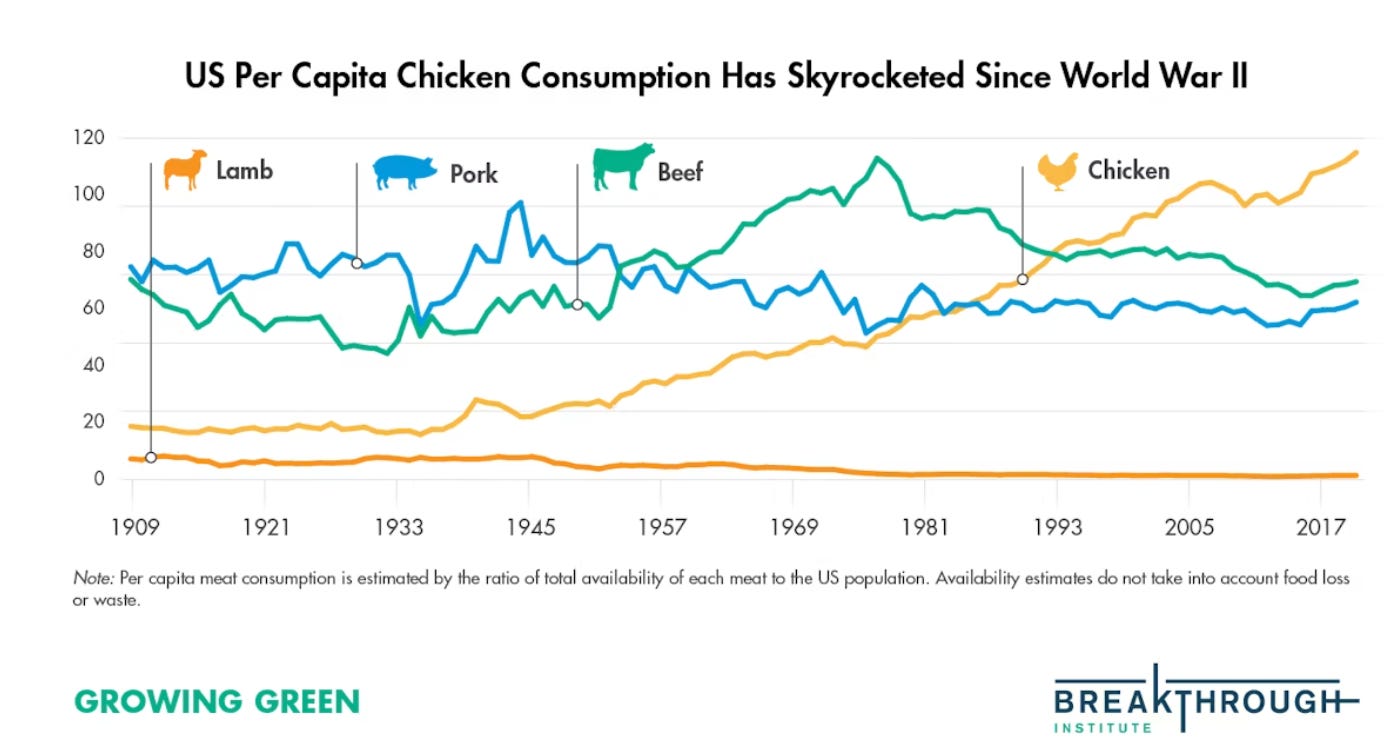
And despite McKibben’s predictions—and record-breaking beef prices—demand for beef from U.S. consumers is relatively flat. USDA expects Americans to eat about 1% less beef in total this year than last, which would be just about 8% more than in 2019 when beef prices were around half of what they are today. The current dip in beef consumption, according to USDA, also has less to do with prices, and more to do with limited supply.
The last time beef prices spiked like this, in the early 1970s, it did not drive Americans away from beef either. As feed prices soared, so did beef prices. The Nixon administration responded by putting price ceilings on meat. The U.S. beef cow herd was, at the time, the largest in history—around 45 million beef cows. Ranchers responded to high feed costs and the price ceiling by liquidating their herds and flooding the market. This glut was largely responsible for the 1970s peak in U.S. beef consumption. But what actually brought beef prices down over the next two decades was a combination of health concerns about red meat, a newly efficient poultry industry that lowered costs, and effective marketing that made chicken more appealing to the American consumer.
There is no similar confluence of events today. In the 1980s, health messaging pushed people away from beef. Today, the loudest health movement, MAHA, is pushing people towards it. And there is no new cheap alternative to take market share. McKibben conflates plant-based products and cultivated products in the essay, incorrectly suggesting that these alternatives, in general, can be cheaper than livestock products. But alternative meats simply have not yet become cheap enough or good enough to meaningfully impact beef consumption. Cultivated meat—literal meat grown in lab or factory settings—has only had very limited sales restricted mainly to short-run specials at expensive restaurants. And while plant-based meat made waves in the years immediately after COVID when beef prices were already on the rise, sales have fallen dramatically in the last few years.
Even if meat alternatives can outcompete beef on price, there is little evidence yet to say that they will attract American consumers the same way that chicken did in the last quarter of the 20th century. In the Netherlands, where a 2024 comparison found the cheapest plant-based burgers to be 31% cheaper than beef, plant-based meat was only 4.1% of all pre-packaged meat sales that same year. And between 2023 and 2025, sales of plant-based meat in the Netherlands fell 16.4% by volume. These alternatives have simply not yet won over the hearts and minds of consumers, even in places that have less polarization around topics like climate change and environmentalism, and have not experienced a meat culture war.
McKibben does, rightly, suggest that instead of alternative meats replacing beef, it’s more likely that chicken and pork may just take even more market share from beef. This, he correctly argues, would still be a real benefit for the climate. And while chicken and pork prices have also risen dramatically since the pandemic, they have not increased as much as beef prices. Since February 2020, chicken prices have increased by 38% and pork by 24%, to $4.17/lb and $4.23/lb respectively. If there is a substitution effect away from beef, it will likely be to one of these incumbents.
Still, McKibben’s analysis runs even shorter on logic when considering the rest of the world. No matter the dynamics driving American beef eating, global beef consumption is likely to continue rising. Projections from OECD and FAO suggest that global beef consumption will grow by about 13 percent over the next decade, with much of that growth in meat demand coming from middle-income countries. As populations in these countries increase, get richer, and urbanize, the demand for meat is expected to grow. Beef, in particular, represents a symbol of wealth in many parts of the world, so as people have more money to spend on food, they are more likely to choose beef.
Ultimately, whether high prices today can reduce beef consumption by some small percentage doesn’t really matter. The beef industry will not be made redundant overnight by high prices alone.
Instead of dreaming beef away, McKibben might instead wield his mighty pulpit to advocate for ways to actually reduce the emissions of the beef industry, limit its impact on wild landscapes, and protect local environments. While beef remains one of the most greenhouse gas-intensive foods, beef production has gotten far more carbon efficient over time. A recent paper in the Journal of Animal Science found that American beef is 29% less emissions intensive, and uses 25% less water, 29% less land, and 39% less fossil fuel resources per KG of carcass weight, in 2022 than it was in 1972. Lowering beef’s environmental and climate impacts is possible through wider adoption of existing high-tech tools, further innovation in production practices in already highly efficient beef-producing regions, and promotion of already-proven practices to close productivity gaps everywhere else.
The last time Americans ate meaningfully less beef, it wasn’t because steak got too expensive. It was because an alternative was both cheaper and more appealing. Hoping for beef’s decline likely won’t get the climate movement anywhere. To actually reduce beef’s environmental and climate impacts, we’d need both better, and cheaper, alternatives, and better beef.