

By Matthew L. Wald
A container ship looks like a perfect place for a nuclear reactor, from a technology standpoint. But a lawyer might call it the worst. It’s a good example of the divergence between what the world needs, and what the world can get.
Here’s the engineer’s view:
A container ship has a steady energy demand of tens of megawatts, and consumes a lot of oil to cross the oceans. Many ships are “slow steaming,” cutting speed to reduce fuel burn, and a 10 percent reduction in speed cuts fuel consumption by 30 percent.
If the energy were cheap, ships could be designed to travel at 35 knots instead of the 16 to 25 knots that is now standard. That could make one cargo ship do the work that now requires two. In addition, each ship would have more space for cargo. Container ships today have big tanks for millions of gallons of fuel oil, and the engines can be more than 40 feet high and nearly 90 feet long.
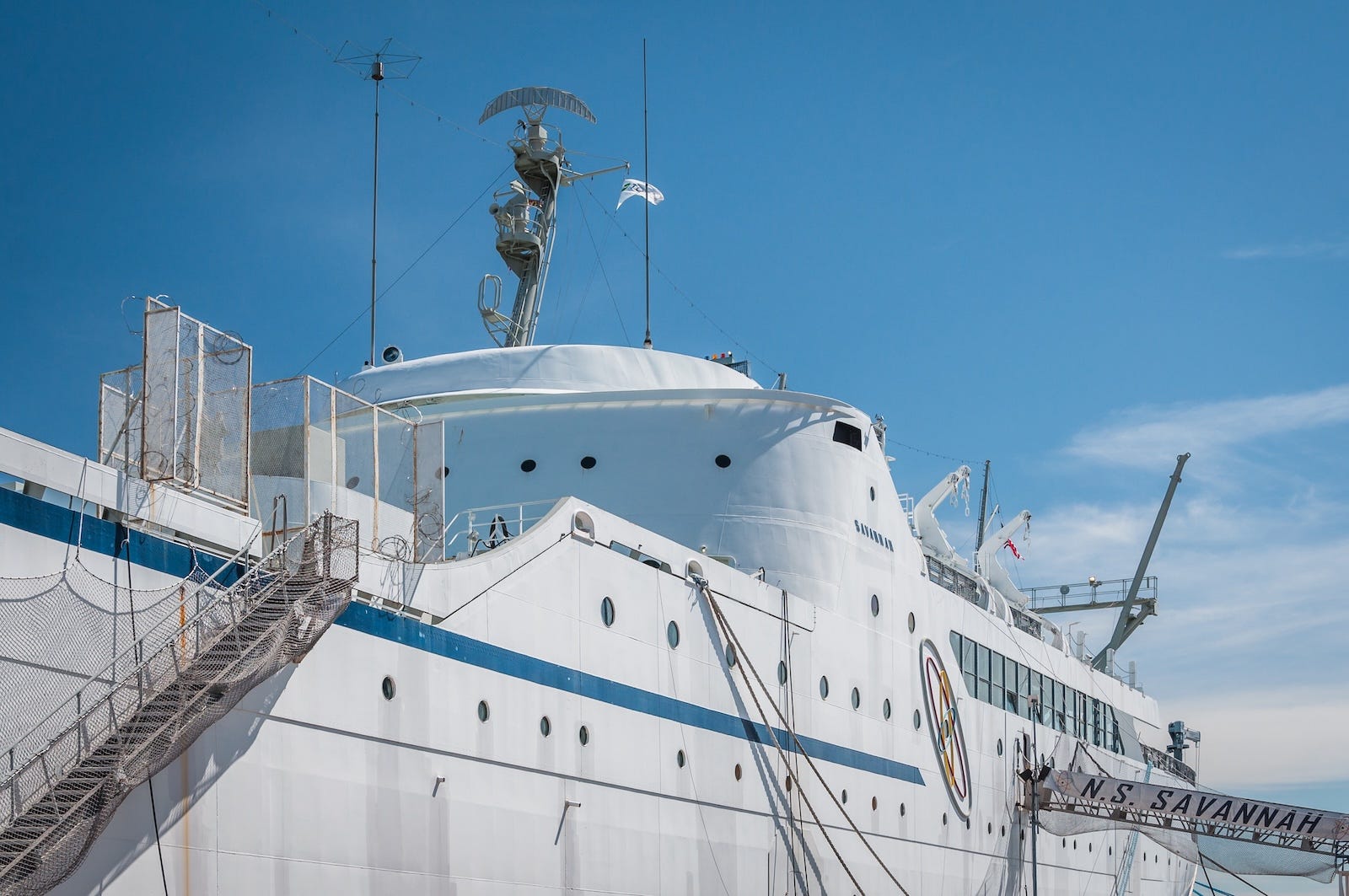
And technological progress makes the idea of powering ships with nuclear energy even more attractive. In the small world of non-military ships already running on nuclear power, the reactors have all been pressurized water models, which is the type that the engineers had the most experience with at the time the ships were built. Pressurized water reactors are high-pressure machines that are big and bulky. The best-known example was the Nuclear Ship Savannah, an Atoms-for-Peace era demonstration project launched in 1959 with extensive help from the Atomic Energy Commission. It operated between 1962 and 1971.
That 74-megawatt reactor could propel the ship for 16,000 hours of sailing between refueling stops. (With time out for port calls, that’s about two years). But the reactor had to be reachable by crane for refueling, so it was located in the center of the ship, a radical redesign. It needed a containment with steel walls from 2.5 to 4 inches thick because it operated at more than 1,700 pounds of pressure per square inch.
The Savannah was also far from a typical cargo ship; it included 30 air-conditioned staterooms. With a displacement of just under 20,000 metric tons, it was less than one-tenth the size of a modern container ship.
A reactor for a cargo ship or a cruise ship built today would probably use molten salt or a “pebble bed” design. Those are lower pressure and more flexible.
And there are good reasons for fleet owners to make a switch. Globally, about 3 percent of carbon dioxide emissions is from cargo ships. The overall number is roughly equal to aviation, but airlines have worked hard to lower their emissions (mostly to save fuel), while improvements to cargo efficiency are more limited.
An agreement made earlier this year by the International Maritime Organization will require ships to start lowering their fuel intensity in 2028, relative to a 2008 baseline, and pay a fee if they fail. The plan is for a 65 percent reduction by 2040, and ships that over-comply can earn credits that they can bank or sell to others. A nuclear powered ship could fill a function similar to what an electric vehicle does for a car company: lower the fleet average to acceptable levels.
Reactor-powered ships would solve another problem: coastal air pollution. California now requires ships coming within 24 miles of the coast to use fuel with a sulfur content of 0.1 percent or less. Clean air advocates blame ship emissions for air pollution near Oakland, Long Beach, and Los Angeles. (East Coast ports have problems, too, but the prevailing winds blow ship emissions out to sea.) In 2020, the International Maritime Organization put a cap of 0.5 percent in place, and 0.1 percent in some areas.
The problem is potentially manageable because, as with 18-wheel trucks on the highways, a small group of vehicles use a large fraction of the fuel. The 7,300 biggest ships consume more than 50 percent of marine fuels, and thus would be a good target, according to Scott Edwards, a vice president of Core Power Energy, which is trying to develop nuclear-powered ships. And the ships don’t last forever, so they could be replaced by nuclear ships as the old ones retire.
The idea has attracted government attention. In September, the U.S. and the U.K. signed a memorandum of understanding on “technology prosperity,” and it called for “exploring opportunities for novel applications of advanced nuclear energy, including civil maritime applications.”
One possible target: Liquefied natural gas carriers, which are proliferating. Those carry natural gas that is turned to a liquid by chilling it to below -260 degrees F (162 degrees C). But the liquid tends to boil, and turn back into a gas, so the tankers use that for propulsion. A reactor could run chillers to keep the cargo cold and deliver all of it to the receiving port.
License, Registration and Proof of Insurance, Please
And here’s the lawyer’s perspective:
Nuclear reactors are regulated by national governments. So are ships. But they are different governments.
About 36 percent of the world’s shipping is registered in Liberia, another 14 percent in Panama, and 11 percent in the Marshall Islands. The numbers are a little different when counted by tonnage; in that ranking, Panama is bigger than Liberia, and Hong Kong, Singapore, and Malta are also major players.
No matter. None of these countries has a nuclear program.
China, Japan, the United States, and South Korea all have extensive nuclear expertise, but collectively less than 10 percent of world shipping flies those flags. Only about 0.7 percent of ships carry a U.S. flag.
Homeless Fuel
Spent fuel, and the residue of reprocessing, generally stays in the country where it was generated. For maritime reactors, that would probably mean going back to the country whose flag the ship carries. Liberia and Panama are not the kind of places that have spent fuel management programs, however.
Reactors also carry insurance. But Price-Anderson, the U.S. legislation that limits liability for nuclear accidents, doesn’t cover ships.
And land-based reactors have security rules, but the risk profile doesn’t match what cargo ships see. The waters off Yemen, Somalia, and Indonesia are thick with pirates. These pirates would probably not be particularly interested in a reactor, because the nuclear material is so radioactive that it requires remote handling, making tampering or theft an offense that is effectively punishable by death. But pirates may not know what they are facing, and could cause damage.
Another risk, of course, is sinking. Materials in some reactors, notably sodium, burn in contact with water. And ordinary water, or seawater, can improve the conditions for fission in some circumstances. These are key points when considering the design.
But with all of those qualifiers, nuclear energy appears to be a good candidate to replace diesel fuel in maritime propulsion. In October, MIT released a report on what it would take to convert ships to nuclear. Among the principles, the nuclear ships should be at least as safe as the conventional ones. The oil-powered ships are dirty even when they work well, and often don’t work well, so the bar isn’t particularly high.
Another issue is determining who is qualified to get a license. In the U.S., applicants to get a reactor license must show that they are financially capable. Shipping, though, is a highly volatile business, and companies come and go. Ship owners are also not known for responsible disposal of obsolete vessels, and the idea of decommissioning is not native to the industry.
Operating a nuclear-powered civilian ship would probably require the consent of the port or the destination country. Bi-lateral agreements, between countries like the United States and the U.K., or perhaps between the United States and China, seem feasible. At a panel discussion at a recent American Nuclear Society conference, Mark Tipping, of Lloyd’s Register, a ship classification agency, pointed out that the London Gateway Port is planning to install a 20-megawatt reactor to run the port itself. “Once you’ve got nuclear in the port, you’ve started the conversation on wider applications of nuclear,” he said.
In October, Lloyd’s published a guide, “Navigating Nuclear Energy in Maritime,” that discusses, among other issues, which agencies could regulate the technologies.
There is an extensive history of nuclear-propelled ships, but it isn’t civilian. Submarine propulsion reactors operate with very high standards of safety and efficiency, but they are in a special category, as they are the only reactors where the operator lives and works inside the containment. They are quite small, often described as about the dimensions of a 55-gallon barrel, although the details are classified. In pairs or larger clusters, military reactors also power aircraft carriers.
Civilian propulsion reactors would be different, because the military ones run on high-enriched uranium, which would not be available for commercial use. And the U.S. Navy and the Department of Energy have big budgets for research and development, and fuel production.
The civilian sector also has to be mindful of personnel requirements. The size of the operating crew would have to be compatible with freighter crew limits.
With all of those constraints, maritime propulsion is still an attractive target for replacement with nuclear; it’s a continuous load, now met with polluting fuel, in a major economic sector that is amenable to economies of scale.