

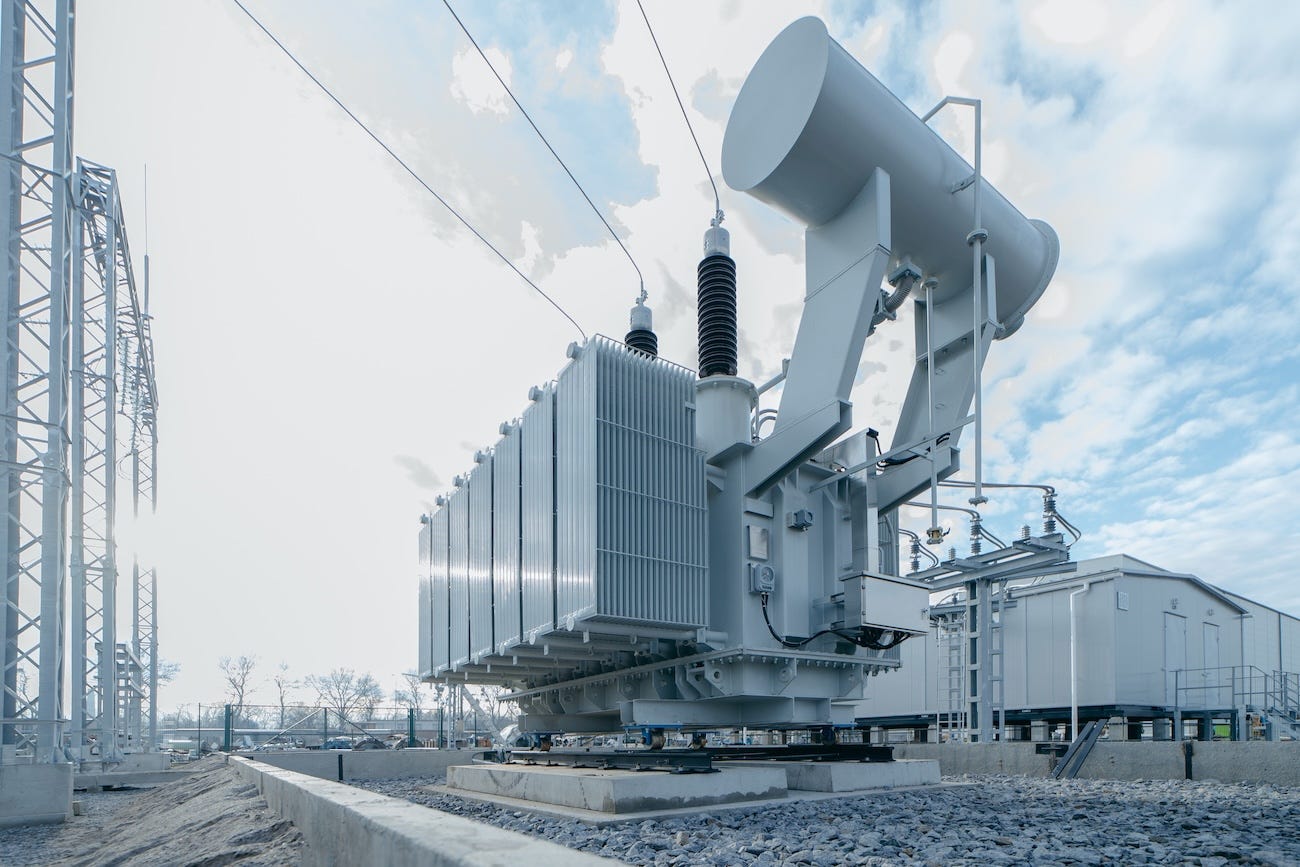
The United States is experiencing a once-in-a-generation surge in demand for the equipment that makes the electric grid. Driven by the replacement of aging infrastructure and growing electricity consumption from data centers, new manufacturing, and home electrification, America wants more grid components than its electro-industrial base can supply.
The symptoms of this supply-demand asymmetry are especially pronounced for transformers. U.S. transformer imports and prices doubled from 2019 to 2025, and lead times ballooned so much that some utilities are placing orders five years in advance. Grain-oriented electrical steel (GOES) is one of the key bottlenecks.
Every transformer on the grid runs on a core made of GOES, from the large power transformers (LPTs) that carry over 90% of the nation’s electricity to the 60 to 80 million distribution transformers feeding energy to homes and businesses. GOES prices doubled from 2020 to 2024, and U.S. imports of GOES transformer cores quadrupled from 2018 to 2025.
Yet domestic production remains constrained by the production capacity of a single steel mill. Located 30 miles north of Pittsburgh, the Butler Works mill—owned by Cleveland-Cliffs—is America’s only domestic source of grain-oriented electrical steel.
Conventional economics suggests the solution to America’s GOES shortage is simply to expand supply, perhaps by expanding Butler Works or by building a new steel mill. But the metallurgy says otherwise.
Across multiple metrics, GOES made by Butler Works is inferior to GOES made in nations like Japan and Korea. Because GOES imports and domestic GOES are non-substitutable, an expansion of existing production capacity would increase U.S. supply for a good that much of the U.S. market doesn’t want. The U.S. government has the resources and statutory authority to make meaningful progress toward onshoring transformer supply chains, but it is essential that support be directed at expanding production of the right kind of GOES rather than expansion without accompanying modernization.
Specifically, Cleveland-Cliffs GOES is too narrow for many LPT core manufacturers. It tops out at 920mm wide, while the market prefers at least 932mm and increasingly looks for widths over 1000mm. Manufacturers can fuse two pieces together, but the discontinuity at the seam can introduce new energy losses, and precision welding for thousands of paper-thin GOES laminations adds sizable labor costs.
Additionally, in distribution transformer cores, Cleveland-Cliffs GOES loses up to 39 percent more energy than GOES from Japanese steelmakers Nippon and JFE. This stems from a technique invented by JFE in the 1970s that, to this day, is only used by Nippon, JFE, and Korean steelmaker POSCO.
Japanese GOES loses substantially less energy than American GOES because Japanese steelmakers JFE and Nippon use more advanced processing technologies than Cleveland-Cliffs, the sole U.S. manufacturer of GOES
The process lets these East Asian mills etch grooves into the GOES sheets that reduce energy losses; then, after sheets are wound into a core, they treat the core with heat to relieve mechanical stress from core winding and reduce energy losses even further. In contrast, the older etching process used at Butler Works makes grooves that deform if exposed to the temperatures needed for the heat treatment step, also known as annealing. As a result, Butler Works doesn’t anneal its GOES and misses out on the resulting improvements to energy efficiency.
The quality gap separating U.S. and foreign GOES has existed for decades, but protectionist policies and a quarter-century of stable electricity demand kept awareness of the problem confined to a few federal investigations on antidumping duties, countervailing duties, and Section 232 tariffs. The U.S. GOES dilemma only recently began making headlines thanks to new load growth and an aging electric grid that are driving a surge in demand for transformers.
Due in part to its technical nature, federal actions haven’t addressed the full scope of this problem. For instance, the Department of Defense recently ordered $400 million of GOES from Cleveland-Cliffs—a purchase agreement that nominally supports GOES production but does nothing to enable production of the right kind of GOES sought by domestic manufacturers of LPT and distribution cores.
Meanwhile, Section 232 tariffs and Liberation Day tariffs treated GOES—a highly differentiated, specialty good—as if it were an interchangeable commodity. Section 232 tariffs in 2018 initially applied only to GOES imports but not imports of manufactured goods containing GOES, including transformer cores. Firms responded by importing foreign GOES to Mexico and Canada, minimally manufacturing them into laminations or cores, then exporting them duty-free to the US.
U.S. imports of transformer cores grew over 400% from $126 million in 2018 to $524 million in 2025. The increase can be linked to a loophole in Section 232 tariffs on GOES, implemented in March 2018, as well as new electricity demand from data centers, manufacturing, and residential electrification.
At the same time, US transformer manufacturers could only serve domestic demand for energy-efficiency by importing foreign GOES at a steep tariff premium. With GOES accounting for about 20 percent of a transformer’s total cost, these tariffs pushed up raw material prices for the US transformer industry. Rather than protecting American manufacturing, tariffs burdened it with a structural disadvantage.
The loophole that excluded GOES-derived goods was filled recently in August 2025, but its damage to the domestic transformer industry is already done. The emigration of transformer supply chains has made grid expansion more expensive and import-dependent.
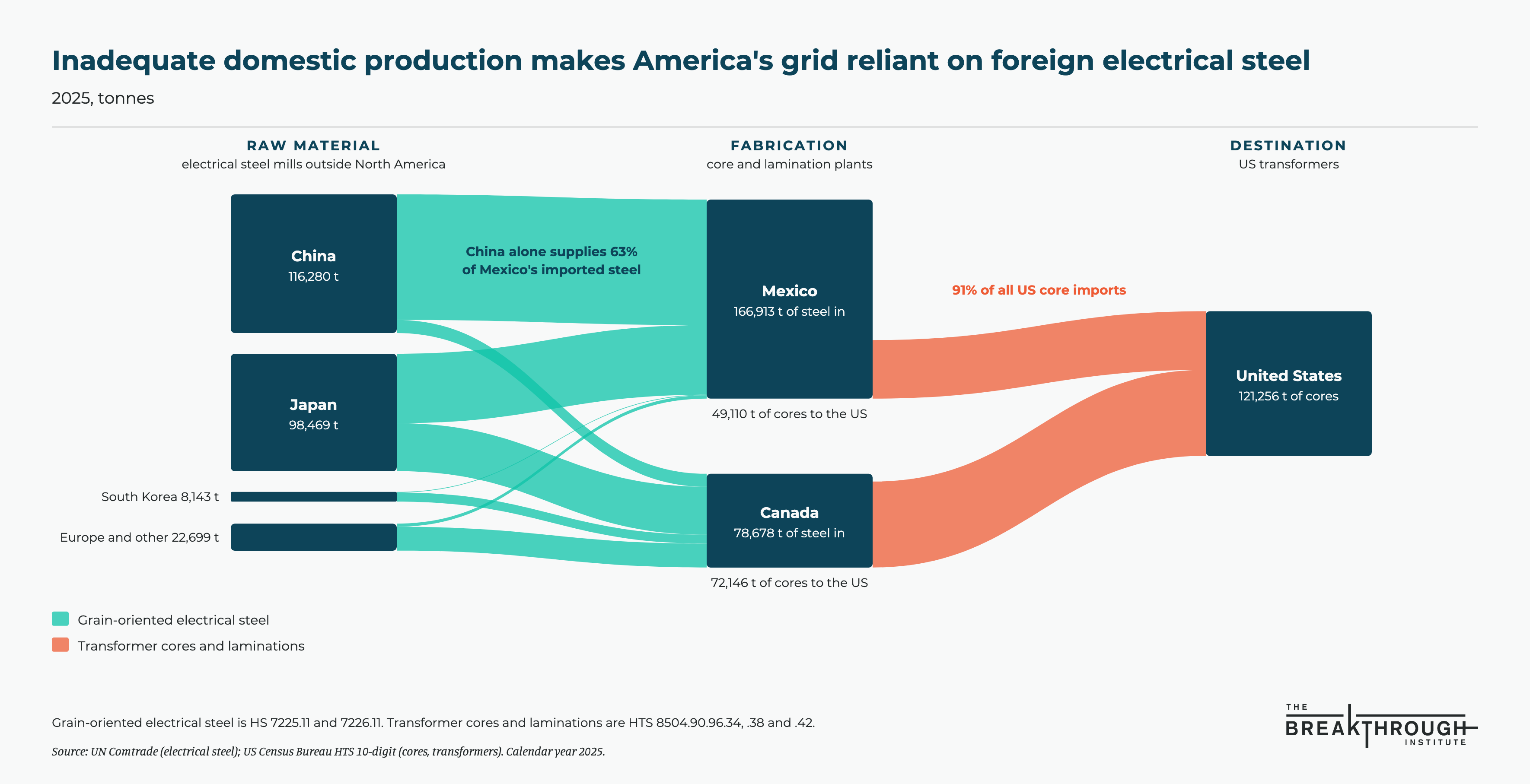
U.S. imports of transformer cores grew over 400% from $126 million in 2018 to $524 million in 2025. The increase can be linked to a loophole in Section 232 tariffs on GOES, implemented in March 2018, as well as new electricity demand from data centers, manufacturing, and residential electrification.
Thankfully, the GOES bottleneck should not be too difficult to solve. A coordinated strategy that invests in domestic manufacturing and reforms trade policies would yield significant and swift returns by driving down the costs of transformers, electricity, and a modernized grid.
The cost of Butler Works retrofit or a modern greenfield GOES mill both fall in the range of $1-2 billion—a drop in the bucket compared to the $1.2 trillion in infrastructure spending authorized by IIJA and the half a trillion in loan authority of the Energy Dominance Financing (EDF) Office. New GOES projects announced in recent years qualify for the Innovative Clean Energy Loan Guarantee Program (Sec. 1703), as they would use “new or significantly improved technologies” and the reduced energy losses from more high-permeability GOES would “avoid, reduce, utilize, or sequester air pollutants or GHGs.” Just as easily, the Energy Dominance Financing Program (Sec. 1706) can fund GOES modernization, as such a project would “support or enable the provision of known or forecastable electric supply at time intervals necessary to maintain or enhance grid reliability or other system adequacy needs.”
Be it through EDF, U.S. Export-Import Bank, or Section 303 of the Defense Production Act, any office financing U.S. GOES production will have to coordinate investment strategy with the White House, Department of Commerce, and U.S. Trade Representative (USTR). Historical implementation of antidumping and countervailing duties and recent Section 232 tariffs merely placed levies on imported GOES and derived products without bridging the production quality gap. Tariffs can act as effective tools to protect a nascent industry from more mature, cheaper competitors, but the current moment chiefly calls for targeted investment over protectionism. Immediate tariff relaxation would allow grid modernization to proceed faster and at a lower cost to U.S. manufacturers, utilities, and ratepayers. The U.S. should not consider reinstating tariffs until modernized GOES production capacity has entered operation and navigated successfully down the cost curve.
Any LPTs and distribution transformers installed on the grid today will, in all likelihood, remain in service through 2060 or beyond. The nation’s electric grid for the remainder of the 21st century ought to run on high-efficiency transformers built using the best electrical steel technology can make in 2026. Over coming years, data centers, power plants, and manufacturing facilities will need faster access to best-in-class LPTs, and tens of millions of the country’s distribution transformers operating past their expected lifespan will require replacement. The limitations of GOES production at Butler Works loom large in the mind of the domestic transformer industry, as they must for any Congress or Administration serious about revitalizing America’s transformer supply chain.

I wonder how many other aspects of modern, efficient transmission the US is behind on.